
Choosing the closest name when searching for insulation companies near me is often a gamble that leads to damp walls and wasted cash rather than real warmth. It’s a common frustration for Scottish homeowners who struggle with high heating bills whilst adapting to the new Heat Retention Rating (HRR) framework introduced this year. You deserve the security of a fully approved contractor who prioritises your home’s long-term structural health and your family’s domestic well-being.
This article reveals how to identify local specialists who are truly qualified to handle the unique thermal demands of our climate. We promise to show you exactly how to secure maximum savings and comfort, including a real-world case study of a home that achieved peak energy efficiency. You’ll learn the details of the 2026 building standards and see why upgrading to the recommended 270mm loft insulation depth can save a typical semi-detached household £200 every year.
Key Takeaways
- Learn how to vet insulation companies near me by prioritising “Fully Approved” status and a proven track record with Scottish stone tenements.
- Understand the critical role of local expertise in managing the high humidity and wind-driven rain prevalent across Edinburgh, Fife, and the West.
- Explore a Stirling case study to see how tackling inadequate loft and underfloor insulation delivers maximum savings in traditional detached homes.
- Compare the moisture-wicking benefits of sustainable sheep’s wool against standard mineral wool to find the best fit for your property’s thermal behaviour.
- Discover how a specialist free insulation inspection identifies hidden draughts and ensures your home meets the latest 2026 energy standards.
Searching for insulation companies near me shouldn’t just be about finding the closest van on the road. It’s about securing a specialist who understands that proximity doesn’t equal expertise. In Scotland, our homes face unique challenges from wind-driven rain and high humidity that can compromise poorly installed materials. You need a partner with a “Proven Track Record” in local residential properties, from traditional stone tenements to modern timber-framed builds. A “Fully Approved” contractor provides the total accountability of a “Supply and Fit” service. This means they take responsibility for the entire project, from the initial specialist free insulation inspection to the final certificate of completion.
A true specialist offers a diverse range of Building insulation materials because one size never fits all. Whether it’s mineral wool for a standard semi-detached loft or moisture-wicking sheep’s wool for a breathable traditional build, the priority is always “Maximum Savings & Comfort.” Avoid firms that only push a single product; they’re often trying to clear stock rather than solve your specific heat loss problems. By choosing a company that provides options, you ensure the solution matches your property’s specific thermal behaviour.
The Red Flags of “Solar Cowboy” Installers
Don’t be swayed by high-pressure sales tactics or vague promises of “free” upgrades. Many national insulation companies near me that appear in search results are actually lead-generation sites with no local office in the Central Belt. These “Solar Cowboy” installers often skip the technical details, such as checking for existing dampness or ventilation needs. If a company uses “today only” pressure tactics or can’t explain the current 2026 grant eligibility criteria, they aren’t the right fit. A local expert prioritises your home’s health over a quick sale and will always provide a detailed technical assessment before asking for a commitment.
Accreditations That Guarantee Peace of Mind
TrustMark is the primary government-endorsed quality scheme that protects Scottish homeowners from poor workmanship. Ensure your chosen contractor is “Fully Approved” and carries professional indemnity insurance of at least £2 million. You can verify a firm’s history via Companies House; look for a steady “Proven Track Record” of at least five years rather than a business that’s only been active for a few months. Local social proof, such as 50 or more verified testimonials from your specific region, provides the final layer of security. This due diligence ensures you receive the long-term value and safety your family deserves.
Why Local Expertise Matters for Scottish Homes and Climates
National directories for insulation companies near me often overlook the brutal reality of the Scottish climate. Whilst a standard install might work in the drier South East of England, properties in Edinburgh and Fife must withstand horizontal, wind-driven rain and high humidity. Using non-breathable materials in a traditional stone tenement can trap moisture within the walls. This leads to interstitial condensation, a hidden threat that rots timber joists and creates persistent mould issues. A “Trusted Local Specialist” understands that Scottish building fabric needs to breathe to maintain domestic well-being and structural integrity.
Every council area, from Perth to Stirling, has specific interpretations of Scottish Building Standards, especially for room-in-roof projects. Local installers are familiar with these nuances, ensuring your project is “Fully Approved” and compliant with the latest Heat Retention Rating (HRR) system launching in Autumn 2026. Before you commit, it’s wise to book a Specialist Free Insulation Inspection to identify exactly how your home loses heat. This technical approach ensures you don’t just add layers, but actually solve thermal defects.
Insulating Traditional Stone Properties in Edinburgh and Stirling
Standard cavity wall insulation isn’t an option for the solid-walled properties found across Edinburgh and Stirling. These homes require Internal Wall Insulation (IWI) to improve comfort without ruining the historical aesthetic. A “Proven Track Record” in these buildings is vital because thermal bridging often occurs at floor joists and window reveals. When we treat these traditional builds, we prioritise several key technical outcomes. For a comprehensive overview of breathable solutions that protect historic fabric, our guide to insulating a stone house in Scotland covers the latest moisture-management techniques in detail:
- Eliminating cold spots at window reveals to stop mould.
- Using vapour-permeable materials to preserve floor joist integrity.
- Maintaining the property’s original character whilst achieving “Maximum Savings & Comfort.”
Navigating the ECO4 Scheme in Scotland
The funding landscape is shifting as we move through 2026. Whilst the primary ECO4 Scotland phase concluded on March 31, 2026, local specialists are now helping homeowners transition to the new Heat Retention Rating (HRR) incentives. These new funds are specifically designed to help landlords reach the 2028 HRR Band C requirement. Identifying the best insulation companies near me is crucial for accessing these evolving funds. Eligibility often depends on your EPC rating, but a local partner will know the exact criteria for Perth and the North. For a full breakdown of what’s available, our guide to insulation grants Scotland details the latest 2026 criteria for the Home Energy Scotland Grant and Loan Scheme. If you’re looking for professional advice on your next upgrade, contact the team at ScotTherm Insulation for a technical consultation.
Case Study: Delivering Maximum Savings for a Traditional Property in Stirling
The search for reliable insulation companies near me often ends when homeowners see tangible proof of performance. In early 2026, we completed a comprehensive upgrade for a four-bedroom detached home in Stirling. The property owners were facing escalating heating bills despite keeping their thermostat high. Our initial assessment revealed that whilst the home had some existing insulation, it was failing to provide the “Maximum Savings & Comfort” we guarantee. The house suffered from significant heat loss through the roof and a constant cold draught rising through the ground floorboards.
The Technical Survey: Identifying Hidden Heat Leaks
Every successful project begins with a data-driven approach. Our specialist free insulation inspection identified that the existing mineral wool in the loft had settled to just 100mm. This is far below the current 270mm recommendation. We used thermal imaging to show the homeowners exactly where their money was escaping. The results were stark; bright yellow plumes on the display indicated massive heat loss through the uninsulated ground floor joists. We developed a bespoke plan to address both areas, ensuring the solution fit their specific budget and thermal needs.
The Installation Process: Clean, Efficient, and Professional
Disruption is a major concern for families, so we organised the site to ensure the home remained functional throughout the two-day install. Our team of “Fully Approved” contractors first tackled the loft, topping up the insulation to the 270mm standard. We then moved to the sub-floor. By installing high-performance underfloor insulation, we sealed the thermal envelope of the house. We paid particular attention to maintaining essential sub-floor ventilation to prevent any future damp issues. This is a critical step that less experienced insulation companies near me often miss.
Post-Installation: Measuring the Impact on Comfort and Cost
The results were immediate. The homeowners reported a significant change in ambient warmth, noting that the house no longer felt draughty in the evenings. Based on the 2026 energy price caps, the 25% reduction in annual heating costs means the upgrade will pay for itself much faster than anticipated. Beyond the financial gain, the property’s EPC rating improved, which is vital for long-term value. We concluded the project with final safety checks and provided the “Fully Approved” certification, giving the family total peace of mind. This successful project proves that local expertise is the key to domestic well-being in the Scottish climate.
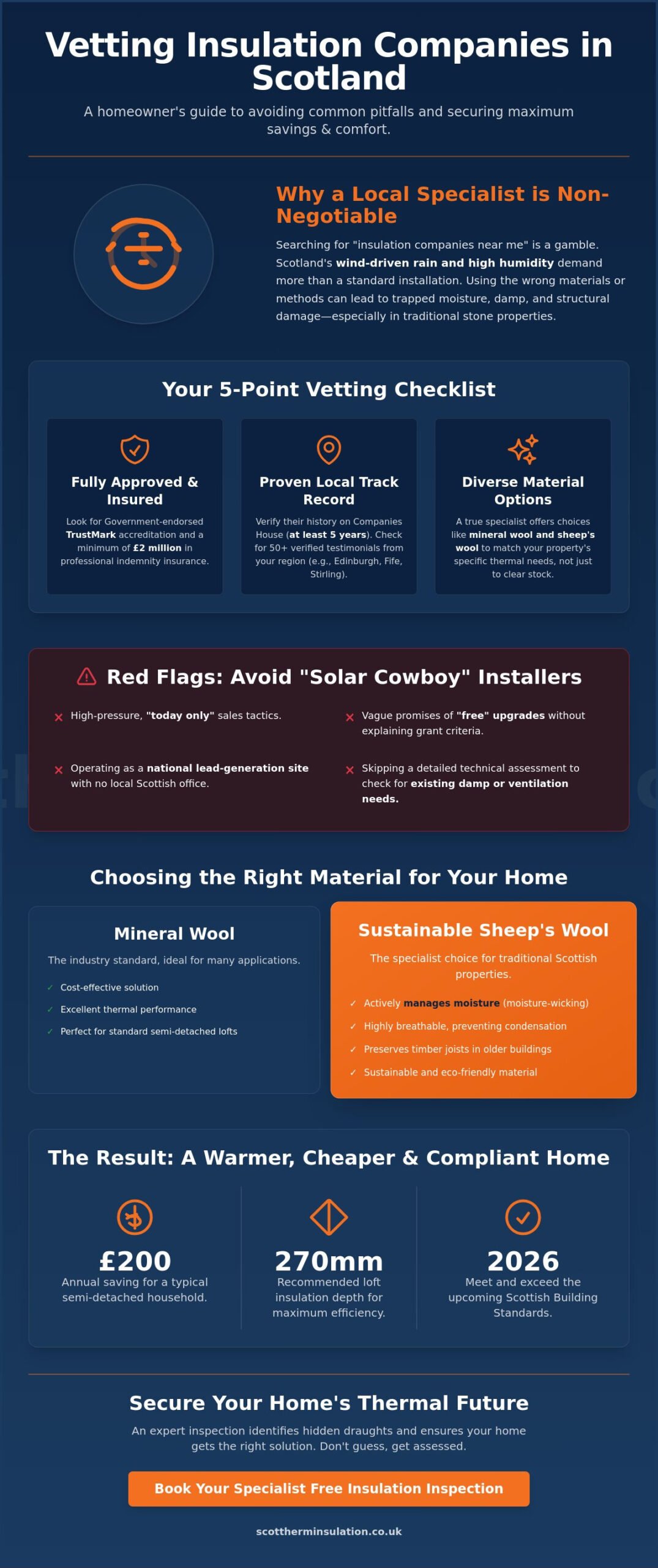
Choosing the Right Material: Mineral Wool vs Sustainable Sheep’s Wool
Selecting the right material is the foundation of “Maximum Savings & Comfort.” Whilst searching for insulation companies near me, you’ll likely encounter two primary options: mineral wool and sheep’s wool. Both offer excellent thermal resistance (R-value), but their performance in the damp Scottish climate varies significantly. Mineral wool is the industrial standard, known for its fire-resistant properties and acoustic damping. In contrast, sheep’s wool is a high-performance natural fibre that manages moisture in a way synthetic materials cannot. Your choice should depend on your property’s age, your budget, and your long-term environmental goals.
Fire safety is a non-negotiable priority for any “Fully Approved” contractor. Both materials achieve high safety ratings, but they do so differently. Mineral wool is naturally non-combustible, whilst sheep’s wool is often treated with borax to meet stringent fire standards. Sustainable materials also offer chemical-free benefits, which is a growing concern for 65% of homeowners concerned about indoor air quality in 2026. A specialist will help you conduct a cost-benefit analysis, comparing the initial investment against the 40-year durability of these high-quality products.
Mineral Wool: The Reliable, Cost-Effective Standard
This material remains the favourite for modern loft insulation in Scotland due to its proven reliability and price point. Professional installation for a typical semi-detached house generally costs between £400 and £800, providing an immediate return on investment. Beyond thermal benefits, it’s an excellent acoustic barrier, significantly reducing noise transfer between floors. To maintain thermal integrity over decades, we use specific cross-layering techniques. This prevents the “slumping” often seen in DIY attempts, ensuring the material doesn’t gaps or thin spots over time.
Sheep’s Wool: The Eco-Friendly Specialist Choice
For those seeking a premium, sustainable option, sheep’s wool insulation is unmatched. It naturally regulates humidity by absorbing and releasing moisture without losing its insulating power. This breathability protects your timber joists from rot in the high-humidity environments typical of the Central Belt. Priced at an average of £9.93 per square metre plus VAT, it represents a higher initial investment than mineral wool. However, it’s a renewable resource that supports local agriculture and is the preferred choice for sensitive room-in-roof projects and for anyone insulating a stone house in Scotland where moisture management is paramount. If you want to explore which material best suits your property, book your technical assessment with ScotTherm Insulation today.
How to Book Your Specialist Free Insulation Inspection with ScotTherm
Finding the right fit amongst insulation companies near me requires more than a quick phone call. We believe every project must start with a technical home assessment to ensure the solution matches your property’s unique thermal profile. Unlike generic quote generators that provide estimates based on floor area alone, our specialist free insulation inspection is a thorough, no-obligation deep dive into your home’s efficiency. We look beyond the surface, examining everything from your loft hatch to the sub-floor ventilation beneath your floorboards. This rigorous approach ensures we identify the root cause of heat loss rather than just treating the symptoms.
Our commitment to transparency means you’ll receive a clear, fixed-price quote with no hidden extras. You won’t face the “price creep” often associated with less experienced contractors. We also understand that the administrative side of home improvements can be daunting. That’s why we handle all the complex paperwork for grant applications on your behalf. Whether you’re transitioning from the ECO4 scheme or preparing for the new Heat Retention Rating (HRR) framework arriving in Autumn 2026, our team ensures you access every penny of available funding without the stress. To understand the full range of Scottish Government support available to you, our comprehensive guide to insulation grants Scotland homeowners can claim in 2026 is an essential resource before you book.
Your Path to Maximum Savings and Comfort
Our process is designed for clarity and peace of mind. We follow a proven three-step journey to transform your home’s performance:
- Comprehensive Survey: A technical audit of your home’s current Heat Retention Rating and thermal defects.
- Professional Fit: Installation by “Fully Approved” contractors using premium, moisture-regulating materials.
- Peace of Mind: Final safety checks and the provision of “Fully Approved” certification for your records.
We coordinate with the finest local installers across the country to guarantee “Best” results for every “Supply and Fit” project. Our “Proven Track Record” ensures that whether you reside in a stone tenement or a modern detached villa, the work is completed to the highest Scottish Building Standards. You can reach our dedicated teams in Edinburgh, Stirling, and Perth for immediate assistance.
Ready to Transform Your Home?
With the Scottish Government’s deadline for landlords to reach HRR Band C by April 1, 2028, and the updated EPC framework launching this year, taking action now is a smart financial move. Slots for inspections fill up quickly as winter approaches, so it’s vital to book your assessment whilst funding is available. Our local coverage extends across Fife, Perth, Stirling, Edinburgh, and North Berwick. Don’t settle for a generic service when you can choose the “Scot” specialist for a warmer, draught-free home. Contact ScotTherm today to secure your domestic well-being and start your journey towards “Maximum Savings & Comfort.”
Secure Your Home’s Thermal Future with Scottish Specialists
Identifying the right insulation companies near me is the most important step in protecting your property from the Autumn 2026 Heat Retention Rating changes. We’ve explored how local knowledge prevents damp issues in traditional stone builds and why upgrading to the 270mm loft insulation standard provides an annual saving of £200 for typical semi-detached homes. You now have the technical checklist needed to verify “Fully Approved” status and avoid the long-term risks of poor workmanship.
It’s time to move from research to results. As “Fully Approved” Scottish contractors, we specialise in high-performance, sustainable sheep’s wool and professional mineral wool installs to ensure your home’s health. Don’t leave your comfort to chance whilst the 2026 energy landscape evolves. Book Your Specialist Free Insulation Inspection with ScotTherm Today to ensure Maximum Savings & Comfort are guaranteed for your property. We look forward to helping you create a warmer, more cost-effective home for the years ahead.
Frequently Asked Questions
How do I know if an insulation company near me is reputable?
You can identify reputable insulation companies near me by verifying their TrustMark accreditation and ensuring they have a permanent local office in Scotland. A reliable firm will always offer a specialist free insulation inspection before providing a fixed-price quote. Look for a “Proven Track Record” of at least five years to ensure the team understands the specific thermal demands of our climate.
Can I get free insulation in Scotland through the ECO4 scheme?
Yes, the ECO4 scheme provides 100% funding for energy efficiency measures to eligible households in EPC bands D, E, F, and G. Whilst the primary March 2026 deadline has passed, many Scottish government incentives still support low-income families and those on specific benefits. An accredited assessor can confirm your eligibility during a technical home visit to ensure you receive the maximum support available.
How much can I save on my heating bills with new loft insulation?
Topping up loft insulation from 100mm to the recommended 270mm depth can save a typical semi-detached household between £150 and £200 every year. These figures are based on 2026 energy price caps and improved Heat Retention Ratings. Beyond the financial savings, a “Fully Approved” installation ensures your home remains draught-free and comfortable during the harshest winter months.
Which is better: mineral wool or sheep’s wool for a Scottish home?
Sheep’s wool is the superior choice for traditional stone properties due to its natural breathability and moisture-wicking properties. It protects timber joists from rot by regulating humidity, which is vital in our damp climate. Mineral wool remains the favourite for modern builds; it offers a cost-effective, fire-resistant solution that delivers “Maximum Savings & Comfort” for homeowners on a stricter budget.
How long does a professional insulation installation typically take?
Most residential insulation projects are completed within one to two working days. A specialist team will organise the site to ensure minimal disruption to your daily routine whilst they fit the materials. Larger projects, such as a full “Room in Roof” conversion, may require additional time; however, you’ll receive a specific timeline during your initial technical consultation.
Do I need to leave my house while the insulation is being installed?
No, you won’t need to vacate your home during the installation process. Our “Fully Approved” contractors work efficiently to seal off work areas and protect your living space from dust or debris. We prioritise your domestic well-being, ensuring the project is finished cleanly and professionally so you can enjoy the immediate benefits of a warmer home.
What is a specialist free insulation inspection and why do I need one?
This is a technical audit that pinpoints exactly where your property is losing heat through the roof, walls, or floors. It’s a vital step because it identifies hidden defects like thermal bridging or inadequate ventilation that generic quotes often overlook. Choosing insulation companies near me that provide this service ensures your upgrade is technically sound and meets the latest 2026 building standards.
Is underfloor insulation worth the investment for older properties?
Yes, underfloor insulation is highly effective for older homes with suspended timber floors, as it can stop up to 15% of a property’s total heat loss. It eliminates the uncomfortable draughts that rise through floorboards whilst maintaining the necessary sub-floor airflow. This upgrade significantly improves the “ambient warmth” of your ground floor, making it a key component for achieving “Maximum Savings & Comfort.”