
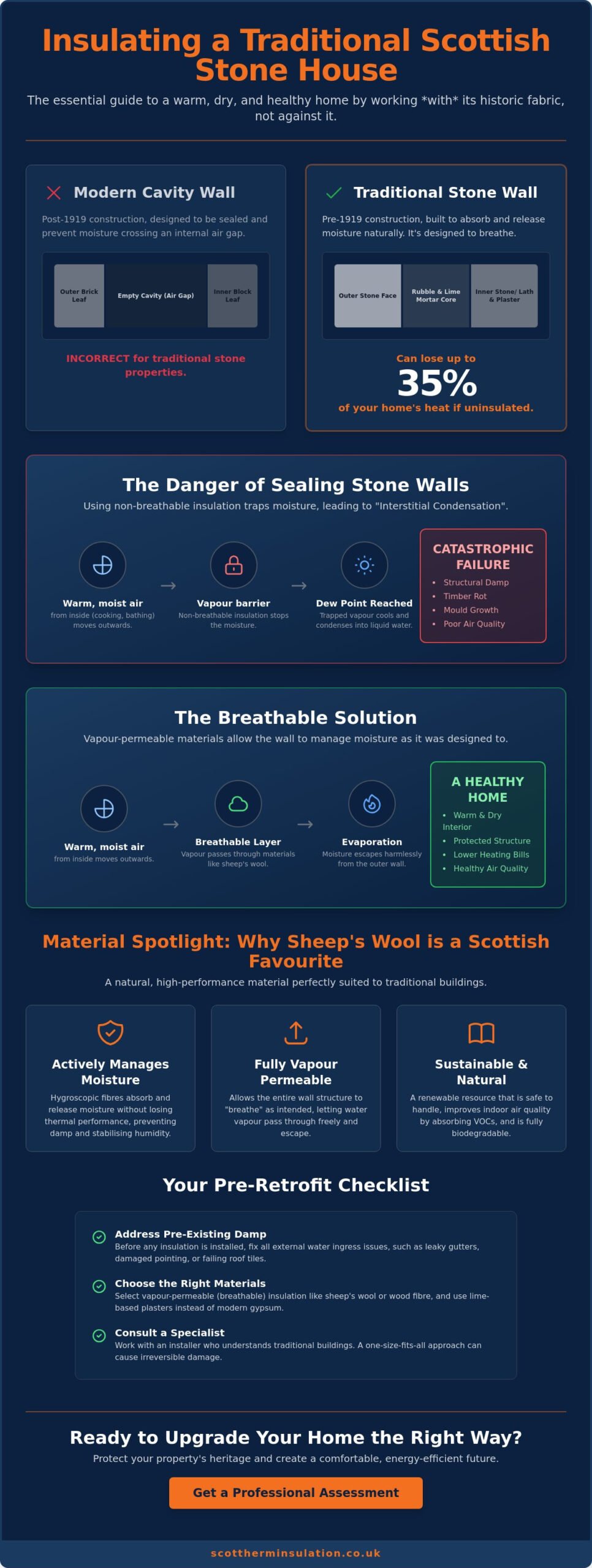
The most effective way to keep your traditional property warm isn’t actually to seal it up tight. Your home was designed to breathe with the landscape, and ignoring this natural ventilation is the quickest way to cause damp. If you’re looking into insulating a stone house scotland, you’re likely balancing the need for lower heating bills against the fear of interstitial condensation and rot. It’s a valid concern, especially since solid stone walls can lose up to 35% of a building’s heat if left untreated.
We agree that nobody should have to choose between a cold living room and a structural damp problem. This 2026 guide promises to show you how to thermally upgrade your home whilst protecting its historic fabric. You’ll learn about the latest breathable materials like sheep’s wool, how to access 0% VAT incentives, and why moisture management is the secret to a truly energy-efficient Scottish home. We’ll also examine the current grant landscape to help you achieve a warmer, more sustainable future without compromising your property’s integrity.
Key Takeaways
- Traditional Scottish homes require a breathable approach because solid stone walls handle moisture differently than modern cavity constructions.
- Learn why insulating a stone house scotland requires vapour-permeable materials to prevent interstitial condensation and protect your property’s structural integrity.
- Discover the unique thermal benefits of sheep’s wool, a firm favourite for its ability to manage moisture whilst maintaining its insulation value.
- Compare internal and external wall insulation options to find the most viable solution for your specific building style and local conservation requirements.
- Understand why addressing pre-existing conditions like leaky gutters and pointing is vital before installing any new thermal measures.
Stone Houses vs Modern Cavity Walls: Why Traditional Scottish Homes Need a Unique Approach
Most homeowners start their energy efficiency journey by looking for standard solutions. However, insulating a stone house scotland is a specialised task that differs fundamentally from working on a modern housing estate. Whilst post-war homes use two layers of brick with a gap between them, traditional Scottish properties rely on solid wall construction. These walls are often 600mm thick or more, comprising an outer face of dressed stone, a rubble-filled core, and an inner stone face. This massive structure acts as a thermal store, but it also behaves like a sponge.
Traditional buildings were never meant to be airtight. They were built using porous materials like sandstone, granite, and lime mortar. These materials are designed to absorb moisture from the Scottish rain and release it through evaporation when the sun shines or the wind blows. This process is the foundation of a healthy building. If you ignore these Building insulation principles and seal a stone house with modern plastics or non-breathable membranes, you trap water inside the wall. This leads to catastrophic damp, timber rot, and a significant decline in indoor air quality.
The Myth of the Cavity in Traditional Scottish Stonework
It’s a common mistake to assume every home has a void waiting to be filled. Searching for “cavity wall insulation scotland” is rarely productive for owners of pre-1919 properties. In these buildings, the “hollow” sound you might hear when tapping an internal wall is usually just the lath and plaster finish. It isn’t a structural cavity. Attempting to find a gap to inject with foam in a solid stone wall is a dead end. You must identify your wall type correctly before choosing an insulation method to avoid wasted surveys and inappropriate treatments.
The “Breathability” Factor: Why It Matters in a Wet Climate
In the context of insulating a stone house scotland, breathability refers to vapour permeability rather than just draughts. Scottish rain is persistent. Stone and lime mortar absorb this moisture, which then needs a path to escape. Modern synthetic insulation acts like a plastic wrap, stopping this natural evaporation. When moisture gets stuck, it reaches its dew point and turns into liquid water inside your walls. For a 200-year-old Edinburgh tenement, breathability is the essential ability of the masonry to manage moisture levels by allowing water vapour to move freely through the wall fabric without becoming trapped.
Choosing the right approach means working with your home’s natural physics. By using breathable materials like sheep’s wool or mineral wool, you can create a warmer environment whilst ensuring the stone remains dry and the structure stays sound for another century.
The Science of Moisture Management in Solid Stone Walls
Moisture management is the cornerstone of any successful retrofit. When insulating a stone house scotland, you must account for the constant movement of water vapour. In a heated home, warm air holds moisture from cooking, bathing, and breathing. This vapour naturally migrates toward the colder exterior. In a traditional stone building, the walls are permeable, allowing this vapour to pass through. Using natural, breathable materials allows the building to act like a “third lung,” buffering humidity levels and maintaining a stable indoor environment.
The primary risk in this process is the “dew point.” This is the specific temperature where water vapour turns back into liquid. If this occurs within the wall structure, it can lead to hidden dampness. According to the technical guide on insulating stone walls provided by Historic Environment Scotland, managing this risk is vital for the longevity of the masonry. When the relative humidity inside a home is kept between 40% and 60%, the occupants feel warmer at lower temperatures. This occurs because dry air doesn’t conduct heat away from the body as quickly as damp air. By stabilising humidity, you create a more consistent, cosy atmosphere that requires less energy to maintain.
Understanding Interstitial Condensation
Interstitial condensation is the “silent killer” of traditional buildings. It happens when moisture gets trapped between a cold stone wall and a non-breathable insulation layer, such as rigid foam or plastic-backed boards. Because the water cannot escape, it sits against the stone and any embedded timber. Over time, this leads to the decay of floor joists and the corrosion of wall ties. Whilst modern builders often suggest “vapour barriers” to stop moisture entering the wall, these often fail in old houses. They trap existing moisture inside the structure, preventing it from ever drying out. Choosing professionally installed breathable solutions ensures your home stays dry from the inside out.
Capillary Action and Drying Potential
Stone walls are designed to get wet and then dry. After a typical Scottish downpour, capillary action draws water into the stone. The wall then relies on a clear “drying path” to the outside air and the internal environment to shed that moisture. If you install internal wall insulation (IWI) that is too thick or non-permeable, you effectively block this path. The wall stays saturated for longer, increasing the risk of frost damage to the external masonry. In a traditional Scottish context, a failed drying path can lead to hidden rot in the ends of joists that are bedded directly into the stone, often not discovered until structural damage has occurred. High-performance natural fibres maintain this capillary link, allowing the wall to continue its natural wetting and drying cycle without compromise.
Internal vs External Wall Insulation: Which is Best for Your Scottish Property?
Deciding on the right method for insulating a stone house scotland depends heavily on your property’s location and architectural status. For many, the choice is between Internal Wall Insulation (IWI) and External Wall Insulation (EWI). IWI is the most common choice for Edinburgh tenements and terraced houses because it allows homeowners to upgrade their efficiency without altering the street-facing masonry. EWI, while offering high thermal performance, is often blocked by planning restrictions when applied to traditional stone facades.
The cost vs benefit analysis varies by building type. EWI is generally more expensive due to scaffolding requirements and the need for specialist renders. It covers the entire building envelope and effectively eliminates cold bridges. IWI is more accessible for individual homeowners. You can install it room-by-room to minimise disruption. This phased approach allows you to manage your budget whilst gradually improving the comfort of your living spaces. Solid walls can be responsible for up to 35% of heat loss, making this a high-priority investment regardless of the chosen method.
The Pros and Cons of Internal Wall Insulation (IWI)
The primary benefit of IWI is that it preserves the external stone aesthetic and character of your home. You won’t face the same planning hurdles as you would with external cladding. The main drawback is a slight reduction in room size. The insulation system typically adds 50mm to 100mm to the wall thickness. You’ll also need to factor in the cost of moving skirting boards, radiators, and electrical sockets. We recommend considering loft insulation scotland as a complementary first step, as roughly 25% of a home’s heat is lost through an uninsulated roof.
Navigating Planning Permission in Scotland
EWI is rarely allowed on listed stone buildings or in conservation centres across Scotland. Local authorities prioritise the preservation of the historic “look and feel” of our towns. In contrast, IWI often falls under “Permitted Development” rules. This means it doesn’t usually require full planning permission unless the building is listed. Even then, internal changes are often viewed more favourably if they use breathable, sympathetic materials. When insulating a stone house scotland, you should always consult a specialist to ensure your project meets current building regulations and conservation standards.
Choosing the Best Materials: Why Sheep’s Wool is the Scottish Favourite
Selecting the correct material for insulating a stone house scotland is a decision that dictates your home’s health for the next century. In our damp northern climate, the material must do more than just stop heat from escaping. It must actively manage the moisture that inevitably enters the wall fabric. Whilst modern construction often relies on rigid plastics, traditional Scottish masonry requires a more sympathetic, flexible approach. Sheep’s wool has emerged as the premier choice for these properties because it works in harmony with the building’s natural physics.
The standout feature of sheep’s wool is its hygroscopic nature. It can absorb up to 33% of its own weight in moisture without losing its thermal resistance, or R-value. This means that during a humid Scottish winter, the wool manages the dampness within the wall, releasing it safely when conditions dry out. Beyond its technical performance, wool is a champion of sustainability. It is a locally sourced, renewable resource with very low embodied energy. It also provides significant health benefits. Wool fibres naturally absorb and neutralise harmful chemicals like formaldehyde, acting as a passive air purifier for your living spaces.
Sheep’s Wool vs Synthetic Insulation
Synthetic insulation boards, such as PIR or Celotex, are often tempting due to their high thermal ratings. However, these rigid boards cannot form a perfect seal against the uneven surface of a traditional stone wall. This creates small air gaps where moisture can collect and stagnate, eventually leading to mould. Unlike these petroleum-based products, sheep’s wool is naturally fire-retardant and does not emit toxic fumes if exposed to high heat. For a deeper look at these benefits, you can explore our guide on wool insulation.
Mineral Wool: The Reliable Alternative
Mineral wool, often made from molten glass or stone, remains a suitable and cost-effective choice for many stone homes. It provides excellent breathability and is completely non-combustible, offering a high level of fire safety. When insulating a stone house scotland with mineral wool, it is vital to use high-density batts. Lower-quality, loose-fill versions can “slump” over time, leaving uninsulated cold spots at the top of your walls. Correct installation ensures the material stays exactly where it’s needed, providing a consistent thermal blanket that lasts for decades.
If you’re ready to protect your home with materials designed for the Scottish climate, you can request a specialist insulation survey today to find the perfect fit for your property.
Planning Your Retrofit: From Inspection to Professional Installation
Retrofitting a traditional property requires a disciplined, step-by-step approach to avoid unintended consequences. When insulating a stone house scotland, you cannot simply apply modern methods and hope for the best. A successful project follows a logical sequence that prioritises the building’s health alongside your thermal comfort. By following this structured path, you ensure your investment provides long-term value and protects the structural integrity of your home.
- Step 1: Conduct a comprehensive moisture and thermal survey to identify existing damp issues and heat loss patterns.
- Step 2: Address “pre-existing conditions” such as leaky gutters, blocked air bricks, or failing lime pointing that could compromise the new insulation.
- Step 3: Select a breathable insulation system, such as sheep’s wool or mineral wool, tailored to your specific masonry type.
- Step 4: Hire specialists who demonstrate a deep understanding of traditional Scottish building fabric and vapour movement.
- Step 5: Implement post-installation monitoring to confirm the house is performing efficiently and remaining dry.
The Importance of a Specialist Inspection
A standard Energy Performance Certificate (EPC) survey is rarely sufficient for a complex stone house retrofit. These generic assessments often fail to account for the specific moisture dynamics of solid walls. We recommend a specialist free insulation inspection to map out the thermal profile of your property. This detailed look identifies “cold bridges” around window reveals and door frames. If these spots are neglected, they can become magnets for condensation once the rest of the wall is insulated. Identifying these risks early prevents mould growth and ensures a consistent internal temperature.
Finding the Right Installers in Scotland
Local expertise is your greatest asset in this process. You should look for insulation companies near me that have a verified history of working with heritage buildings in Edinburgh, Fife, and the Central Belt. A qualified contractor will prioritise safety and breathability over a quick sale. When interviewing potential installers, ask specific questions about how they manage the dew point and which vapour-permeable materials they intend to use. Before making your final decision, it is worth reading our comprehensive guide on how to choose the best insulation companies, which covers the essential certifications to verify and how to avoid poor workmanship. A specialist team will understand that insulating a stone house scotland requires a sympathetic touch. They won’t suggest sealing your walls with non-breathable plastics. Instead, they will offer a solution that respects the age of your property whilst delivering the 21st-century warmth you deserve.
Protecting Your Heritage Home for the Next Century
Breathability isn’t just a technical concept; it’s the lifeline of your traditional property. By prioritising vapour-permeable materials and respecting the natural physics of solid masonry, you can achieve modern thermal comfort without risking structural decay. We’ve explored how sheep’s wool acts as a natural moisture regulator for our unique climate, and why a specialist survey is the only reliable way to avoid hidden dampness and cold bridging.
As a dedicated Scottish specialist with local climate expertise, we focus on high-performance, sustainable retrofits. Our team consists of certified installers of sustainable sheep’s wool who take pride in protecting the integrity of traditional properties across the Central Belt and beyond. You can secure a warmer, more efficient future for your family by choosing a partner who understands the science of stone. Book your specialist free insulation inspection with ScotTherm Insulation today to ensure your project is completed with technical precision.
Your home is a vital piece of history. With the right approach to insulating a stone house scotland, you’ll enjoy a cosy, damp-free environment that remains healthy for generations to come.
Frequently Asked Questions
Can I use cavity wall insulation in a stone house in Scotland?
No, traditional stone properties are solid wall constructions and don’t have a cavity to fill. Standard cavity insulation is designed for modern homes built with a clear gap between brick layers. Attempting to inject insulation into a solid stone wall is impossible and can lead to structural issues if natural moisture paths are blocked.
Will insulating my stone walls from the inside cause damp?
Internal insulation won’t cause damp if you use breathable materials and ensure the external masonry is in good repair. Problems only arise when non-permeable materials trap vapour behind the insulation layer. By using vapour-permeable solutions, you allow the wall to dry naturally whilst keeping the heat inside your living space.
Do I need planning permission to insulate my stone house?
You generally don’t need planning permission for internal wall insulation unless your property is a listed building. External insulation is different; it almost always requires approval from your local authority, particularly in conservation areas. It’s always best to check with a specialist to ensure you comply with Scottish building standards before starting work.
What is the best insulation material for traditional Scottish stone walls?
Vapour-permeable materials like sheep’s wool or mineral wool are the best choices for traditional masonry. These fibres are essential for insulating a stone house scotland because they manage moisture levels effectively. They prevent the build-up of interstitial condensation that can lead to rot in hidden floor joists or timber lintels.
How much space will I lose with internal wall insulation?
You’ll typically lose between 50mm and 100mm of space along each external wall. This thickness includes the insulation material, the fixing system, and the final plasterboard finish. Whilst it slightly reduces the room’s footprint, the improvement in thermal comfort and the elimination of cold spots usually outweighs the minor loss of floor space.
Can I get a grant for insulating my stone house in Scotland?
Several grants are available as of May 2026, including the Home Energy Scotland Grant which offers up to £7,500 for insulation. The ECO4 scheme also provides up to 100% funding for eligible households until March 2026. These incentives make upgrading a traditional stone property significantly more affordable for homeowners across the country. You can find a full breakdown of eligibility criteria and application steps in our guide to insulation grants scotland.
How long does it take to insulate a traditional stone property?
A full internal insulation project usually takes between one and two weeks for a standard terraced home. This timeline includes the removal of skirting boards, installation of the breathable system, and the final decorative finish. Many homeowners choose to insulate room-by-room to spread the cost and minimise disruption to their daily routine.
Is sheep’s wool better than mineral wool for old houses?
Sheep’s wool is often superior for moisture management because it can absorb a third of its weight in water without losing its thermal efficiency. Mineral wool is a high-quality, non-combustible alternative that also allows the building to breathe. Both are excellent choices for old houses, provided they are installed at the correct density to prevent slumping over time.