
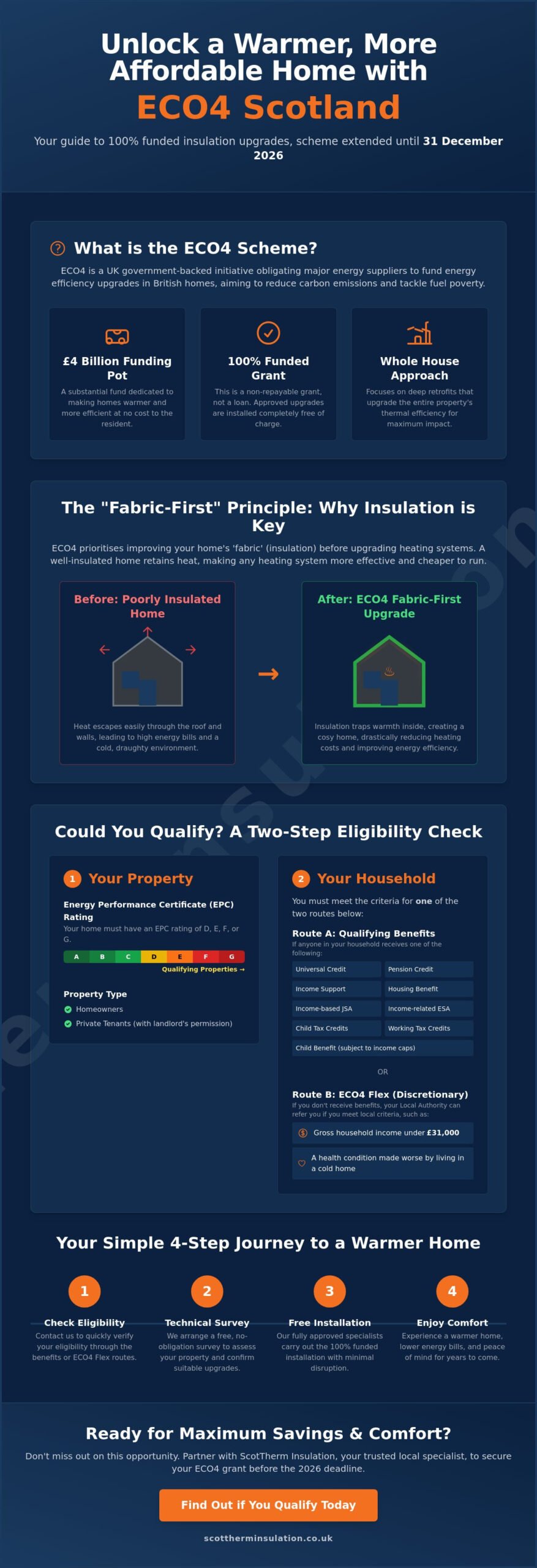
What if the secret to a warmer home isn’t a more powerful heater, but a ‘fabric-first’ revolution that traps every bit of warmth inside? With the eco4 scotland scheme officially extended until 31 December 2026, thousands of households across the country are now eligible for 100% funded insulation upgrades. We know it’s frustrating to face soaring heating bills whilst living in a draughty property, especially with the fear of grant scams making it hard to know who to trust. You deserve a home that’s both cost-effective and cosy without the stress of complex paperwork or unreliable contractors.
At ScotTherm Insulation, we believe in providing the peace of mind that comes from using fully approved specialists with a proven track record. Most homeowners are fed up with confusing government changes, so we’ve simplified the process. This guide will show you exactly how to secure your share of the £4 billion funding pot to achieve maximum savings and comfort. We’ll break down the 2026 eligibility routes, including the £31,000 income threshold for ECO4 Flex, so you can verify your status and transform your living environment before the deadline.
Key Takeaways
- Identify if your property qualifies by checking for an EPC rating between D and G and verifying your status through qualifying benefits.
- Understand how the eco4 scotland scheme prioritises ‘fabric-first’ measures like Loft and Room-in-Roof insulation to deliver a significant impact on your energy bills.
- Explore the ECO4 Flex route which provides a vital safety net for households with a gross annual income under £31,000 or specific health vulnerabilities.
- Learn the essential steps of the application process, including the technical survey needed to confirm your home is suitable for 100% funded upgrades.
- Discover how to partner with a trusted local specialist to ensure your home remains warm and energy-efficient well beyond the 2026 scheme extension.
What is the ECO4 Scheme in Scotland for 2026?
The eco4 scotland initiative is the latest development in a long-term strategy to upgrade the energy efficiency of homes across the country. As the fourth stage of the Energy Company Obligation (ECO) scheme, this version represents a significant shift from previous iterations. While older schemes often allowed for isolated, single-measure improvements, the 2026 regulations mandate a “Whole House” approach. This means that instead of a surface-level patch, the scheme focuses on deep retrofits that transform a property’s entire thermal envelope. The primary goal is to eliminate fuel poverty amongst Scottish households, ensuring that families can live in warm, comfortable environments without facing crippling bills. With the scheme now extended until 31 December 2026, there’s a vital opportunity for residents to access non-repayable funding for these comprehensive upgrades.
The Role of Major Energy Suppliers
Major energy providers, including companies like British Gas, SSE, and E.ON, are legally obligated to fund these efficiency measures to offset their carbon footprint. This isn’t a government loan; it’s a direct grant that helps Scotland move toward its ambitious Net Zero 2045 targets. Because the funding is non-repayable, it removes the financial barrier that often prevents homeowners from making necessary improvements. By requiring these suppliers to invest in the quality of the national housing stock, the eco4 scotland scheme creates a more sustainable community through high-quality, professional installations. This ensures that the benefits of the scheme are felt by those who need them most, providing security and peace of mind for the future.
Fabric-First: Why Insulation Comes Before Heating
The 2026 guidelines are built on the “fabric-first” principle, which prioritises securing the building’s physical structure before mechanical systems are upgraded. If you install a modern heating system in a house with poor loft or wall insulation, the warmth simply escapes through the roof and walls. It’s a wasted investment that fails to provide the “Maximum Savings & Comfort” we aim for. By prioritising the thermal envelope first, we ensure that energy is used efficiently and heat is retained where it belongs. The fabric-first approach is the mandatory starting point for all ECO4 projects in 2026, ensuring the property’s structure is thermally sound before any secondary measures are introduced. This strategy guarantees that the home remains energy-efficient for the life of the building.
ECO4 Scotland Eligibility: Who Qualifies in 2026?
Qualifying for the eco4 scotland scheme in 2026 depends on a combination of your household’s financial circumstances and the energy performance of your property. The core eligibility route is linked to specific state benefits. If a member of your household receives Universal Credit, Pension Credit, or Income Support, you likely meet the primary criteria. Child Benefit recipients also qualify, provided they fall below the income thresholds set in Ofgem’s official ECO guidance. For example, a couple with two children must have a gross annual income below £32,300 to remain eligible for these non-repayable grants.
Beyond benefits, your home must have an Energy Performance Certificate (EPC) rating of D, E, F, or G. This ensures that the £4 billion funding pot is directed toward the least efficient buildings in the country. Both homeowners and private tenants are encouraged to apply, though tenants will need their landlord’s written permission before any works begin. It’s worth noting that social housing tenants are generally excluded from standard ECO4 as they are usually supported through separate devolved programmes.
The ECO4 Flex Route: Discretionary Funding
Not everyone on a low income receives qualifying benefits. This is where the ECO4 Flex route becomes essential. Local authorities in Scotland, including councils in Edinburgh and Fife, have the power to nominate households for funding based on their own local criteria. The most common threshold is a gross annual household income of less than £31,000. Additionally, residents with health conditions that are worsened by cold environments, such as cardiovascular issues or respiratory illnesses, may qualify regardless of income. You can find more detail in our ECO4 Eligibility in Scotland: A 2026 Checklist for Edinburgh, Fife, and Stirling.
Property Criteria for Scottish Homes
Scotland’s unique architecture presents specific challenges for energy efficiency. Traditional solid-wall cottages and tenements often struggle with heat retention, making them ideal candidates for eco4 scotland funded measures like room-in-roof or underfloor insulation. Properties that are “off-gas” (those not connected to the mains gas grid) are frequently prioritised for the most significant funding packages. This is because these homes often rely on more expensive or less efficient heating methods. If you’re unsure where your property stands, you can check your eligibility for insulation with our team of specialists. We understand the nuances of the Scottish housing stock and can guide you through the technical requirements for 2026.
Key Insulation Measures Covered by ECO4
While many providers focus on high-tech gadgets like solar panels, the eco4 scotland scheme recognises that high-quality insulation is the foundation of a truly energy-efficient home. A ‘fabric-first’ approach ensures that your property’s thermal envelope is secure before any mechanical upgrades are considered. This is vital in the damp, windy Scottish climate where heat loss through uninsulated surfaces often accounts for over 50% of a household’s total energy wastage. By prioritising the structure itself, we ensure that every penny of the £4 billion funding pot delivers maximum savings and comfort for the long term.
The scheme covers several critical measures designed to suit the unique architecture found across Scotland. These include:
- Loft Insulation: The most cost-effective way to stop heat rising and escaping through the roof.
- Room-in-Roof Insulation: Essential for converted attics and older 1.5-storey homes where standard loft rolls aren’t sufficient.
- Underfloor Insulation: Specifically designed for suspended timber floors, which are common in traditional properties across the Central Belt.
- Internal Wall Insulation (IWI): The primary solution for solid-stone properties that lack a cavity to fill.
Loft and Room-in-Roof Upgrades
Standard loft insulation typically involves laying thick mineral wool rolls between and over joists to meet modern thermal standards. However, for rooms built into the roof space, we use rigid PIR boards or specialised foil insulation to maintain head height whilst providing superior heat retention. Proper ventilation is a non-negotiable part of our process to prevent damp and condensation. You can read more about these specific requirements in our guide to Free Loft Insulation in Scotland: Myth-Busting the 2026 Grants in Edinburgh and Fife. Older residents on a fixed income should also explore our dedicated resource on loft insulation grants for pensioners in Scotland, which explains how Pension Credit recipients and those in properties with low EPC ratings can access non-repayable funding worth up to £25,000.
Internal Wall Insulation for Traditional Builds
Scotland has a high concentration of solid-wall homes, particularly in historic centres like Edinburgh and Stirling. Because these buildings don’t have a cavity, they cannot be insulated using traditional injection methods. Internal Wall Insulation involves fixing high-performance insulation boards to the inside of your external walls, which are then plastered for a seamless finish. This process significantly reduces heat loss in stone-built properties. For a detailed look at the application, see our Internal Wall Insulation Grants in Scotland: A 2026 Guide for Homeowners.
Sustainable Materials: Sheep’s Wool and Mineral Wool
In older Scottish buildings that need to “breathe,” we often advocate for natural materials like sheep’s wool. Unlike synthetic alternatives, sheep’s wool has natural moisture-wicking properties that help manage humidity and prevent structural rot. Mineral wool is another excellent choice for its fire-resistant and acoustic benefits. At ScotTherm, we take pride in our material selection, ensuring that every installation uses the best, eco-friendly products suited to your property’s specific needs. Our expertise as a trusted local specialist ensures that your home remains warm, dry, and energy-efficient well beyond the 2026 scheme deadline.
The ECO4 Application Process for Scottish Homeowners
Securing 100% funded insulation through the eco4 scotland scheme is a structured journey designed to ensure your home’s long-term health. Unlike previous schemes that often allowed for quick, haphazard fixes, the 2026 framework follows a rigorous five-step path. This ensures every measure, from sheep’s wool in the loft to underfloor boards, works in harmony with your property’s specific structure. The process is designed to be transparent, removing the stress of paperwork whilst focusing on the goal of maximum savings and comfort.
- Step 1: Initial Verification. We check your qualifying benefits or local authority status and verify your current EPC rating to confirm you meet the 2026 requirements.
- Step 2: Technical Assessment. A qualified surveyor performs a deep-dive into your home’s thermal performance to identify the most effective measures.
- Step 3: Retrofit Design. Under the current legal framework, a PAS 2035 Retrofit Coordinator creates a bespoke “Whole House” plan. This step is critical as it ensures ventilation and insulation are perfectly balanced to prevent future issues.
- Step 4: Approved Installation. Our fully approved contractors carry out the works using high-quality materials and industry-standard techniques.
- Step 5: Final Certification. We lodge an updated EPC on the national register, providing tangible proof of your home’s improved efficiency.
The Importance of a Technical Survey
A technical survey is far more than a simple price quote. Under the eco4 scotland rules, this assessment must be provided free of charge to the homeowner. The surveyor’s role is to calculate precise heat loss and identify any pre-existing damp or structural issues that could compromise the insulation. This stage is vital for traditional Scottish homes, where moisture management is a priority. A professional surveyor ensures that your “fabric-first” upgrade is safe, effective, and tailored to the unique needs of your property.
Avoiding ECO4 Scams and “Cowboy” Installers
The rise in funding has unfortunately attracted “cowboy” installers and grant scams. You should never provide bank details to cold callers; the scheme is funded by major energy suppliers, meaning there are no upfront costs for eligible households. Always verify that your chosen installer is TrustMark registered. This is the only government-endorsed quality scheme that guarantees protection and high standards. Choosing a local specialist with a proven track record in the Central Belt provides an extra layer of security. If you’re ready to start your journey toward a warmer home, check your eligibility today with our expert team.
Maximum Savings & Comfort: Why Choose ScotTherm for ECO4?
Choosing the right partner for your eco4 scotland project is as important as the insulation itself. At ScotTherm, we focus on the dual benefit of reducing your monthly outgoings whilst creating a warmer, more comfortable living environment. We don’t just supply and fit materials; we provide long-term value through a proven track record of excellence. By specialising in high-performance options like mineral wool and breathable sheep’s wool, we ensure your home is protected against the specific challenges of the Scottish climate. Our goal is to provide peace of mind through technical proficiency and a dedication to domestic well-being.
Local Expertise for the Scottish Climate
National firms often apply a “one size fits all” approach that fails to account for the persistent dampness and biting winds of the North Sea. Our team understands these patterns because we live here. We’re intimately familiar with the specific ECO4 Flex criteria set by local authorities in Edinburgh, Fife, and across the Central Belt. Our “Scot” prefix acts as a badge of regional accountability, reflecting our commitment to the communities we serve. This local knowledge allows us to identify the most effective measures for traditional tenements and modern villas alike, ensuring every installation meets the highest thermal standards.
Our “Fully Approved” Guarantee
Being a “Fully Approved” insulation contractor means we adhere to the strictest safety and quality regulations in the industry. We prioritise the structural integrity of your home, ensuring that every retrofit design provides the necessary ventilation to prevent dampness. This commitment to quality has helped us build a reputation as a trusted local specialist. We don’t believe in high-pressure sales; instead, we lean into the security of our verified status and the long-term savings we deliver for our customers. We invite you to book a free specialist insulation inspection to see how we can transform your property. Start your journey to a warmer home today and secure your 100% funded upgrades before the 31 December 2026 deadline.
Secure Your Warmer Home Before the 2026 Deadline
The extension of the eco4 scotland scheme until 31 December 2026 provides a vital window for homeowners to eliminate draughts and high energy bills. You now have the roadmap to navigate the PAS 2035 retrofit process and the various eligibility routes, including the £31,000 income threshold for local authority flex funding. By prioritising the fabric of your property with materials like sustainable sheep’s wool or mineral wool, you’re investing in the long-term health of your building and its inhabitants.
Don’t leave your comfort to chance with unverified installers. As Fully Approved TrustMark Contractors with a proven track record across Edinburgh, Fife, and Perth, we ensure every installation meets the highest professional standards. We focus on delivering maximum savings and comfort through technical precision and regional accountability. Check your ECO4 eligibility and book your free survey with ScotTherm Insulation today. It’s the simplest way to stop heat from escaping and start enjoying a truly cosy, cost-effective living space.
Frequently Asked Questions
Is the ECO4 grant really 100% free for Scottish residents?
Yes, the eco4 scotland scheme provides 100% non-repayable grants for households that meet the eligibility criteria. The funding comes directly from major energy suppliers who are legally obligated to meet carbon reduction targets by 31 December 2026. Because it’s a grant rather than a loan, you don’t have to pay back a single penny of the installation costs.
Can I get ECO4 funding if I live in a flat or tenement in Edinburgh?
Yes, flats and traditional tenements are eligible for the scheme. Internal wall insulation is often the most effective measure for these properties since they lack a cavity wall. If you’re a private tenant in a tenement, you’ll need written permission from your landlord before the survey begins. Homeowners in these buildings can apply directly to secure a warmer, more efficient living space.
How much can I save on my energy bills with ECO4 insulation?
Savings depend on your property type, but the impact is often substantial. According to 2024 data from the Energy Saving Trust, installing loft insulation in a typical semi-detached home can save up to £250 per year on heating bills. When you combine this with underfloor or wall insulation, the total reduction in your monthly outgoings can be even higher.
What happens if my home already has some insulation?
You can still qualify for “top-up” insulation if your current levels don’t meet modern building standards. Current regulations recommend a loft insulation depth of 270mm. If your home only has 100mm or 150mm installed, the eco4 scotland scheme can fund the remaining layers to ensure you achieve maximum thermal efficiency and comfort.
Do I need to be on benefits to qualify for ECO4 Flex in Scotland?
No, the ECO4 Flex route is specifically designed for households that don’t receive qualifying benefits but are still struggling with high energy costs. Local authorities in Scotland can nominate residents who have a gross annual household income of less than £31,000. You may also qualify if a resident has a health condition, such as a respiratory illness, that is worsened by a cold home.
How long does the ECO4 insulation installation process typically take?
The physical installation of measures like loft or underfloor insulation usually takes between 1 and 2 days. The initial stages, including the technical survey and the PAS 2035 retrofit design phase, can take several weeks to complete. We prioritise a thorough assessment to ensure the “Whole House” plan is perfectly suited to your property’s structural needs.
Can I choose which insulation materials are used in my home?
A qualified retrofit coordinator determines the most suitable materials based on your home’s age and construction. However, you can discuss your preferences for sustainable options like sheep’s wool or mineral wool during the technical survey. We focus on using breathable materials for older Scottish properties to maintain structural health whilst increasing heat retention.
What is the difference between ECO4 and the Great British Insulation Scheme (GBIS)?
ECO4 follows a “Whole House” approach that often bundles multiple measures together to achieve a deep retrofit. In contrast, the Great British Insulation Scheme (GBIS) typically focuses on a single insulation measure, such as just loft or just cavity wall insulation. ECO4 is generally more comprehensive and aims for a larger improvement in your home’s Energy Performance Certificate rating.