
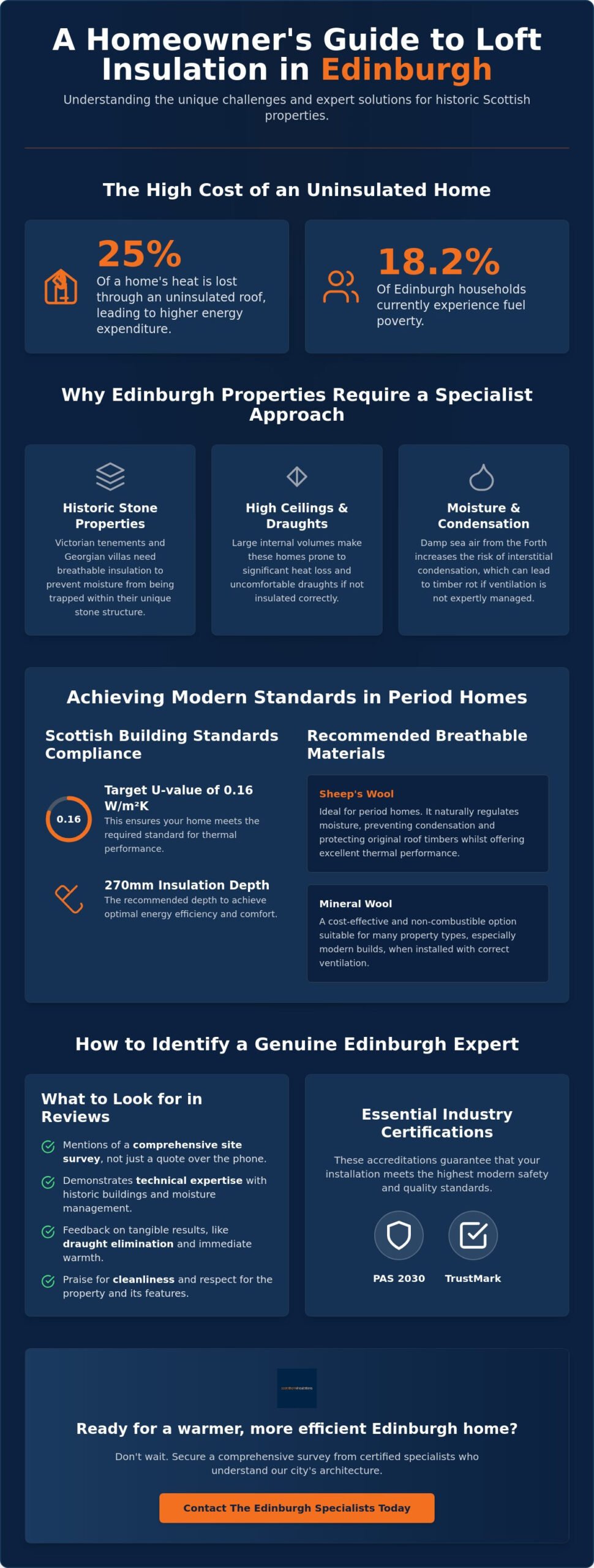
Did you know that 18.2% of households in Edinburgh are currently experiencing fuel poverty whilst a quarter of a home’s heat is lost through an uninsulated roof? When you search for loft insulation edinburgh reviews, you’re likely looking for more than just a quick fix; you want a permanent solution to high heating bills and the biting draughts common in our historic stone properties. You deserve the peace of mind that comes from knowing your home is protected by certified specialists who understand the specific needs of Scottish architecture.
We understand the frustration of rising costs and the fear that an incorrect installation might lead to damp issues in an older building. This guide will help you discover what genuine Edinburgh homeowners say about their experiences and teach you how to identify the technical expertise required for a successful upgrade. We will examine the benefits of materials like sheep’s wool and mineral wool, explain how to meet the 0.16 W/m²K U-value required by Scottish Building Standards, and help you navigate the March 2026 grant deadlines for a warmer, more efficient home.
Key Takeaways
- Understand why Edinburgh’s unique stone properties and high ceilings require a specialist approach to moisture management and breathability.
- Learn how to filter loft insulation edinburgh reviews to identify installers with genuine technical expertise in historic buildings.
- Discover why official PAS 2030 and TrustMark certifications are essential for ensuring your installation meets modern safety and quality standards.
- Explore the benefits of using breathable, premium materials such as sheep’s wool to protect the structural integrity of period homes.
- See how a professional installation can transform a draughty top-floor tenement, significantly reducing monthly energy expenditure and improving comfort.
Navigating Loft Insulation Edinburgh Reviews: Why Local Expertise Matters
Scanning through loft insulation edinburgh reviews is the first step for many homeowners, but a five-star rating alone doesn’t tell you if an installer understands the thermal dynamics of a 150-year-old sandstone property. True quality in this market is defined by technical proficiency and a deep understanding of our city’s unique architectural heritage. National companies often use a “one-size-fits-all” approach that works for modern homes but fails when applied to an Edinburgh tenement. Local specialists bring regional pride and a level of accountability that national sales teams simply cannot match.
Distinguishing between national sales companies and local Scottish specialists is essential for long-term peace of mind. Large corporations often subcontract labour to the lowest bidder, which can lead to inconsistent quality and installers who might ignore vital ventilation requirements. A local Edinburgh expert relies on their reputation within the community. They understand our specific climate and the challenges of damp sea air from the Forth. This local accountability ensures your installer is just a short drive away rather than at the end of a national call centre queue.
The Edinburgh Property Landscape
Edinburgh’s housing stock is incredibly diverse. We have the iconic Victorian tenements of Marchmont, the grand Georgian villas of the New Town, and modern suburban builds in areas like Liberton. Each structure reacts differently to temperature and moisture. A positive review for a modern house in Fife won’t necessarily apply to a Leith tenement because older stone properties require breathable building insulation materials to prevent structural damage. Whilst modern homes can handle standard mineral wool, historic stone needs a specialist who knows how to manage airflow and condensation in a cold roof environment.
What to Look for in a Genuine Review
When you’re reading loft insulation edinburgh reviews, look for specific mentions of a comprehensive site survey. A reputable expert won’t just quote a price over the phone; they’ll discuss the technical challenges of your specific roof type and explain how they’ll achieve the required 0.16 W/m²K U-value. Pay attention to feedback regarding the “before and after” thermal performance. Did the house feel warmer immediately? Were the draughts eliminated? Amongst the technical details, don’t overlook comments on cleanliness and respect for the property. Edinburgh homes often have tight access points and delicate original features. A quality installer treats your home with care, ensuring they leave the site exactly as they found it.
Decoding Technical Challenges in Edinburgh Home Insulation
Reading through loft insulation edinburgh reviews often reveals a common theme: the immediate drop in heating bills. However, the technical reality of achieving that comfort in a traditional Scottish property is complex. The primary concern for any installer in our city is managing moisture and condensation within a cold roof environment. Edinburgh’s coastal position means our air is naturally damp. When warm air from a high-ceilinged room meets a cold attic, the risk of interstitial condensation is high. Without precise ventilation, new insulation can inadvertently trap this moisture, leading to rot in original roof timbers.
Period homes with lath and plaster ceilings present another hurdle. These structures are more delicate than modern plasterboard and require a careful touch. Installers must ensure that the weight of the insulation, particularly when aiming for the 270mm depth required to meet modern Scottish energy efficiency standards, doesn’t compromise the ceiling’s integrity. Access is frequently restricted in older villas and tenements. This makes the choice of material and the method of installation a matter of technical precision rather than just manual labour.
Tenement Lofts: A Specialist Task
Shared roof spaces in Edinburgh tenements are unique environments that demand strict adherence to legal and safety requirements. Professional installers must manage fire breaks between properties whilst ensuring that ventilation remains unobstructed for all residents. It’s a delicate balance that requires coordinating with multiple owners and understanding the structural layout of these historic blocks. For a deeper look at these regulations, you can read our Loft Insulation in Scotland: The Ultimate Homeowner Guide. Protecting your neighbours is just as important as protecting your own home.
Breathability and the Scottish Climate
Our damp climate makes the breathability of materials a frequent point of discussion amongst savvy homeowners. Whilst synthetic materials have their place, natural options like sheep’s wool insulation offer superior performance in historic stone buildings. Sheep’s wool is highly hygroscopic; it can absorb up to 33% of its own weight in moisture without losing its R-value or thermal effectiveness. This natural behaviour regulates humidity and protects the fabric of the building. If you’re concerned about moisture in your attic, choosing breathable insulation solutions is the most effective way to ensure long-term structural health and comfort.
Beyond the Five-Star Rating: Identifying Quality Workmanship
High-level loft insulation edinburgh reviews can be helpful, but you must look past the star rating to find evidence of technical precision. Vague praise like “great service” or “friendly team” doesn’t guarantee that the installer followed the strict PAS 2030 standards required for modern energy efficiency projects. A quality review should highlight the installer’s attention to detail, such as the use of eaves vents to maintain airflow or the careful protection of downlights. If a quote seems too good to be true, it often indicates that the company is cutting corners on material density or skipping the essential ventilation work that prevents long-term structural damage.
Official certifications are your primary safeguard against poor workmanship. In the UK, TrustMark and PAS 2030 status are non-negotiable for any reputable contractor. These credentials ensure the business is regularly audited and adheres to high standards of safety and performance. When you consult an Energy Saving Trust guide, you’ll recognise that proper installation is about more than just laying blankets of material; it’s a technical process that requires a certified professional to manage the thermal envelope of your home correctly.
A common concern amongst Edinburgh residents is whether thicker insulation will cause damp. Top-tier installers address this objection upfront by conducting a post-installation sign-off. This often includes thermal imaging checks to verify that there are no cold spots or “thermal bridges” where condensation could form. By confirming that the insulation is consistent and the ventilation is unobstructed, these specialists provide the peace of mind that your home will remain both warm and dry.
Vetting Your Insulation Contractor
Start by verifying that the company has a physical Edinburgh address and a legitimate Scottish company registration. A local presence suggests they’re invested in the community and will be available for any future follow-up. During your initial contact, ask for case studies involving stone villas or tenements similar to your own property. A professional survey should feel like a technical consultation rather than a high-pressure sales pitch. The surveyor should spend time in your attic measuring depths and checking for existing moisture rather than just focusing on the final price.
The Red Flags of “Solar Cowboys”
Be cautious of companies that use aggressive marketing tactics or offer “free” insulation without a thorough check of your eligibility. Some rogue traders, often referred to as “solar cowboys” due to their history in adjacent sectors, may try to sell non-breathable spray foams that are entirely unsuitable for older Edinburgh homes. These materials can trap moisture against roof timbers, leading to expensive repairs. Always verify grant claims by reading our ECO4 Scotland: The Complete 2026 Guide to understand the actual qualifying criteria for government-backed schemes before committing to any work.
Case Study: Transforming Thermal Comfort in an Edinburgh Tenement
Marchmont is famous for its grand Victorian tenements, but for the owners of a top-floor property on Warrender Park Road, the architectural charm was overshadowed by a biting winter chill. Before contacting us, the residents faced energy bills exceeding £300 per month. Despite keeping the heating on for several hours, the rooms remained draughty and uncomfortable. This scenario is a frequent theme in loft insulation edinburgh reviews, where homeowners struggle to balance the preservation of original features with the modern need for thermal efficiency.
Our technical survey identified significant heat loss through the vast, uninsulated roof space. The property still featured its original lath and plaster ceilings, which required a delicate approach to avoid cracking the ornate cornices below. We proposed a solution using 270mm of breathable sheep’s wool insulation combined with comprehensive draught-proofing of the loft hatch and eaves. This choice was specifically made to protect the historic stone fabric of the building whilst providing the highest level of thermal performance.
The Installation Process
The installation began with careful site preparation. We used protective sheeting to safeguard the home’s interior and managed dust levels strictly to protect the delicate plasterwork. Our team installed a primary layer of sheep’s wool between the joists, followed by a secondary layer laid cross-ways. This method ensures a continuous thermal envelope without gaps, effectively “wrapping” the home in a thick, insulating blanket. We paid particular attention to the eaves, installing specialized vents to ensure that airflow remained unobstructed. This step is crucial in Scottish climates to prevent moisture build-up and the eventual timber rot that often plagues poorly executed DIY projects.
Customer Feedback and Review
The transformation was evident within hours of completion. The homeowner noted an immediate change in the “room feel,” describing the environment as significantly more stable and quiet. Beyond the heat retention, the dense fibres of the wool provided a noticeable improvement in acoustic insulation, dampening the city centre noise from the streets below. “The process was seamless,” the resident shared. “From the initial technical survey to the final clean-up, the team showed total respect for our home. We’ve already seen our heating demand drop by 25%.”
Choosing the right materials is the foundation of a successful project. You can learn more about why we recommend this specific material in our guide to Wool Insulation: The Sustainable Choice. If you are ready to reduce your energy expenditure and improve your home’s comfort, contact our Edinburgh specialists today for a professional assessment.
Choosing Your Edinburgh Insulation Partner: The ScotTherm Difference
When you filter through loft insulation edinburgh reviews, the most consistent feedback for top-tier providers focuses on trust and technical transparency. At ScotTherm Insulation, we’ve built our reputation on these exact values. We recognise that your home is likely your most significant asset, especially if it’s one of Edinburgh’s historic stone properties. Our commitment to using premium, breathable materials like sheep’s wool isn’t just about sustainability; it’s about the long-term structural health of your roof. We provide a specialised service that understands the intersection of modern thermal performance and traditional building techniques.
Our “No-Pressure” promise is a cornerstone of our business model. Many national companies employ high-pressure salesmen who are incentivised by quick signatures. At ScotTherm Insulation, your initial contact is with a technical expert. We conduct thorough surveys that identify specific thermal bridges and ventilation requirements rather than just providing a generic quote. This disciplined, quality-conscious approach ensures that you receive a bespoke solution tailored to your property’s unique needs. We take pride in the tangible impact our work has on the regional community, helping to lift households out of fuel poverty whilst reducing the city’s carbon footprint.
Our Local Credentials
We focus our expertise exclusively on Edinburgh, Fife, and the Lothians. This geographic focus allows the team at ScotTherm Insulation to maintain a deep understanding of local Scottish building standards and energy efficiency targets. Every project we undertake is designed to meet or exceed the current regulatory requirements for existing homes. We are not a faceless corporation; we are a dedicated team of results-oriented specialists who value regional accountability. Our history of successful installations across the city acts as a badge of reliability, reminding every client of our strict adherence to the highest industry standards.
Next Steps for a Warmer Home
Starting your journey toward a more comfortable, cost-effective home is a straightforward process. You can book a survey via our website or over the phone. Once you contact ScotTherm Insulation, you can expect a response within 24 hours to arrange a convenient time for your technical assessment. We prioritise clear communication and will provide a detailed breakdown of the proposed work, ensuring you have all the information needed to make an informed decision. Peace of mind comes from using certified professionals who put your domestic well-being first. We invite you to experience the ScotTherm Insulation difference for yourself.
Book your free Edinburgh home insulation survey today
Secure Your Home’s Thermal Future
Choosing the right specialist is about protecting the fabric of your property whilst ensuring lasting comfort. You now understand that navigating loft insulation edinburgh reviews requires looking for technical substance, such as mentions of breathable materials and moisture management in historic stone buildings. By prioritising certified experts who adhere to PAS 2030 standards, you avoid the risks associated with unverified installers and sub-standard materials.
Our team brings local Scottish expertise and 5-star reliability to every project, specialising in the unique requirements of Edinburgh tenements and period homes. We use certified breathable insulation to safeguard your home’s structural integrity and deliver tangible energy savings. It’s time to transform your living environment into a warm, cost-effective sanctuary. Take the first step toward a more efficient property by booking your professional assessment today.
Get a Free Technical Insulation Survey in Edinburgh
Your journey to a warmer, drier home starts with the right local partner who understands the specific needs of our city’s architectural heritage.
Frequently Asked Questions
How much does loft insulation cost in Edinburgh in 2026?
The investment required for loft insulation depends on your property’s specific dimensions, the current insulation depth, and your choice of materials. Factors such as restricted access in older tenements or the need for specialised ventilation will also influence the final quote. We recommend booking a technical survey to receive an accurate assessment tailored to your home’s unique architectural needs.
Is sheep’s wool better than mineral wool for Edinburgh tenements?
Sheep’s wool is often the preferred choice for historic Edinburgh tenements due to its natural ability to manage moisture. It is highly breathable and can absorb humidity without losing its thermal properties, which protects original roof timbers. Mineral wool remains a reliable, fire-resistant, and cost-effective alternative that is well-suited for modern builds and standard attic spaces.
Can I get a grant for loft insulation in Edinburgh?
Government-backed grants are available through the ECO4 and Great British Insulation Scheme (GBIS) until 31 March 2026. Eligibility depends on your property’s Energy Performance Certificate (EPC) rating and your household income or benefit status. These schemes are designed to help Scottish homeowners reduce energy bills and carbon emissions before the current funding period concludes.
How long does it take to install loft insulation in a typical flat?
Most installations in a standard Edinburgh flat or top-floor tenement take between four to six hours to complete. Larger detached properties or homes with complex access issues might require a full working day. Our teams prioritise a seamless process, ensuring we leave your home clean and tidy immediately after the installation is finished.
Will loft insulation help with the noise from my neighbours?
High-density materials like sheep’s wool or mineral wool provide significant acoustic insulation alongside their thermal benefits. This is particularly effective in top-floor tenements for dampening street noise or reducing sound transfer from the apartments below. You will likely notice a quieter, more tranquil living environment immediately after the work is completed.
Does loft insulation cause damp or mould in older Scottish houses?
Insulation itself does not cause damp, but poor installation that blocks airflow can lead to issues. Maintaining clear eaves ventilation is critical in our damp, coastal climate to prevent moisture build-up in the roof space. Professional installers use breathable materials and technical vents to ensure your home remains dry and healthy whilst staying warm.
How do I know if my current loft insulation needs replacing?
Scottish Building Standards currently require a depth of 270mm for loft insulation in existing homes to achieve maximum efficiency. If your current material is compressed, damp, or less than 100mm thick, it has likely lost its thermal effectiveness. Replacing old, degraded insulation with modern, high-performance materials will result in a noticeable reduction in your annual heating expenditure.
What is the best way to find a trusted insulation installer in Edinburgh?
The most effective method is to scrutinise loft insulation edinburgh reviews for mentions of technical proficiency and PAS 2030 certification. Focus on feedback that discusses the installer’s understanding of stone buildings and their commitment to property cleanliness. A reputable local specialist will always provide a comprehensive site survey to explain the best solution for your specific roof type.