
Did you know that simply “sealing up” a traditional stone property could do more harm than good to its long-term structural health? If you’re living in a classic tenement or a granite cottage in Scotland, you’re likely tired of draughty rooms and heating bills that seem to climb every winter, yet you worry about the risks of interstitial condensation. When considering loft insulation for older homes, understanding the true cost goes beyond the initial price. It’s about investing in the right breathable materials that allow your heritage property to function correctly whilst keeping the warmth where it belongs.
You want a home that feels cosy and stays affordable to run without compromising the masonry for the next generation. We understand that balancing modern efficiency with traditional building techniques requires a specialist touch. This guide provides a definitive breakdown of how to achieve thermal efficiency without risking damp. We’ll explore the latest 2026 Scottish building regulations, the current 0% VAT incentives, and how to access the Home Energy Scotland grant of up to £7,500. You’ll learn why a “fabric first” approach using materials like sheep’s wool or mineral wool is the most strategic way to secure your home’s value and comfort.
Key Takeaways
- Understand why traditional stone properties require vapour-permeable materials like sheep’s wool to prevent moisture build-up and protect masonry health.
- Identify the specific variables, such as loft access and material selection, that determine the total loft insulation cost for older homes scotland in 2026.
- Discover why a “fabric first” approach prioritising the roof and floors offers a superior return on investment compared to disruptive wall insulation.
- Learn how to navigate Scottish government funding, including grants of up to £7,500, to significantly reduce the out-of-pocket expense for energy upgrades.
- Recognise the importance of professional installation to ensure your insulation meets the latest 2026 Scottish Building Regulations for thermal performance.
Understanding the Thermal Challenges of Traditional Scottish Stone Properties
Traditional Scottish homes built before 1919 weren’t designed to be airtight. Unlike modern cavity-wall properties that rely on a physical gap to stop moisture, sandstone and whinstone buildings are “solid wall” structures. They function as a thermal mass that absorbs and releases moisture. This process is managed by traditional lime mortar, which is naturally porous and allows the building to “breathe.” If you replace this with modern cement or non-breathable barriers, you trap water inside the stone, leading to damp and structural decay.
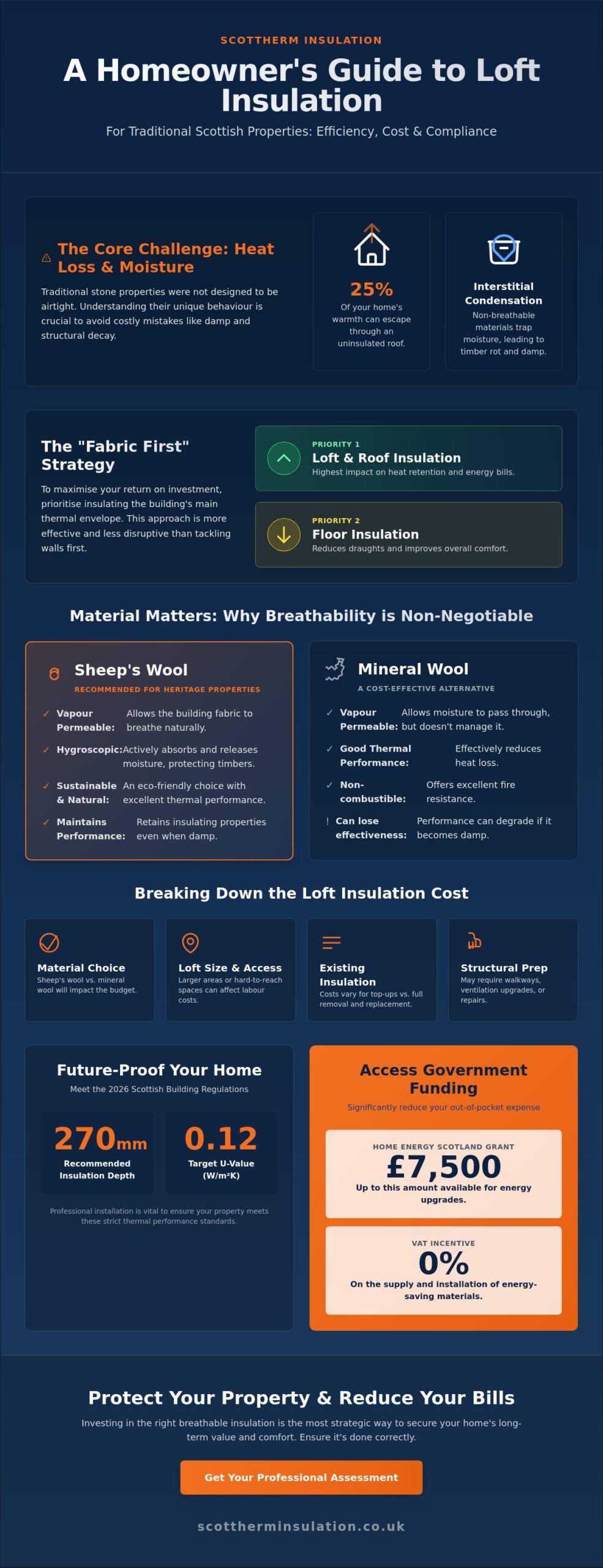
In a typical Edinburgh tenement or a rural highland cottage, heat escapes through the roof at an alarming rate. Data shows that up to 25% of your home’s warmth vanishes through an uninsulated loft. When calculating the loft insulation cost for older homes scotland, you must account for these unique architectural quirks. Standard solutions often fail because they don’t respect the building’s need to manage moisture. High heating bills and draughty rooms are usually the first signs that your home’s thermal envelope isn’t performing as it should.
The Science of Breathable Insulation
Breathability isn’t just a buzzword; it’s a survival mechanism for historic masonry. Choosing the right building insulation materials is critical for long-term health. Synthetic spray foams or rigid plastic boards can create a vapour barrier that seals moisture against your roof timbers. Over time, this leads to interstitial condensation and timber rot. Natural fibres like sheep’s wool or specific mineral wools allow vapour to pass through. This keeps the loft dry and ensures your structural timbers remain healthy for the next generation.
Regulatory and Conservation Factors
Scottish homeowners face a complex regulatory landscape. Many older properties sit in conservation areas or hold listed status, particularly in historic centres like Perth, Stirling, and Fife. The Scottish Government’s 2026 Heat in Buildings Standard introduces stricter efficiency requirements, but these must be balanced against heritage preservation. Always consult local planning authorities before making significant changes to the fabric of your home. Using approved, breathable materials often simplifies this process, as they align with conservation best practices and help you meet the 0.12 W/m²K U-value targets set for 2026.
Breaking Down the Loft Insulation Cost for Older Homes in Scotland
Calculating the loft insulation cost for older homes scotland involves more than just a square-metre rate. Traditional properties often present unique challenges that modern builds don’t. For instance, the size of your loft and the existing level of insulation play a major role. If you’re topping up from a legacy depth to the 2026 recommended standard of 270mm, your investment will differ from a complete strip-out and replacement. Accessibility is another key driver. Lofts with restricted head height or those requiring specialised blown-in solutions for hard-to-reach eaves will naturally require a different budget than a wide-open attic space.
Beyond the materials, you must consider the necessary structural preparations. Many older Scottish homes require improved ventilation to prevent moisture build-up once the insulation is in place. You might also need to install raised walkways to protect the new insulation from being compressed, which can reduce its effectiveness significantly. Professional installers will also account for the safe removal of any old, degraded materials that no longer meet safety or thermal standards. These preparatory steps ensure the long-term health of your property whilst maximising your energy savings.
Material Choice: Mineral Wool vs Sheep’s Wool
The material you choose has a direct impact on both your budget and your home’s breathability. For many homeowners, wool insulation is the gold standard for stone houses. Unlike synthetic alternatives, natural sheep’s wool can absorb and release moisture without losing its thermal properties. This moisture-wicking ability is vital for protecting the roof timbers of traditional properties. While mineral wool remains a popular, cost-effective choice for budget-conscious projects, it lacks the same level of environmental sustainability and long-term durability found in natural fibres. When insulating traditional buildings, the goal is to balance initial expenditure with the lifetime value of the property’s structural health.
Scottish Regional Labour and Access Factors
Location significantly influences installation pricing across the Central Belt. In cities like Edinburgh, the sheer height and complex layouts of Victorian tenements can complicate logistics. Transporting materials up several flights of stairs or working in cramped, “room-in-roof” spaces requires more time and specialised labour. Most professional installations take between one and two days, depending on the complexity of the site. Choosing a local specialist ensures your contractor understands the specific climate and building styles of the region. If you’re looking to improve your home’s efficiency, you can view our range of breathable insulation solutions to see which fits your property best.
Comparing Wall Insulation vs Loft Insulation: Which Offers Better ROI?
When assessing the best return on investment for your property, it’s essential to look at the payback period. Loft insulation typically pays for itself within three years, making it the most financially sound starting point for any renovation. In contrast, wall insulation involves significantly higher capital expenditure and much longer timelines to recover costs. While solid stone walls do contribute to heat loss, the physics of rising heat means the roof remains the primary escape route for your energy pounds. Prioritising the attic allows you to see immediate reductions in your monthly outgoings with minimal upfront disruption.
Internal Wall Insulation (IWI) often presents a logistical challenge that many homeowners aren’t prepared for. It requires rooms to be vacated, radiators to be moved, and electrical sockets to be refitted. For a traditional Scottish property, the loft insulation cost for older homes scotland is a fraction of the price of a full wall retrofit. By focusing on the roof first, you address the area responsible for up to 25% of your home’s total heat loss. This strategic approach ensures you get the maximum thermal benefit for every pound spent before considering more invasive and expensive measures.
The Problem with Wall Insulation in Stone Houses
Fitting rigid insulation boards to the inside of a sandstone wall can hide original period features like ornate cornices, deep skirting boards, and window shutters. More importantly, it creates a risk of thermal bridging and moisture traps. If the stone cannot breathe, water vapour condenses behind the insulation, which can lead to timber rot in joist ends. External Wall Insulation (EWI) is rarely an option for historic stone facades in conservation areas like St Andrews or Perth. Planning authorities usually reject EWI because it fundamentally alters the character of the streetscape, leaving the loft as the most viable area for improvement.
Prioritising the “Easy Wins” for Your Budget
If you compare the cost per square metre, insulating your attic is far more accessible than stripping back walls. This is why loft insulation scotland is regarded as the definitive first step in any “fabric first” strategy. By securing the roof first, you stabilise the internal temperature and make any subsequent upgrades more effective. When you evaluate the loft insulation cost for older homes scotland, remember that this single measure can save a semi-detached house up to £270 per year according to the Energy Saving Trust guide. Combining this with underfloor insulation creates a complete thermal envelope without the disruption of major wall works.
Strategic Insulation: The “Fabric First” Approach for Older Homes
The “fabric first” principle is the cornerstone of modern energy efficiency. It prioritises the building’s structure over the heating system. There’s little sense in installing a low-carbon heat pump if a quarter of that warmth escapes through the roof. By fixing the envelope first, you ensure any new heating technology operates at peak efficiency. When you consider the loft insulation cost for older homes scotland, you’re actually looking at the foundation of a long-term energy strategy. This approach stabilises internal temperatures and reduces the load on your boiler immediately.
Draught-proofing works in tandem with high-performance insulation. In older properties, cold air often enters through gaps in floorboards, window frames, and loft hatches. Addressing these leaks whilst installing breathable insulation creates a comprehensive barrier against the Scottish winter. This ensures that the heat you pay for stays inside your living spaces rather than leaking into the atmosphere.
The Underfloor Advantage
Many traditional homes feature suspended timber floors that allow cold air to circulate beneath the living space. This creates a persistent “chill from below” that forces you to turn up the thermostat even when the heating is on. Professional under floor insulation seals these gaps whilst maintaining the necessary sub-floor ventilation. By using breathable materials between the joists, you can stop draughts and significantly improve comfort in ground-floor rooms. Industry data suggests that insulating these floors can reduce heat loss by up to 15% in older properties.
Optimising Room-in-Roof Conversions
Attic conversions present specific thermal challenges. Sloping ceilings and dormer windows often lack the space for standard 270mm insulation depths. These areas require specialised materials that provide high thermal resistance without compromising the limited headroom. If your conversion was done decades ago, it likely fails current 2026 standards. Upgrading these spaces with modern, breathable fibres prevents the “sauna in summer, freezer in winter” effect common in older conversions. Professional boarding over the insulation also ensures you don’t lose valuable storage space whilst maintaining thermal performance.
To begin your home’s transformation, contact our specialist team for a professional assessment of your property’s unique insulation requirements.
Professional Installation and Funding: The ScotTherm Insulation Approach
ScotTherm Insulation understands that traditional Scottish architecture requires a nuanced approach. Standard “one-size-fits-all” solutions often ignore the delicate balance of moisture and airflow required in pre-1919 stone buildings. Our expertise is rooted in a deep understanding of these structures, ensuring that every project respects the property’s heritage whilst delivering modern thermal performance. By choosing specialised local installers, you avoid the risks associated with generic national firms that may not appreciate the local climate or the specific challenges of sandstone and whinstone masonry.
Our commitment to sustainability and building health is evidenced by our preference for high-value, breathable materials. Sheep’s wool insulation is a cornerstone of our service because it naturally regulates moisture, which is a critical factor for the longevity of Scottish roof timbers. This material choice, combined with our technical proficiency, ensures that the loft insulation cost for older homes scotland translates into long-term structural security and physical comfort. It’s the voice of experience that prioritises safety and long-term value over quick, cheap fixes.
Navigating the complex world of government support is a key part of our service. We help homeowners understand the ECO4 Scotland landscape, which provides vital assistance for eligible households. This scheme, running until March 31, 2026, focuses on improving the EPC ratings of homes that need it most. Our team provides the peace of mind that comes from using certified professionals who are accountable to their local community and regional identity.
Our Process: Inspection to Installation
Every project begins with a detailed assessment. We provide a specialist insulation inspection because we know that no two older homes are identical. During this visit, we customise thermal solutions to match your property’s specific masonry and timber conditions. A primary focus is ensuring correct ventilation. We don’t seal a loft without verifying that airflow is maintained, as this is the only way to prevent future damp issues and timber decay. This disciplined, quality-conscious process ensures your home remains a safe, warm environment for years to come.
Grants and Funding for Scottish Homeowners
Securing financial support can significantly offset the loft insulation cost for older homes scotland. We actively guide you through the available insulation grants scotland for 2026. This includes checking your eligibility for the Home Energy Scotland grant, which currently offers up to £7,500 for energy efficiency improvements. Whether you’re in Edinburgh, Fife, Perth, or Stirling, our experts are ready to provide a clear, professional quote tailored to your home’s needs. We act as your partner in transforming your property into a high-performance, low-energy home that is preserved for the next generation.
Secure Your Home’s Heritage and Thermal Comfort
Investing in your property’s thermal envelope is the most effective way to lower energy bills whilst protecting the structural integrity of traditional masonry. By prioritising breathable materials like sustainable sheep’s wool, you ensure that moisture is managed correctly, preventing the damp issues often associated with older Scottish buildings. Understanding the loft insulation cost for older homes scotland is the first step towards a warmer, more efficient environment that stands the test of time. A “fabric first” strategy ensures your home retains heat effectively before you consider more expensive heating upgrades.
As specialists in traditional Scottish stone properties and ECO4 scheme approved installers, we’re dedicated to helping you navigate the 2026 funding landscape. Our local expertise in sustainable sheep’s wool ensures that your insulation project meets the highest industry standards for safety and performance. Don’t let another winter pass with high bills and draughty rooms. Book Your Specialist Free Insulation Inspection Today to verify your eligibility for grants and receive a tailored assessment. Taking action now secures a cosier, more cost-effective home for your family and preserves your property for the next generation.
Frequently Asked Questions
Is it worth insulating an old stone house in Scotland?
Yes, insulating a traditional stone property is one of the most effective ways to reduce heating bills and improve domestic comfort. Since these buildings often have high thermal mass but poor heat retention, warmth escapes rapidly through the roof. Professional installation can save a semi-detached house up to £270 per year on energy costs, making it a high-return investment that pays for itself quickly.
Will insulating my loft cause damp in a traditional property?
Insulation only causes damp if it is installed incorrectly or uses non-breathable materials that trap moisture against structural timbers. Traditional Scottish homes rely on constant airflow to keep masonry and wood dry. By ensuring proper ventilation at the eaves and using vapour-permeable materials, you protect the structural health of your property whilst significantly increasing its thermal efficiency.
What is the best insulation material for breathable stone walls?
Natural sheep’s wool is the premium choice for traditional stone properties due to its superior moisture-wicking properties. It absorbs and releases vapour without losing thermal performance, which is vital for the health of sandstone and whinstone buildings. Mineral wool is also a highly effective, vapour-permeable alternative that provides excellent fire resistance and thermal protection for budget-conscious projects.
Can I get a grant for loft insulation in an older home?
Several government-backed schemes provide funding for energy upgrades in older Scottish homes. The ECO4 scheme and the Great British Insulation Scheme are available until March 2026 for eligible households. Additionally, Home Energy Scotland offers grants of up to £7,500 for efficiency improvements, which can significantly offset the loft insulation cost for older homes scotland for many homeowners.
How much does loft insulation cost per square metre in Scotland?
Pricing varies based on the chosen material, the loft’s size, and the existing insulation depth. A standard 270mm installation for a typical 3-bedroom semi-detached home costs approximately £930, while topping up existing insulation is generally cheaper. Premium materials like sheep’s wool or lofts with restricted access will influence the final rate, so a professional inspection is the best way to get an accurate figure.
Does insulating a stone house require planning permission?
Standard loft insulation rarely requires planning permission as it is considered an internal improvement. However, if your property is a listed building or situated in a conservation area, you should check with your local planning authority. They ensure that any changes, even internal ones, respect the historic character and structural requirements of the building’s heritage status.
How long does it take to professionally insulate a traditional loft?
Most professional loft insulation projects in traditional Scottish homes are completed within one to two days. This timescale covers the entire process, from preparing the space and installing ventilation baffles to laying the final insulation layers. Larger tenements or properties requiring the installation of specialised storage walkways or the removal of old materials may take slightly longer to complete.
What is the difference between breathable and non-breathable insulation?
Breathable insulation allows water vapour to pass through the material, which prevents moisture from becoming trapped against roof timbers or stone walls. Non-breathable materials, such as certain synthetic foams, create a vapour barrier that can lead to condensation and rot. Choosing breathable products is essential to manage the loft insulation cost for older homes scotland whilst ensuring the long-term structural integrity of the property.