
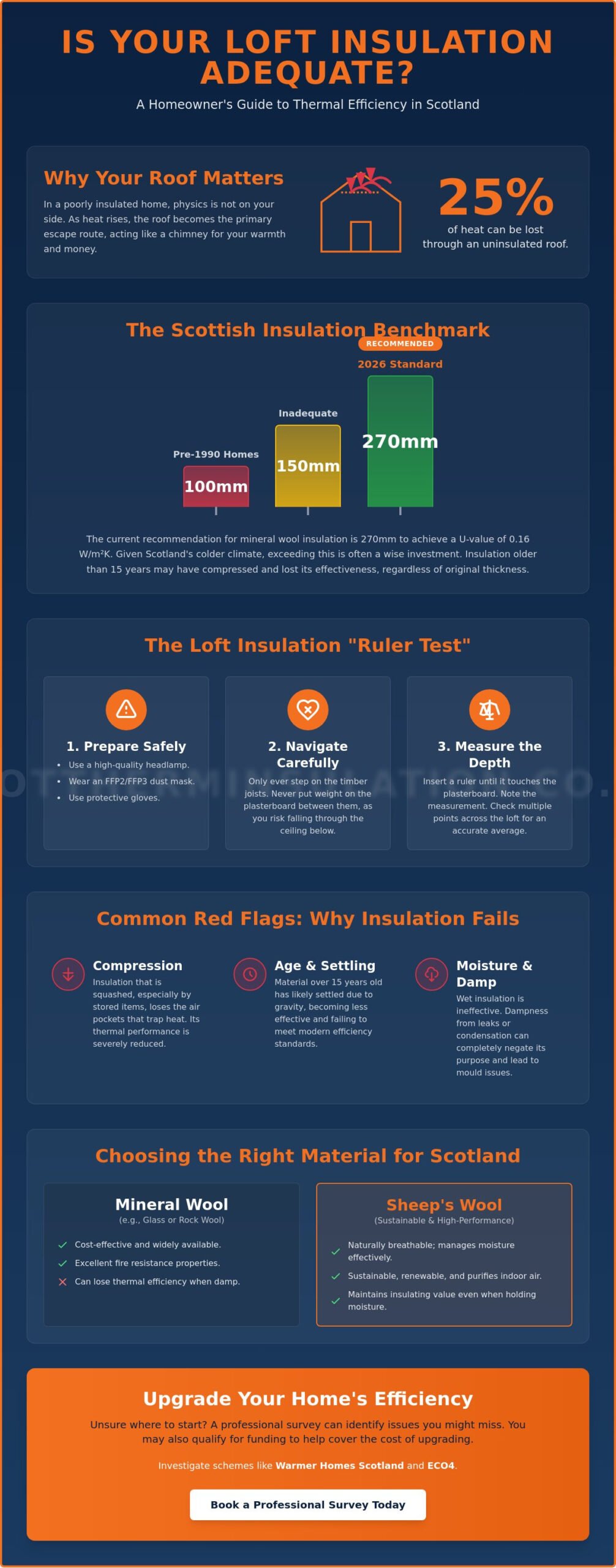
If you could see the heat escaping through your roof right now, would it look like a steady stream of your hard-earned money vanishing into the cold Scottish sky? You aren’t alone if you’ve turned the heating up whilst still feeling a chill or noticed a persistent draft from the loft hatch. Many homeowners find themselves asking, “is my loft insulation adequate scotland”, especially as energy standards tighten and winters remain unforgiving. It is a valid concern; an uninsulated or poorly insulated home can lose up to 25% of its heat through the roof.
We understand that conflicting advice on recommended thickness can be confusing. This guide provides a clear method for you to measure your own insulation and compare it against the 270mm depth standard required for modern Scottish building efficiency. You’ll learn how to identify if your home meets the 2026 EPC requirements and whether you might qualify for government funding through schemes like Warmer Homes Scotland. By the end of this article, you’ll have a practical plan to secure your home’s warmth and ensure your property is truly thermally efficient.
Key Takeaways
- Understand the 270mm benchmark for Scottish homes and why our specific climate often justifies exceeding the minimum UK thickness standards.
- Learn how to perform a safe “Ruler Test” to help you answer the question, “is my loft insulation adequate scotland”, by measuring depth accurately from the plasterboard.
- Identify common red flags, such as moisture or compression, that can render even thick layers of insulation ineffective at retaining heat.
- Evaluate the performance of different materials, including how sheep’s wool manages moisture levels more effectively than standard mineral wool in damp environments.
- Gain clarity on how professional surveys and current Scottish funding schemes like ECO4 can help reduce the cost of upgrading your home’s efficiency.
Understanding the Scottish Standard: Is 270mm Still Enough in 2026?
The 270mm recommendation is often cited as the gold standard for mineral wool, yet for many homeowners, this is merely the starting point. In the context of our unique climate, determining is my loft insulation adequate scotland involves more than just a quick glance. As we move through 2026, the definition of efficiency has shifted alongside rising energy costs and stricter environmental goals. What was acceptable a decade ago may now be costing you hundreds of pounds in wasted fuel.
To evaluate your home, you must understand U-values. This technical term describes the rate of heat transfer through a structure. Following fundamental Building insulation principles, the lower the U-value, the better your roof retains heat. Whilst a depth of 270mm typically achieves the required 0.16 W/m²K, Scotland’s lower mean temperatures often mean that exceeding this minimum is a smarter financial move for long-term comfort and property protection.
Age is another critical factor. While some materials claim a 40-year lifespan, insulation that is 15 years or older often fails to meet modern standards. Over time, gravity and moisture can cause materials to settle and compress, stripping away the air pockets that trap heat. If your insulation has flattened or looks “tired,” it’s no longer the effective thermal barrier it once was, regardless of its original thickness.
Why 25% of Your Heat Escapes Through the Roof
Physics dictates that heat rises. In an uninsulated or poorly protected property, your roof acts like a giant chimney, drawing warmth out of your living spaces. This is why the loft is the primary point of failure in a home’s thermal envelope. If you are asking, “is my loft insulation adequate scotland”, you are likely noticing that your boiler is working harder than it should. Modern loft insulation in Scotland has evolved to combat this, ensuring that the 25% of heat typically lost through the rafters stays exactly where it belongs: inside your home.
The 2026 Efficiency Benchmark for Scottish Homes
The standard for what we consider “cost-effective” has changed dramatically. Properties built before 1990 often have as little as 50mm or 100mm of glass wool. By 2026 standards, this is almost equivalent to leaving a window open all winter. With energy prices remaining a significant household outgoing, the benchmark for adequacy has moved. What was considered a “thick” layer twenty years ago is now seen as a major source of financial waste, making a top-up or full replacement a priority for those looking to secure their domestic well-being.
The Loft Insulation “Ruler Test”: How to Measure Your Current Depth Safely
Measuring the depth of your thermal barrier is the only way to truly answer the question, is my loft insulation adequate scotland. Whilst it sounds simple, older Scottish properties, such as traditional stone cottages or tenements in Edinburgh and Fife, often present unique challenges like irregular joist spacing or restricted access. Before you climb the ladder, you must prioritise your safety. Lofts are often dark, dusty, and physically demanding environments that require careful navigation.
Follow this safety-first checklist before entering the space:
- Proper Lighting: Use a high-quality headlamp to keep both hands free for balance on the ladder and joists.
- Protective Gear: Wear a disposable FFP2 or FPP3 dust mask and gloves to avoid irritating your lungs or skin with old, loose fibres.
- Joist Awareness: Only step on the timber joists or use crawl boards. Never step on the plasterboard between them, as you will fall through the ceiling.
Once you are safely positioned, use a standard ruler or tape measure to check the depth. Insert the ruler into the material until it touches the plasterboard of the ceiling below. Note the measurement from the plasterboard to the top of the insulation. It is vital to check multiple points across the loft, including corners and near the eaves. Insulation is often unevenly distributed, and a thick patch near the hatch doesn’t guarantee your whole home is protected. If you find the process difficult or the space inaccessible, a professional survey from ScotTherm Insulation can provide a definitive, safe assessment of your home’s efficiency.
Compare your findings against these “Adequacy Zones” to determine your next steps:
- Under 100mm (Critical): Your home is losing significant heat. This level was common in houses built several decades ago but is now entirely insufficient.
- 100mm to 250mm (Needs Top-up): You have a baseline of protection, but you aren’t meeting modern efficiency standards or achieving maximum savings.
- 270mm or more (Adequate): Your depth meets the current Scottish Building Standards, provided the material is in good condition and not compressed.
Step-by-Step DIY Loft Assessment
When measuring, don’t press down on the material. Compressing insulation squeezes out the air pockets that provide thermal resistance, which ruins its effectiveness. Take a moment to identify your material; glass wool is typically yellow or pink, whilst rock wool is often grey or brown. Don’t forget to check the loft hatch itself. An uninsulated hatch without a draught seal acts like an open window, allowing heat to bypass your insulation entirely and pour into the roof space.
Identifying Joist Heights and Compression
A simple visual cue for adequacy is the height of your joists. In most Scottish homes, joists are approximately 100mm high. If you can see the tops of these timbers, your insulation is almost certainly inadequate. Thermal bridging occurs when heat bypasses the insulation and escapes directly through the more conductive timber joists. To prevent this, insulation should cover the joists completely. Avoid using your loft for heavy storage by squashing insulation with suitcases or boards. This compression can reduce the thermal effectiveness of the material by up to 50%.
Common Red Flags: Why Your Insulation Might Fail Despite Being Thick
It is a common misconception that simply having a thick layer of material guarantees a warm home. When homeowners ask, is my loft insulation adequate scotland, they are often looking at depth alone. However, even 270mm of insulation can fail if the material’s integrity is compromised. According to the latest insulation statistics for Scotland, a significant number of properties still fall short of optimal thermal performance due to hidden defects. Physical thickness is only one part of the efficiency equation.
Scotland’s damp climate poses a constant threat to standard mineral wool. If moisture enters the loft space through a roof leak or high internal humidity, the fibres absorb water and lose their ability to trap air. This creates a thermal conductor rather than a barrier. Many poor-quality installations also accidentally block the eaves. This stops essential airflow, leading to interstitial condensation. This hidden moisture can rot your roof timbers and render your insulation useless long before its expected lifespan ends.
Another issue is “settling.” Over several decades, older materials can shrink or flatten. This creates small gaps, known as thermal bypasses, where warm air simply flows around the insulation. Even a 5% gap in coverage can lead to a 50% drop in overall thermal efficiency. If you see gaps between the rolls of insulation or around the edges of the loft, your home is leaking heat despite the material looking “thick” in the centre.
Damp, Mould, and Moisture Traps
Spotting “soggy” insulation is a clear indicator of failure. If the material feels heavy, smells musty, or shows dark patches of mould, it must be replaced immediately. Topping up damp material only traps moisture against your ceiling plasterboard. In our humid regional climate, using breathable sheep’s wool insulation is often the superior choice for older properties. It naturally manages moisture levels by absorbing and releasing water vapour without losing its thermal performance.
The “Ghosting” Effect and Cold Spots
You might notice dark streaks on your ceiling or rooms that feel draughty despite your heating being on. This “ghosting” often points to cold spots in the loft where the thermal barrier is broken. Insulation is frequently missing in hard-to-reach areas like the very edges of the eaves or behind water tanks. These gaps allow heat to pour out, leaving specific areas of your home feeling uncomfortably cold. If you suspect these hidden failures, a professional survey is the most reliable way to confirm if your home is truly protected.
Choosing the Right Material for Scotland: Mineral Wool vs Sheep’s Wool
When determining is my loft insulation adequate scotland, homeowners often focus solely on depth. However, the material you choose dictates how that depth performs in our specific regional climate. Most Scottish homes currently use mineral wool, which includes glass wool and rock wool. These materials are cost-effective and often made from recycled glass, providing a reliable thermal barrier when kept perfectly dry. Yet, in a country known for high humidity and damp winters, the performance of synthetic fibres can fluctuate depending on the moisture levels in your loft.
Sheep’s wool offers a high-performance alternative that is uniquely suited to the Scottish environment. Unlike mineral wool, which relies on an industrial manufacturing process, sheep’s wool is a sustainable, renewable resource with a significantly lower environmental footprint. It also addresses the common “itch factor” associated with glass fibres. Because wool is non-toxic and contains no harmful chemicals or volatile organic compounds, it contributes to better indoor air quality and is much safer to handle. This makes it an ideal choice for families concerned about the long-term health of their domestic environment.
Performance in Damp Conditions
Standard mineral wool behaves like a sponge; it loses its R-value and thermal resistance once it becomes damp. In contrast, sheep’s wool is naturally breathable and hygroscopic. Sheep’s wool can absorb up to 33% of its weight in moisture without losing thermal efficiency. This unique behaviour allows it to regulate humidity within the loft space, protecting your roof timbers from rot whilst maintaining a consistent temperature in the rooms below. Additionally, wool is naturally fire-retardant and will self-extinguish if exposed to a flame, providing an extra layer of safety for your household.
Cost vs Value Over 40 Years
While premium materials like sheep’s wool require a higher upfront investment than basic mineral wool, they offer superior long-term adequacy. Synthetic materials often settle or degrade over several decades, leading to the “top-up” cycle mentioned in previous sections. A one-time installation of high-quality wool maintains its loft and performance for the life of the building. This prevents the need for future remedial work and ensures your energy bills remain low regardless of the weather outside. If you are looking for a permanent solution to heat loss, consider a professional sheep’s wool installation to secure your home’s thermal future.
Upgrading Your Home: Professional Installation and Grants in Scotland
Whilst the DIY ruler test is a vital first step, a professional survey provides the forensic detail needed to confirm if your home meets the 2026 Band C requirements. Specialist installers use thermal imaging to detect thermal bypasses that are invisible to the naked eye, such as gaps behind water tanks or thin spots in hard-to-reach eaves. A professional assessment also includes a comprehensive air-flow analysis. This ensures that whilst you are trapping heat, you aren’t inadvertently creating a moisture trap that could damage your roof timbers. For homeowners asking, is my loft insulation adequate scotland, this level of technical scrutiny is the only way to move from guesswork to a certified thermal solution.
The logistics of a professional installation are streamlined to minimise disruption to your daily routine. For most properties in Edinburgh, Stirling, or North Berwick, a full installation is completed within a single day. Preparation is straightforward; we simply ask that you clear the loft of stored items to allow our team full access to the joists and eaves. Our installers handle everything else, from the safe extraction of old, degraded materials to the precise fitting of new barriers. This structured approach prioritises your home’s safety and long-term value over the temporary fixes offered by amateur top-ups.
Is Your Home Eligible for ECO4 Funding?
The landscape of insulation grants in Scotland provides significant opportunities for homeowners to upgrade their properties without a heavy financial burden. The ECO4 Scotland scheme remains active through 2026, targeting properties with an EPC rating of D to G. For those who don’t qualify for ECO4, the Warmer Homes Scotland programme supports households with an income of £36,000 or less. Property types with complex structures, such as room-in-roof configurations common in older Fife and Perth tenements, benefit most from these professional interventions, as they require specialized material handling to maintain thermal integrity without compromising vital ventilation.
The ScotTherm Insulation Difference: Local Expertise
Choosing a specialist who understands the unique architectural challenges of the Scottish building stock is essential for a successful upgrade. ScotTherm Insulation provides the security of a verified history and the peace of mind that comes from using certified professionals who live and work in your community. We take pride in the tangible impact our work has on families across the Central Belt, helping them achieve both financial efficiency and physical comfort. Our team ensures that every installation adheres to the highest industry standards, backed by official verification and a commitment to environmental responsibility.
Book your specialist free insulation inspection with ScotTherm Insulation today to ensure your property is thermally efficient and fully compliant with 2026 standards.
Secure Your Home’s Warmth for the Future
Ensuring your property meets the 2026 efficiency standards is more than a regulatory box-ticking exercise; it’s a vital investment in your home’s long-term resilience. By moving beyond the entry-level question of is my loft insulation adequate scotland, you’ve taken the first step toward reclaiming the heat that typically vanishes through an unprotected roof. Whether you choose the high-performance moisture management of sheep’s wool or a modern mineral wool top-up, the result is a more stable, cost-effective domestic environment that stands up to our regional climate.
As specialist local installers for Edinburgh, Fife, Perth, and across the Central Belt, we bridge the gap between technical building standards and your daily comfort. Our accredited team ensures that every installation, whether funded through ECO4 grants or private investment, is fitted with the precision required to prevent thermal bridging and moisture traps. This professional oversight provides the security of a verified thermal barrier, protecting your roof structure and your family’s well-being for decades to come.
Take control of your energy outgoings before the next winter chill sets in. Book Your Specialist Free Insulation Inspection with ScotTherm Insulation today and join the growing number of Scottish homeowners securing their thermal future. We look forward to making your home a warmer, more efficient place to live.
Frequently Asked Questions
How many inches of loft insulation do I need in Scotland?
You need approximately 11 inches (270mm) of loft insulation to meet current Scottish Building Standards. This specific depth is required to achieve a U-value of 0.16 W/m²K, which is the benchmark for modern fuel conservation. Whilst 270mm is the recommended minimum for mineral wool, many homeowners choose to exceed this depth to combat Scotland’s colder mean temperatures and ensure long-term thermal efficiency.
Can I put new loft insulation over the old stuff?
You can install new insulation over existing material provided the original layer is dry, uncompressed, and free from mould. This process, often called “topping up”, is a practical way to reach modern thickness standards without the cost of a full removal. However, if your old insulation is damp or shows signs of infestation, it must be professionally removed to prevent trapping moisture against your ceiling timbers.
What happens if I have too much loft insulation?
Installing excessive insulation can lead to restricted airflow at the eaves, which causes condensation and potential rot in the roof structure. Whilst depth is important for heat retention, maintaining clear ventilation paths is vital for the health of your home. If the eaves are blocked, moisture becomes trapped in the loft space, leading to interstitial condensation that can damage both the insulation and the timber joists.
How much can I save on my heating bills with adequate loft insulation?
Adequate loft insulation can reduce your home’s heat loss by up to 25%, which leads to a tangible reduction in annual heating costs. Because your boiler doesn’t have to work as hard to maintain a steady temperature, your fuel consumption drops significantly. Ensuring is my loft insulation adequate scotland is one of the most effective ways to secure financial efficiency and physical comfort during the winter months.
Do I need to insulate the loft hatch as well?
You must insulate the loft hatch to prevent it from acting as a major thermal bypass point. An uninsulated hatch allows warm air to escape directly into the cold loft, bypassing the rest of your insulation. To ensure a complete thermal seal, you should fix a thick layer of insulation to the back of the hatch and install high-quality draught-proof strips around the frame.
Is sheep’s wool better than mineral wool for Scottish lofts?
Sheep’s wool is often the superior choice for the Scottish climate because it maintains its thermal performance even in high humidity. Unlike mineral wool, which loses effectiveness when damp, sheep’s wool can absorb up to 33% of its weight in moisture without losing its R-value. This breathability makes it an ideal material for older stone properties that require natural moisture management to prevent damp issues.
How do I know if my loft insulation is damp?
You can identify damp insulation by looking for dark discolouration, a clumped texture, or a persistent musty smell in the loft. If the material feels heavy or soggy to the touch, it has likely absorbed water from a roof leak or poor ventilation. Damp insulation acts as a conductor for heat rather than a barrier, meaning it must be replaced to restore your home’s thermal integrity.
Are there grants available for loft insulation in Scotland in 2026?
Yes, several funding options are available in 2026, including the ECO4 scheme which targets low-income households and runs until December 2026. The Warmer Homes Scotland scheme also provides support for households with an income of £36,000 or less. These grants are designed to help homeowners reach modern efficiency standards, ensuring their home’s thermal barrier is adequate without the burden of high upfront costs.