
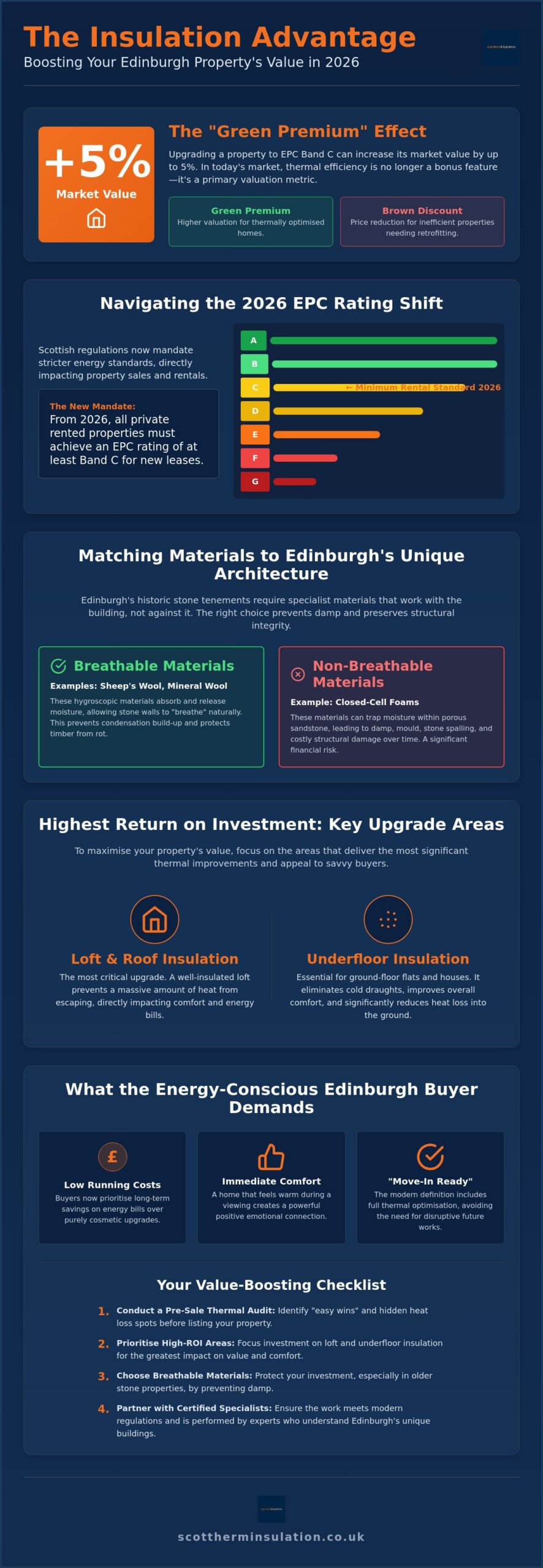
Did you know that upgrading a property to an EPC Band C can increase its market value by up to 5 per cent in the current climate? In 2026, the ability to increase home value with insulation edinburgh has become a primary driver for owners facing stricter Scottish energy standards and the new Heat Retention Rating system. You are likely familiar with the struggle of heating a drafty stone tenement whilst worrying about the confusion of changing regulations. It is natural to feel concerned about the risk of damp in older buildings or the fear that your property might become difficult to lease under the latest environmental mandates.
This guide provides a clear, authoritative roadmap for navigating these updates to boost your property’s worth. We will explore how professional loft, roof, and underfloor upgrades satisfy modern building regulations and appeal to energy-conscious buyers. You will learn how to transform your home into a high-performing asset that offers both immediate physical comfort and significant long-term financial gain in the Edinburgh market. We combine technical proficiency with local expertise to ensure your investment is both safe and profitable.
Key Takeaways
- Understand how the 2026 Scottish energy regulations and EPC ratings directly influence property prices and marketability in the Lothian region.
- Discover why breathable materials like sheep’s wool and mineral wool are essential for preserving Edinburgh’s historic stone tenements whilst preventing damp.
- Learn how to increase home value with insulation edinburgh by focusing on high-return areas like lofts and underfloor spaces in ground-floor flats.
- Identify “easy wins” through a pre-sale thermal audit to address condensation and improve your property’s Heat Retention Rating before listing.
- Recognise the importance of partnering with certified local specialists who understand the unique climatic and structural challenges of the Scottish capital.
The Direct Impact of Energy Efficiency on Edinburgh Property Values
Thermal efficiency has transitioned from a hidden feature to a primary valuation metric in the Edinburgh property market. In 2026, a high Energy Performance Certificate (EPC) rating acts as a badge of quality that signals financial sustainability to potential buyers. You will find that homes in the Lothian region with superior thermal performance now command a “green premium,” whilst those with outdated systems face a “brown discount.” This discount represents the price reduction buyers demand to cover the inevitable cost of future retrofitting. To increase home value with insulation edinburgh, you must view thermal upgrades as a strategic investment rather than a maintenance chore.
Modern buyers in the capital increasingly prioritise long-term running costs over cosmetic features like high-end kitchens or designer bathrooms. A stone tenement with a modern, efficient thermal envelope is far more attractive than a drafty equivalent with surface-level decorations. This shift is driven by a desire for domestic well-being and the practical need to comply with evolving Scottish legislation. By choosing high-quality Building insulation materials, you protect the structural integrity of your property whilst ensuring it remains competitive in a market that values sustainability.
Understanding the EPC Rating Shift in 2026
The Scottish Government has implemented stricter energy standards that directly affect your ability to market a home. As of 2026, all private rented properties in Scotland must achieve an EPC rating of at least Band C before a new lease can be granted. This regulatory pressure has filtered into the residential sales market, particularly in affluent areas like Morningside and Stockbridge. Moving a property from a Band D to a Band B rating can significantly enhance its desirability and final sale price. Current market data suggests that by the end of 2026, the EPC Green Premium will account for a valuation gap of approximately 5 per cent between thermally optimised homes and their less efficient neighbours.
The Psychology of the Energy-Conscious Edinburgh Buyer
The “move-in ready” label now implies that a home is fully optimised with loft and underfloor insulation. Buyers want to avoid the anxiety of future energy price volatility and the disruption of major renovation works after they have moved in. During the cold Edinburgh winters, the impact of thermal comfort on a viewing cannot be understated. A home that feels warm and retains its heat creates a positive emotional connection that drafty properties simply cannot match. Investing in professional insulation ensures your property stands out as a secure, comfortable, and future-proof asset. This proactive approach allows you to increase home value with insulation edinburgh whilst providing peace of mind to the next owner.
Matching Insulation Materials to Edinburgh’s Unique Architecture
Edinburgh’s architectural landscape is a tapestry of historic sandstone and modern glass. To increase home value with insulation edinburgh, you must select materials that align with the specific physics of your property. Sandstone is a porous, living material. It requires a sympathetic approach to thermal upgrades to avoid the common pitfalls of damp and structural degradation. Choosing the wrong material isn’t just a technical error; it’s a financial risk that can lead to costly repairs and a lower valuation during a home report.
The goal is to create a thermal envelope that respects the building’s original design whilst meeting modern expectations for comfort. Investors who understand this distinction can market their properties as both heritage-rich and future-proof. Whether you own a Georgian townhouse or a 1970s semi-detached home, the material choice determines the longevity of your investment and the health of the building’s occupants.
The Edinburgh Tenement: A Specialist Insulation Challenge
Traditional tenements in areas like Bruntsfield or the New Town were designed to allow moisture to move through the walls. Using non-breathable, closed-cell materials can trap water within the stone, leading to spalling or timber rot. This is why wool insulation is increasingly favoured by preservation-conscious investors. It is naturally hygroscopic, meaning it can absorb and release moisture without losing its thermal properties. When researching energy efficiency in historic buildings, it becomes clear that moisture management is just as important as heat retention. Sheep’s wool acts as a buffer, protecting the delicate internal fabric of heritage homes whilst significantly lowering energy demand.
Modern Materials for 21st-Century Efficiency
Modern developments, such as the contemporary apartment blocks in Leith or the suburbs, present different opportunities. These structures often utilise cavity walls or timber frames where mineral wool is the industry standard for efficiency. Mineral wool offers high fire resistance and excellent acoustic dampening, which is a major selling point for flats in busy urban centres. It provides consistent thermal conductivity values that help you hit those critical 2026 EPC targets without the premium cost of specialist heritage products. By matching the insulation material to the build date and construction type, you ensure that every pound spent contributes to a higher resale value. It’s about precision and regional expertise. You can consult with our team to identify the most compatible solution for your specific Edinburgh postcode.
Loft and Underfloor Insulation: The Highest ROI Upgrades
To truly increase home value with insulation edinburgh, you must prioritise the areas where heat loss is most aggressive. Whilst choosing the correct breathable materials is vital for the building’s health, the financial return on your investment is dictated by where those materials are applied. Loft and underfloor upgrades represent the most effective “low-hanging fruit” for Edinburgh investors. ScotTherm Insulation provides high-performance solutions that serve as the foundation for these valuation gains. These interventions provide the fastest payback periods through a combination of reduced utility bills and an immediate jump in EPC scoring. A property that demonstrates a proactive approach to heat retention is significantly more marketable than one relying on outdated, degraded materials.
An integrated insulation strategy transforms a drafty tenement or a suburban semi-detached into a high-performing asset. Buyers in 2026 are increasingly savvy about “hidden” efficiency. They look beyond the surface to see if the fundamental thermal envelope has been addressed. By tackling both the roof and the floor, you eliminate the primary escape routes for expensive heat; this creates a cumulative effect that boosts the property’s overall Heat Retention Rating (HRR) and final valuation.
Loft Insulation: The Essential First Step
Uninsulated roof spaces are responsible for approximately 25 per cent of a home’s total heat loss. Many older Edinburgh properties still contain thin, settled, or damp-damaged insulation that fails to meet current 2026 building standards. To achieve the recommended U-value of 0.16 W/m²K, a loft typically requires a depth of 270mm of high-quality material. Upgrading this area is a straightforward process that yields substantial results. For a standard semi-detached home in Edinburgh, professional loft insulation in Scotland typically pays for itself through energy savings alone in under three years, whilst providing an immediate uplift in property valuation.
Underfloor Insulation: Stopping the Edinburgh Draft
In the capital’s ground-floor tenement flats, underfloor insulation is often described as the “secret weapon” for property value. Traditional timber floorboards over vented sub-floor voids are notorious for creating uncomfortable drafts and cold spots. Professional under floor insulation stops this rising chill and transforms the living environment. This upgrade is particularly effective for boosting EPC ratings in lower-level properties where heat loss through the floor is a primary concern. It is essential that these installations are handled by specialists to maintain critical sub-floor ventilation; this prevents timber decay whilst ensuring the home remains warm and dry. This balance of technical safety and thermal performance is exactly what modern surveyors look for when assessing a property’s worth.
Preparing Your Home for Sale: A Value-Boosting Checklist
Before you list your property on the Edinburgh market, a strategic review of its thermal performance can uncover “easy wins” that prevent low valuations. You want to present a home that is efficient, dry, and structurally sound. To increase home value with insulation edinburgh, you must look beyond the EPC band and address the specific details that surveyors scrutinise during a Home Report inspection. A tidy, professionally insulated loft space signals to buyers that the property has been meticulously maintained. This attention to detail often differentiates a quick sale from a stagnant listing.
A proactive approach involves more than just adding material. You should consider how the insulation looks and functions for the next owner. Combining high-performance insulation with professional loft boarding adds functional storage value, which is a massive selling point in Edinburgh’s smaller tenement flats and terraced houses. It transforms a dark, dusty void into a bright, usable area that adds tangible square footage to the buyer’s perception of the home.
Thermal Audit and Damp Prevention
Identifying potential issues before a surveyor arrives is essential. A pre-sale thermal audit helps you spot “cold bridges” where heat escapes; these areas often lead to condensation and mould growth amongst older Lothian properties. These issues are red flags for buyers and can lead to significant price renegotiations or even mortgage rejections. Using breathable materials is a powerful selling point because it demonstrates a commitment to the building’s long-term health. You must ensure that ventilation works in harmony with your insulation to keep the sandstone fabric dry and the internal air quality high.
Documentation and Certification for Sellers
The administrative side of property sales is often where insulation value is lost or gained. DIY insulation projects, whilst well-intentioned, can sometimes decrease a home’s value if they lack professional certification or fail to meet current safety standards. Solicitors and mortgage lenders require verified proof of work to satisfy their risk assessments. Professional installation records from the team at ScotTherm Insulation provide a clear paper trail that aids the conveyancing process. This documentation ensures the energy section of your Home Report accurately reflects the property’s efficiency. It gives you a stronger position during final price negotiations. You can book a professional survey to identify the best value-boosting upgrades for your property before it hits the market.
Why ScotTherm Insulation is the Trusted Partner for Edinburgh Homeowners
Choosing the right contractor is a decision that impacts your property’s safety and its long-term financial trajectory. National companies often apply generic, one-size-fits-all solutions that fail to account for the unique challenges of the Scottish climate or the specific requirements of Edinburgh’s architectural heritage. To truly increase home value with insulation edinburgh, you require a partner who understands the relationship between thermal performance and structural integrity. ScotTherm Insulation combines technical proficiency with a deep commitment to domestic well-being, ensuring that every project enhances both the comfort and the marketability of your home.
Our approach aligns with Edinburgh’s ambitious “Net Zero” city goals. By selecting sustainable materials and high-performance systems, we help homeowners contribute to a greener capital whilst securing their own financial future. We don’t just install material; we provide a verified history of success and the peace of mind that comes from using certified professionals. This local expertise is what distinguishes a standard renovation from a high-value property investment.
Local Expertise in Edinburgh and the Lothians
We possess a thorough understanding of Edinburgh City Council building standards and the specific nuances of tenement requirements. Whether you are navigating the complexities of a New Town heritage project or a modern development in Leith, our team provides tailored advice that satisfies both surveyors and solicitors. We take immense regional pride in our work. We treat every property in Fife, Stirling, and Edinburgh as if it were our own. This dedication extends to helping eligible households access support through the ECO4 Scotland scheme. This initiative ensures that energy efficiency is accessible to the wider community, fostering a more sustainable housing market across the Lothians.
Quality Assurance and Long-Term Value
The durability of your investment depends on the quality of the materials used. ScotTherm Insulation specialises in premium mineral wool and sustainable sheep’s wool, selected for their superior thermal properties and environmental credentials. Our certified installation process ensures that these materials perform at their peak for decades. This professional rigour is essential to increase home value with insulation edinburgh, as it provides the technical validation that modern buyers demand. You aren’t just buying insulation; you are investing in a warmer, more cost-effective environment that stands up to the rigours of the Scottish winter. Contact ScotTherm Insulation today to protect your property investment.
Future-Proofing Your Edinburgh Property Investment
Thermal efficiency is no longer a luxury; it is a fundamental requirement for the 2026 housing market. By prioritising high-return areas like lofts and underfloor spaces, you transform your home into a resilient asset that exceeds modern energy expectations. You’ve seen how breathable materials protect historic sandstone whilst professional documentation simplifies the selling process. Taking these proactive steps allows you to increase home value with insulation edinburgh and ensures your property remains a top-tier choice for discerning buyers.
We are specialists in Edinburgh tenement insulation and certified installers of sustainable sheep’s wool. Our team provides expert guidance on 2026 EPC improvements to help you navigate changing regulations with confidence. Don’t leave your property’s worth to chance when professional thermal optimisation is within reach. Book your expert Edinburgh insulation survey today to begin your journey toward a warmer, more profitable home. We look forward to helping you protect and enhance your investment in our historic city.
Frequently Asked Questions
How much value does loft insulation add to a house in Edinburgh?
Professional loft insulation is a primary factor in achieving a higher EPC rating, which can increase property value by approximately 5 per cent in the 2026 market. Buyers in the Lothians view a thermally efficient roof as a sign of a well-maintained home. This upgrade prevents the “brown discount” often applied to drafty properties. It represents a low-cost intervention with one of the highest returns on investment available to homeowners.
Is sheep’s wool insulation better than mineral wool for older Edinburgh tenements?
Sheep’s wool is often the superior choice for traditional sandstone tenements due to its natural breathability and hygroscopic properties. It manages moisture effectively whilst preventing the timber rot that can occur with non-breathable materials. Mineral wool is highly efficient for modern builds, but heritage properties benefit from the sympathetic moisture regulation that wool provides. This choice protects the structural integrity of older buildings, ensuring they remain a safe and valuable asset.
Will a new EPC rating really help me sell my house faster in Scotland?
A high EPC rating is a significant competitive advantage that often leads to a faster sale in the current Scottish market. With the 2026 energy standards now in effect, buyers are actively filtering for properties that meet Band C or above to avoid future upgrade costs. A thermally optimised home reduces buyer anxiety regarding energy price volatility and domestic comfort. It positions your property as a “move-in ready” asset, which is highly desirable in Edinburgh.
Can I get a grant to increase my home value with insulation in Edinburgh?
You may be eligible for support through the Warmer Homes Scotland programme or the Home Energy Scotland Grant and Loan scheme. These initiatives provide financial assistance for energy-saving improvements, including various insulation types. Using these grants to increase home value with insulation edinburgh allows you to enhance your property’s marketability whilst minimising your initial capital outlay. It is advisable to check current eligibility criteria through official Scottish Government channels or a certified local installer.
Does underfloor insulation help with damp in ground-floor flats?
Professional underfloor insulation helps manage damp by reducing condensation on cold floor surfaces whilst maintaining essential sub-floor ventilation. In ground-floor tenement flats, stopping the rising chill from the void below creates a warmer, drier living environment. This balance is critical; poor installation can trap moisture, but a specialist approach ensures the timber joists remain protected. A dry, warm floor is a major selling point that improves both comfort and the property’s technical survey results.
How long does professional loft insulation take to install?
A standard professional loft insulation installation in an Edinburgh semi-detached home is typically completed within a single day. The process is efficient and causes minimal disruption to your daily routine. Our team handles the preparation, material laying, and any necessary walkway or boarding installations with precision. This quick turnaround makes it an ideal upgrade before listing a property on the market. It provides an immediate boost to your home’s thermal performance and EPC score.
What is the minimum EPC rating required to sell a house in Scotland in 2026?
There is currently no legal minimum EPC rating required for a private residential sale in Scotland, but the market expectation has shifted heavily toward Band C. Private landlords must ensure properties reach Band C before granting new tenancies as of 2026. This regulation means that any buyer looking for an investment property will likely reject homes below this standard. Achieving a Band C rating ensures your home appeals to the widest possible range of potential purchasers.
Is it worth insulating a room-in-roof if I plan to sell soon?
Insulating a room-in-roof is highly recommended if you plan to sell soon, as these spaces are notorious for significant heat loss. Potential buyers often view attic rooms as unusable if they feel cold or damp during a winter viewing. Upgrading this area with high-performance materials transforms it into a functional living space, adding tangible value to your home. It is a strategic move that directly impacts the Heat Retention Rating and makes the property stand out in the Edinburgh market.