
The most expensive material on the market might still leave your home freezing if the installer doesn’t understand the unique breathability needs of a Scottish property. Choosing between different insulation companies in 2026 is no longer just about the lowest price; it’s about finding a specialist who can meet the rigorous Section 6 building standards. You have likely felt the frustration of rising energy costs whilst your rooms remain stubbornly cold, and the fear of hiring a “cowboy” installer only adds to the stress.
We agree that every homeowner deserves a warm, energy-efficient living space without the worry of poor workmanship. This guide promises to simplify the vetting process and help you decide whether mineral wool or sheep’s wool is the right fit for your specific house type. We will preview the essential certifications you must verify and explain how to secure a professional installation that delivers lower bills and lasting comfort. By the end of this article, you’ll have the confidence to hire a certified professional who understands the specific thermal requirements of your home.
Key Takeaways
- Learn to identify the physical signs of thermal bridging and draughts to pinpoint exactly where your property is losing heat.
- Understand the specific industry-recognised certifications and regional expertise required to vet insulation companies effectively for a Scottish project.
- Compare the performance and breathability of materials like mineral wool and sheep’s wool to ensure your choice suits your home’s construction.
- Follow a structured step-by-step guide to hiring, from requesting a specialist technical survey to reviewing site-specific recommendations.
- Discover why local expertise is non-negotiable for navigating Scotland’s unique building regulations and traditional property types.
How to Identify Heat Loss in Your Property
Identifying heat loss begins with a logical assessment of your home’s thermal envelope. Many homeowners rely on their Energy Performance Certificate (EPC) to spot weaknesses, which is a sensible starting point. An EPC provides a standardised rating of your property’s efficiency, highlighting where heat escapes most readily through walls, roofs, or floors. However, a paper report cannot replace a physical inspection. Professional building insulation strategies require a hands-on assessment of thermal bridging. This occurs when a more conductive material allows heat to bypass your thermal barrier entirely, often at wall junctions or around window frames. Identifying these thermal weak points is the first step toward a warmer home.
Common Red Flags of Poor Insulation
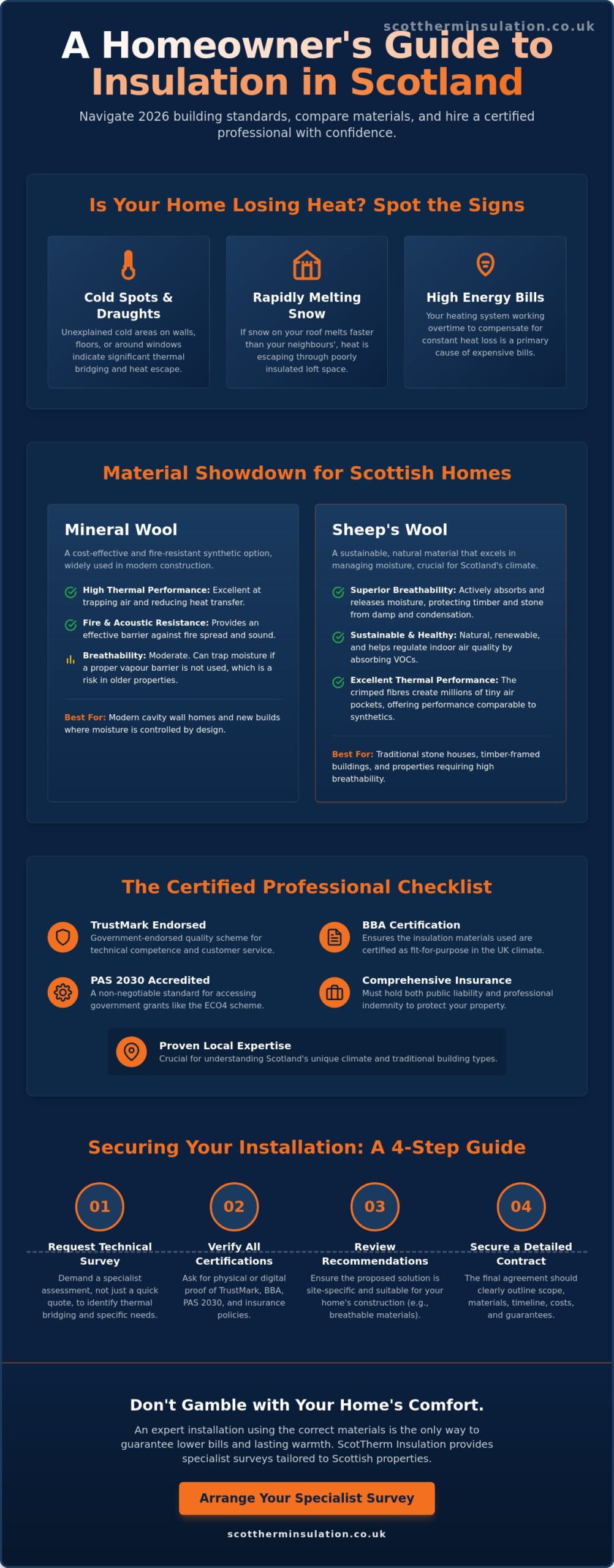
Physical symptoms of heat loss are often easy to spot if you know where to look. Cold spots on walls or floors during the winter months suggest gaps in your thermal barrier or areas where the material has slumped over time. You should also watch your roof during a frost or light snowfall. If you notice that snow melts rapidly on your roof whilst your neighbours’ roofs remain white, you likely have a significant loft insulation problem. Heat is rising through your ceiling and warming the roof tiles from below, wasting money and energy. These inefficiencies translate directly into high energy bills, as your heating system works harder to replace the warmth that’s constantly escaping. Reliable insulation companies will look for these specific signs during a technical survey to determine the best course of action.
The Impact of the Scottish Climate
The Scottish climate presents a unique set of challenges that demand a robust insulation strategy. High humidity and wind-driven rain can penetrate outer walls, significantly affecting the performance of traditional materials. Insulation companies working in the Central Belt or the Highlands must account for these factors to prevent long-term damage. A “one size fits all” approach often leads to interstitial condensation, which can damage the structure of your home. This is particularly true for traditional properties. It’s vital to consider insulating a stone house in Scotland using breathable materials. Unlike modern cavity walls, stone structures rely on the natural movement of moisture to stay dry. Using non-breathable synthetics in these environments can trap dampness, leading to mould and structural decay. Choosing a specialist who understands the regional requirements of Scottish stone ensures your home stays both warm and structurally sound.
Vetting Insulation Companies: Essential Credentials and Standards
Trust is built on verification. In 2026, the landscape of home energy efficiency is defined by stricter regulations and the continued importance of the ECO4 scheme. You shouldn’t just take an installer’s word for their quality. Instead, look for tangible proof of their adherence to industry standards. Professional insulation companies should proactively provide evidence of their accreditations before you even request them. This transparency is the hallmark of a reliable specialist who prioritises safety and long-term value over a quick sale. A verified history of success in your specific region is the most reliable indicator of future performance.
Must-Have Certifications for Installers
TrustMark is the government-endorsed quality scheme that ensures installers have been thoroughly vetted for technical competence and customer service. Alongside this, the British Board of Agrément (BBA) certification confirms that the specific materials being used are fit for purpose in the UK’s challenging climate. If you are applying for government funding, your installer must be PAS 2030 accredited. This is a non-negotiable requirement for schemes like ECO4, which remains a primary route for energy efficiency improvements in 2026. For authoritative guidance on which grants are currently available in your area, Home Energy Scotland provides comprehensive resources for homeowners. Always verify that a company holds both public liability insurance and professional indemnity to protect your property during the installation process.
Assessing Local Reputation and Reliability
National conglomerates often lack the specific regional knowledge required for traditional Scottish property types. Prioritising insulation companies near me ensures that your installer understands local building standards, such as the Section 6 requirements. Local specialists in Edinburgh, Fife, and Perth have a vested interest in maintaining their reputation within the community. When evaluating track records, look for verified case studies that feature homes similar to yours. Genuine customer feedback often highlights the specifics of the installation process, rather than just generic praise. A company that offers a dedicated aftercare service demonstrates long-term accountability for their workmanship and the peace of mind you deserve.
A professional quotation should be detailed and transparent. It must follow a technical survey and include site-specific recommendations rather than a generic estimate. Ensure the contract clearly outlines the scope of work, the materials to be used, and the expected performance outcomes. This level of detail protects you from hidden costs and ensures the final result meets your expectations for a warmer, more efficient home. If you want to ensure your project is handled by regional experts, you can view our professional credentials to see how we meet these high standards for every Scottish homeowner.
Comparing Synthetic vs Sustainable Insulation Materials
Choosing the right material is just as critical as selecting between various insulation companies. It isn’t simply about the thermal resistance (R-value); it’s about how that material behaves within the specific structure of your home. Traditional Scottish properties, particularly those built with stone, require materials that allow moisture to move freely. Whilst synthetic options offer high R-values, trapping dampness against a stone wall causes significant structural harm over time. A sustainable approach often provides better long-term protection for the building fabric.
The Benefits of Sheep’s Wool Insulation
Sheep’s wool is a premium, sustainable choice that excels in the damp Scottish climate. Its primary advantage lies in moisture management. Wool can absorb up to 33% of its weight in moisture without losing its insulating properties, which helps prevent damp and rot in timber frames. This makes wool insulation an ideal solution for Edinburgh tenements and Fife cottages where breathability is essential. Beyond thermal performance, wool is naturally fire-retardant and purifies the air by absorbing harmful chemicals like formaldehyde. It’s the preferred choice for room-in-roof projects because it fits snugly into irregular spaces and is safe to handle without protective equipment.
When to Choose Mineral Wool
For many standard loft and underfloor projects, modern mineral wool remains a highly effective and cost-efficient option. It provides excellent thermal efficiency and is widely available, making it a staple for many insulation companies. Contemporary mineral wool is designed for better durability and performance than its predecessors. It’s non-combustible and typically carries a Euroclass A1 fire rating, providing the highest level of safety for your household. When installed correctly in a ventilated loft space, it offers a reliable thermal barrier that significantly reduces heat loss at a lower initial investment than natural fibres. It is a disciplined, results-oriented choice for modern builds or standard attic spaces.
Both materials offer significant longevity, often lasting the lifetime of the building if kept dry. However, the environmental impact differs. Sheep’s wool has exceptionally low embodied carbon and is fully biodegradable at the end of its life. Mineral wool, whilst often made from recycled glass or volcanic rock, requires more energy to manufacture. Your decision should balance your budget with your home’s construction type and your personal environmental goals. A specialist installer will help you weigh these factors during a technical survey to ensure the material matches your property’s specific needs.
How to Hire an Insulation Company: A Step-by-Step Guide
Hiring insulation companies requires a structured approach to ensure your investment delivers the promised energy savings. Many homeowners make the mistake of choosing an installer based solely on a phone estimate. However, a professional process follows five distinct stages to guarantee both technical accuracy and domestic well-being. By following a logical framework, you protect your property from poor workmanship and ensure long-term thermal efficiency. This disciplined approach distinguishes specialized local experts from high-pressure sales teams.
The Importance of the Technical Survey
A quote provided without a physical visit is never sufficient for a high-quality installation. A robust technical survey identifies existing damp, assesses ventilation requirements, and evaluates the structural integrity of your timbers. This is the moment to use a specialist free insulation inspection to define the exact scope of work. By identifying thermal bridging or slumping material early, you avoid costly remedial work later. The surveyor should provide a site-specific recommendation that matches your property’s unique construction needs.
When you receive your detailed quotes, look beyond the bottom-line price. A cheaper quote might omit essential tasks like waste removal or the installation of eaves vents to maintain airflow. Compare the specific materials proposed; as we discussed previously, the choice between mineral wool and sheep’s wool affects both cost and breathability. Ensure the contract includes a clear timeline and a breakdown of all labour and material costs. This transparency acts as a linguistic anchor for the quality you should expect from professional insulation companies.
Preparing for Installation Day
Preparation is key to a smooth experience. You should clear access to lofts, crawl spaces, or room-in-roof areas before the team arrives. Expect a degree of noise and dust, though professional installers will use protective coverings to keep your living areas clean. Most standard loft projects are completed within a single day. Crucially, verify that all ventilation points, such as soffit vents, remain clear after the material is laid. Obstructing these points can lead to condensation issues in the future, particularly in the damp Scottish climate.
Once the work is finished, perform a final walkthrough with the lead installer. They should show you the coverage and confirm that all access hatches are properly insulated and draught-proofed. You must receive your official guarantee and any relevant certification for your records. This documentation is essential for future home sales or energy audits. If you are ready to start this process with a trusted local team, you can book your technical survey here to secure your home’s thermal future.
Why Local Expertise Matters for Scottish Insulation Projects
Regional expertise is a technical necessity rather than just a badge of pride. Scotland’s Section 6 building standards are more stringent than those in other parts of the UK, requiring specific U-values to ensure homes are nearly zero-energy ready. Professional insulation companies must understand these local requirements to guarantee that your project is fully compliant and effective. A team based in the Central Belt or Fife understands how wind-driven rain and high humidity levels impact the building fabric. This specialised knowledge ensures that the materials chosen, whether mineral wool or sheep’s wool, will perform reliably in the local climate.
In addition to climate-specific considerations, ensuring the safety of older building fabrics is a vital part of the technical process. You can explore Asbestos consultancy, surveys, lab testing, air clearance. 4 stage clearance, water absorption testing, asbestos in soils testing by Ukas accredited consultancy. to ensure your property is safe and compliant before insulation work begins.
Specialised Solutions for Regional Homes
Traditional Scottish architecture requires a bespoke approach that national firms often overlook. Edinburgh’s stone tenements and the coastal cottages of Fife have unique thermal profiles that demand breathable solutions. When we assess loft insulation in Scotland, we must account for the specific pitch and ventilation needs of these older roof structures. Similarly, under floor insulation is critical for draughty ground floors where heat escapes through suspended timber. We customise insulation thickness based on local climate data to maximise your home’s EPC rating and financial efficiency. This disciplined strategy ensures your property remains warm whilst preventing the damp issues common in the North.
Long-term Value and Peace of Mind
Choosing a local, privately owned Scottish limited company provides a level of accountability that national conglomerates cannot match. ScotTherm Insulation prioritises safety and long-term value over quick sales, ensuring that every installation meets both internal quality benchmarks and official certification standards. We believe that a professional installation should be a proactive investment that pays for itself through consistent energy savings. By supporting regional experts, you contribute to the local economy whilst securing a more comfortable living environment. Our team acts as a steady, experienced partner throughout the process, from the initial survey to the final walkthrough.
The foundation of a successful project is a transparent, hands-on assessment. Our specialist free insulation inspection serves as a trust-building first step, allowing us to identify the specific needs of your property without any high-pressure tactics. This consultation mirrors a professional industrial survey, where technical proficiency meets domestic well-being. We provide the clarity you need to hire with confidence, ensuring your Scottish home stays warm, dry, and energy-efficient for years to come. If you’re ready to secure your home’s thermal future, you can contact our local team today to arrange your technical inspection.
Secure Your Home’s Thermal Future
Choosing between different insulation companies in 2026 is a decision that impacts your property’s health and your household’s financial efficiency for decades. You now understand that a successful project requires more than just a thick layer of material; it demands a technical survey to address thermal bridging and a careful selection of breathable materials like sheep’s wool for traditional stone structures. By prioritising local expertise, you ensure your home meets the specific Section 6 building standards required in Scotland.
ScotTherm Insulation has served as local Scottish experts since 2022, specialising in both breathable sheep’s wool and high-performance mineral wool. We remain disciplined in our commitment to quality, ensuring every installation is fully TrustMark and BBA standards compliant. Don’t let another winter pass with high heating costs and cold rooms. You can Book your specialist free insulation inspection with ScotTherm Insulation today to receive a site-specific plan for your property. Take the first step toward a warmer, more cost-effective home with a team that values long-term safety and regional accountability over quick sales.
Frequently Asked Questions
How do I know if an insulation company is reputable?
A reputable company will proactively provide evidence of government-endorsed quality schemes such as TrustMark and British Board of Agrément (BBA) certification. They should possess a physical presence in your region and offer a technical survey rather than a generic phone estimate. Reputable insulation companies share verified case studies and customer feedback to demonstrate their track record with similar Scottish property types.
Can I get a grant for home insulation in Scotland in 2026?
Yes, the ECO4 scheme remains the primary government grant available for energy efficiency improvements in 2026. This scheme focuses on low-income and vulnerable households with properties rated D to G on their EPC. Whilst the Great British Insulation Scheme ended on 31 March 2026, ECO4 continues to provide funding for various insulation types to help reduce heating costs across Scotland.
Do insulation companies offer free surveys or inspections?
Most professional insulation companies offer free technical surveys to define the scope of work accurately. This physical assessment is essential for identifying thermal bridging, existing damp, or ventilation needs that a phone consultation would miss. You should use this opportunity to ask technical questions and verify the installer’s expertise before signing a contract or committing to a specific material.
What is the best type of insulation for an old stone house?
Breathable, natural materials like sheep’s wool are the superior choice for traditional stone houses. Stone walls rely on the movement of moisture to remain dry; using non-breathable synthetic insulation can trap dampness within the structure. Sheep’s wool manages humidity levels effectively, protecting the building fabric whilst providing the robust thermal barrier required for the challenging Scottish climate.
How long does a typical loft insulation installation take?
A typical loft insulation installation for a standard three-bedroom semi-detached home is usually completed within a single day. The process involves clearing the space, laying the chosen material to the required depth, and ensuring all ventilation points remain unobstructed. More complex projects, such as room-in-roof or underfloor installations, may require additional time depending on the accessibility and structural requirements of your property.
Will new insulation cause damp or condensation in my home?
New insulation won’t cause damp if it’s installed alongside adequate ventilation. Professional installers ensure that airflow is maintained through eaves vents and soffits to prevent moisture build-up in the roof space. Condensation only becomes a risk when a “fabric first” approach ignores the house’s need to breathe, which is why a technical survey is critical for every Scottish project.
What certifications should I ask my insulation installer for?
You should ask for TrustMark registration, BBA certification for materials, and PAS 2030 accreditation if you’re applying for government grants. These credentials act as a shorthand for safety and reliability. Additionally, ensure the installer holds valid public liability insurance and professional indemnity to protect your home and provide peace of mind during the installation process.
Is sheep’s wool insulation better than mineral wool?
Neither is universally better as the choice depends on your specific property and budget. Sheep’s wool offers superior moisture management and air purification, making it ideal for traditional homes and room-in-roof projects. Mineral wool is a highly cost-effective, non-combustible alternative that provides excellent thermal efficiency for standard lofts. A specialist will help you weigh these benefits based on your home’s construction.