
Small lifestyle changes like turning down the thermostat are merely temporary bandages for a home that cannot hold its heat. If you live in a traditional stone building or a draughty post-war semi, you are likely losing hundreds of pounds through your roof and floors every single winter. It’s frustrating to watch your monthly outgoings climb whilst you still feel persistent cold spots and draughts in the rooms you use most. You deserve a property that is both affordable to run and genuinely comfortable to live in, regardless of the Scottish weather outside.
This 2026 guide reveals exactly how much can insulation save on energy bills scotland by future-proofing your home against volatile prices. We’ll show you how professional loft or underfloor treatments can slash your annual costs by hundreds of pounds while creating a more consistent, cosy environment. We also cut through the confusion regarding the latest Scottish Government grants. You will find a clear, reliable breakdown of the Warmer Homes Scotland programme and the ECO4 scheme, ensuring you understand how to access the funding your household is entitled to for long-term financial and physical ease.
Key Takeaways
- Understand why traditional Scottish housing stock, from tenements to cottages, requires specific insulation strategies to combat regional wind chill and humidity.
- Discover exactly how much can insulation save on energy bills scotland by addressing structural heat loss through high-impact loft and underfloor treatments.
- Compare the thermal performance of specialised materials like mineral wool and sustainable sheep’s wool to ensure effective moisture management in stone buildings.
- Learn how to navigate the 2026 Scottish grant landscape, including the ECO4 scheme and Warmer Homes Scotland, to identify funding for your home improvements.
- Identify why a “fabric-first” approach is the most cost-effective way to future-proof your property before considering a heating system upgrade.
Understanding Heat Loss and Your Heating Bills in Scotland
Living in Scotland brings specific environmental pressures that homeowners in the south rarely face. High humidity levels and relentless wind chill mean your heating system isn’t just fighting the cold; it’s fighting the elements. Many people ask how much can insulation save on energy bills scotland, but the answer starts with your home’s “building fabric.” This term refers to the structural materials that make up your walls, roof, and floors. In older Scottish tenements and cottages, this fabric is often solid stone or timber, which, while durable, offers very little thermal resistance on its own.
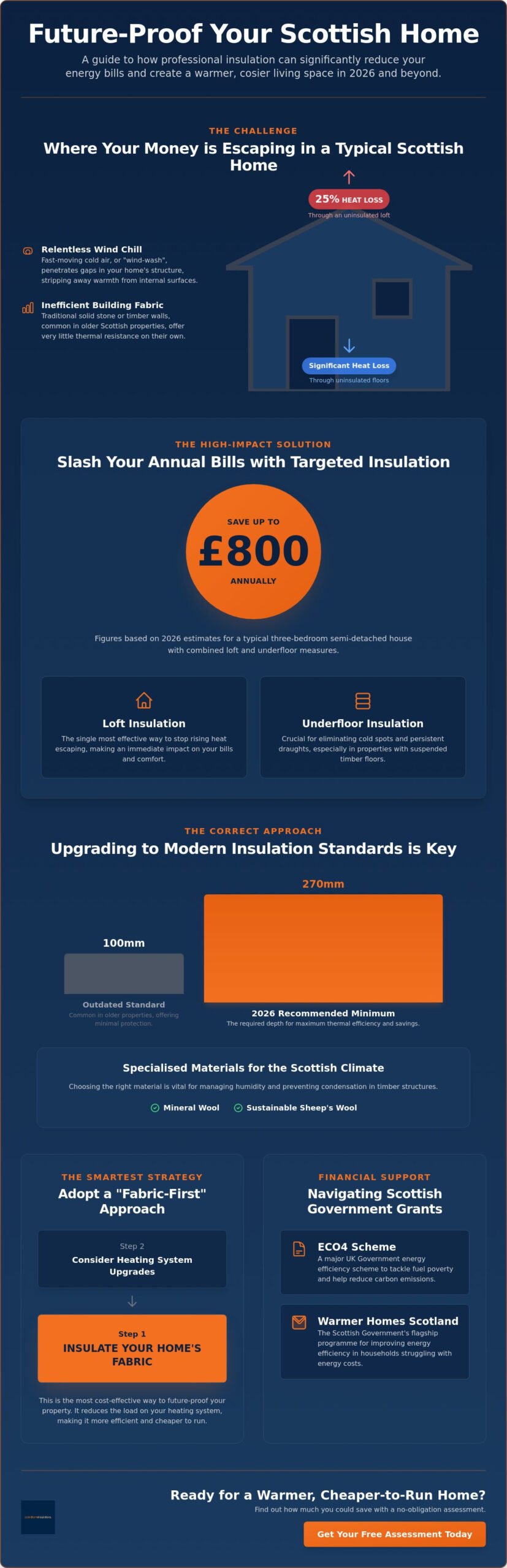
Without a robust thermal barrier, your home behaves like a sieve. Heat escapes through the path of least resistance, usually the roof and the ground floor. Improving the Energy efficiency in British housing is the only way to stop the constant cycle of your boiler firing up to replace heat that has already vanished. Industry data suggests an uninsulated loft can be responsible for 25% of a home’s total heat loss, forcing you to pay for energy you never actually get to use.
The Science of Heat Loss in Northern Climates
Heat moves in three ways: conduction through solid walls, convection via rising air, and radiation. In a Scottish winter, convection is the primary culprit. Warm air naturally rises, and if your loft isn’t properly sealed, that expensive air escapes into the atmosphere. Rural properties face an additional challenge called “wind-wash.” This occurs when fast-moving cold air penetrates the gaps in your building’s structure, literally stripping away the warmth from your internal surfaces and making your rooms feel draughty even with the radiators on full.
Identifying Your Home’s Thermal Weak Points
Finding where you’re losing money doesn’t always require expensive equipment. You can start by checking your Energy Performance Certificate (EPC). If your property is rated D or lower, you’re likely overpaying significantly for your energy. Homeowners in Fife and Edinburgh often find that traditional sash windows or gaps in floorboards are the main sources of draughts. You can feel these “cold spots” by simply running a hand along the skirting boards or near the loft hatch on a windy day.
The type of wall you have also dictates your savings potential. Solid stone walls, common in older Scottish builds, lose heat much faster than modern cavity walls. While cavity wall insulation can save between £200 and £300 annually, addressing solid walls or uninsulated lofts provides the most dramatic reduction in your monthly outgoings. Understanding these weak points is the first step toward a warmer, more affordable home.
High-Impact Structural Changes: Loft and Underfloor Insulation
When investigating how much can insulation save on energy bills scotland, the most significant returns come from addressing the top and bottom of your property. Heat naturally rises, but in many Scottish homes, it simply passes through the ceiling into an unheated attic space. Implementing professional loft insulation scotland is often the single most effective way to lower your annual outgoings. For a typical three-bedroom semi-detached house, combined measures can save between £450 and £800 per year according to 2026 estimates.
Traditional Scottish architecture often features “Room-in-Roof” designs, where attic spaces have been converted into bedrooms. These areas present a unique challenge because standard loft rolls cannot be used on the sloping ceilings. Without specialised treatment, these rooms become ice boxes in winter and saunas in summer. Addressing these structural gaps ensures your entire home remains usable and efficient throughout the year. Structural insulation usually pays for itself within just a few Scottish winters through direct energy savings.
Loft Insulation: Beyond the Standard 100mm
Many older properties still rely on a thin 100mm layer of insulation installed decades ago. By 2026 standards, 270mm is the minimum depth required for maximum thermal efficiency. If your current insulation is damp or compressed, it may require a full “strip and replace” to restore its performance. It’s vital to maintain essential roof ventilation whilst adding these thick layers of mineral wool. This prevents condensation from building up in the timber structure, which is a common concern in our humid climate. You can check the Scottish Government energy saving grants to see if you qualify for assistance with these upgrades.
Stopping Draughts with Underfloor Insulation
Your floorboards can act as a giant radiator for the cold ground beneath your home. In traditional Edinburgh tenements and detached homes in Fife, cold air often whistles through the gaps between joists. Professional under floor insulation eliminates these cold spots by creating a continuous thermal seal. We use breathable materials to protect the integrity of your timber floorboards, ensuring moisture doesn’t become trapped. This structural change doesn’t just lower bills; it transforms the physical comfort of your living space. If you’re tired of wearing extra layers indoors, it might be time to assess your home’s insulation needs with a specialist.
The financial impact of these structural changes is clear. Based on 2026 data, Scottish homeowners can expect the following annual savings:
- Loft Insulation: £150 to £300 per year.
- Cavity Wall Insulation: £200 to £300 per year.
- Solid Wall Insulation: £255 to £455 per year.
When you consider how much can insulation save on energy bills scotland, these figures represent a permanent reduction in your cost of living. Unlike temporary fixes, structural insulation protects your bank balance for decades to come.
Choosing the Right Materials for the Scottish Climate
Selecting the correct material is just as vital as the installation itself. In Scotland, where humidity levels are high, the choice between mineral wool and natural fibres can determine the longevity of your building’s structure. Many homeowners ask how much can insulation save on energy bills scotland, but the answer depends on how well the material manages moisture. Traditional stone buildings require breathable solutions to prevent damp from becoming trapped against the masonry. If moisture cannot escape, it can lead to structural decay and reduced thermal performance over time.
Professional-grade materials like sheep’s wool and mineral wool offer excellent fire safety ratings and will last for decades. Whilst synthetic options are common, there is a growing preference amongst Scottish homeowners for natural fibres that offer superior eco-credentials. High-performance insulation doesn’t just block heat; it protects the integrity of your home’s timber and stone. These materials are tested to rigorous industry standards, ensuring they won’t degrade or lose their thermal properties. Investing in quality materials means you won’t have to revisit your insulation for thirty years or more.
The Benefits of Sustainable Sheep’s Wool
Natural wool insulation is a favourite for heritage properties in Perth and Stirling due to its unique ability to manage humidity. Unlike synthetic alternatives, wool can absorb up to 33% of its weight in moisture without losing its thermal efficiency. It then releases this moisture when the air dries out, acting as a natural regulator for the home. This material is naturally fire-retardant and even helps to purify the air by absorbing harmful chemicals like formaldehyde. For owners of traditional stone cottages, sheep’s wool ensures the building fabric can “breathe,” preventing the damp issues common in our northern climate.
Mineral Wool: The All-Rounder for Modern Efficiency
Mineral wool remains a highly effective choice for large-scale loft projects due to its low thermal conductivity. It is designed to block the transfer of heat through the ceiling, keeping your living spaces warm whilst the attic remains cool. This cost-effectiveness makes it a popular option for those looking to maximise their return on investment. Our professional installers use specific techniques to eliminate “cold bridging.” This occurs when gaps in the insulation allow heat to bypass the thermal barrier, often around roof joists or hatches. By ensuring a continuous, thick layer of mineral wool, we provide a robust shield against the cold. You can explore various Scottish Government energy efficiency schemes to help fund these high-quality material upgrades.
Navigating Scottish Energy Grants and the ECO4 Scheme
Funding is the most common hurdle for homeowners looking to improve their property’s efficiency. When considering how much can insulation save on energy bills scotland, the initial investment for measures like solid wall or underfloor treatments can seem significant. However, the Scottish landscape offers some of the most robust financial support in the UK. The Energy Company Obligation (ECO4) is a primary driver for these improvements, requiring large energy suppliers to fund efficiency upgrades for low-income and vulnerable households until December 2026. In Scotland, this scheme is often delivered through local accredited installers who understand the specific requirements of our regional housing stock.
Home Energy Scotland acts as the central gateway for verifying your eligibility. They provide impartial advice and refer households to the most appropriate funding stream, whether that is a UK-wide obligation or a specific Scottish Government programme. By using a “whole-house” approach, these schemes ensure that your home receives a comprehensive package of measures designed to work together, rather than isolated fixes that may not deliver the maximum possible ROI.
Step-by-Step Guide to Claiming ECO4 Funding
Securing support through eco4 scotland follows a logical, structured process. First, you should check your Energy Performance Certificate (EPC) rating; properties rated D, E, F, or G are typically prioritised for deep retrofits. Next, verify if you receive qualifying means-tested benefits such as Pension Credit or Universal Credit. If you don’t receive benefits but your household income is under £31,000, you may still qualify through the “LA Flex” route. Finally, you must contact a certified Scottish installer to conduct a technical home survey. This survey confirms which structural changes, such as loft or room-in-roof insulation, will provide the greatest benefit to your specific building fabric.
Other Funding Routes: Warmer Homes Scotland
If you don’t meet the specific ECO4 criteria, the Warmer Homes Scotland scheme remains the flagship option for many. This government-funded programme supports vulnerable households with improvements that can exceed £10,000 in value, often covering the full cost of the work. Eligibility is extended to those with a combined household income of £36,000 or less, or those receiving certain disability benefits. Unlike standard loans, these are non-repayable grants, providing a secure way to upgrade your home without financial strain.
For homeowners who fall outside these thresholds, the Home Energy Scotland Grant and Loan Scheme offers a grant for up to 75% of the cost, capped at £7,500. Rural households can even access an additional £1,500 uplift. You can check your eligibility for Scottish insulation funding to see which of these insulation grants scotland can help you achieve the long-term savings your home deserves. By leveraging these funds, you can effectively answer the question of how much can insulation save on energy bills scotland by eliminating the upfront cost entirely.
Your Action Plan for a Warmer, Cheaper-to-Run Home
Achieving a thermally efficient home requires a strategic sequence of improvements. We advocate for a “Fabric First” approach, which means you should prioritise structural insulation before considering expensive boiler upgrades or heat pump installations. A high-efficiency heating system in a house with poor insulation is like a powerful engine in a car with no tyres; it simply cannot deliver the performance you expect. By sealing the building fabric first, you ensure that any heat generated by your system stays exactly where it belongs. This creates a stable thermal environment that reduces the workload on your boiler and helps you realise the full potential of how much can insulation save on energy bills scotland.
Professional installation is the foundation of these long-term savings. A specialist inspection often uncovers hidden heat leaks that the average homeowner might miss, such as gaps in the eaves or unsealed floor joists in traditional properties. Addressing these structural flaws provides a permanent solution that protects your household against future energy price volatility in Perth, Fife, and Stirling.
Quick Wins to Support Your New Insulation
While waiting for your professional upgrade, you can implement several immediate measures to support your home’s efficiency. The “Boiler Challenge” is a highly effective tactic; reducing the flow temperature on your combi boiler to around 60°C can significantly improve efficiency without compromising comfort. You should also consider using heavy, thermal-lined curtains to act as secondary barriers against window heat loss. If you own a spa, the same logic of thermal barriers applies; you can learn more about Northern Hot Tub Covers to discover how high-quality lids prevent heat from escaping. Draught excluders for internal doors are also effective. It’s vital to maintain clear ventilation paths to prevent moisture build-up whilst sealing air leaks, ensuring your home remains healthy and dry.
Why Local Expertise Matters in Scotland
Scottish properties have unique architectural quirks that demand a specialised touch. A standard installer might struggle with the specific challenges of Edinburgh tenements or the exposed stone of Fife cottages. Our team brings deep regional knowledge and holds essential certifications, including RECC and TrustMark. This ensures every project meets rigorous safety and quality standards. We take pride in helping our regional community achieve lasting domestic well-being through technical proficiency and reliable service. Using a certified professional gives you the security of insurance-backed guarantees and the peace of mind that your home is in safe hands.
Ready to secure your property against rising costs? Book your specialist free insulation inspection with ScotTherm Insulation today and take the first step toward a cheaper-to-run property in Perth, Fife, or Stirling. An expert survey will provide you with a clear roadmap to a warmer, more sustainable home.
Secure Your Home’s Thermal Future Today
Investing in high-performance insulation provides a permanent solution to the high cost of living in Scotland. By addressing the building fabric through specialised loft or underfloor treatments, you create a stable environment that resists the unique pressures of our northern climate. Whether you choose the natural breathability of sheep’s wool for a heritage cottage or mineral wool for a modern build, the result is a home that is easier to heat and significantly cheaper to run.
Many homeowners are pleasantly surprised when they discover how much can insulation save on energy bills scotland, particularly when the work can often be fully funded through the ECO4 scheme or Scottish Government grants. Transitioning from a draughty property to a cosy, energy-efficient sanctuary is a practical step that pays dividends for decades. You don’t have to tolerate cold spots or exorbitant heating bills any longer.
As Scottish-based local experts and ECO4 Scheme certified installers, we specialise in protecting traditional homes with breathable materials whilst ensuring compliance with the highest industry standards. Take the first step toward a more comfortable, cost-effective winter today. Get a Free Specialist Insulation Inspection and Personalised Savings Quote. A warmer, future-proofed home is well within your reach.
Frequently Asked Questions
How much can I actually save on my heating bills with loft insulation in Scotland?
A standard 270mm loft installation typically saves between £150 and £300 per year on heating bills according to 2026 data. When you consider how much can insulation save on energy bills scotland, the total impact for a three-bedroom semi-detached house can reach up to £800 annually when combined with underfloor treatments and draught-proofing. These savings are permanent and help protect your household against future price hikes.
Is it worth insulating under my floorboards if I already have carpets?
Yes, underfloor insulation is highly recommended even if you have carpets and underlay. Carpets provide surface comfort but don’t stop cold air from being pulled through the gaps in your floorboards by the “stack effect.” Insulating between the joists creates a robust thermal seal that eliminates these draughts, making your ground floor significantly warmer and more efficient to heat.
Do I qualify for free insulation under the ECO4 scheme in Scotland?
You may qualify for full funding if you receive means-tested benefits like Universal Credit or Pension Credit, or if your household income is under £31,000. The ECO4 scheme, which runs until December 2026, also requires your property to have a poor Energy Performance Certificate (EPC) rating, typically between D and G. Home Energy Scotland can verify your eligibility for these non-repayable grants.
Why is sheep’s wool recommended for older Scottish homes over cheaper materials?
Sheep’s wool is the superior choice for traditional stone and timber buildings because of its natural breathability. It can absorb and release moisture without losing its thermal performance, which is vital for preventing damp in the humid Scottish climate. This material also offers natural fire-retardant properties and acts as an air purifier, making it a favourite for heritage properties in Perth and Stirling.
Can I install loft insulation myself, or do I need a professional fitter?
Whilst you can buy rolls for a DIY project, professional installation is necessary to access government grants and ensure your home meets 2026 building standards. Professionals have the expertise to manage complex “Room-in-Roof” spaces and ensure that essential eaves ventilation isn’t blocked. Incorrect DIY installation can lead to condensation issues or reduced thermal efficiency if “cold bridging” occurs.
Will adding thick insulation cause damp or mould in my roof space?
Thick insulation only causes issues if the roof’s ventilation is restricted. Professional fitters use specific baffles and vents to ensure that air continues to circulate through the loft space whilst the living areas below stay warm. This balance is critical in Scotland to prevent moisture from condensing on cold timber surfaces, which is how mould typically begins to grow.
What is the current standard thickness for loft insulation in 2026?
The current standard for maximum thermal efficiency is 270mm of mineral wool or equivalent natural fibres. Many older Scottish homes still have the original 100mm layer installed decades ago, which is no longer sufficient to prevent significant heat loss. Upgrading to the modern standard is one of the fastest ways to see a reduction in your monthly energy outgoings.
How long does a professional insulation installation typically take?
Most standard loft or underfloor projects are completed within one to two days. The process is designed to be non-intrusive, and because we use clean, professional-grade materials, there is very little disruption to your daily routine. Once the work is finished, the thermal benefits are immediate, and your home will begin retaining heat much more effectively from the first evening.