
What if the primary reason your Fife home feels cold isn’t your heating system, but the invisible river of icy air flowing beneath your feet? You’ve likely topped up your loft insulation and kept the radiators on high, yet those persistent draughts through the floorboards continue to drive up your monthly outgoings. It’s a common frustration for many in Scotland who worry that installing the wrong materials might trap moisture and cause timber rot. Finding expert underfloor insulation installers in Fife is the essential first step to ensuring your home remains both warm and structurally sound.
We understand that you want a ground floor that feels comfortable underfoot without the fear of compromising your property’s integrity. This article will show you how professional installation can eliminate biting draughts and slash your energy bills. You’ll discover why breathable materials like sheep’s wool are often the superior choice for our local climate. We’ll also preview the latest Scottish building regulations, including the 0.18 W/m²K U-value requirement; we’ll even explain how the Home Energy Scotland grant can provide up to £1,500 towards your project costs to make your home more efficient.
Key Takeaways
- Understand how the ‘stack effect’ pulls cold air through floor gaps and why thermal barriers are the most effective way to stabilise your home’s temperature.
- Learn why material breathability is critical for the longevity of your floor joists and how to avoid the risks associated with interstitial condensation.
- Discover why the most reliable underfloor insulation installers Fife provides use the ‘crawler’ method to protect your home without disturbing your décor.
- Check your eligibility for the ECO4 scheme or the 0% VAT rating to significantly reduce the cost of your energy-saving improvements.
- Recognise the importance of choosing a dedicated insulation expert over a general builder to ensure your installation meets the latest Scottish building standards.
What is Underfloor Insulation and Why Does Your Fife Home Need It?
Underfloor insulation is the technical process of installing high-performance thermal barriers directly beneath your ground-floor floorboards. Its primary purpose is to stop precious heat from escaping into the ventilated void below your home. For many local residents, understanding What is Underfloor Insulation is the first step toward solving the mystery of why their homes feel cold despite constant heating. In Fife, our regional housing stock is heavily defined by Victorian and Edwardian properties. These buildings almost always feature suspended timber floors which, whilst architecturally significant, are prone to severe draughts that traditional loft insulation simply cannot fix. Professional underfloor insulation installers in Fife specialise in sealing these subterranean gaps to transform your property’s internal climate.
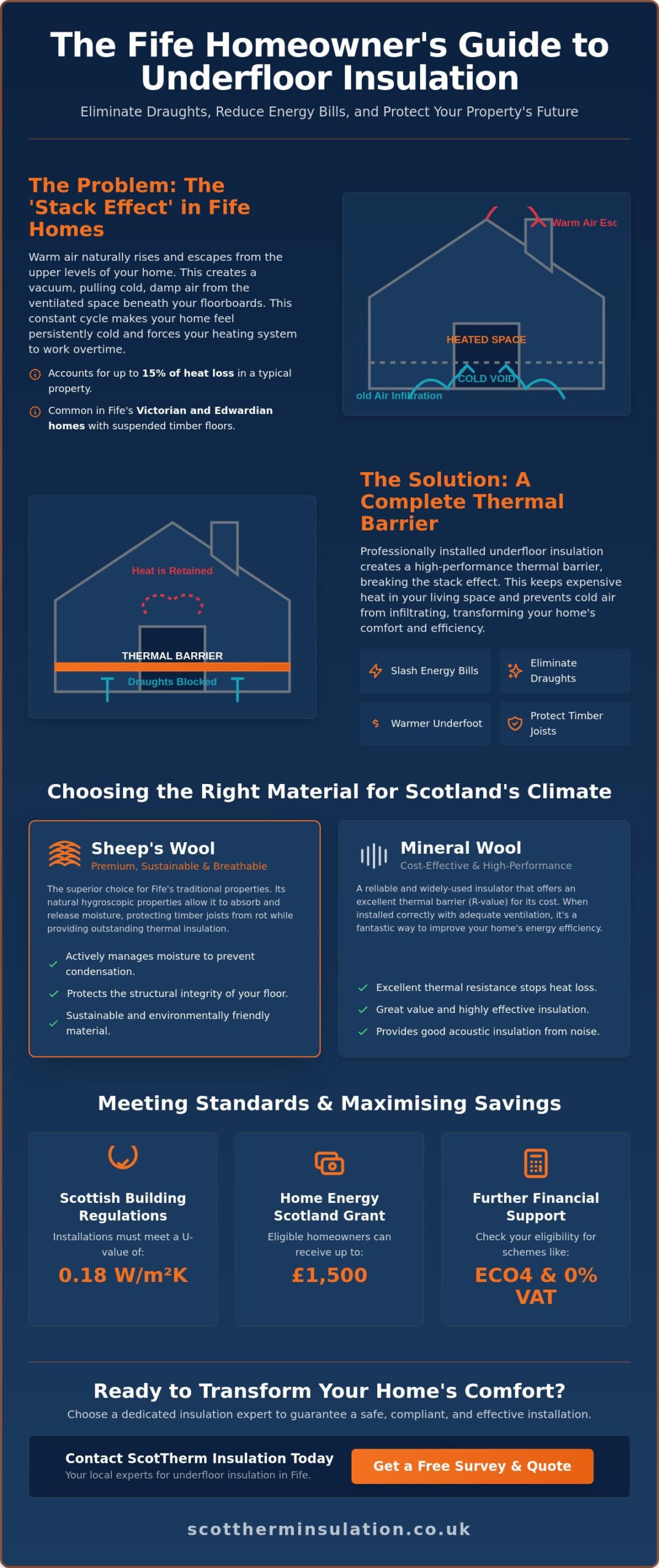
You’ve likely felt the biting coastal wind that’s common across the East Neuk and St Andrews. When this wind hits your home, it triggers the “stack effect.” As warm air naturally rises and exits through your roof or upper storeys, it creates a vacuum that pulls cold air in from the lowest point. In Fife’s traditional homes, this means icy air is sucked through air bricks and up through the gaps in your floorboards. This constant cycle forces your central heating system to work twice as hard to maintain a steady temperature. By insulating the floor, you break this cycle and create a stable, warm base that keeps heat where it belongs.
The Science of Heat Loss Through Floors
Uninsulated floors act as a “thermal bridge” between your living space and the cold earth below. Even if your walls are thick and your windows are double-glazed, a bare floor allows heat to bleed out through conduction. It’s the scientific reason your feet often feel icy even when your thermostat reads a comfortable 21 degrees. High-quality insulation creates a complete thermal envelope for the building. This ensures that the energy you pay for stays within the room, significantly reducing the workload on your boiler and creating a more consistent level of domestic comfort.
Identifying Your Floor Type: Suspended vs. Solid
Before you contact underfloor insulation installers in Fife, you should identify which floor type you have. If your home has air bricks on the external walls or the floor sounds hollow when you tap it, you likely have a suspended timber floor. These voids are the ideal candidates for insulation because materials like mineral wool or sheep’s wool can be fitted between the joists. Solid concrete floors are common in newer developments but don’t offer the same easy access. For the majority of Fife’s heritage properties, focusing on suspended timber floors provides the highest return on investment by instantly eliminating the most aggressive draughts in the home.
Choosing the Right Materials: Sheep’s Wool vs. Mineral Wool
Selecting the correct material is the most critical decision for the long-term health of your property. Whilst thermal performance is vital, the longevity of your floor joists depends on effective moisture management. Experienced underfloor insulation installers in Fife understand that our coastal humidity requires materials that can breathe. Using non-breathable, synthetic alternatives can trap moisture against the timber. This leads to interstitial condensation, which is a primary cause of timber rot in traditional Scottish homes. By choosing breathable fibres, you protect the structural integrity of your floorboards whilst creating a warmer living environment.
At ScotTherm, we prioritise high-performance mineral wool and sustainable sheep’s wool for their distinct advantages. Both materials offer excellent R-values, which measure a material’s resistance to heat flow. A higher R-value means better thermal retention and lower energy requirements. Whilst mineral wool provides a consistent, cost-effective barrier, sheep’s wool offers unique hygroscopic properties. This means it can absorb and release moisture without losing its insulating power. This dual benefit of heat retention and moisture control is why many homeowners seek professional Grants and Savings to upgrade their property’s thermal envelope.
The Benefits of Sustainable Sheep’s Wool
Sheep’s wool is the premium choice for Fife’s Victorian and Edwardian housing stock. Its natural breathability allows it to manage moisture levels under the floorboards by wicking dampness away from the timber joists. It is an eco-friendly material with remarkably low embodied energy, often being locally sourced to reduce its carbon footprint. For those living in heritage properties, wool insulation provides the peace of mind that the building’s fabric is being preserved using traditional, sustainable methods.
High-Performance Mineral Wool Solutions
Mineral wool remains the industry standard for cost-effective thermal performance. It is exceptionally effective at preventing heat loss and features non-combustible properties that improve the fire safety of your ground floor. Our underfloor insulation installers in Fife use a “friction-fitting” technique with mineral wool batts. By cutting the material slightly wider than the joist spacing, we ensure the batts stay in place through tension alone. This eliminates gaps and prevents the cold bypass that often occurs with poorly fitted alternatives. If you want to find the most efficient solution for your home, our local Fife specialists can provide a tailored recommendation based on your floor’s condition.
The Installation Process: What Fife Homeowners Should Expect
Professional underfloor insulation installers in Fife prioritise a clean, non-invasive approach to home energy upgrades. Unlike general builders, we look for existing access points like cellar entries or small hatches tucked under the stairs. The “Crawler” method is our preferred technique for most traditional properties. This involves our technicians entering the subterranean void from below, which means your carpets and heavy furniture stay exactly where they are. It’s an efficient way to upgrade your home’s thermal performance without the chaos of a major renovation.
Sometimes, a property lacks a sufficient void for a crawler to navigate. In these specific cases, we carefully lift a small number of floorboards to gain access from above. We understand the value of your original timber and work with precision to ensure every board is replaced securely. Throughout the entire process, we maintain strict adherence to the Energy Saving Trust guide on floor insulation. This ensures your home meets national standards for thermal efficiency whilst protecting the structural health of the building.
A common concern for Fife residents is the risk of damp. We never block your external air bricks. These are essential for keeping the timber joists dry and healthy. Our installers ensure that insulation is fitted tightly between the joists whilst leaving the necessary airflow paths clear. This careful balance of warmth and ventilation is what protects your home from the moisture risks mentioned earlier. We take pride in leaving every site exactly as we found it, but with a significantly warmer ground floor.
Step 1: The Technical Site Survey
Every project begins with a detailed assessment of your home’s unique layout. We measure the void’s depth and check the health of your existing timber joists to ensure they are suitable for insulation. We also map out any electrical cables or water pipes. These services often need lagging or specific clearance to remain safe and accessible. Once the survey is complete, you receive a bespoke quote based on the exact square metreage of your property.
Step 2: Securing the Insulation
We use high-tension netting or breathable membranes to secure the mineral wool or sheep’s wool batts. This prevents the material from sagging over time. We pay special attention to the “wall-to-floor” junction, as this is where the most aggressive draughts enter the living space. By sealing these perimeters, we eliminate the cold spots that often plague traditional ground floors. Our specialist underfloor insulation installers in Fife perform final checks to ensure the material isn’t compressed, as squashing the fibres would reduce their R-value and effectiveness.
Grants and Savings: Making Underfloor Insulation Affordable in 2026
Financial barriers shouldn’t prevent you from enjoying a warmer, more efficient home. Fortunately, current legislation and regional funding programmes make 2026 an ideal time to invest in your property’s thermal health. One of the most immediate benefits is the zero rate of VAT on the installation of energy-saving materials. This government initiative is set to run until 31 March 2027, effectively reducing the final invoice for your project by 20% compared to standard home improvements. When you work with professional underfloor insulation installers in Fife, this saving is applied directly to your quote, making high-performance materials like sheep’s wool or mineral wool more accessible than ever before.
With 24.6% of households in Scotland currently in fuel poverty, the drive to reduce energy outgoings has never been more urgent. Underfloor insulation provides a high return on investment because it addresses the “stack effect” mentioned earlier, which is responsible for significant heat loss in traditional Fife cottages and tenements. By sealing the ground floor, you reduce the demand on your heating system, leading to lower monthly bills. Most homeowners find that the combination of lower energy costs and available grant funding allows the installation to pay for itself within a relatively short period. Our team helps you navigate these financial options to ensure you maximise every available penny of support.
ECO4 Funding for Fife Residents
The Energy Company Obligation (ECO4) scheme is a major pillar of support for energy efficiency in Scotland, and it is currently active until December 2026. This scheme often provides fully funded insulation for households that meet specific income-based criteria or receive certain benefits. If you don’t meet the standard national criteria, you may still qualify through “LA Flex” (Local Authority Flexibility) referrals, where Fife Council identifies residents who would benefit most from improved thermal comfort. To see if your property qualifies for this non-repayable support, you can view our ECO4 Scotland guide for a full eligibility checklist.
Home Energy Scotland (HES) Support
Home Energy Scotland remains a vital resource for local homeowners, offering a blend of grants and interest-free loans. Currently, residents can access grant funding of up to £1,500 for insulation measures, with an additional £500 available as an interest-free loan if required. To access this support, a professional technical survey is usually the first mandatory step. Many Fife residents choose to maximise their claim by combining their project with loft insulation scotland upgrades, creating a complete thermal seal from the ground up. If you are ready to secure your funding, we recommend you contact our Fife specialists to arrange your initial assessment and start your application.
Why Choose ScotTherm as Your Underfloor Insulation Installers in Fife?
Choosing a contractor for your home is a matter of trust. As dedicated underfloor insulation installers in Fife, we provide a level of specialisation that general builders often cannot match. Our teams live and work in the communities they serve, from the historic streets of Dunfermline to the coastal homes of Kirkcaldy and St Andrews. This regional presence isn’t just a badge of pride; it ensures we understand the specific challenges posed by the Fife climate and the diverse range of Scottish building styles. We focus exclusively on insulation services, meaning our technical proficiency is concentrated entirely on making your home warmer and more efficient. We aren’t generalists or gas engineers; we are insulation experts who prioritise the physics of heat retention.
We maintain a strict commitment to the structural longevity of your property. As discussed in previous sections, using the wrong materials can lead to timber decay. We prioritise breathable solutions, such as mineral wool and sheep’s wool, which allow your floor joists to remain dry and healthy. Our transparent surveys are designed to provide honest assessments rather than high-pressure sales. We look at the long-term health of your home, ensuring that every recommendation we make is both safe and effective. By focusing on quality-conscious installations, we provide the peace of mind that comes from using certified professionals who understand the local housing stock.
Our Fife Installation Teams
Our technicians are familiar with everything from traditional coastal cottages to modern new builds. We operate a strict “leave no trace” policy, which means we treat your home with the utmost respect. Whether we are accessing the underfloor void via the crawler method or lifting floorboards, we ensure the workspace is as clean when we leave as it was when we arrived. This disciplined approach has earned us verified reviews from local customers who have successfully transformed their icy ground floors into comfortable living spaces. Our regional accountability means we take pride in the tangible impact our work has on the Fife community, ensuring every project meets our high standards of excellence.
Booking Your Free Fife Home Survey
Requesting an assessment is a straightforward process. You can contact us via our website or telephone to arrange a convenient time for a visit. The 30-minute technical assessment is comprehensive. We check for void depth, timber condition, and ventilation requirements without any obligation on your part. This professional consultation provides the specific data you need to make an informed decision about your home’s energy future. We will even discuss how your project aligns with current Scottish building regulations to ensure full compliance. Book your specialist underfloor insulation survey in Fife today and take the first step toward a draught-free home.
Secure a Warmer Future for Your Fife Home
Upgrading your ground floor is one of the most effective ways to stabilise your home’s temperature and reduce the pressure on your heating system. By addressing the draughts caused by the stack effect, you transform your living environment from a cold, breezy space into a consistently cosy sanctuary. The results are immediate. Choosing breathable materials like sheep’s wool is essential for protecting your timber joists, whilst the current 0% VAT rating and Scottish grant schemes make these high-performance improvements more affordable than ever.
As TrustMark Registered Installers, we combine technical proficiency with deep regional knowledge. Our local Fife-based installation teams are specialists in breathable sheep’s wool and mineral wool solutions, ensuring every project meets the highest industry standards for safety and efficiency. If you’re ready to stop heat loss and start saving, you need the most dependable underfloor insulation installers fife can provide to guide you through the process.
Get a Free Quote from Fife’s Underfloor Specialists
We look forward to helping you create a more comfortable, energy-efficient home that your family can enjoy for years to come.
Frequently Asked Questions
How much can I save on my energy bills with underfloor insulation in Fife?
Energy savings vary based on your property’s size and current efficiency, but insulating your ground floor can significantly lower your monthly outgoings. By stopping the stack effect from pulling icy air through your floorboards, you reduce the workload on your central heating system. This is a vital step for the 24.6% of Scottish households currently facing fuel poverty, as it creates a more stable internal temperature that requires less energy to maintain.
Do I need to lift my floorboards for the insulation to be installed?
You don’t always need to lift your floorboards to complete the project. Professional underfloor insulation installers in Fife prefer the crawler method, which involves accessing the void through existing hatches or cellar entries. This approach ensures your carpets and furniture remain undisturbed. If your home lacks a subterranean void, our team will carefully lift a small selection of boards to install the material from above with minimal disruption.
Will underfloor insulation cause my floor joists to rot?
Insulation won’t cause timber decay if you use breathable materials and maintain proper ventilation. We prioritise sheep’s wool and mineral wool because these fibres allow moisture to escape rather than trapping it against the wood. Our technicians also ensure that external air bricks remain completely clear. This allows the necessary airflow to circulate beneath the insulation, keeping your joists dry and structurally sound for the long term.
Can I get a grant for underfloor insulation in Scotland in 2026?
Yes, several funding streams remain active throughout 2026 to help with installation costs. The ECO4 scheme is available until December 2026 for eligible households, whilst Home Energy Scotland provides grants of up to £1,500 for insulation measures. You can also take advantage of the 0% VAT rate on energy-saving materials, which is scheduled to run until March 2027. These incentives make it a high-value time to upgrade your home’s efficiency.
How long does it take to insulate a standard ground floor?
A standard ground floor installation is typically completed within one to two days. The exact duration depends on the total square metreage of your home and the complexity of the underfloor access. Our teams are experienced in working within the specific layouts of Fife’s traditional cottages and modern villas, ensuring the work is finished efficiently without compromising on the precision of the thermal seal.
Is sheep’s wool better than mineral wool for underfloor insulation?
Both materials offer excellent thermal resistance, but sheep’s wool is often the preferred choice for Fife’s older housing stock. It possesses natural hygroscopic properties, meaning it can manage moisture levels more effectively in damp coastal climates. Mineral wool remains a fantastic, cost-effective alternative that provides exceptional fire resistance and high R-values. We assess your property’s specific needs during our survey to recommend the most suitable material for your floor type.
What is the minimum crawl space required for an underfloor installation?
For our technicians to safely use the crawler method, we generally require a minimum clearance of 400mm to 500mm beneath the joists. This space allows us to navigate the void and secure the insulation batts correctly using netting or membranes. If your crawl space is shallower than this, we will discuss an alternative approach, such as lifting floorboards, to ensure a comprehensive and safe installation for your property.
Does underfloor insulation help with soundproofing between floors?
Underfloor insulation provides a significant acoustic benefit by dampening airborne sound. The dense structure of mineral wool or sheep’s wool batts acts as a sound absorber, reducing the transfer of noise from the void below into your living areas. Whilst its primary purpose is thermal retention, many homeowners notice a quieter, more peaceful atmosphere on their ground floor immediately after the installation is complete.