
What if the very stone walls that give your Scottish home its character are also the primary reason your heating bills remain sky high? For many homeowners, the cost to insulate a stone house scotland feels like a moving target, especially whilst balancing modern comfort with the need to protect historic masonry. You likely already know that traditional solid walls require a specialist touch to prevent trapped moisture and structural decay.
It is a common frustration to receive conflicting advice on how to treat heritage buildings without causing damp. This guide provides clarity by detailing the essential factors that influence your investment, from material choices like breathable sheep’s wool to the latest 2026 grant schemes. You’ll discover how to achieve a draught-free, energy-efficient home that maintains its structural integrity for generations. We cover everything from current VAT exemptions to the specific benefits of high-performance loft and underfloor solutions tailored for the unique Scottish climate. By the end, you’ll have a clear path toward a warmer home and lower monthly costs.
Key Takeaways
- Understand why traditional stone masonry like granite or sandstone requires a specialised financial approach compared to modern cavity wall properties.
- Learn how to accurately estimate the cost to insulate a stone house scotland by accounting for wall thickness and the current condition of your masonry.
- Discover why choosing breathable materials such as sheep’s wool is essential for preventing structural damp and avoiding future repair bills.
- Identify the 2026 funding routes, including ECO4 and Home Energy Scotland loans, that can help reduce your upfront investment.
- Find out why prioritising room-in-roof and loft insulation offers the fastest return on investment for traditional Scottish cottages.
Understanding the Cost Factors for Scottish Stone Properties
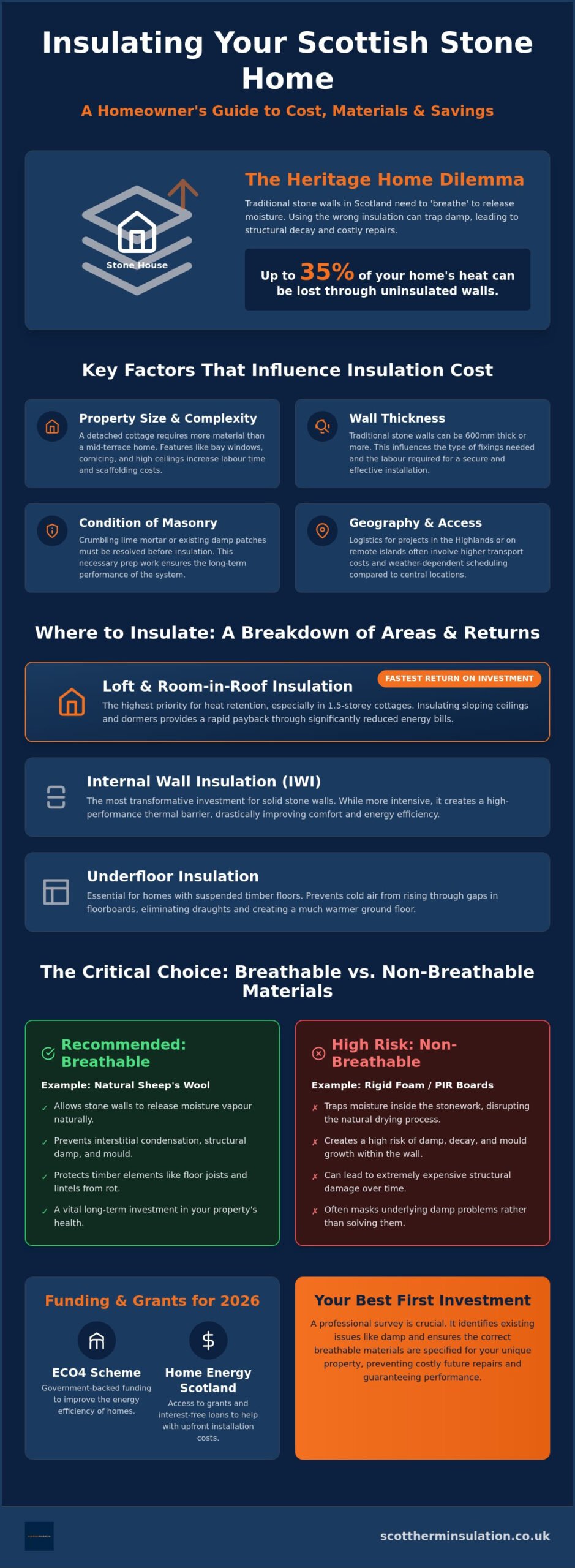
Traditional Scottish homes built from sandstone, granite, or whinstone require a distinct financial strategy compared to modern cavity-wall properties. When calculating the cost to insulate a stone house scotland, you aren’t just paying for materials; you’re investing in the preservation of a structural legacy. These solid walls behave differently than brick. They absorb moisture from the environment and release it through evaporation. If you disrupt this cycle with the wrong materials, you risk structural damp and long-term decay.
Wall thickness is a major variable. Many traditional properties feature walls that are 600mm thick or more, which influences the choice of fixings and the labour required for a secure installation. The condition of the mortar also plays a role. If the lime mortar is crumbling, it must be addressed to ensure the insulation layer performs as intended. Geography adds another layer of complexity. Logistics for a project in the Highlands or on a remote coastal site often involve higher transport costs and weather-dependent scheduling compared to a central-belt terrace.
The hidden cost of ignoring breathability is perhaps the most significant risk. Using non-breathable foam or rigid boards can trap moisture within the stone, leading to rot in floor joists and timber lintels. When selecting building insulation materials, prioritising natural fibres like sheep’s wool ensures the building can breathe, protecting your investment from expensive future repairs. Research indicates that approximately 35% of a home’s heat is lost through uninsulated walls, making the choice of material a critical factor in both comfort and building health.
Property Size and Architectural Complexity
The physical footprint of your home dictates the volume of materials, but architectural features often have a larger impact on the final quote. A detached cottage requires full coverage, whereas a mid-terrace tenement only needs work on the front and rear elevations. Features like bay windows, ornate cornicing, and high ceilings increase labour time. Higher stone walls also necessitate extensive scaffolding, which is a fixed cost that scales with the height and accessibility of the property.
The Condition of Existing Masonry
Before any insulation is installed, the substrate must be sound. Repointing with traditional lime mortar is often a necessary prerequisite to prevent water ingress. If your home has existing damp patches, these must be professionally resolved first. Internal finishes also matter. Many Scottish homes still feature original lath and plaster, which may need to be carefully managed or removed before internal wall insulation is applied. Addressing these issues upfront prevents the insulation from merely masking a deeper structural problem.
Breaking Down Installation Costs by Area: Walls, Lofts, and Floors
When evaluating the total cost to insulate a stone house scotland, it’s helpful to categorise work by the level of disruption and the speed of financial return. Internal Wall Insulation (IWI) represents the most transformative but intensive investment for stone walls as it necessitates the removal of internal finishes to install high-performance, breathable thermal barriers. While wall work involves a larger scope, loft and floor improvements often provide a more immediate impact on your daily comfort for a smaller initial outlay.
Traditional 1.5 storey cottages, common across the Scottish landscape, present unique architectural challenges. These properties often feature room-in-roof configurations where bedrooms are built directly into the attic space. Insulating these sloping ceilings and dormer windows is a high-value priority because heat escapes rapidly through these thin, uninsulated surfaces. Similarly, addressing the ground floor is essential for homes with suspended timber floors; you’re likely losing significant heat as icy air rises through the gaps between original floorboards.
Loft and Room-in-Roof Considerations
The choice of material significantly influences your budget and long-term results. While standard mineral wool is a cost-effective choice, many homeowners now prioritise premium sustainable options like sheep’s wool for its superior moisture-handling properties in heritage buildings. Professional loft insulation scotland provides the fastest ROI, often paying for itself within a few years through reduced energy demand. When planning, remember to factor in the cost of loft boarding and ladders if you require functional storage space. Many projects are supported by the Home Energy Scotland Grant and Loan, which helps homeowners invest in higher-quality, sustainable materials.
Suspended Timber Floor Insulation
Installing under floor insulation is the most effective way to eliminate persistent floor-level draughts that make Scottish winters feel so harsh. The primary cost drivers include the height of the crawl space and the structural integrity of the existing joists. If our surveyors identify damp or timber rot, these issues must be treated before the insulation is fitted. Over the long term, sealing the ground floor leads to significant savings on heating bills and creates a noticeably warmer living environment. To discover which area of your home should be prioritised first, you can view our full range of specialist insulation services here.
Breathable vs Non-Breathable Materials: The Long-Term Financial Impact
Selecting materials based solely on the lowest quote is a common pitfall that often results in significant financial loss. Whilst non-breathable foam boards may seem like a bargain, they frequently trap moisture against the stone, leading to thousands of pounds in damp repairs and timber rot. In traditional masonry, moisture must be allowed to migrate through the wall; blocking this path causes interstitial condensation. This is why the true cost to insulate a stone house scotland includes the long-term protection of the building’s fabric.
By following expert advice on insulating traditional buildings, homeowners can avoid the “sealing” mistake. Natural materials manage humidity levels dynamically, which preserves the longevity of original floor joists and roof timbers. Investing in the right material now prevents the structural decay that often follows “quick-fix” synthetic installations. When we assess a property, we prioritise materials that work in harmony with the stone rather than fighting against it.
The Case for Sustainable Sheep’s Wool
Many specialists consider wool insulation the gold standard for stone properties due to its unique cellular structure. Sheep’s wool can absorb and release moisture without losing its thermal efficiency, effectively acting as a natural dehumidifier in the humid Scottish climate. Unlike synthetic alternatives that may degrade or sag over time, high-quality wool maintains its loft and performance for decades. Beyond the financial logic, natural fibres offer unquantifiable value through air purification, as they naturally absorb harmful chemicals like formaldehyde, creating a healthier living environment for your family.
Mineral Wool and High-Performance Synthetics
For projects where budget is a primary constraint, mineral wool offers a cost-effective middle ground. It provides better breathability than rigid foam boards whilst remaining more affordable than premium sheep’s wool. However, success depends on precision. Correct vapour control layers must be priced into the quote to ensure moisture doesn’t become trapped within the insulation layer. We always advise against sealing a stone house too tightly; traditional buildings rely on a certain level of air exchange to stay healthy. Our team ensures that every installation balances thermal performance with the essential ventilation required to protect your home’s structural integrity.
Grants and Funding: Reducing the Cost of Insulation in 2026
Reducing the cost to insulate a stone house scotland often depends on matching your property’s specific needs with the right government-backed scheme. In 2026, the funding landscape is highly structured, focusing on the most energy-inefficient homes. For many Scottish households, the ECO4 scheme remains the flagship opportunity, potentially covering the entire cost of a whole-house insulation package. This initiative is particularly beneficial for traditional stone properties, which often carry low EPC ratings of D through G due to their solid wall construction. Understanding the total cost to insulate a stone house scotland becomes much easier once you factor in these significant financial supports.
The Warmer Homes Scotland scheme provides full funding for eligible households with an income of £36,000 or less. For those who don’t meet these low-income criteria, the Home Energy Scotland (HES) loan and cashback offer another robust route. These interest-free loans make the upfront investment manageable by spreading the cost over several years. High-value insulation grants scotland are specifically designed to bridge the gap between standard modern retrofits and the specialised requirements of heritage buildings.
Navigating the ECO4 Application Process
Securing eco4 scotland funding involves a clear validation process. First, verify your property’s EPC rating. Because stone houses lose heat so rapidly, they often fall into higher funding tiers, making them prime candidates for comprehensive upgrades. Working with an approved Scottish installer is essential, as they manage the complex grant paperwork on your behalf. We recommend starting with a professional survey to confirm your home’s technical requirements. This ensures the chosen materials protect the building’s structural integrity whilst improving comfort.
Local Authority Flexible Eligibility (LA Flex)
If you don’t qualify via the standard benefit route, the LA Flex scheme provides an alternative. Local councils in areas like Fife, Perth, and Edinburgh identify residents who are vulnerable to fuel poverty or on a modest income. This allows for a more nuanced approach, combining grants with private investment to achieve a warm, draught-free home. With the ECO4 deadline currently extended to the end of December 2026, now is the time to finalise your application. You can check your eligibility for insulation funding with our specialist team today.
Professional Installation: Why a Specialist Survey is Your Best Investment
Attempting a DIY approach to insulating traditional masonry often leads to costly structural errors. Stone properties require a delicate balance of thermal resistance and moisture management that standard retail products simply cannot provide. When calculating the total cost to insulate a stone house scotland, you must account for the technical precision required to avoid trapping condensation within your walls. A professional installation ensures that every vent, joist end, and corner is treated with the correct material, preserving your home’s health whilst drastically reducing heat loss.
A professional thermal performance survey is the foundation of a successful project. During this assessment, our specialists use advanced tools to identify specific cold spots and existing moisture issues that might be hidden behind lath and plaster. We examine the thickness of your sandstone or granite walls and check the condition of your timber floor joists. This level of detail allows us to provide a fixed, transparent quote that reflects the actual needs of your property rather than a vague estimate. Beyond the immediate comfort, a professional certificate of installation provides essential evidence for your home’s Energy Performance Certificate (EPC), adding tangible value if you ever decide to sell.
The ScotTherm Approach to Scottish Homes
Our team brings deep regional expertise to every project across the Central Belt and beyond. We understand the specific architectural challenges of Edinburgh tenements, where space is at a premium, as well as the exposed nature of rural stone cottages in Fife and Perthshire. We only use certified, high-performance materials like sheep’s wool and specialised mineral wool to ensure your home remains breathable and warm. To keep your daily routine on track, we organise every project with a focus on efficiency. We manage the logistics of material delivery and site preparation to minimise disruption to your home life, ensuring a clean and professional finish.
Next Steps: Booking Your Assessment
Preparing for an insulation survey is straightforward. Clear access to your loft hatch and any crawl spaces under your floorboards allows our surveyors to conduct a thorough inspection. It is vital to move away from “one-size-fits-all” estimates that ignore the unique character of Scottish stone. Every house has its own history and structural quirks that dictate the best insulation strategy. By choosing a bespoke assessment, you ensure that your investment is protected by technical expertise and industry-standard guarantees. To begin your journey toward a more efficient home, Contact our team for a professional insulation survey today and receive a tailored plan for your property.
Securing a Warmer Future for Your Traditional Home
Your traditional stone home is a significant asset that deserves protection from the harsh elements. We have explored how the cost to insulate a stone house scotland represents a strategic investment in both your daily comfort and the building’s long-term structural health. By prioritising breathable materials and leveraging 2026 funding routes like ECO4, you can eliminate draughts whilst preserving the integrity of your masonry. It’s about finding the right balance between modern efficiency and heritage preservation.
As Scottish-based experts since 2022, ScotTherm specialises in sustainable sheep’s wool solutions that manage moisture naturally. Our status as approved ECO4 installers means we can help you navigate the application process to maximise your funding access. We provide the technical proficiency required to ensure your retrofit is safe, effective, and durable. Book your specialist insulation survey with ScotTherm today to receive a bespoke assessment tailored to your property. You don’t have to settle for a cold home; a more efficient, cost-effective future is well within reach.
Frequently Asked Questions
Is it worth insulating a stone house in Scotland?
Yes, it is a highly effective investment because uninsulated solid stone walls account for approximately 35% of a home’s total heat loss. Improving the thermal envelope of your property not only reduces monthly outgoings but also protects the structural masonry from the extreme temperature fluctuations common in the Scottish climate. A well-insulated stone home is significantly more comfortable, easier to heat, and holds higher value on the property market.
Does internal wall insulation cause damp in stone houses?
Internal wall insulation only causes damp if non-breathable materials or incorrect vapour barriers are used. Traditional stone buildings need to breathe; using natural fibres like sheep’s wool allows moisture to migrate safely through the walls. A specialist survey ensures the installation is designed to prevent interstitial condensation and protect your timber floor joists from moisture-related decay.
How much can I save on my heating bills by insulating my stone cottage?
Homeowners can typically save between £630 and £730 on annual energy bills by insulating the walls, loft, and floors of a standard three-bedroom semi-detached property. These savings are particularly noticeable in stone cottages where solid walls offer very little natural thermal resistance against the wind and rain. Loft insulation alone often pays for itself through these energy savings in as little as two years.
Can I get a grant for insulating a traditional stone property?
Yes, several grants are available in 2026, including the ECO4 scheme which can cover the entire cost to insulate a stone house scotland for eligible households. Warmer Homes Scotland and interest-free loans from Home Energy Scotland also support heritage retrofits for those on modest incomes or in fuel-poor areas. Eligibility usually depends on your household income, the property’s current EPC rating, and your primary heating source.
Which is better for stone walls: sheep’s wool or mineral wool?
Sheep’s wool is the superior choice for stone walls due to its natural ability to absorb and release moisture without losing thermal efficiency. It acts as a buffer in the humid Scottish climate, protecting original timbers from rot better than any synthetic material. Mineral wool is a reliable, cost-effective alternative that provides excellent fire resistance, provided it is installed with the correct vapour control layers to manage moisture migration.
How long does it take to install internal wall insulation?
A standard internal wall insulation project typically takes between one and two weeks to complete, depending on the number of rooms and architectural complexity. This timeframe includes the removal of existing finishes, the installation of the thermal barrier, and the final plastering. We organise our projects to minimise disruption, often focusing on one area at a time to keep your home functional whilst work is underway.
Do I need planning permission to insulate my stone house in Edinburgh?
You generally don’t need planning permission for internal wall insulation, but listed buildings or properties in conservation areas often require Listed Building Consent. In historic centres like Edinburgh, it is essential to check with the local planning authority before altering the internal fabric of a heritage property. Our surveyors can often provide guidance on these regional requirements during your initial assessment.
What is the most cost-effective way to insulate an old stone building?
The most cost-effective starting point is professional loft insulation, which offers the fastest return on investment and immediate heat retention. After the loft, addressing suspended timber floors is the next priority for stopping persistent ground-level draughts. When calculating the total cost to insulate a stone house scotland, prioritising these two areas often provides the most significant comfort improvements for the lowest initial outlay.