
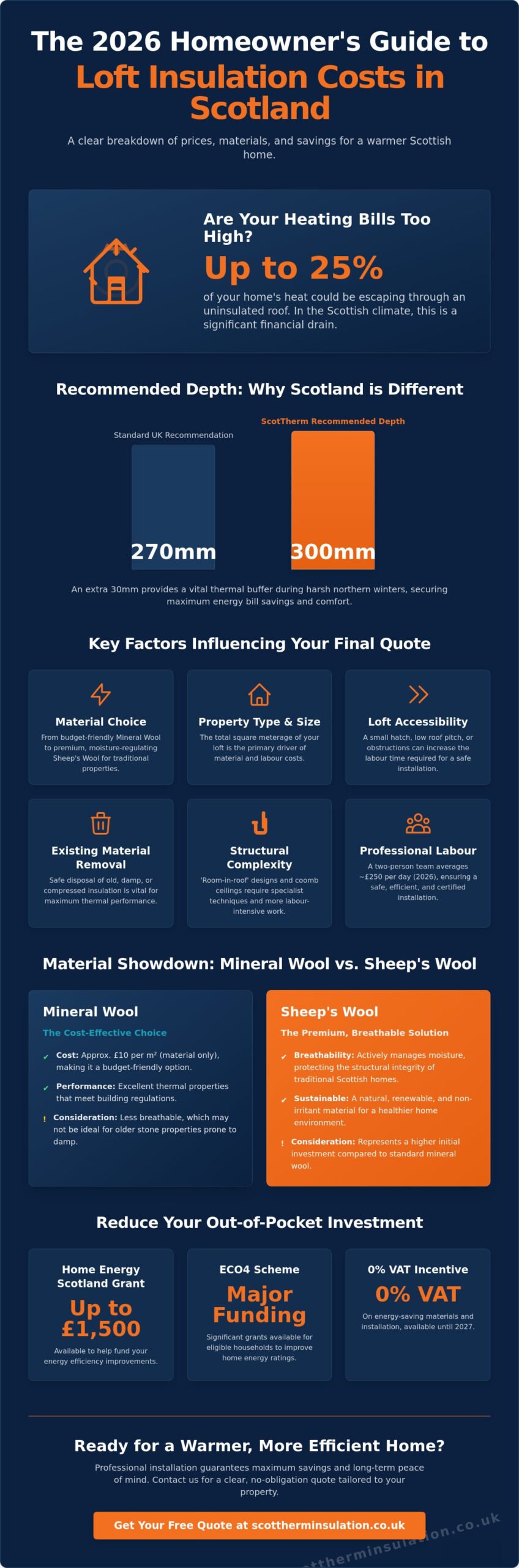
Did you know that up to 25% of your home’s heat is escaping through an uninsulated roof right now? In our unique Scottish climate, that isn’t just a comfort issue; it’s a significant financial drain that many homeowners simply accept as a part of life. We understand how frustrating it is to watch heating bills climb while trying to decipher conflicting advice about “free” grants and professional installation fees. Calculating the cost of loft insulation in Scotland shouldn’t feel like a guessing game, especially when you’re trying to protect an older stone property from dampness.
In this 2026 guide, you’ll discover the real-world factors that influence the price of insulating your home, from budget-friendly mineral wool to premium, breathable sheep’s wool. We’ll show you how to navigate current funding like the Home Energy Scotland Grant, which can provide up to £1,500 towards your project. We’ll break down labour expectations, material benefits, and the 0% VAT incentives available until 2027; giving you a clear roadmap to a warmer, more efficient Scottish property.
Key Takeaways
- Understand how professional labour rates and regional factors in the Central Belt shape the overall cost of loft insulation in Scotland for 2026.
- Evaluate the benefits of moisture-regulating sheep’s wool compared to standard mineral wool to protect the structural integrity of traditional stone-built properties.
- Learn why increasing insulation depth to 300mm is essential for combating northern winters and securing maximum energy bill savings.
- Identify how logistical variables, such as loft hatch accessibility and existing material clearance, impact the final price of your installation.
- Navigate the latest 2026 funding options, including the ECO4 scheme and Home Energy Scotland grants, to significantly reduce your out-of-pocket investment.
Understanding the Average Cost of Loft Insulation in Scotland for 2026
Determining the cost of loft insulation scotland requires looking beyond simple material prices. In our northern climate, insulation isn’t just a building requirement; it’s a critical shield against rising energy prices and coastal winds. Whilst UK-wide guides often suggest a standard thickness of 270mm, many Scottish homeowners now budget for 300mm. This extra depth provides a vital thermal buffer during harsh winters in the Central Belt and beyond. It’s a proactive choice that aligns with fundamental building insulation principles, ensuring that heat is retained where it belongs rather than escaping through the roof.
There is a distinct difference between “material only” costs and a professional “supply and fit” service. Buying rolls of mineral wool from a DIY centre might seem cheaper initially, but it doesn’t account for the precision required to avoid cold bridging or the safety risks of working in cramped spaces. Professional installers in areas like Fife or Perth also factor in regional logistics, such as parking permits in busy town centres or the travel time to more rural properties. These small details ensure the job is completed to a certified standard, providing long-term peace of mind that a DIY attempt simply can’t match.
Average Costs by Property Type
Your property’s architecture is the primary driver of your quote. A mid-terrace home usually requires less material than a sprawling traditional Scottish cottage, which often features irregular rafter spacing. Semi-detached and detached family homes have larger footprints that naturally increase the volume of insulation needed. Edinburgh tenements present a unique challenge; installers must navigate high ceilings and narrow hatches, often requiring specialist equipment or additional labour to move materials through shared stairwells. These accessibility factors are just as important as the floor area itself.
The “Cost per Square Metre” Metric
Most professionals break down the cost of loft insulation scotland using a square metre (m2) metric. Standard mineral wool is the most cost-effective choice, typically priced around £10 per m2 for the material alone. To estimate your project, measure the length and width of your loft floor, but don’t forget to account for the depth of the joists. Labour is generally calculated as a day rate for a two-person team, which averages approximately £250 in 2026. This team ensures the material is laid without gaps and that ventilation remains clear, which is essential for preventing dampness in older Scottish homes.
Key Variables That Influence Your Final Insulation Quote
Whilst average figures provide a helpful baseline, the specific cost of loft insulation scotland often fluctuates based on your property’s unique layout. Accessibility remains one of the most influential factors; a tiny, awkward hatch or a particularly low roof pitch can double the labour time required for a safe installation. If an installer has to spend extra hours manoeuvring in a restricted space, the standard £250 daily labour rate will naturally apply for longer. A clear, empty loft is the most cost-effective starting point, but we often find that Scottish homeowners require a clearance service or additional preparation before the new material can be laid.
Old Insulation Removal and Disposal Costs
Many people assume they can simply ‘top up’ existing material, but this isn’t always the best long-term investment. If your current insulation is compressed, damp, or shows signs of pest infestation, a full removal is necessary to protect your home’s structural integrity. Disposing of old glass wool requires specific safety protocols and specialised equipment, which adds to the initial quote. However, laying fresh mineral or sheep’s wool directly onto clean joists ensures maximum thermal performance and prevents the moisture trap that often occurs when new layers are placed over degraded materials.
Room-in-Roof and Coomb Ceiling Complexity
Traditional Scottish architecture frequently features ‘coomb’ ceilings or dormer windows, which present a higher level of difficulty than a standard flat loft floor. Specialist room in roof insulation techniques are required for these spaces to ensure the narrow structural gaps are fully protected without compromising ventilation. Because these areas involve insulating sloping rafters rather than just the floor, the material choices and labour intensity are more specialised, reflecting a higher price point than basic blanket insulation.
Finally, your desire for storage space will influence the final cost of loft insulation scotland. To maintain the recommended 270mm to 300mm depth, you cannot simply lay boards directly onto the insulation; this compresses the fibres and ruins their thermal efficiency. Instead, installers use raised leg systems to create a platform above the material. This setup, combined with the essential draught-proofing of the loft hatch and the insulation of water tanks and pipes, creates a complete thermal envelope. Following the Energy Saving Trust guide on these finishing touches ensures you don’t lose heat through neglected gaps. If you’re unsure which variables apply to your property, a specialist survey from ScotTherm can provide a tailored breakdown for your home.
Material Choice: Comparing Mineral Wool and Sustainable Sheep’s Wool
Selecting the right material is a decision that balances immediate budget considerations with the long-term health of your property. In Scotland, where dampness and high humidity are constant challenges for older stone buildings, this choice becomes even more significant. Whilst the cost of loft insulation scotland is often viewed through the lens of thermal efficiency, the “breathability” of the material is what protects your rafters from rot over decades. Different materials also require varying depths to meet modern building standards; for instance, achieving a 300mm thickness is the current gold standard for ensuring your home remains resilient against northern winters.
Performance vs Price: Mineral Wool
Mineral wool remains the industry standard for most modern Scottish developments. It is a highly cost-effective material that provides excellent thermal performance and is naturally non-combustible, which enhances the fire safety of your home. Because it is produced in high volumes, it allows for a lower initial investment whilst still significantly reducing your annual energy bills. For homeowners with standard brick-and-mortar properties or modern timber frames, mineral wool offers a reliable, certified solution that balances performance with affordability. It’s a straightforward choice that delivers immediate results without the premium price tag of natural alternatives.
The Long-Term Value of Sheep’s Wool
For those living in traditional Scottish homes, particularly those built with stone and lime, wool insulation offers unique structural benefits that justify its higher initial cost. Unlike synthetic materials, sheep’s wool is naturally hygroscopic; it can absorb and release moisture without losing its insulating properties. This prevents condensation from building up against cold timber joists, a common cause of structural damage in Edinburgh and Fife. Beyond its technical prowess, it is a non-toxic, sustainable fibre that is safe to handle and improves indoor air quality. Choosing this premium material is an investment in the longevity of your property, potentially saving thousands in future damp-related repairs.
The price gap between these materials can be significant, but current funding incentives make the transition to sustainable options more accessible. Homeowners can utilise the Home Energy Scotland Grant and Loan Scheme to offset a substantial portion of these costs. This government support, combined with the 0% VAT rate on energy-saving installations until 2027, means that premium, breathable materials are no longer out of reach for the average household. When calculating the cost of loft insulation scotland, it’s vital to consider these grants alongside the projected energy savings to see the true return on your investment.
Calculating Your Return on Investment and Energy Bill Savings
Viewing the cost of loft insulation scotland as a one-off expense misses the broader financial picture. It’s better understood as a high-yield investment in your property’s efficiency. The fundamental “25% Heat Loss Rule” explains why; an uninsulated roof acts like a thermal chimney, allowing a quarter of your expensive heating to vanish into the Scottish sky. By sealing this exit point, you aren’t just improving comfort; you’re fundamentally changing your home’s economic profile. Most homeowners find that the initial outlay pays for itself through reduced outgoings in a relatively short period, often outperforming traditional savings accounts in terms of annual “yield” through bill reductions.
Annual Heating Bill Reductions
The scale of your savings depends heavily on your property’s footprint. A detached house, with its large, exposed roof area, will naturally see the most dramatic drop in fuel consumption. Conversely, a mid-terrace property benefits from the heat of its neighbours but still suffers if its own loft is bare. Professional installation is vital here to prevent “thermal bridges.” These are small gaps or compressed areas where heat can still leak through, often found around the eaves or hatch. Insulating a typical 3-bedroom semi-detached house in Scotland from 0mm to 270mm can save up to £270 per year on energy bills based on 2026 projections.
The Environmental ROI
Beyond the bank balance, there’s a significant environmental return to consider. Upgrading your insulation can reduce your household carbon footprint by up to 1 tonne of CO2 every year. This is a critical step for anyone looking to transition to low-carbon heating systems like heat pumps in the future. Because heat pumps operate at lower temperatures than gas boilers, your home must be “insulation first” to remain warm. This fabric-first approach is the most cost-effective strategy to reach Net Zero, ensuring your home is ready for the next generation of energy technology.
Finally, a well-insulated loft directly improves your Energy Performance Certificate (EPC) rating. In a competitive property market, a higher EPC score is a verified badge of quality that can increase resale value and appeal to energy-conscious buyers. It proves the home is cheap to run and well-maintained. If you’re ready to see how these savings apply to your specific roof space, you can request a professional survey from ScotTherm to get an accurate projection of your property’s potential.
Navigating Scottish Grants and Professional Installation with ScotTherm
Securing the best cost of loft insulation scotland often involves looking beyond the initial quote and exploring the robust support systems provided by the Scottish Government. Whilst the financial benefits of a warmer home are clear, the administrative path to securing funding can feel complex. Professional guidance ensures you don’t miss out on significant savings that could potentially cover the entire project. In 2026, the focus remains on making Scottish homes climate-resilient, and several schemes are specifically designed to help homeowners transition to higher efficiency standards without the heavy financial burden.
ECO4 and Government Funding
The ECO4 Scotland scheme is a primary resource for households looking to eliminate the upfront expense of energy upgrades. This UK-wide initiative, which runs until December 2026, prioritises low-income households and those in receipt of specific benefits, including various pension credits. For eligible residents, ECO4 can provide 100% grant-funded insulation, effectively reducing your out-of-pocket costs to zero. If you don’t meet the strict ECO4 criteria, you should still explore other insulation grants in Scotland, such as those managed by Home Energy Scotland, which offer substantial grants and interest-free loans for primary residences. Homeowners who do not qualify for government support can still benefit from the current 0% VAT incentive on professional installations, ensuring a self-funded project remains as cost-effective as possible.
The ScotTherm Professional Standard
Choosing a local specialist like ScotTherm provides more than just a certificate of completion; it offers the security of regional expertise. DIY insulation might seem like a way to lower the cost of loft insulation scotland, but it frequently leads to expensive structural issues. Without professional knowledge of airflow, it’s easy to block essential ventilation points at the eaves. In the damp Scottish climate, restricted airflow causes condensation to build up, leading to timber rot and black mould that can remain hidden for years. Our team understands the specific requirements of properties across Edinburgh, Fife, and Perth, ensuring that every install maintains the delicate balance between thermal retention and breathability.
Our disciplined approach begins with a comprehensive assessment of your loft’s current condition and your specific thermal needs. We prioritise high-quality, certified materials and precise installation techniques that avoid the common pitfalls of “quick-fix” services. This commitment to quality ensures that your investment provides tangible value for decades rather than just a few seasons. To understand the specific requirements for your property and receive a fixed, transparent quote, book your specialist free insulation inspection today. Our local experts will help you identify the best material choices and guide you through the latest 2026 grant applications to ensure you receive every penny of support you’re entitled to.
Securing Your Home’s Energy Future
Upgrading your home’s thermal envelope is one of the most effective ways to combat rising energy prices and the unpredictable Scottish weather. We’ve explored how selecting the right materials, from breathable sheep’s wool to high-performance mineral wool, ensures your property remains protected from dampness whilst maximising heat retention. Understanding the cost of loft insulation scotland allows you to move from guesswork to a clear financial plan, especially when leveraging the government grants and 0% VAT incentives available in 2026.
ScotTherm provides the regional expertise needed to navigate these choices safely. As specialist local installers for Edinburgh, Fife, and Perth, we ensure every project meets the highest professional standards. We are experts in both Mineral Wool and Sustainable Sheep’s Wool; and we remain fully certified for ECO4 government grant installations. Our team is ready to help you optimise your home’s efficiency and secure your long-term comfort.
Request your professional loft insulation quote from ScotTherm today and take the first step toward a warmer, more sustainable future for your Scottish home.
Frequently Asked Questions
How much does loft insulation cost for a 3-bedroom semi-detached house in Scotland?
Industry averages for a 3-bedroom semi-detached property typically range between £825 and £930 for standard mineral wool installation. However, the exact cost of loft insulation scotland depends on factors like roof pitch and the required depth. Most professional quotes will account for the recommended 300mm thickness to ensure maximum thermal efficiency in our northern climate, providing a vital buffer against rising energy prices.
Can I get free loft insulation in Scotland in 2026?
Yes, free insulation is available through the ECO4 scheme until December 2026 for eligible low-income households and those on certain benefits. Additionally, the Warmer Homes Scotland programme provides funding of £10,000 or more for qualifying households struggling with energy costs. Home Energy Scotland also offers grants covering up to 75% of costs, making energy efficiency upgrades accessible for many primary residences across the country.
Is it cheaper to do loft insulation myself or hire a professional?
DIY installation might seem cheaper initially as you only pay for materials, which typically cost around £10 per m² for mineral wool. However, hiring a professional ensures that essential ventilation remains clear and that there are no thermal bridges. Certified installers also provide the necessary documentation for EPC upgrades and grant compliance, which often offsets the initial labour cost through guaranteed long-term safety and efficiency.
What is the most cost-effective loft insulation material for Scottish weather?
Mineral wool is the most cost-effective material due to its high thermal performance and lower initial price point. Whilst sheep’s wool is a premium choice for breathable stone properties, mineral wool is the industry standard for modern developments. It provides a reliable fire-safe barrier and is highly effective at meeting the 300mm depth recommended for colder Scottish winters, ensuring your home remains warm throughout the year.
How long does it take for loft insulation to pay for itself in energy savings?
Most Scottish homeowners see a full return on investment within three to five years. For a typical semi-detached house, insulating from 0mm to 270mm can save up to £270 per year on energy bills. With the current 0% VAT rate on professional installations until 2027, the cost of loft insulation scotland is recovered faster than ever, especially when combined with available government grant funding.
Does loft insulation cause dampness in older Scottish houses?
Insulation itself doesn’t cause dampness, but poor installation can lead to condensation if loft vents are blocked at the eaves. In older stone-built properties, using breathable materials like sheep’s wool helps manage moisture levels naturally. A professional installer ensures that airflow is maintained, preventing the structural rot and mould that often result from DIY errors or using incorrect materials in traditional Scottish architecture.
Will I need to remove my old insulation before installing new layers?
Removal is only necessary if the existing material is damp, compressed, or contaminated by pests. If your current insulation is in good condition but simply too thin, a professional can “top it up” to the required 300mm depth. However, laying new material over degraded or moist glass wool can trap moisture against your timber joists, so a specialist inspection is vital before you proceed.
Does the ECO4 scheme cover room-in-roof insulation in Scotland?
Yes, the ECO4 scheme includes provisions for room-in-roof insulation for eligible households. This is particularly beneficial in Scotland, where many traditional homes feature coomb ceilings and dormer windows that are more expensive to insulate than flat loft floors. Qualified installers can access this funding to cover the costs of these more complex thermal upgrades, ensuring the entire property is protected from heat loss.