
How much of your household budget is currently escaping through your roof or floorboards just to keep the Scottish winter at bay? It’s a frustrating reality for many homeowners across the country, especially those living in older properties where traditional heating methods struggle against rising energy costs. You likely feel that your home should be a sanctuary of warmth rather than a source of financial stress. Finding reliable information about insulation grants scotland can feel like a full-time job, particularly when you’re trying to distinguish between UK-wide schemes and those specific to our local climate.
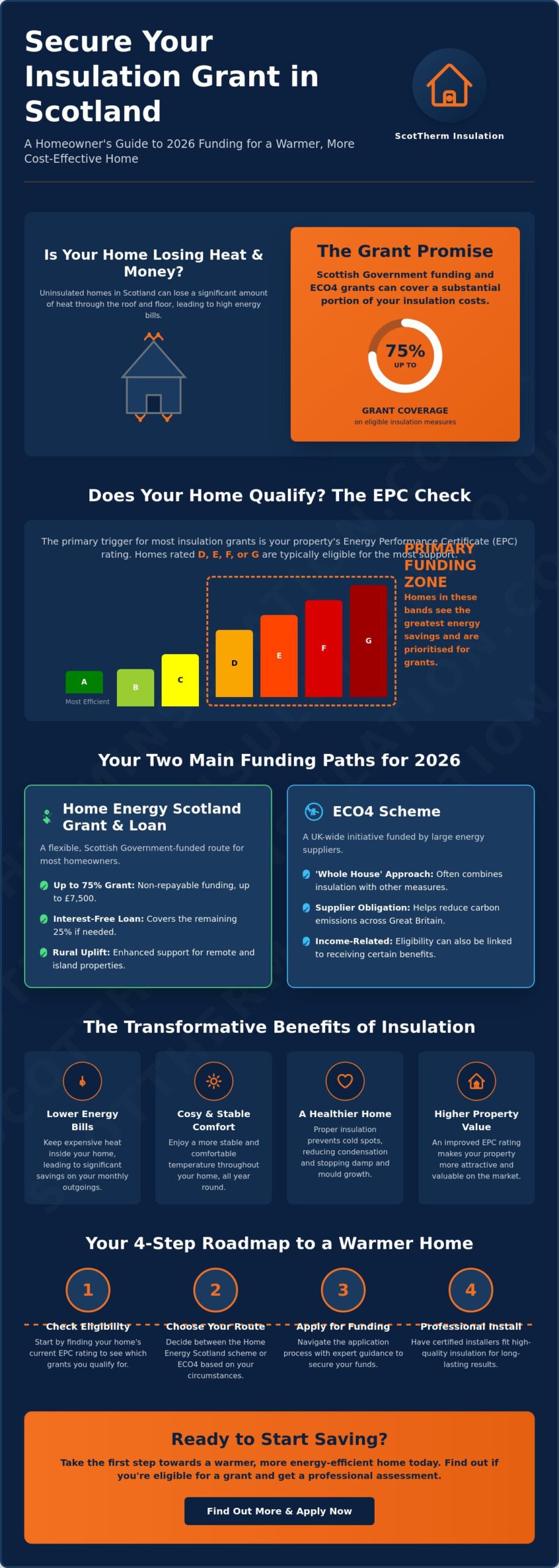
Discover how to secure Scottish Government funding and ECO4 grants to make your home warmer and more energy-efficient this year. We’ve verified the latest 2026 criteria for the Home Energy Scotland Grant and Loan Scheme, which offers grants covering up to 75% of costs for measures like loft or underfloor insulation. This guide provides a clear roadmap for accessing these non-repayable funds while avoiding the risks of poor-quality installations. You’ll learn how to identify the right funding route for your specific property, ensuring your home remains a cost-effective and cosy environment for years to come.
In this guide:
- Identify the primary funding routes for insulation grants scotland, including the UK-wide ECO4 scheme and the dedicated Home Energy Scotland Grant and Loan.
- Understand the property eligibility requirements, specifically how an Energy Performance Certificate (EPC) rating of D, E, F, or G acts as the main trigger for funding.
- Learn how to access non-repayable grants that cover up to 75% of costs for essential upgrades like loft, underfloor, and room in roof insulation.
- Discover the benefits of using specialist materials such as sheep’s wool or mineral wool to ensure your property remains breathable and warm in our unique climate.
- Follow a clear, step-by-step roadmap to navigate the application process and ensure your home improvements are handled by certified professional installers.
Understanding Insulation Grants in Scotland for 2026
In Scotland, energy efficiency isn’t just a luxury; it’s a necessity for enduring our long, damp winters. For many homeowners, the cost of upgrading an older property can feel prohibitive. This is where insulation grants scotland play a vital role. These grants are essentially non-repayable funds or low-interest loans provided by the government or energy suppliers. They aim to reduce the carbon footprint of our housing stock whilst ensuring that every household can afford to stay warm. Unlike standard commercial offers, these schemes prioritise long-term value and professional standards over quick, superficial fixes.
The Scottish Government has committed to a legally binding target of reaching Net Zero by 2045. This goal is five years ahead of the rest of the UK, which explains why the funding landscape here is often more robust and accessible. To hit these targets, thousands of homes must be retrofitted with high-quality materials like mineral wool or underfloor insulation. 2026 marks a significant turning point in this journey. With several major schemes currently active, it’s the ideal time for homeowners to secure their funding before potential policy shifts or budget reallocations occur later in the parliament. It’s helpful to remember that UK-wide initiatives, such as the Great British Insulation Scheme, have already seen transitions in early 2026, proving that these windows of opportunity don’t stay open forever.
Why Scotland Leads the Way in Energy Efficiency
Our unique climate demands a specialised approach to building science. Scottish homes face intense wind-driven rain and high humidity levels that properties in the south rarely encounter. Local funding recognises these challenges. Instead of a one-size-fits-all model, Scottish grants often support measures that protect our historic building stock from moisture damage. Energy Performance Certificate (EPC) ratings are the primary tool used to measure success in 2026. Properties rated D, E, F, or G are frequently eligible for the highest levels of support, as these homes offer the greatest potential for energy savings and carbon reduction.
The Financial and Physical Benefits of Insulating Now
The most immediate benefit of accessing insulation grants scotland is the noticeable drop in monthly energy outgoings. By creating a thermal barrier in your loft or beneath your floorboards, you stop expensive heat from escaping. This creates a more stable, comfortable domestic environment. Beyond the finances, there is a significant health benefit. Proper insulation, when installed by certified specialists, regulates the internal temperature and prevents the cold spots where condensation thrives. This effectively stops damp and mould from taking hold in your living spaces. Furthermore, as energy regulations tighten, a home with a high EPC rating becomes a much more valuable and tradable asset in the Scottish property market.
The Primary Funding Routes: ECO4 and Home Energy Scotland
Getting the right support for your home starts with knowing which path to take. In 2026, the landscape for insulation grants scotland is primarily defined by two major streams. One is funded by the Scottish Government, whilst the other is an obligation placed on energy companies. Both aim to make properties warmer, but their eligibility criteria and application processes differ significantly. Choosing the correct route ensures you receive the maximum financial assistance available for your specific property type and household income.
The HES Grant and Loan: A Flexible Option
For many homeowners in the Central Belt and beyond, the Home Energy Scotland Grant and Loan Scheme is the most accessible route. This initiative provides a grant covering up to 75% of the cost of energy efficiency measures. The maximum grant amount is usually £7,500. If the remaining 25% is still a barrier, an interest-free loan is available to bridge the gap. This flexibility makes it a preferred choice for those looking to install loft insulation, underfloor insulation, or room in roof insulation without a massive upfront investment. It’s a structured, reliable way to improve your home’s thermal performance.
Homes in remote or island locations receive extra support through this scheme. The “Rural Uplift” provides an additional £1,500 for energy efficiency grants. This ensures that the higher costs of transporting materials and labour to remote areas don’t prevent homeowners from securing a warmer property. It’s a vital feature that acknowledges the geographic diversity of our country and ensures that no community is left behind in the transition to more efficient housing.
ECO4 Scotland: Targeting Vulnerable Households
The Energy Company Obligation (ECO4) takes a different approach. Instead of a percentage grant, it often provides 100% non-repayable funding for low-income households or those receiving qualifying benefits. ECO4 is unique because it focuses on a “whole house” strategy. Rather than just fixing a single issue, the scheme looks at the property holistically to ensure it reaches a specific Energy Performance Certificate (EPC) target. Large energy suppliers fund these improvements directly to meet their carbon reduction quotas.
You can find a detailed breakdown of how this works in our ECO4 Scotland: The Complete 2026 Guide to Free Home Insulation. For those in severe fuel poverty, the Warmer Homes Scotland scheme acts as another safety net. Managed by Warmworks, it provides a comprehensive package of measures to help those who need it most. If you’re unsure which route fits your property, speaking with a local insulation specialist can help clarify your options and streamline your application.
Eligibility Criteria: Does Your Scottish Home Qualify?
Determining your eligibility for insulation grants scotland begins with a look at your property’s current energy performance. Most Scottish Government energy saving grants prioritise homes with an Energy Performance Certificate (EPC) rating of D, E, F, or G. These ratings highlight properties that are inefficient and lose heat rapidly. If you don’t have a current EPC, a professional survey can often establish your property’s status as part of the application process. This technical trigger ensures that funding reaches the homes where it will have the most significant impact on carbon reduction and warmth.
Household income and benefit status represent the second pillar of eligibility. For the ECO4 scheme, a member of the household typically needs to receive a qualifying means-tested benefit. This includes Universal Credit, Pension Credit, or Housing Benefit. If you don’t receive benefits, you might still qualify through the Local Authority Flexibility (LA Flex) route. This allows local councils to set their own criteria to support residents who are on a low income or are vulnerable to the cold. Both homeowners and private tenants are eligible to apply, although tenants must obtain written permission from their landlord before any physical work, such as installing underfloor insulation, can commence.
Grants for Traditional Scottish Property Types
Scotland is famous for its historic architecture, from grand Edinburgh tenements to stone cottages in Fife and Stirling. These buildings require a specialised approach. Standard synthetic materials can sometimes trap moisture against traditional stone, leading to structural issues. Many funding routes now recognise this and support the use of breathable materials like sheep’s wool or mineral wool. These natural fibres allow the building to “breathe” whilst providing exceptional thermal resistance. Understanding these nuances is vital for local homeowners. You can find more detail in our guide on Insulating a Stone House in Scotland: The 2026 Guide to Breathable Solutions.
The Role of the Specialist Free Insulation Inspection
A professional survey is the essential first step in any successful grant application. It’s the moment where technical theory meets the reality of your loft or crawl space. During this visit, a certified inspector will measure your current insulation depth and check for adequate ventilation. They also look for any existing damp or structural issues that could affect the installation. This inspection ensures that the measures being funded are safe, appropriate, and likely to deliver the promised energy savings. To help you prepare for this visit, we’ve compiled a Specialist Free Insulation Inspection in Edinburgh & Stirling: The 2026 Homeowner’s Checklist. This resource outlines exactly what an inspector needs to see to move your application forward.
Navigating the Application Process and Avoiding Pitfalls
Securing insulation grants scotland requires a methodical approach to ensure your application moves through the system without delays. The journey typically begins with an initial enquiry to Home Energy Scotland or a certified installer. Once you’ve established potential eligibility, the next phase involves gathering evidence to support your claim. Inaccurate paperwork is the most frequent reason for application rejection, so taking the time to organise your files early is a wise investment in your home’s future comfort.
You will need to provide clear documentation, including proof of property ownership and current benefit award letters if applying via the ECO4 route. For those using the Home Energy Scotland Grant and Loan Scheme, the Energy Saving Trust aims to process applications and claims within 10 working days of receiving all necessary documents. This efficient turnaround, verified as of March 2026, means you can move from enquiry to approval relatively quickly. However, any missing information or unsigned forms will reset this clock, so double-check every entry before submission.
Choosing an Approved Installer
To access government funding, you must use a TrustMark-registered professional. This certification acts as a badge of quality and safety, ensuring that the work meets rigorous industry standards. You should be cautious of “free insulation” cold callers who cannot provide verified credentials or a physical business address. Regional expertise is particularly valuable in cities like Edinburgh and Perth, where properties often have unique architectural quirks. A local specialist understands the specific challenges of our climate and will ensure your mineral wool or sheep’s wool insulation is fitted with the precision required for long-term performance. Our guide on how to choose the best insulation companies for your Scottish property outlines the essential certifications and vetting steps every homeowner should follow before committing to an installer.
Managing the Installation Phase
Preparation is key to a smooth installation day. You should clear your loft or underfloor area of any stored items to provide the team with unhindered access. A professional installer will always prioritise ventilation; blocking eaves or air bricks is a common mistake that leads to condensation and damp issues. If you are planning to add loft boarding or ladders, discuss this with your specialist beforehand. They can ensure the insulation depth remains compliant with grant requirements whilst allowing for safe access. To get started with a verified provider, you can request a professional grant assessment today and begin your journey toward a more efficient home.
Maximising Your Grant with Professional Local Installation
Securing insulation grants scotland is a significant first step, but the true value lies in the quality of the installation and the materials chosen for your property. A grant provides the financial means, but a specialist installer provides the long-term performance. At ScotTherm Insulation, we focus on high-performance materials like sheep’s wool and mineral wool because they are uniquely suited to our environment. These materials don’t just sit in your loft; they actively manage the specific challenges of the Scottish climate, such as high humidity and rapid temperature shifts.
Breathable insulation is essential for the health of older Scottish homes. Natural fibres like sheep’s wool can absorb and release moisture without losing their thermal properties, which prevents the structural damp issues often associated with cheaper, synthetic alternatives. When these materials are fitted by a professional, they create a seamless thermal envelope. We pay close attention to avoiding “cold bridges,” which are small gaps in the insulation where heat can still escape and condensation can form. By ensuring a continuous barrier in areas like room-in-roof insulation or underfloor spaces, we guarantee that the energy savings promised by your grant are actually realised.
Beyond the Grant: Long-term Value and Comfort
It is tempting to simply accept the first “free” offer that comes your way, but the cheapest grant-funded option isn’t always the best for your home’s longevity. Poorly installed or inappropriate materials can lead to ventilation problems that cost more to fix than the original insulation was worth. Real comfort comes from a home that retains heat evenly across every room. Choosing a partner with regional pride ensures that your project is handled with the care a local property deserves. For more advice on finding the right partner, see our guide on the Best Insulation Companies Near Me: Choosing Local Scottish Specialists in 2026.
Next Steps: Securing Your 2026 Funding
The funding landscape in 2026 is generous, but these budgets are finite. Acting whilst the current funding pots are full ensures you don’t miss out on the maximum available grants for loft, underfloor, or mineral wool insulation. The process is straightforward when you work with a steady, experienced specialist who understands the administrative requirements of the Scottish Government and energy suppliers. We recommend starting with a bespoke assessment to identify exactly which measures will deliver the most ease and efficiency for your specific household. Your journey to a warmer, more cost-effective home is only a professional consultation away.
Secure Your Warmer Home for 2026
The opportunity to transform your property’s energy efficiency has never been more accessible than it is right now. By navigating the current landscape of insulation grants scotland, you can access substantial funding to install high-performance materials like breathable sheep’s wool or mineral wool. Whether you qualify for the 75% HES grant or 100% funding via ECO4, the primary goal remains the same: creating a drier, more cost-effective living environment that withstands the unique Scottish climate.
Choosing a partner with specific expertise in Scottish stone properties ensures that your upgrades protect the structural integrity of your home whilst maximising thermal retention. As TrustMark Registered Installers, we prioritise safety and long-term value in every project. Don’t let another winter pass with heat escaping through your roof or floors. Take the first step toward a permanently warmer home by speaking with a local expert who understands the technical nuances of our regional building stock and has specific expertise in breathable sheep’s wool solutions.
Book Your Specialist Free Insulation Inspection Today to confirm your eligibility and secure your 2026 funding allocation. You deserve a home that’s as efficient as it is comfortable.
Frequently Asked Questions
Are insulation grants still available in Scotland in 2026?
Yes, insulation grants scotland remain widely available throughout 2026. The Scottish Government continues to fund the Home Energy Scotland Grant and Loan Scheme to meet its ambitious 2045 Net Zero targets. Additionally, the ECO4 scheme is scheduled to run until at least March 2026, providing vital support for households looking to improve their energy efficiency before the next policy transition.
Can I get a grant for loft insulation if I am not on benefits?
Yes, you don’t need to be on benefits to access financial support for loft insulation. The Home Energy Scotland Grant and Loan Scheme is open to most homeowners and provides a grant covering up to 75% of the cost. If you live in a specific council area, you might also qualify via the LA Flex route, which helps residents on low incomes who don’t receive traditional benefits.
How much can I save on my energy bills with a Scottish insulation grant?
Savings vary based on your property type, but the impact on your monthly outgoings is usually substantial. By installing measures like loft or underfloor insulation, you create a thermal barrier that prevents expensive heat from escaping. This means your heating system runs less frequently to maintain a comfortable temperature, leading to a direct and permanent reduction in your energy costs.
What is the difference between ECO4 and the Home Energy Scotland grant?
The primary difference lies in the funding source and the eligibility criteria. ECO4 is a UK-wide obligation on large energy suppliers that targets low-income households with a “whole house” approach to efficiency. The Home Energy Scotland scheme is a dedicated Scottish Government initiative that offers a combination of grants and interest-free loans to a broader range of homeowners across the country.
Do I have to pay anything towards the cost of the insulation?
Your financial contribution depends on which funding route you qualify for. ECO4 often provides 100% non-repayable funding, meaning you pay nothing toward the installation. Under the Home Energy Scotland scheme, grants typically cover up to 75% of the total cost, and you have the option to take out an interest-free loan to bridge the gap for the remaining balance.
Is sheep’s wool insulation covered by Scottish Government grants?
Yes, sheep’s wool is an eligible material under many insulation grants scotland, particularly for traditional stone properties. This high-performance, breathable material is often the preferred choice for our damp climate because it manages moisture effectively whilst providing exceptional warmth. Using natural fibres ensures your historic property remains protected from damp issues whilst significantly improving its overall energy performance rating.
How long does the application process for an insulation grant take?
The application process is designed to be efficient for homeowners. As of March 2026, the Energy Saving Trust aims to process Home Energy Scotland applications within 10 working days of receiving all necessary documentation. Once your grant is approved, the installation date will depend on the schedule of your TrustMark-registered specialist and the specific technical requirements of your property.
Can I get a grant for underfloor insulation in an older Edinburgh property?
Yes, underfloor insulation is a core measure supported by both the ECO4 and Home Energy Scotland schemes. It’s particularly effective for older Edinburgh properties with suspended timber floors, where cold draughts are a persistent issue. Installing high-quality insulation beneath your floorboards eliminates these draughts and ensures that heat stays within your living spaces rather than escaping into the crawl space below.