
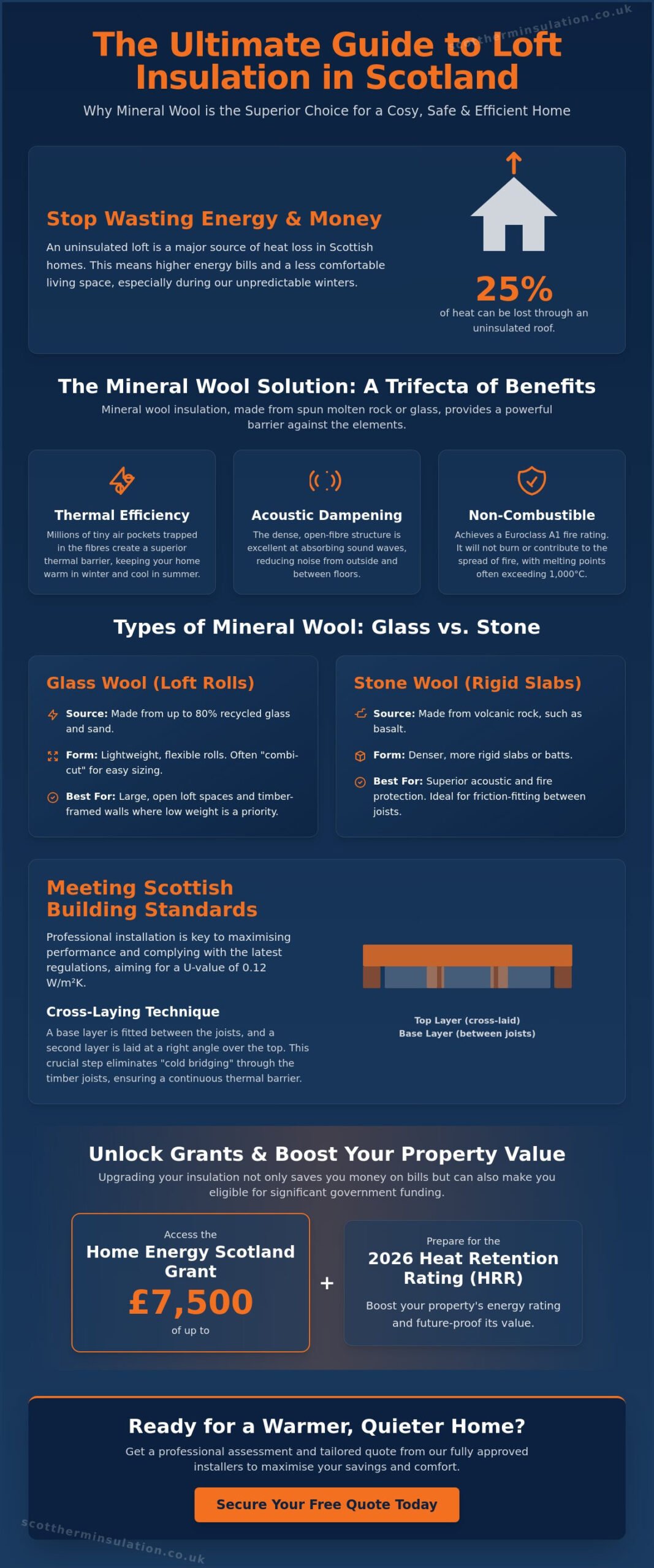
Did you know that an uninsulated loft is responsible for up to 25% of your home’s heat loss? In a climate as unpredictable as ours, that is a staggering amount of energy and money simply vanishing through the rafters. You likely want a home that stays cosy during a Highland winter without the stress of soaring energy bills or concerns about fire safety. Using mineral wool is one of the most effective ways to secure your property against the elements while meeting the strict new Scottish building standards.
We agree that every homeowner deserves a quiet, safe, and energy-efficient space. This guide will show you why mineral wool is the ultimate climate-ready material for Scotland, offering a unique trifecta of thermal efficiency, acoustic dampening, and non-combustible safety. You will gain a clear understanding of the differences between glass and stone wool to help you decide which is right for your specific needs.
We also preview the upcoming 2026 Heat Retention Rating (HRR) system and explain how to access the Home Energy Scotland grant of up to £7,500. This article provides everything you need to know to achieve the 0.12 W/m²K U-value standard while ensuring maximum savings and comfort in your home today.
Key Takeaways
- Understand the critical differences between glass and stone wool to select the right material for your home’s specific layout.
- Learn how mineral wool compares to PIR boards and sheep’s wool in terms of breathability, fire safety, and long-term value.
- Discover the professional techniques used to cross-lay mineral wool to eliminate cold bridging and ensure maximum heat retention.
- Find out how to perform a simple “ruler test” to see if your loft meets the latest 2026 Scottish Building Standards.
- Identify how upgrading your insulation can boost your property’s Heat Retention Rating and unlock significant Home Energy Scotland grants.
What is Mineral Wool Insulation and Why Does it Matter?
Mineral wool is a highly effective, fibrous insulation material manufactured by spinning molten rock or glass at incredibly high speeds. This industrial process creates a dense web of fibres that excels at trapping air and resisting heat transfer. For those looking for a technical breakdown of What is Mineral Wool, it’s essentially categorised into two primary types: stone wool, which is derived from volcanic rock like basalt, and glass wool, which is made from recycled glass sand. Both types are staples for professional insulation fitters across Scotland because they offer a reliable, long-term solution for our unique housing stock.
Choosing the right material is vital for achieving maximum savings and comfort. Mineral wool has become the most popular choice amongst specialists because it doesn’t just keep the heat in; it also addresses fire safety and noise pollution. Unlike some rigid foam alternatives, these flexible fibres can be easily cut and friction-fitted between joists, ensuring there are no gaps for heat to escape. This versatility makes it an essential component for any homeowner aiming to meet the 2026 Scottish Building Standards while protecting their property from the elements.
The Science of Spun Fibres
The magic of this material lies in its structure. By spinning the raw materials into fine strands, manufacturers create millions of tiny air pockets within the wool. Because still air is a poor conductor of heat, these pockets form a powerful thermal barrier that keeps your home warm during the harshest winters. Safety is another major factor. Stone wool, in particular, has an exceptionally high melting point, often exceeding 1,000°C. This contributes to the Euroclass A1 fire rating common in these products, meaning they are non-combustible and won’t contribute to the spread of a fire.
Acoustic vs Thermal Performance
While thermal retention is often the priority, mineral wool offers a distinct advantage over PIR boards when it comes to soundproofing. Its dense, open-fibre structure is far superior at absorbing sound waves, making it the ideal choice for insulating between floors or walls. This is particularly beneficial for residents in Edinburgh tenements or busy urban centres where traffic noise is a constant issue. Higher density variants of stone wool provide a substantial mass that blocks airborne sound effectively. It’s a versatile, dual-purpose insulator designed to meet the rigorous 2026 energy and comfort standards required for modern Scottish living.
Types of Mineral Wool: Glass Wool vs Stone Wool
While all mineral wool provides a robust thermal barrier, the choice between glass and stone variants depends on your specific project goals. Glass mineral wool is typically manufactured from a high percentage of recycled glass and is sold in lightweight, flexible rolls. In contrast, stone mineral wool consists of volcanic rock and is often found in denser, rigid slabs or batts. Understanding these physical differences is the first step toward achieving a warmer, quieter home.
Trade professionals often select materials based on the installation environment. Glass wool is exceptionally light, making it easier to transport through tight loft hatches and handle in cramped spaces. Stone wool is much heavier but offers superior structural integrity. If you are unsure which material fits your property’s unique requirements, our team of fully approved installers can assess your loft and provide a tailored recommendation for maximum savings and comfort.
Glass Wool (Loft Rolls)
Modern glass wool products, such as Knauf Earthwool, have transformed the industry with their “combi-cut” technology. These rolls are perforated, allowing installers to easily snap them to the required width without needing a saw. This significantly reduces waste and speeds up the fitting process. Sustainability is a major highlight here; many manufacturers use up to 80% recycled content. As noted by the US Department of Energy on Insulation, this high recycled content makes it an eco-friendly choice for modern homeowners. It remains the ideal solution for large, uninterrupted loft floors and timber-framed walls where weight is a primary consideration.
Stone Wool (Rigid Slabs)
Stone wool is the preferred choice for high-performance acoustic and fire protection. Because it is made from volcanic basalt, it is much denser than glass wool. This density allows slabs to be friction-fitted between floor joists or wall studs. The material effectively grips the sides of the timber, eliminating gaps that could lead to thermal bypassing. Unlike lighter alternatives, stone wool is incredibly durable and doesn’t slump or settle over time when installed in vertical wall cavities. This ensures the insulation remains effective for the life of the building. It provides peace of mind for those living in high-traffic areas or multi-storey homes where sound dampening is just as important as heat retention.
Mineral Wool vs Alternative Materials: A Comparison
Homeowners often weigh up mineral wool against PIR (Polyisocyanurate) boards when planning a retrofit. While PIR boards offer a high thermal resistance per millimetre, they’re rigid and can be difficult to fit perfectly in the irregular spaces of an older Scottish home. Any small gap around a rigid board allows heat to bypass the insulation entirely. Mineral wool, by contrast, is flexible and easily compressed into awkward corners, ensuring a continuous thermal envelope. It also provides superior acoustic dampening and is generally more budget-friendly for comprehensive loft projects. When you’re insulating high-moisture zones like bathrooms or kitchens, we always recommend using a dedicated vapour barrier alongside your wool to prevent interstitial condensation from reaching the roof timbers.
The Breathability Factor in Scotland
Living in a traditional Edinburgh tenement or a stone-built cottage requires a specific approach to moisture management. These historic structures were designed to be breathable, allowing moisture to move through the fabric of the building. Using non-breathable materials can lead to trapped condensation and eventually damp. Many homeowners now opt for wool insulation as a premium, natural alternative that manages moisture exceptionally well. Whilst mineral wool is a synthetic fibre, it remains far more vapour-permeable than rigid foam boards. It’s a practical choice for 100-year-old homes where maintaining airflow is just as important as hitting a specific U-value. This balance ensures your home stays warm without compromising the health of the building’s structure.
Cost-Effectiveness and Longevity
In the 2026 energy market, mineral wool represents the best “bang for your buck” for most Scottish households. With material costs typically ranging between £5 and £10 per square metre, it allows for a full-depth installation that meets the 0.12 W/m²K standard without breaking the bank. It’s built to last, too. Because it’s made from stone or glass, it’s naturally resistant to rot and doesn’t provide a food source for vermin. When installed correctly, it can last for the entire lifespan of the building. It doesn’t degrade or lose its thermal properties over time, providing a permanent solution for your home’s efficiency. This durability makes it a cornerstone of our service as insulation installers in Scotland, as it provides the peace of mind that comes with a proven track record of performance.
Professional Installation: Best Practices for Scottish Lofts
Scottish homes, from granite tenements in Aberdeen to sandstone villas in Glasgow, present unique installation hurdles that require a specialist touch. Achieving the required 0.12 W/m²K U-value involves more than simply unrolling a product; it demands technical precision. One of the most frequent errors is blocking the eaves. Maintaining clear airflow is vital to prevent condensation and protect your roof timbers from rot. Our professional installers use eaves trays or baffles to ensure a clear air path remains open while the mineral wool reaches the very edge of the wall plate for a complete thermal seal.
To eliminate “cold bridging”, where heat escapes through the timber joists rather than the insulation, we always utilise a two-layer cross-laying technique. The base layer is fitted snugly between the joists, while the second layer is laid at a 90-degree angle across the top. This method creates a seamless blanket that covers the timber and prevents thermal leaks. Hiring insulation services near me ensures your project is fully compliant with the latest Scottish Building Standards and avoids these common technical pitfalls.
Loft Boarding and Mineral Wool
Many homeowners want to retain their loft for storage, but placing heavy boxes directly onto the fibres is a mistake. Compressing the material crushes the air pockets that provide thermal resistance, which can slash the insulation’s effectiveness by over 50%. To maintain the necessary 270mm to 300mm depth recommended in our guide to loft insulation Scotland, you must install loft legs. These specialised stilts raise the floorboards above the insulation, allowing the material to remain at its full height whilst providing a sturdy, safe platform for your belongings.
Handling and Safety Protocols
Working with these materials requires strict safety measures to prevent skin and respiratory irritation. Essential PPE includes long sleeves, durable gloves, sealed goggles, and high-quality FFP3 masks. When cutting mineral wool, use a sharp serrated knife to produce clean edges rather than tearing the material, which helps keep dust to a minimum. Professional fitters use specialised equipment to minimise airborne fibres, ensuring the work environment remains safe for both the installers and your family. If you want to ensure your home is upgraded safely and efficiently, book a survey with our approved team today for a professional installation that delivers maximum savings and comfort.
Choosing the Right Solution for Your Home in 2026
Before committing to an upgrade, you can perform a simple “ruler test” in your loft to assess your current protection. Simply clear a small patch of flooring and measure the depth of the existing material. If you find less than 270mm of coverage, your home is likely losing up to 25% of its heat through the roof. Upgrading to mineral wool is one of the most effective ways to boost your property’s Energy Performance Certificate (EPC) and prepare for the new Heat Retention Rating (HRR) system arriving in autumn 2026. This new metric measures how well your building actually holds onto warmth, making high-performance materials more valuable than ever for Scottish homeowners.
Our local expertise in regions like Fife and Perth allows us to understand the specific climate challenges faced by homeowners in these areas. We don’t just supply materials; we provide a comprehensive thermal strategy tailored to your property type. Every project we undertake is completed to “Fully Approved” standards, ensuring that your installation is safe, compliant, and durable. This professional oversight is essential for securing the long-term value of your home whilst ensuring you meet the 0.12 W/m²K U-value requirement set by current building standards.
Maximising Energy Savings
For a typical detached home in Stirling, addressing loft insulation can lead to a dramatic reduction in annual heating costs. To achieve a total thermal envelope, we recommend pairing your loft project with under floor insulation. This combined approach prevents heat from escaping through both the top and bottom of your property, creating a consistently cosy environment. Many households are also eligible for support through the ECO4 Scotland programme, which offers grants for energy-saving measures until 2026. This funding can significantly offset the cost of professional installation for qualifying households across the country.
The ScotTherm Professional Guarantee
We’re dedicated to delivering “Maximum Savings & Comfort” to every client we serve. Our team prioritises non-combustible mineral wool, especially in high-density housing areas where fire safety is a paramount concern. This material provides peace of mind that synthetic foam boards simply cannot match. We take pride in our proven track record, helping families create warmer, safer homes that are ready for the future. If you’re ready to lower your bills and improve your home’s comfort, contact our local specialist team today for a free insulation inspection.
Future-Proof Your Scottish Home Today
Investing in the right insulation is a vital step toward securing a warmer, more sustainable future for your property. The evidence shows that mineral wool serves as a high-performance “all-rounder”, providing the fire safety and acoustic dampening that modern Scottish building standards demand. Whether you want to prepare for the 2026 Heat Retention Rating changes or simply aim to eliminate damp and draughts, this material offers a reliable and cost-effective solution. It’s about more than just energy; it’s about the peace of mind that comes from a safe, quiet, and well-protected household.
As Fully Approved Scottish Contractors, ScotTherm brings a proven track record to every project across Edinburgh, Fife, and Perth. We are specialists in high-performance mineral wool applications, ensuring your loft meets the strict 0.12 W/m²K U-value requirements without compromising on essential ventilation. Our team is ready to help you achieve maximum savings and comfort with a tailored installation strategy that suits your specific home type. Don’t leave your property’s efficiency to chance. Book your expert insulation survey with ScotTherm today and take the first step toward a cosier, more efficient home. You’ll enjoy the benefits of lower bills and a better EPC rating for years to come.
Frequently Asked Questions
Is mineral wool insulation safe for my home?
Yes, mineral wool is exceptionally safe because it is non-combustible and carries a Euroclass A1 fire rating. It doesn’t emit harmful gases and acts as a fire barrier, providing extra protection for your family. Whilst the fibres can cause temporary skin irritation during fitting, it poses no health risk once installed and covered. This material is a standard choice for safety-conscious homeowners across Scotland.
Does mineral wool cause damp or condensation in the loft?
Mineral wool doesn’t cause damp, but poor installation can lead to moisture issues. It’s a breathable material that allows moisture vapour to pass through; however, you must maintain clear airflow at the eaves. If you block your loft’s ventilation, moisture will trap against the cold roof timbers. Professional fitters ensure that your insulation works with your home’s natural ventilation to prevent condensation.
How thick should mineral wool insulation be to meet 2026 standards?
To meet the latest Scottish Building Standards and achieve a U-value of 0.12 W/m²K, you typically need a total depth of 270mm to 300mm. If you already have some insulation, you can simply “top up” the existing layer to reach this height. This thickness ensures your property is ready for the 2026 Heat Retention Rating (HRR) assessments and helps keep your heating bills as low as possible.
Can I install mineral wool insulation myself?
You can install mineral wool as a DIY project, but professional fitting is recommended to ensure full compliance with energy regulations. Experts have the specialised tools to cut the material accurately and avoid gaps that lead to heat loss. They also handle the necessary safety protocols and ensure that delicate areas like electrical cables and downlights aren’t covered incorrectly, which prevents potential fire hazards.
What is the difference between Rockwool and glass wool?
The main difference lies in the raw materials and density. Stone wool, often referred to by the brand name Rockwool, is made from volcanic rock and is denser, making it better for fire resistance and soundproofing. Glass wool is made from recycled glass and is generally lighter and more flexible. Both are excellent insulators, but stone wool is often preferred for friction-fitting in vertical walls or between floor joists.
Does mineral wool insulation block out noise from neighbours?
Yes, mineral wool is highly effective at absorbing sound waves and reducing noise pollution. Its dense, fibrous structure traps sound, making it far superior to rigid foam boards for acoustic performance. It’s a popular choice for mid-terrace homes or tenements where blocking out noise from neighbours or street traffic is a priority. This dual-purpose benefit adds significant value to your home’s overall comfort levels.
Is mineral wool more expensive than sheep’s wool?
Mineral wool is generally the more affordable option compared to sheep’s wool. Whilst sheep’s wool is a premium natural product with excellent moisture-management properties, mineral wool provides a similar thermal performance at a lower price point. This makes it the most cost-effective choice for homeowners looking to maximise their energy savings on a budget. Both materials are available through our fully approved installation service.
How long does mineral wool insulation last before it needs replacing?
Mineral wool is designed to last for the entire lifespan of your building, often 40 years or more. It doesn’t degrade, lose its shape, or suffer from reduced thermal efficiency over time if kept dry. Because it’s resistant to rot and vermin, it remains a stable and reliable barrier. It won’t need replacing unless it becomes physically damaged by a major roof leak or significant structural changes.