
What if the very material meant to lower your energy bills actually makes your home impossible to sell or remortgage? For many homeowners, the reality of spray foam has turned from a quick fix into a significant financial headache. You’re likely worried about property devaluation or the strict RICS guidelines that have made lenders increasingly cautious. Finding reliable alternatives to spray foam insulation in Scotland is no longer just about comfort; it’s about protecting your most valuable asset from damp, rot, and the “zero-tolerance” lending policies seen in 2026.
We understand that you want a warm, cost-effective home without the stress of structural damage. This guide will show you why traditional, breathable solutions like sheep’s wool and mineral wool are the safest choices for our unique climate. You’ll learn how these lender-approved methods meet the latest Scottish building standards, ensuring your property remains mortgageable whilst keeping your family cosy. We’ll preview the best materials for your loft and floors, giving you the peace of mind that comes from professional, certified insulation.
Key Takeaways
- Understand why many UK lenders now have a zero-tolerance policy towards spray foam and how traditional insulation protects your home’s resale value.
- Learn why breathable alternatives to spray foam insulation scotland, such as sheep’s wool, are essential for preventing interstitial condensation and timber rot in our damp climate.
- Compare the benefits of sustainable sheep’s wool and cost-effective mineral wool to find the right balance between thermal performance and budget.
- Discover how to secure a lender-approved insulation certificate by prioritising visible roof timbers and professional installation.
- Gain peace of mind by choosing solutions that meet the latest 2026 Scottish Building Standards while ensuring long-term structural integrity.
Why Homeowners are Seeking Alternatives to Spray Foam in Scotland
The property market in Scotland has reached a critical turning point regarding loft treatments. What was once marketed as a high-tech solution has now become a significant barrier for those looking to sell or remortgage their homes. Many homeowners find themselves in a difficult position as lenders adopt an increasingly strict stance. This mortgage crisis isn’t just a rumour; it’s a documented trend affecting thousands of properties across the UK. Lenders are wary because spray foam, particularly the closed-cell variety, creates a permanent seal over the roof structure. This seal prevents surveyors from inspecting the condition of the timber rafters, effectively hiding potential defects from the very people tasked with valuing the home.
When you consider building insulation materials, the primary goal is thermal efficiency without compromising structural health. Spray foam often fails this second test. By bonding directly to the timber and roof felt, it can trap moisture that would otherwise evaporate naturally. Over time, this leads to interstitial condensation, a process where water vapour turns into liquid inside the roof assembly. For a Scottish home, this often results in timber rot that remains invisible until the damage is catastrophic. This is why many families are now researching safe alternatives to spray foam insulation scotland to ensure their homes remain both warm and saleable.
The RICS Position and Surveyor Concerns
The Royal Institution of Chartered Surveyors (RICS) released a consumer guide in 2023 that significantly changed how these installations are viewed. By 2026, these guidelines have become the standard for every surveyor in the country. If a surveyor encounters spray foam during a home report, they often issue a Category 3 result. This means the property is not suitable for a mortgage until the foam is removed or a specialist structural report is provided. Removing the material is a costly, invasive process because it bonds so tightly to the roof’s fabric, often requiring the replacement of the roof felt or even the rafters themselves.
The Scottish Climate Factor
Scotland’s weather presents unique challenges for any insulation strategy. We deal with high humidity and frequent wind-driven rain, which puts immense pressure on roof ventilation. Traditional Scottish building methods rely on the roof’s ability to breathe to stay dry. Non-breathable materials like spray foam clash with these historic designs by blocking essential airflow. Without this ventilation, the moisture from our damp climate becomes trapped against the wood. Choosing breathable alternatives to spray foam insulation scotland ensures that your roof can handle the Scottish elements whilst maintaining its structural integrity for decades to come.
Breathable Insulation: The Superior Choice for the Scottish Climate
Scotland’s climate is notoriously damp, with high humidity levels that can wreak havoc on a home’s structure. Breathable insulation isn’t just a luxury in this environment; it’s a structural necessity. Unlike synthetic foams that create a plastic-like seal, breathable materials allow water vapour to pass through the building fabric without condensing into liquid. This process is vital for preventing interstitial condensation. Often called the “silent killer” of Scottish roofs, this type of damp occurs when warm, moist air from the home hits a cold surface inside the roof and turns into water. By choosing breathable alternatives to spray foam insulation scotland, you ensure that moisture can escape naturally before it causes damage.
Most traditional Scottish homes are designed with a “cold roof” principle. This means the insulation sits on the loft floor, allowing the rafters and the space above to stay cool and well-ventilated. Breathable materials like mineral wool or sustainable sheep’s wool work in perfect harmony with this design. They provide the thermal barrier you need to lower energy bills whilst keeping the roof structure healthy. These materials don’t just block heat; they actively manage the environment within your loft space, ensuring your property aligns with the Scottish Building Standards for energy efficiency and moisture control.
Why Your Roof Needs to ‘Breathe’
There’s a vital difference between air-tightness and vapour-permeability. You want to stop draughts to keep your home warm, but you must allow moisture vapour to move through your walls and roof. Historic Scottish stone homes have survived for centuries because they manage moisture through their porous materials. In the context of BS 5250 standards, breathability is defined as the capacity of a material to permit the passage of water vapour, preventing the accumulation of moisture that leads to structural decay. Using non-breathable foam disrupts this balance, whereas natural fibres maintain it.
Preventing Timber Rot and Damp amongst Rafters
Natural fibres are exceptional at protecting wood because they can absorb and release moisture without losing their insulating properties. Sheep’s wool, for example, can hold a significant amount of its own weight in water vapour, releasing it only when the external conditions are dry enough. This prevents stagnant, humid air from settling amongst your rafters. When combined with proper ventilation gaps at the eaves, these breathable insulation solutions create a future-proof strategy. They offer the peace of mind that your roof remains dry, your timbers stay rot-free, and your home stays mortgageable for the long term.
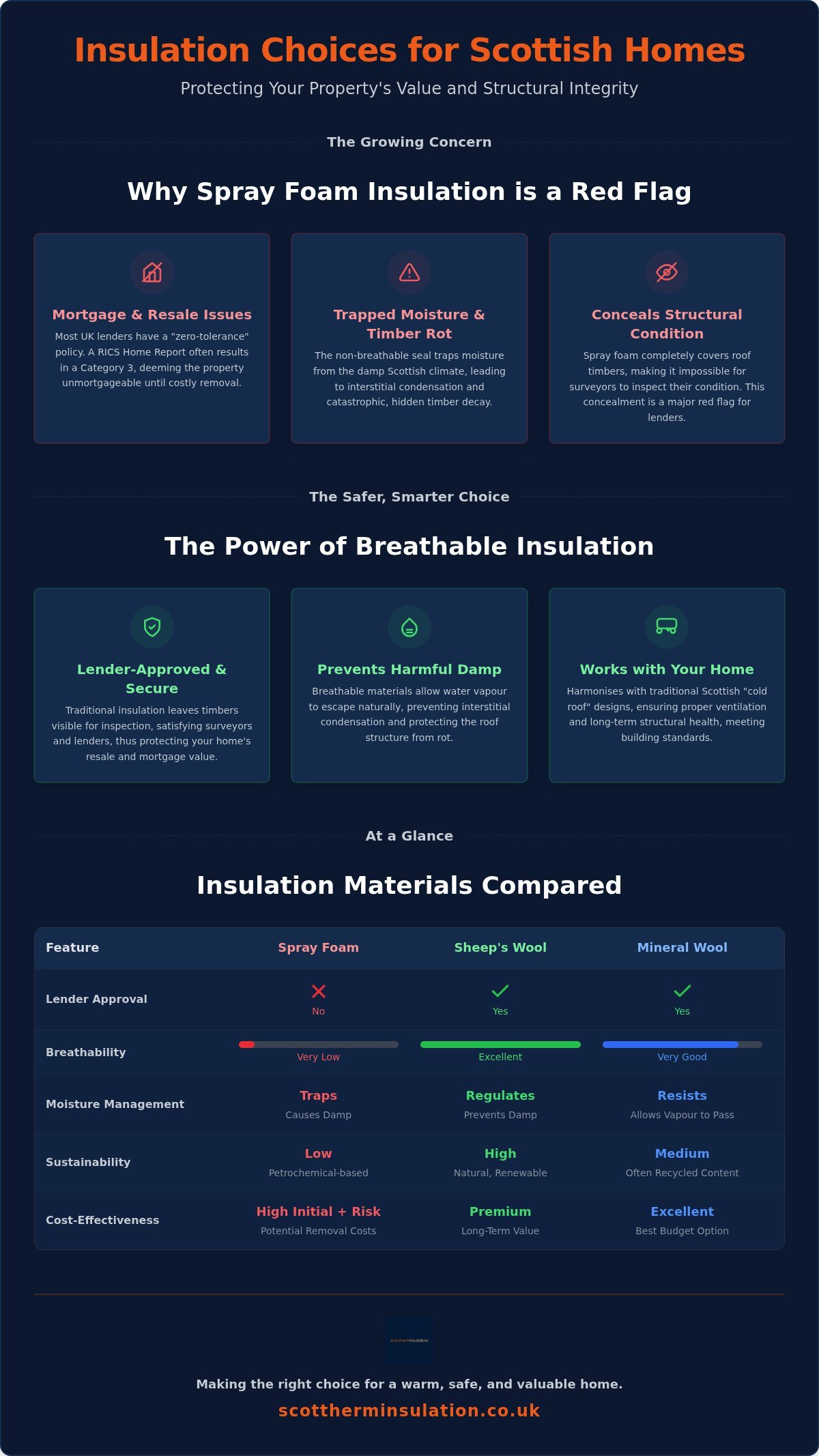
Comparing the Best Alternatives: Sheep’s Wool vs. Mineral Wool
Selecting the right material for your loft requires a balance between thermal performance, budget, and long-term structural safety. When evaluating alternatives to spray foam insulation scotland, two primary materials stand out as the industry gold standard: sheep’s wool and mineral wool. Unlike spray foam, which creates a permanent and often problematic bond to your roof, these traditional materials are installed as “dry” solutions. This means your roof timbers remain visible for future surveys, ensuring your home remains fully mortgageable and easy to inspect. Both options are universally accepted by UK lenders because they don’t hide structural defects or trap moisture against the wood.
In terms of performance, both materials excel at meeting the 2026 Scottish Building Standards. To achieve the required U-values, a depth of 270mm is typically recommended for loft spaces. While their R-values (thermal resistance) are broadly similar at these depths, their environmental footprints and moisture-handling capabilities differ. Sheep’s wool is the premium, sustainable choice, whilst mineral wool offers a highly reliable, non-combustible alternative that fits most budgets. Choosing between them often depends on the age of your property and your specific environmental goals.
The Benefits of Sheep’s Wool in Scotland
Sheep’s wool is uniquely suited to the Scottish climate due to its incredible moisture-regulating properties. It can absorb up to 33% of its weight in water vapour without losing its insulating power, acting like a natural dehumidifier for your loft. This makes it a favourite choice for historic properties in Edinburgh and Fife, where maintaining the breathability of older stone structures is essential. It also possesses natural fire resistance and can even filter harmful chemicals like formaldehyde from the indoor air. When you follow Historic Environment Scotland’s guidance on traditional buildings, natural fibres are often the recommended path for protecting our architectural heritage.
Mineral Wool: Reliable Performance and Fire Safety
Mineral wool remains a popular choice for modern lofts across Stirling, Perth, and North Berwick. It’s made from molten rock or glass spun into a fibrous structure, providing exceptional fire safety with a non-combustible rating. Beyond heat retention, it offers superior acoustic insulation, which is a major benefit if you live near busy transport links or within active town centres. It’s easy to install amongst standard joist spacings and maintains its shape for decades without settling. If you’re looking for cost-effective alternatives to spray foam insulation scotland that provide immediate comfort and peace of mind, mineral wool is a proven, high-performance solution that meets every modern regulatory requirement.
Protecting Your Property Value and Mortgageability
Ensuring your home remains a liquid asset is just as vital as keeping it warm. In the 2026 property market, energy efficiency has become a primary concern for buyers, but not all upgrades are viewed equally. Mortgage lenders across the UK have maintained a strict stance on certain materials, often refusing to lend on properties where the roof structure is obscured. By choosing alternatives to spray foam insulation scotland, you provide future buyers and their surveyors with the transparency they need. This visibility is essential for a smooth house sale, as it allows for a clear assessment of the timber rafters and roof felt.
The financial risks of choosing the wrong material are substantial. If a home survey identifies spray foam, a sale can fall through instantly, leaving the seller with the significant cost of professional removal and structural repairs. In contrast, traditional breathable materials act as a badge of quality. They signal that the property has been maintained using industry-standard methods that respect the building’s longevity. Providing a lender-approved insulation certificate at the point of sale has become a powerful tool for Scottish homeowners to secure their asking price whilst ensuring the property remains mortgageable.
Surveyor-Friendly Loft Solutions
Surveyors require clear sightlines to confirm the structural health of a roof. Materials like mineral wool and sheep’s wool are installed between or over joists, leaving the critical timber elements exposed for inspection. This approach eliminates the guesswork that leads to “Category 3” survey results. When you invest in loft insulation scotland, you receive professional documentation from local experts like ScotTherm. These certificates prove that your installation meets the highest safety standards, giving both lenders and buyers total confidence in the property’s condition.
Future-Proofing with ECO4 and Grants
Accessing government funding is a smart way to offset the costs of high-quality upgrades. Most current schemes, including the Home Energy Scotland Grant and eco4 scotland, specifically favour breathable, traditional materials over spray foam. These programmes are designed to improve the nation’s housing stock without creating long-term damp issues. By using insulation grants scotland, you can install premium solutions like sheep’s wool or mineral wool that are fully compliant with 2026 regulations. This ensures your home is not only warmer but also fully aligned with the latest environmental and financial standards. To ensure your home is protected for the long term, book an assessment with our local specialists to discuss approved insulation solutions.
Professional Installation: Transitioning to a Safer Insulation Strategy
Professional installation is the final piece of the puzzle for maintaining a healthy, mortgageable home. Whilst laying mineral wool batts might seem like a straightforward task, many DIY attempts inadvertently block the eaves. This stops the essential cross-ventilation required to keep your roof dry and your timbers healthy. Our team ensures that every installation maintains a clear air gap, adhering to the strict BS 5250 guidelines for moisture control. By choosing professional alternatives to spray foam insulation scotland, you’re investing in a system that has been verified for safety, longevity, and thermal efficiency.
We begin every project by identifying whether your property has a traditional slate roof or a modern tiled structure. This assessment allows us to recommend the ideal depth and material, whether that’s sustainable sheep’s wool for its moisture-buffering qualities or mineral wool for its fire-safe performance. We provide a clear, structured plan before any work begins, ensuring you understand how the chosen material will interact with your home’s unique ventilation needs. This precision ensures your home meets the 0.12 W/m²K roof U-value required by the 2026 Scottish Building Standards.
Specialist Services in Edinburgh, Fife, and Stirling
Scottish property stock varies wildly, from Edinburgh’s historic tenements to modern villas in Stirling. We adapt our strategies for every era, ensuring that older stone buildings retain their natural breathability. A whole-house approach is often the most effective way to save on energy bills. This includes considering under floor insulation alongside loft upgrades to eliminate draughts from the ground up. Our teams are organised to work efficiently, minimising disruption to your daily routine whilst delivering a clean, professional finish that adds tangible value to your property.
Why Choose ScotTherm for Your Alternative Insulation?
Our reputation as local experts is built on a commitment to breathable, safe, and lender-approved materials. We understand the specific weather patterns of the region, from the salt-laden air in North Berwick to the heavy rainfall in Perth. This local knowledge allows us to provide advice that national corporations simply can’t match. Every installation we complete is backed by our history of excellence and adherence to the latest building regulations. If you’re ready to secure your home’s thermal and financial future, book your free insulation inspection with our specialists. Contact ScotTherm for a professional assessment today.
Secure Your Home’s Future with Breathable Solutions
Protecting your home from the damp Scottish climate requires more than just heat retention; it demands a strategy that respects the structural health of your property. By choosing breathable alternatives to spray foam insulation scotland, you ensure your roof remains dry and your timbers stay rot-free. We have explored how traditional materials like mineral wool and sustainable sheep’s wool maintain the “cold roof” principle whilst keeping your property fully mortgageable for the long term.
As a local Scottish family-run business, we take pride in providing solutions that meet the 2026 Scottish Building Standards without compromising your asset’s value. We are specialists in breathable sheep’s wool and provide lender-approved insulation certificates with every installation to give you total peace of mind. Taking the right steps now prevents the financial and structural headaches often associated with non-breathable synthetic foams.
Ready to upgrade your home safely? Book your specialist free insulation inspection with ScotTherm today. Our team is here to help you create a warmer, more secure, and cost-effective environment for your family.
Frequently Asked Questions
Is spray foam insulation being banned in Scotland in 2026?
No legal ban on the material exists in 2026, but its use has become highly restricted by building standards and lending criteria. Most homeowners now avoid it because it clashes with the latest RICS consumer guidance and Scottish Building Standards. Choosing recognised alternatives to spray foam insulation scotland is the most reliable way to ensure your property remains compliant and easy to sell.
Will spray foam insulation stop me from getting a mortgage?
Spray foam can indeed prevent you from securing a mortgage or remortgaging your home. Many UK lenders have adopted a zero-tolerance policy because the foam obscures the roof timbers, making it impossible for surveyors to check for rot or structural defects. Switching to breathable, visible materials ensures your home stays mortgageable by allowing for clear structural inspections during any future home report.
Which is the best alternative to spray foam for a traditional stone house?
Sustainable sheep’s wool is the superior choice for traditional Scottish stone properties. These older buildings rely on the movement of moisture through their fabric to stay dry and healthy. Natural wool can absorb and release water vapour without losing its thermal efficiency, making it the safest way to protect historic rafters in damp regions like Edinburgh and Fife.
How much does it cost to remove spray foam and replace it with wool?
The cost of removal varies significantly based on the size of your roof and whether the foam is open-cell or closed-cell. It is an invasive process that often requires stripping the material from the rafters and replacing the roof felt. Whilst it’s a significant investment, replacing it with breathable wool prevents further structural damage and restores the property’s market value.
Is sheep’s wool insulation as warm as spray foam?
Sheep’s wool provides equivalent thermal comfort when installed to the recommended depth of 270mm. Whilst foam is often marketed for its thinness, natural wool offers superior moisture control and a more stable thermal mass. It ensures your home meets the strict 0.12 W/m²K roof U-value required by 2026 regulations while maintaining a healthier, more breathable indoor environment.
Do I need to increase loft ventilation if I switch to mineral wool?
Maintaining proper ventilation is essential whenever you install mineral wool or any other loft insulation. You must ensure that eaves vents remain clear to allow for constant cross-ventilation. This prevents stagnant, humid air from building up amongst the rafters, which is the primary cause of timber rot in our unique Scottish climate.
Can I get a grant for alternatives to spray foam in Scotland?
Yes, several government-backed schemes provide funding for approved alternatives to spray foam insulation scotland. The Home Energy Scotland Grant and the ECO4 scheme both offer support for installing traditional, breathable materials like mineral wool. These grants are specifically designed to help homeowners improve their EPC ratings using safe, lender-approved methods that protect the building’s longevity.
Does mineral wool insulation attract pests amongst the rafters?
Modern mineral wool does not attract pests as it is an inorganic material that offers no nutritional value to rodents or insects. It is manufactured to be resistant to nesting and does not degrade over time. When professionally installed, it provides a clean, stable, and fire-safe environment for your loft space that lasts for the lifetime of the building.