
Did you know that sheep wool can absorb up to 30% of its weight in moisture without losing its ability to keep your home warm? For homeowners in Edinburgh, Fife, or the Highlands, this isn’t just a technical detail; it’s a vital defence against the Scottish winter. When you evaluate the cost of sheep wool insulation vs rockwool, it’s tempting to look only at the upfront price tag. You likely want to lower your heating bills whilst ensuring your stone walls don’t suffer from trapped condensation or damp.
In this 2026 guide, you’ll discover the real-world value difference between sustainable sheep wool and traditional rockwool. We’ll help you move past confusing R-values to understand how these materials perform in our specific climate. You’ll gain a clear perspective on the price-to-performance ratio and learn which grants, such as the Home Energy Scotland Grant, might help cover your costs. By the end, you’ll have the confidence to choose an insulation that keeps your home cosy and your energy costs low for years to come.
Key Takeaways
- Distinguish between volcanic rock-based fibres and natural protein fibres to determine which material is most compatible with your property’s age and construction.
- Analyse the cost of sheep wool insulation vs rockwool to understand why the higher upfront price of natural wool provides better long-term protection for traditional Scottish homes.
- Explore how hygroscopic materials maintain thermal integrity and manage moisture levels in the high-humidity environments often found across Fife and Perth.
- Review 2026 eligibility for the Home Energy Scotland Grant to see if you can receive significant funding for your sustainable insulation project.
- Recognise why professional installation is critical to eliminate thermal bridging and ensure your chosen material delivers the maximum possible reduction in your energy bills.
Comparing Sheep Wool and Rockwool: Understanding the Materials
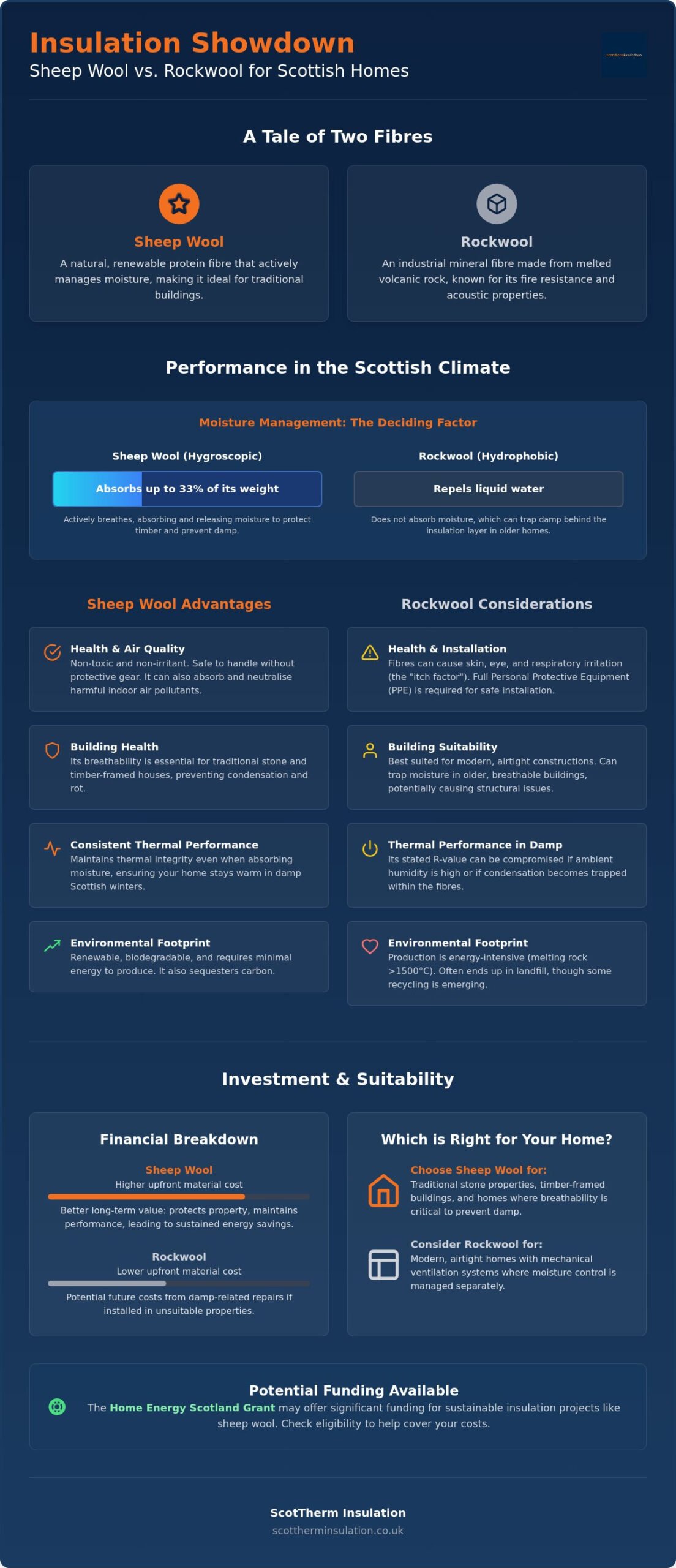
Rockwool, often referred to as mineral wool, is an industrial staple created by melting volcanic rock and slag at temperatures exceeding 1,500 degrees Celsius. This molten material is spun into fine strands and bonded together to form dense batts or rolls. It’s a robust, non-combustible material that has served as the UK standard for decades. Conversely, Wool insulation is a natural, renewable protein fibre harvested from sheep. It’s processed with significantly less energy and possesses inherent carbon-sequestering properties, as the wool stores carbon captured by the sheep during its lifetime. Understanding the cost of sheep wool insulation vs rockwool involves more than just comparing price per square metre; it requires looking at the life cycle and installation requirements of each material.
Homeowners across Scotland are increasingly scrutinising these materials as 2026 building regulations demand higher thermal efficiency. For existing homes, the target U-value for roofs is now 0.16 W/m²K. Achieving this requires a material that doesn’t just fill a gap but performs consistently under the pressure of the Scottish climate. Whether you’re insulating a drafty Victorian loft in Edinburgh or a modern extension in Perth, the decision often balances immediate budget constraints against long-term building health and environmental impact.
The Manufacturing Process and Environmental Footprint
The environmental impact of these materials begins at the factory gate. Rockwool production requires massive energy inputs to achieve the necessary melting point of the stone. Whilst many manufacturers now use recycled content, the process remains carbon-intensive. Sheep wool offers a stark contrast. It requires minimal energy for cleaning and carding. For eco-conscious Scottish homeowners, the fact that wool is biodegradable and renewable makes it a compelling choice. At the end of its life, sheep wool can be composted, whereas rockwool often ends up in landfill, though some specialised facilities are beginning to recycle mineral fibres into new bricks or insulation products.
Health and Safety During Installation
Installation comfort is a major differentiator that many homeowners overlook until the project begins. Mineral fibres are notorious for the “itch factor.” These tiny glass or stone shards can irritate the skin, eyes, and respiratory system. Professional loft insulation fitters always wear full protective gear, including masks and gloves, when handling rockwool to mitigate these risks. Sheep wool is entirely different. It’s non-toxic and safe to touch without any special clothing. This makes it a favourite for families concerned about indoor air quality or those who may need to access their loft space frequently for storage.
Thermal Performance and Breathability in the Scottish Climate
Laboratory R-values provide a useful baseline, but they rarely reflect the reality of a damp Tuesday in Fife or Perth. Standard insulation tests are conducted in bone-dry conditions. In the real world, particularly across Scotland, humidity levels frequently exceed 80%. When you evaluate the cost of sheep wool insulation vs rockwool, you must consider how these materials behave when the air turns misty. A material’s Lambda value measures its thermal conductivity, but this figure can be misleading if the insulation loses its effectiveness the moment it gets slightly damp.
Sheep wool is naturally hygroscopic. This means it actively manages moisture by absorbing and releasing water vapour without compromising its thermal integrity. Rockwool, by contrast, is hydrophobic; it repels liquid water but cannot “breathe” in the same way. In modern, airtight builds, rockwool performs admirably. However, for the thousands of traditional stone properties across the Central Belt, trapping moisture behind a non-breathable layer can lead to significant structural issues. If you’re unsure which material suits your specific roof type, consulting with a Scottish specialist can help you avoid long-term damp problems.
Moisture Management: The Key to Preventing Damp
Sheep wool is unique because it can absorb up to 33% of its own weight in moisture whilst remaining dry to the touch. This process actually generates a small amount of heat, which helps keep the surrounding timber structures warm. In older Scottish homes with solid stone walls, this breathability prevents interstitial condensation. This is the hidden moisture that builds up inside a wall or roof, often leading to timber rot or mould. By choosing a material that works with the building’s natural ventilation, you protect the longevity of your roof timbers and maintain a healthier indoor environment.
Summer Overheating vs Winter Heat Retention
While we focus on the winter chill, summer overheating is becoming a genuine concern for Scottish loft conversions. Sheep wool has a higher thermal mass than most mineral wools. This creates a “phase shift” that slows down the transfer of heat into your living space during the day. Rockwool provides a different set of benefits, most notably its Euroclass A1 non-combustible fire rating. It offers exceptional fire resistance whilst providing reliable winter insulation. Both materials will significantly reduce your energy bills, but your choice should depend on whether your priority is moisture regulation in an old building or maximum fire safety in a newer one.
The Financial Breakdown: Upfront Investment vs Long-Term ROI
When planning a renovation in Scotland, the initial quote often becomes the primary deciding factor. It’s a simple reality that sheep wool requires a higher initial investment than rockwool. This price gap exists because rockwool is a product of industrial mass production, whilst sheep wool is a natural resource that requires specialised harvesting, cleaning, and processing. However, focusing solely on the checkout price ignores the “Total Cost of Ownership” over the next twenty or thirty years. Whether you choose mineral fibres or natural fleece, the professional installation costs remain remarkably similar. The labour involved in clearing a loft, fitting the batts, and ensuring a tight seal doesn’t change based on the material. You’re paying for the same expert time regardless of the product.
The cost of sheep wool insulation vs rockwool should be viewed as a choice between a commodity and a long-term asset. Rockwool is highly effective and offers a lower barrier to entry for those on a strict budget. Sheep wool, however, is often chosen by those looking to invest in the structural health of their property. By understanding how these materials age and interact with your home’s heating system, you can make a decision that balances your immediate bank balance with your future energy security.
Energy Bill Savings and Amortisation
Under the 2026 energy price cap, every percentage point of efficiency matters for Scottish households. Rockwool provides excellent thermal resistance, but its performance can dip if humidity levels rise within the loft space. Because sheep wool maintains its R-value even when moisture levels fluctuate, it often provides more consistent savings on heating bills over time. This superior moisture regulation means your boiler doesn’t work as hard to maintain a steady temperature during those damp Perthshire winters. Additionally, installing premium wool insulation can be a significant selling point. Homeowners in Edinburgh and Fife are increasingly looking for properties with high EPC ratings and sustainable credentials, which can translate into a higher valuation when it’s time to move.
Maintenance and Durability Costs
Durability is another vital component of the cost of sheep wool insulation vs rockwool debate. Rockwool is a dense material, but over several decades, it can be prone to sagging or compression if exposed to heavy moisture or physical disturbance. Once compressed, it loses the air pockets that provide insulation. Sheep wool is naturally elastic. It retains its loft and springiness for the life of the building. Whilst older natural products faced risks from pests, modern sheep wool insulation is treated with integrated moth-proofing during manufacture. This ensures your investment remains intact without the need for expensive remedial work or replacement due to pest damage or damp-induced degradation. Choosing the more resilient material now prevents the hidden costs of replacing failed insulation in fifteen years.
Property Suitability: Which Insulation Should You Choose?
Choosing between these materials requires a careful look at your property’s specific “breathing” requirements. In Edinburgh or Perth, you might be living in a stone-built tenement or a timber-framed modern terrace. The cost of sheep wool insulation vs rockwool should be weighed against the structural risks of each building type. Traditional solid-walled homes were designed to allow moisture to move through the fabric. Modern homes, however, often rely on mechanical ventilation and airtight membranes to manage air quality.
Fire safety is another critical factor for Scottish homeowners. For room-in-roof projects in Stirling or Perth, building regulations are stringent. Rockwool is often the preferred choice here due to its non-combustible nature. However, if you’re insulating a cold loft space above a traditional property, the moisture-management benefits of sheep wool often outweigh the industrial advantages of mineral fibre. A one-size-fits-all approach to insulation often leads to costly remedial work later on.
Best for Traditional and Historic Homes
Solid wall constructions, common in Victorian and Georgian architecture across the Central Belt, are vulnerable to moisture traps. If you seal these properties with non-breathable materials, you risk the “sealed box” effect. This leads to condensation, mould, and eventually, structural decay. Sheep wool is the gold standard for these homes because it allows moisture to pass through whilst maintaining high thermal performance. This is particularly vital for underfloor insulation in suspended timber floors, where air circulation is essential to prevent joist rot. Using a natural, breathable material ensures the building fabric remains healthy and dry.
Best for Modern Developments and Commercial Lofts
Rockwool is often the more logical choice for modern developments where budget-efficiency and high-level fire ratings are the primary drivers. In semi-detached or terraced homes, the density of rockwool provides superior acoustic insulation, significantly reducing noise transfer between neighbours. Because it is a mass-produced industrial product, it remains the default material for many ECO4 Scotland grant-funded projects. If your home has a modern vapour control layer and mechanical extract ventilation, rockwool offers a cost-effective way to meet 2026 energy standards without the premium price of natural fibres. It’s a reliable, high-performance option for newer builds with standard cavity walls.
To find out if your property qualifies for a fully funded upgrade under current government schemes, you can check your ECO4 Scotland eligibility today.
Professional Installation: Maximising Your Investment with ScotTherm
Even the most premium material choice cannot overcome the pitfalls of a poor installation. When considering the cost of sheep wool insulation vs rockwool, homeowners must account for the precision required to create a continuous thermal envelope. If insulation is compressed, it loses the vital air pockets that trap heat. If gaps are left around joists or eaves, thermal bridging occurs, allowing expensive warmth to escape and creating cold spots where mould can flourish. Precision matters. Our team ensures that every roll or batt is fitted tightly and correctly, regardless of the material you choose.
A professional survey is the most reliable way to determine which material suits your property’s specific structural needs. We look beyond the surface to assess ventilation levels, timber health, and existing insulation depth. This technical oversight ensures that your investment delivers the promised energy savings. Whilst the cost of sheep wool insulation vs rockwool differs at the point of purchase, the value of an expert installation remains constant. A well-installed system protects your home’s fabric and your bank balance for decades.
The ScotTherm Difference in Scotland
We take immense pride in our regional accountability. Operating across Edinburgh, Fife, Perth, and Stirling, we understand the specific challenges posed by the Scottish climate and our diverse housing stock. Our installers are not just technicians; they are specialists in thermal efficiency. We follow a rigorous process that begins with a clean site preparation and ends with a verified check of the finished thermal layer. This disciplined approach provides the peace of mind that comes from using certified professionals who are invested in the long-term well-being of their local community.
Next Steps for Your Home Efficiency Project
The path to a warmer, more cost-effective home begins with an accurate assessment. Booking a specialist inspection allows us to compare material costs for your specific layout and identify the most efficient route forward. During the consultation, we will explain the technical benefits of each material and provide a clear, benefit-driven breakdown of the project. We prioritise safety, long-term value, and your domestic comfort above all else. You can Request a professional insulation quote for your Scottish home today to secure your property against the winter ahead.
Our team is ready to help you navigate the technical specifications and grant opportunities available in 2026. Whether you are looking for the breathable luxury of sheep wool or the industrial reliability of rockwool, we provide the expertise needed to transform your home’s energy performance.
Secure Your Scottish Home for the Future
Choosing the right material is a balance between immediate budget and long-term building health. Whilst rockwool offers an efficient and fire-resistant solution for modern properties, the natural breathability of sheep wool remains the gold standard for traditional stone buildings. Evaluating the cost of sheep wool insulation vs rockwool requires looking beyond the initial invoice to the decades of energy savings and structural protection ahead. Whether you prioritise the acoustic benefits of mineral fibre or the moisture-managing properties of natural fleece, the quality of the thermal envelope depends entirely on the precision of the fit.
As accredited Scottish insulation specialists, we provide the technical expertise needed to make this investment count. Our specialist installers for Edinburgh, Fife, and Perth are experts in both mineral and sustainable wool; we ensure your project meets 2026 energy standards with ease. Don’t leave your home’s efficiency to chance. You can Get a Professional Insulation Quote from ScotTherm Insulation today to begin your journey toward a warmer, more sustainable future. We look forward to helping you create a cosier environment for your family.
Frequently Asked Questions
Is sheep wool insulation more expensive than rockwool?
Sheep wool insulation is more expensive than rockwool because it is a natural resource that requires intensive cleaning and processing. Whilst the upfront price is higher, many Scottish homeowners find the long-term protection against damp in older stone properties justifies the initial investment. When you compare the cost of sheep wool insulation vs rockwool, you should factor in the potential savings from avoided remedial work related to moisture damage over the building’s life.
Does sheep wool insulation smell like a farm?
Professional sheep wool insulation does not smell like a farm because it undergoes a rigorous scouring and cleaning process. This removes the raw lanolin and dirt found in raw fleeces. The result is a clean, odourless product that is safe to use in any part of the home. It is an ideal choice for those who are sensitive to the chemical odours sometimes associated with synthetic materials or adhesives.
Which material is better for fire safety, rockwool or sheep wool?
Rockwool is the superior choice for fire safety as it carries a Euroclass A1 non-combustible rating. It can withstand temperatures exceeding 1,000 degrees Celsius without melting or contributing to a fire’s spread. Sheep wool is naturally fire-resistant and will self-extinguish when the flame source is removed, but it does not match the industrial-grade fire protection provided by volcanic rock-based mineral wool. This makes rockwool the standard for high-risk areas.
Can I install sheep wool insulation myself to save on costs?
You can install sheep wool yourself since it is non-toxic and safe to touch, but professional installation is recommended to ensure maximum thermal efficiency. DIY projects often suffer from gaps, compression, or thermal bridging that undermine the material’s performance. Expert installers ensure a continuous thermal envelope, which is vital for achieving the energy savings needed to offset the cost of sheep wool insulation vs rockwool in the long term.
How long does sheep wool insulation last compared to mineral wool?
Both materials are designed to last the lifetime of the building, typically 60 years or more, but sheep wool is often more resilient to physical settling. The natural elasticity of wool fibres allows the batts to retain their loft and springiness even after decades of use. Rockwool is also highly durable, though it can be prone to sagging if it is exposed to significant weight or physical disturbance over time in a loft space.
Are there grants available in Scotland for sheep wool insulation?
Grants are available in Scotland for energy efficiency improvements through the Home Energy Scotland Grant and Loan scheme. In 2026, homeowners can receive a grant for up to 75% of the cost of insulation measures, up to a maximum of £7,500. Eligibility for specific materials like sheep wool under the ECO4 scheme depends on your household income and the specific recommendations of your energy assessment. It is always best to check current eligibility before starting a project.
Which insulation is better for soundproofing between floors?
Rockwool is generally better for soundproofing between floors because its high density effectively blocks airborne noise. It is a popular choice for terraced homes or flats in Edinburgh where reducing sound transfer between neighbours is a priority. Whilst sheep wool does provide some acoustic benefit, the mass and structure of mineral wool fibres make it the industrial standard for creating a quiet indoor environment in multi-occupancy buildings.
Does sheep wool insulation attract moths or vermin?
Modern sheep wool insulation does not attract moths or vermin because it is treated with a salt-based or integrated protection during the manufacturing process. This treatment makes the fibres unpalatable to insects and prevents infestations. Similarly, rockwool is an inorganic material that provides no nutritional value to pests. Both insulation types remain secure and intact within your loft or wall cavities when installed correctly by a professional team.