
What if you could stop 25% of your home’s heat from escaping without losing a single inch of floor space or hiding your property’s original character? Many homeowners across the country feel forced to choose between draughty rooms and the invasive, dusty process of stripping back walls. If you are worried about the risk of dampness in older stone buildings or simply cannot face the upheaval of a major renovation, exploring smart alternatives to internal wall insulation scotland is the most practical path forward.
We understand that maintaining the breathability and structural integrity of a traditional Scottish home is just as important as lowering your monthly outgoings. This guide shows you how to achieve maximum thermal comfort and significant energy savings through less disruptive methods. You will discover how targeting often-overlooked areas like lofts and floors can deliver the warmth you need whilst protecting your home from mould. We will also look at how the current 0% VAT on energy-saving materials and high-performance natural fibres like sheep’s wool make your upgrade both affordable and sustainable.
Key Takeaways
- Understand why skipping internal wall insulation protects your floor space and period features whilst still significantly reducing heating bills.
- Learn how high-performance loft insulation addresses the 25% of heat loss occurring through your roof with minimal home disruption.
- Discover how underfloor insulation for suspended timber floors eliminates cold draughts and creates a complete thermal seal at the base of your house.
- Identify the most effective alternatives to internal wall insulation scotland by choosing breathable materials like sheep’s wool that prevent damp in traditional stone properties.
- Find out how a professional thermal inspection can help you access ECO4 funding and ensure your home’s long-term structural health.
Why Many Homeowners Seek Alternatives to Internal Wall Insulation
Internal wall insulation (IWI) has long been the standard recommendation for Scotland’s older, solid-walled properties. It involves attaching insulation boards or timber frames to the inner face of external walls. Because stone walls cannot be filled with cavity insulation, this internal layer creates a barrier to stop heat from escaping. However, the practical reality of this method often clashes with the lifestyle of modern families and the preservation of historic architecture.
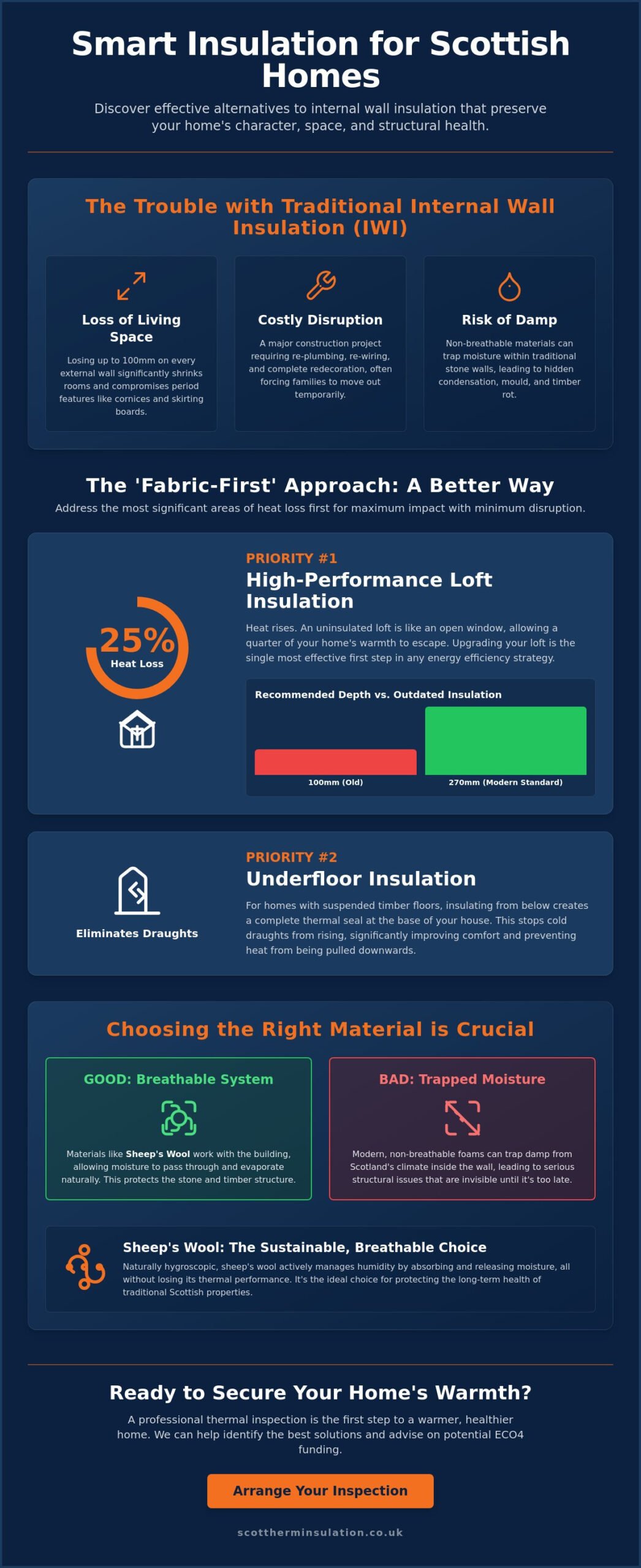
One of the biggest hurdles is the loss of floor area. In a typical Scottish tenement or a compact cottage, losing up to 100mm of space on every external wall can significantly reduce the footprint of a room. You aren’t just losing space; you are often losing original features. Stripping away ornate coving and heavy timber skirting boards to accommodate insulation can ruin the period charm that makes these homes so desirable. This “Scottish Tenement Challenge” means that for many, IWI is simply too invasive. Instead of starting with the walls, we recommend a “Thermal Priority” approach. This means fixing the easiest, most impactful heat leaks first before considering a major wall renovation.
The Disruption and Cost Factor
Choosing IWI isn’t a simple weekend task. It’s a major construction project that usually requires homeowners to move out or live in a building site for several weeks. The costs go far beyond the insulation itself. You have to hire plumbers to relocate radiators and electricians to move sockets and switches. Once the boards are up, every room requires complete redecoration. For those seeking practical building insulation materials that won’t break the bank or the spirit of the household, non-invasive improvements are a far more attractive prospect.
Moisture Risks in Traditional Stone Buildings
Traditional Scottish stone buildings were designed to be “breathable,” allowing moisture to move through the fabric of the building and evaporate. Using modern, non-breathable foams can trap this moisture within the wall. This leads to interstitial condensation, where water droplets form behind the insulation, hidden from view. In our damp climate, this trapped moisture can rot timber joists and encourage mould growth. Exploring breathable alternatives to internal wall insulation scotland ensures that your home stays warm without compromising the structural health of the stone. To ensure your property is protected from all angles, consulting with damp proofing specialists like cavclear.co.uk can help identify potential issues before they escalate. By focusing on areas like the loft and floors, you can achieve significant thermal gains without the moisture risks associated with sealing up your walls.
The Low-Hanging Fruit: High-Performance Loft Insulation
If you want to avoid the mess and lost floor space of wall work, look upwards. Heat naturally rises, and in a typical uninsulated Scottish home, about 25% of that warmth escapes straight through the roof. Upgrading your loft is often the most impactful of all alternatives to internal wall insulation scotland because it addresses a massive thermal leak with almost zero disruption to your daily life. Unlike wall projects, loft work doesn’t require you to move furniture, strip plaster, or redecorate your living areas. It is the most logical starting point for any “fabric-first” energy strategy.
To achieve maximum efficiency, the current industry standard is a depth of 270mm. Many older properties in Edinburgh and Fife still rely on a thin, outdated layer of 100mm or less. Topping this up creates an immediate thermal blanket that keeps your heating where it belongs. However, thickness alone isn’t enough. Professional installation is vital to ensure that eaves ventilation remains clear. If you block the airflow in your roof space, you risk creating stagnant air pockets that lead to timber rot. Our team focuses on maintaining this critical balance between heat retention and structural breathability to protect your home’s long-term value.
Mineral Wool vs Sustainable Sheep’s Wool
While mineral wool is a reliable and cost-effective choice, sheep’s wool insulation offers unique advantages for our local climate. Sheep’s wool is naturally hygroscopic, meaning it can absorb and release moisture without losing its insulating properties. This behaviour is highly valued in Historic Environment Scotland guidance, as it helps manage the humidity levels found in traditional stone buildings. It’s an eco-friendly, high-performance material that provides peace of mind for those prioritising environmental responsibility alongside physical warmth.
Room-in-Roof Insulation for Attic Living
Many 1.5-storey cottages and tenement flats feature rooms built directly into the roof space. These areas are notoriously difficult to keep warm because they lack a standard loft void. In these cases, specialised room-in-roof solutions target the sloping ceilings and small “dwarf” walls. This approach provides a warmer living environment and serves as one of the most effective alternatives to internal wall insulation scotland for homes with limited internal space. For a deeper look at your options, our Loft Insulation in Scotland guide covers everything you need to know about preparing your attic for the winter months. If you’re ready to improve your home’s comfort, you can speak with our specialist team for an expert assessment of your property.
The Hidden Hero: Underfloor Insulation for Suspended Floors
Many traditional homes in Edinburgh and Fife suffer from what we call “cold feet syndrome.” This occurs when icy air from the sub-floor void seeps through gaps in original timber floorboards, making your living room feel draughty even when the heating is on full. Whilst many homeowners focus on the walls, the floor is often the primary source of physical discomfort. Underfloor insulation acts as a thermal seal at the base of your home, blocking these draughts before they reach your living space. For ground-floor flats and villas, this is frequently one of the most effective alternatives to internal wall insulation scotland. It offers a high return on comfort without the need to strip your walls or lose valuable floor space.
You don’t always need to lift every floorboard to achieve this level of warmth. If your property has a crawl space with sufficient height, our specialists can install insulation from below. We secure high-performance batts between the timber joists, held firmly in place with breathable netting. This method is incredibly non-invasive compared to wall work. If access from below is restricted, we carefully lift a small number of boards to slide the insulation into place. This targeted approach preserves your original flooring whilst transforming the temperature of your home. It is a practical solution that avoids the significant redecoration costs associated with wall-based projects.
Stopping the Draughts from Below
The primary benefit of floor insulation isn’t just heat retention; it’s the elimination of air infiltration. Uninsulated suspended floors act like a giant vent, pulling cold air into the house as warm air rises. By sealing this area, you’ll notice an immediate difference in how your home feels. You can often lower your thermostat by a degree or two because the “floor chill” is gone. Crucially, professional installation ensures that we don’t block the air bricks. Maintaining sub-floor ventilation is essential to prevent damp and protect your joists from rot. Research indicates that insulating floors can save as much as £100 a year on energy bills, making it a financially sound choice.
Materials for Underfloor Success
Choosing the right material is vital for a successful installation. Mineral wool and sheep’s wool are ideal because they fit snugly between irregular timber joists, leaving no gaps for air to bypass. Beyond the thermal gains, these materials provide excellent acoustic benefits, muffling the sound of footsteps and reducing noise transfer. For more detailed information on the process and benefits, see our Under Floor Insulation guide. This investment often yields a more noticeable daily improvement in comfort than many other alternatives to internal wall insulation scotland, particularly in older properties with high ceilings.
The Breathable Alternative: Choosing the Right Materials
In traditional Scottish properties, the material you choose is often more important than the thickness of the layer. While many focus solely on R-values, which measure thermal resistance, homeowners in Stirling and North Berwick must prioritise “breathability.” Our sandstone and granite buildings were constructed to handle moisture by allowing it to pass through the walls. If you seal these surfaces with modern plastic foams, you risk trapping water within the stone. This is why selecting the right materials serves as one of the most effective alternatives to internal wall insulation scotland. By using moisture-compatible materials in your loft and floors, you protect the building’s structural health whilst significantly improving its thermal performance.
The science comes down to the difference between hygroscopic and hydrophobic materials. Hydrophobic materials, like most rigid foam boards, repel water. In a solid-walled house, this causes moisture to pool at the interface between the wall and the insulation. Hygroscopic materials, such as sheep’s wool, act like a buffer. They can absorb up to 33% of their own weight in moisture without losing their ability to keep your home warm. This natural regulation prevents the dampness and mould growth that often plague properties where inappropriate, non-breathable insulation has been used.
Why Sheep’s Wool Suits the Scottish Climate
Natural wool is uniquely suited to the damp, unpredictable weather found across Edinburgh, Fife, and Perthshire. Beyond its moisture-handling capabilities, wool actually generates a small amount of heat when it absorbs water vapour, providing an extra layer of thermal security. It also acts as a natural air filter, absorbing harmful chemicals like formaldehyde to improve your indoor air quality. Because it is non-toxic and naturally fire-resistant, it remains the gold standard for traditional Scottish architecture. Choosing this high-tier material allows you to achieve superior comfort levels without the need for the thick, invasive wall boards used in standard internal projects.
Mineral Wool: The Versatile All-Rounder
For budget-conscious homeowners, mineral wool remains a highly effective and versatile choice. It offers excellent fire performance and superior sound-deadening qualities, making it ideal for tenement flats where noise transfer is a concern. The key to its success lies in the installation. A professional fit ensures there are no gaps or “cold bridges” where heat can escape. When installed correctly in your loft or under your floors, mineral wool provides a consistent thermal barrier that rivals the benefits of more expensive wall work.
If you want to ensure your property remains both warm and breathable, you can request a specialist material assessment to find the perfect fit for your home’s unique construction.
How to Determine the Best Insulation Arc for Your Home
Every property has a unique thermal profile, and relying on guesswork often leads to wasted investment. Choosing the right alternatives to internal wall insulation scotland requires a structured approach that considers the building’s age, construction material, and existing ventilation. At ScotTherm Insulation, we move away from “one-size-fits-all” solutions. Instead, we look at the house as a complete system. This “insulation arc” begins by securing the roof, moves to sealing the floors, and finishes by ensuring every material used maintains the breathability of your stone walls. This logical sequence ensures you get the highest return on thermal comfort without the upheaval of major internal renovations.
Our technical surveys are designed to identify the most effective non-invasive measures for your specific location. Whether you own a traditional sandstone tenement in Edinburgh, a Victorian villa in Stirling, or a coastal home in North Berwick, local expertise is vital. The damp, salt-heavy air of the East Coast requires different material considerations than the more sheltered streets of Perth or Fife. ScotTherm Insulation assesses everything from the depth of your current mineral wool to the airflow in your sub-floor voids. This precision prevents common issues like interstitial condensation and ensures your home remains a healthy, dry environment for years to come.
Checking Your Eligibility for ECO4 Funding
The financial barrier to home improvement is often lower than homeowners realise. The ECO4 scheme, which runs until 31 December 2026, provides vital funding for energy efficiency measures in households with a poor EPC rating (D-G). Whilst many assume these grants only cover wall work, they frequently fund the very alternatives to internal wall insulation scotland we have discussed, such as high-performance loft and underfloor insulation. If your household income is £36,000 or less, or if you receive certain benefits, you may qualify for fully funded upgrades. You can find out more in our ECO4 Scotland Guide.
Booking Your Specialist Free Insulation Inspection
Taking the first step towards a warmer home shouldn’t be stressful. During a ScotTherm Insulation technical survey, we provide a clear, tailored plan that respects the character of your property. We don’t just look at what needs to be added; we look at how to protect what is already there. Our team will walk you through the most cost-effective path to lower bills and increased comfort, ensuring you benefit from the current 0% VAT on energy-saving materials. Don’t leave your winter comfort to chance. Book your free inspection with ScotTherm Insulation today and discover how a fabric-first approach can transform your Scottish home.
Take Control of Your Home’s Thermal Future
Achieving a warm, energy-efficient home doesn’t have to mean sacrificing your property’s character or losing valuable floor space. By prioritising high-performance loft and underfloor insulation, you can stop significant heat loss whilst maintaining the essential breathability of your stone walls. These smart alternatives to internal wall insulation scotland provide a non-invasive path to lower bills and physical comfort that lasts for decades. You don’t need to live in a building site to enjoy a cosy, draught-free environment.
Our team of local specialists serves communities across Edinburgh, Fife, Perth, and Stirling, providing the technical precision required for traditional Scottish architecture. As experts in breathable sheep’s wool and fully accredited installers for ECO4 grant funding, we ensure your upgrade is both sustainable and financially efficient. We take pride in helping our regional community navigate the complexities of energy regulations whilst protecting the structural health of their homes. Book your specialist free insulation inspection today to secure your property’s thermal health. It is time to enjoy the peace of mind that comes from a professional, fabric-first approach to home heating.
Frequently Asked Questions
Is internal wall insulation the only way to stop heat loss through solid walls?
No, it isn’t the only solution for keeping a traditional home warm. Whilst wall insulation is effective, focusing on other areas like the roof and floors often provides a better balance of cost and comfort. High-performance loft and underfloor insulation are excellent alternatives to internal wall insulation scotland. These measures target the 25% of heat lost through the roof and the significant draughts that enter through original floorboards.
Can I get a grant for alternatives like loft or underfloor insulation in Scotland?
Yes, several funding options are available for Scottish homeowners in 2026. The ECO4 scheme and the Warmer Homes Scotland grant provide fully funded insulation for eligible households, particularly those with an income of £36,000 or less. These programmes cover loft, underfloor, and room-in-roof insulation. Additionally, the 0% VAT rate on energy-saving materials remains in place until March 2027, making private installations more affordable.
Will insulating my loft make a big difference if my walls are still uninsulated?
Insulating your loft is one of the most impactful changes you can make. Because heat naturally rises, an uninsulated roof acts like an open chimney. Upgrading to the recommended 270mm depth can save between £150 and £300 per year on heating bills. It creates an immediate thermal blanket that significantly reduces the workload on your boiler, even if you haven’t yet addressed your external walls.
What is the best breathable insulation for an old stone house in Scotland?
Sheep’s wool is widely considered the gold standard for traditional stone properties. It is a hygroscopic material, meaning it can absorb and release moisture without losing its thermal efficiency. This natural regulation is vital for sandstone and granite buildings that need to “breathe” to prevent damp. Using wool is one of the safest alternatives to internal wall insulation scotland for protecting long-term structural health.
How much disruption is involved in underfloor insulation compared to wall insulation?
Underfloor insulation involves far less upheaval than wall-based projects. Wall insulation requires moving radiators, relocating electrical sockets, and complete room redecoration. In contrast, underfloor work is often completed via a sub-floor crawl space or by lifting a small number of floorboards. It targets the source of cold draughts at the base of the house without requiring you to move out or strip your walls.
Does sheep’s wool insulation really prevent dampness in traditional buildings?
Yes, sheep’s wool actively manages moisture to prevent the buildup of dampness. Unlike synthetic foams that can trap water against stone surfaces, wool allows water vapour to pass through its fibres. This prevents interstitial condensation, which is a common cause of timber rot in older homes. It is a proactive material choice that keeps both the air in your home and the building fabric itself dry.
Is mineral wool safe to use in a room-in-roof project?
Mineral wool is an exceptionally safe and effective choice for room-in-roof installations. It provides high levels of fire resistance and superior acoustic dampening, which is particularly beneficial for attic bedrooms. When professionally fitted, it snugly fills the gaps between rafters to eliminate cold spots. This ensures your converted loft stays warm in winter and cool in summer whilst meeting all modern safety standards.