
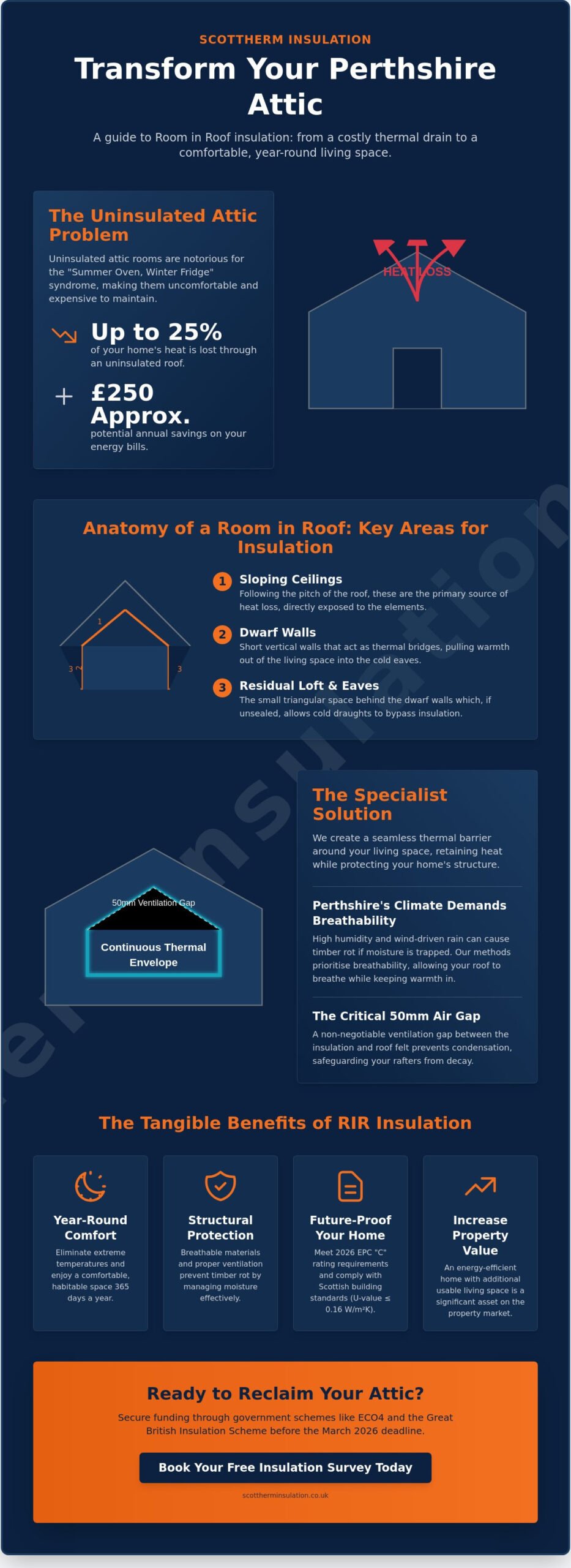
Did you know that an uninsulated home can lose up to 25% of its heat through the roof, effectively turning your upper floor into a costly thermal drain? It’s a common frustration for many local homeowners who find their attic bedrooms or offices unusable during the biting winter months. You want a warm, functional space, but the fear of intrusive construction work or choosing the wrong material for an older Perthshire roof often leads to inaction. We understand that balancing thermal efficiency with the need for a breathable, rot-free structure is a priority for any responsible property owner.
This 2026 guide explains how specialist room in roof insulation perthshire transforms cold attics into comfortable, year-round living spaces that fully comply with Scottish building standards. You’ll discover how to lower your energy bills by approximately £250 a year whilst protecting your home’s structural integrity. We will also preview the latest grant opportunities through the ECO4 and Great British Insulation schemes, helping you navigate the route to a more efficient, valuable home before the current funding cycles conclude in March 2026.
Key Takeaways
- Understand why Perthshire’s unique humidity levels and cold winters necessitate a specialised thermal lining to maintain a healthy, habitable living environment.
- Evaluate the technical advantages of over-rafter versus under-rafter installation to ensure you retain maximum headroom in your transformed attic space.
- Explore the “breathability factor” of sheep’s wool and mineral wool to prevent timber rot and manage moisture effectively in traditional Scottish roof structures.
- Learn how specialist room in roof insulation perthshire helps homeowners and landlords meet the 2026 EPC “C” rating requirements for modern energy standards.
- Identify the specific eligibility criteria for the ECO4 and Great British Insulation schemes to secure potential funding for your energy efficiency upgrades.
Understanding Room in Roof Insulation in the Perthshire Climate
Room in Roof (RIR) insulation is a specialised thermal lining designed for attic spaces that have been converted into bedrooms, offices, or living areas. Unlike standard loft insulation, which involves laying rolls across a flat floor, RIR insulation follows the profile of the room itself. It creates a continuous thermal envelope around the living space. For a comprehensive overview of building insulation and its fundamental principles, understanding how heat transfers through different structural elements is essential. In many uninsulated homes, these rooms suffer from “Summer Oven, Winter Fridge” syndrome. In July, the sun beats down on the slates, making the room stifling. In January, the lack of a thermal barrier allows expensive heat to vanish into the night air. Professional room in roof insulation perthshire solves this by installing high-performance materials directly against the rafters and walls, ensuring the space remains habitable 365 days a year.
The process is significantly more complex than simple “loft rolling” in an empty attic. It requires precision to ensure that every gap is sealed without compromising the necessary airflow that keeps your roof timbers healthy. By creating this tailored shield, you don’t just save money; you reclaim a part of your home that was previously dictated by the weather.
The Anatomy of a Room in Roof
A typical room-in-roof setup consists of three distinct areas that require attention. First, the sloping ceilings follow the pitch of the roof; these are often the primary source of heat loss. Second, the dwarf walls are the short vertical walls that separate the living space from the eaves. If these aren’t insulated, they act as thermal bridges, pulling heat out of the room. Finally, the residual loft is the small triangular space behind the dwarf walls and above the flat ceiling. A specialist approach ensures each of these zones is sealed, preventing cold draughts from bypassing the insulation layers and chilling the room from the outside in.
Why Perthshire Homes Require a Specialist Approach
Properties in areas like Crieff, Blairgowrie, and across the Tay Valley present unique challenges. Many of these homes feature traditional stone construction and heavy slate roofs. These materials are excellent for durability but poor for thermal retention. Perthshire’s climate is characterised by high humidity and frequent wind-driven rain, which can penetrate older roof structures. If you use the wrong insulation material, you risk trapping moisture against the timber rafters, leading to rot. A specialist installer understands that room in roof insulation perthshire must prioritise breathability. We focus on solutions that allow moisture to escape whilst keeping the warmth in, protecting the structural integrity of your home for decades.
The Technical Process: How We Insulate Your Attic Room
Our approach begins with a forensic analysis of your attic’s current performance. We use high-resolution thermal imaging to identify exactly where heat escapes, often revealing hidden gaps in gable walls or behind dwarf walls that standard surveys miss. This precision is vital for effective room in roof insulation perthshire, as even small gaps can lead to significant thermal bridging. We ensure every corner of the living space is accounted for before any material is installed.
A critical technical decision involves choosing between over-rafter and under-rafter methods. Whilst over-rafter insulation is common during full re-roofing, we typically employ the under-rafter method for Perthshire retrofits to avoid disturbing the external slates. Regardless of the method, maintaining a 50mm ventilation gap between the insulation and the roof felt is non-negotiable. This air path prevents the buildup of condensation, which is the primary cause of timber rot in Scottish properties.
The ultimate goal is to seal the thermal envelope, ensuring no breaks exist between the floor insulation and the roof line. This creates a seamless barrier that meets the current Scottish building standards for insulation, which mandate a maximum U-value of 0.16 W/m²K for retrofit roof projects.
Insulating the Slopes and Gables
We apply high-performance rigid boards or flexible wool between the rafters to create a robust thermal shield. Airtightness is essential, yet we ensure the structure retains its natural ability to breathe. By carefully taping joints and sealing gable ends, we eliminate the “draughty attic” feel while achieving the stringent thermal targets required for modern energy efficiency. This process effectively stabilises the temperature of the internal sloping ceilings, which are often the coldest surfaces in the home.
Accessing and Insulating the “Crawl Spaces”
Many homeowners worry about the mess of insulating dwarf walls. We utilise existing access hatches or create discreet entry points to treat these vertical barriers and the “flat ceiling” section at the top of the room without the need for major demolition. A Vapour Control Layer (VCL) is then installed to prevent internal moisture from reaching the cold structure, protecting your internal decor from damp. When planning room in roof insulation perthshire, a specialist review of room in roof insulation can clarify the best technical path forward for your specific layout.
Material Matters: Sheep’s Wool vs Mineral Wool for Scottish Roofs
Choosing the right material for your home is about more than just thermal ratings. In the humid climate of the Tay Valley, moisture management is just as vital as heat retention. For room in roof insulation perthshire, we evaluate materials based on their thermal conductivity and how they interact with the traditional fabric of Scottish homes. While high R-values are essential for keeping heat in, a material that traps moisture against your rafters is a structural liability. We prioritise solutions that protect your timbers whilst creating a cosy environment.
Acoustic performance is another significant factor for local homeowners. Whether you live near the busy A9 or in a wind-swept rural pocket, the right insulation acts as a sound barrier. Both sheep’s wool and mineral wool provide excellent acoustic dampening, significantly reducing the noise from heavy rain or traffic. These materials are also frequently approved for use under the Energy Company Obligation (ECO) scheme, which supports the installation of high-quality, sustainable products in eligible households.
Why We Recommend Sheep’s Wool for Perthshire
Sheep’s wool is a standout choice for the Scottish climate because of its unique molecular structure. It can absorb up to 33% of its own weight in moisture without losing its thermal efficiency. This “breathability” is crucial for older stone properties where moisture levels fluctuate. Beyond its performance, it’s a non-toxic and non-itchy material that actually filters harmful chemicals like formaldehyde from the air. You can read more about why we consider wool insulation the gold standard for traditional builds in our dedicated guide. It offers a sustainable, locally sourced alternative that aligns perfectly with Scotland’s environmental targets.
The Performance of Mineral Wool
Mineral wool remains a highly popular and cost-effective option for many room in roof insulation perthshire projects. It’s manufactured from molten rock or glass, making it naturally non-combustible and excellent for fire safety. Its flexible nature allows it to be friction-fitted into tight voids and irregular rafter spaces, ensuring there are no gaps for heat to escape. If you’re working within a specific budget for a modern conversion, mineral wool provides reliable thermal protection and long-term durability. It doesn’t slump over time, meaning the energy savings you see in year one will continue for the life of the building.
Costs, Grants, and the ECO4 Scheme in Perth & Kinross
Investing in your home’s thermal efficiency shouldn’t be a financial burden. The 2026 landscape for energy grants in Scotland is specifically designed to support a “whole house” approach. This means that for many properties across the region, room in roof insulation perthshire is often part of a comprehensive upgrade package. The ECO4 scheme, which remains active until March 2026, targets households with a combined income under £31,000 or those in receipt of specific benefits. If your property currently holds an EPC rating of D, E, F, or G, you may be eligible for funding that covers up to 100% of the installation costs.
For homeowners who fall outside the ECO4 bracket, the Great British Insulation Scheme (GBIS) offers a secondary route for those in Council Tax bands A to E. Regardless of the funding path, the long-term return on investment is substantial. Verified data shows that professional room in roof insulation can save homeowners approximately £250 every year on energy bills. Beyond these immediate savings, properly insulating your home can increase its overall market value by about 10%, making it one of the most effective property investments available in today’s market.
Navigating the ECO4 Application in Scotland
The application process is structured but requires adherence to strict standards. You must ensure your project is handled by PAS 2030 certified installers, as this is a mandatory requirement for accessing government-backed grants. These professionals manage the technical surveys and ensure the installation meets the high-performance criteria set by the scheme. For a deep dive into the specific 2026 eligibility nuances, you can consult our ECO4 Scotland guide to see if your Perthshire home qualifies for full funding.
Private Investment and Property Value
In the Perthshire property market, particularly in towns like Pitlochry and Auchterarder, energy efficiency is a primary concern for buyers. A professional RIR installation can often jump a property by two full EPC bands. This is increasingly critical for landlords; as of 2026, private rental properties in Scotland generally require an EPC rating of at least ‘C’ for all new tenancies. Choosing professional room in roof insulation perthshire over “cheap” DIY alternatives is vital. Uncertified work often fails to maintain the necessary 50mm ventilation gap, leading to moisture traps and expensive damp repairs that far outweigh any initial savings.
If you’re ready to secure your home’s thermal future, you can check your eligibility for room in roof funding with our specialist team today.
Choosing ScotTherm Insulation: Your Local Perthshire Insulation Specialists
ScotTherm Insulation stands as a dedicated regional expert, deeply rooted in the local community. We recognise that room in roof insulation perthshire requires more than just technical skill; it demands an intimate understanding of the Tay Valley’s specific environmental pressures. Our team brings years of experience to every project, ensuring that your home remains a sanctuary against the biting Scottish winters. We don’t just install materials. We provide long-term thermal security backed by professional certification and robust post-installation support. Our history in the region acts as a badge of local expertise, ensuring your project is handled with the precision required for our unique climate.
Choosing a local specialist means your project is managed by professionals who understand how wind-driven rain and high humidity impact roof longevity. We prioritise the health of your property, ensuring every installation maintains the critical balance between warmth and breathability. This regional focus builds a level of trust and accountability that national providers often struggle to match. We take pride in the tangible impact our work has on our specific regional community, helping neighbours lower their bills and improve their domestic well-being.
Our Proven Track Record across Perth and Kinross
The portfolio at ScotTherm Insulation spans the diverse architectural heritage found throughout the region. We’ve successfully transformed freezing attic rooms in traditional Victorian villas and enhanced the efficiency of modern timber-framed developments. We understand that your attic is a living space, not just a construction site. That’s why we adhere to a strict “no-mess” installation promise, protecting your home’s interior whilst we work. Our reputation is built on the consistent, high-quality results delivered to homeowners across Perth, Stirling, and Fife who now enjoy habitable, cost-effective upper floors throughout the year.
The Whole-Home Efficiency Approach
True energy independence often requires looking beyond a single room. While room in roof insulation perthshire addresses the most aggressive point of heat loss, it works most effectively as part of a joined-up strategy. Heat that is retained at the roof level shouldn’t be lost through the ground. Combining your project with under floor insulation creates a complete thermal barrier from the foundations to the rafters, ensuring maximum comfort on every floor.
For properties with multiple attic configurations, we often integrate standard loft insulation in non-habitable areas to ensure total thermal security. This comprehensive method guarantees the highest possible improvement to your EPC rating and the lowest possible energy bills. If you’re ready to reclaim your cold attic space and protect your home’s structural future, contact ScotTherm Insulation today for your Perthshire home survey. Our specialists are ready to provide a detailed insulation inspection tailored specifically to your property’s unique needs.
Secure Your Home’s Thermal Future Today
Achieving a truly energy-efficient home requires a balance of high-performance materials and technical precision. By choosing a solution that respects the breathability of your roof, you protect your property from the humid Highland climate whilst reclaiming valuable living space for your family. The 2026 standards highlight that professional room in roof insulation perthshire is no longer just an optional comfort; it is a vital structural requirement for maintaining a healthy, high-value home that meets modern Scottish expectations.
As PAS 2030 certified installers, ScotTherm Insulation has served homeowners across Perthshire, Fife, and Stirling since 2022. We specialise in sustainable sheep’s wool and mineral wool applications that align with the latest building regulations and grant requirements. Our team is ready to help you navigate the current funding landscape and deliver a warmer, more cost-effective environment for your household. Book Your Specialist Free Insulation Inspection in Perthshire Today and ensure your property is prepared for the years ahead with a team that values long-term quality over quick fixes.
Frequently Asked Questions
How long does room in roof insulation take to install?
Most installations are completed within one to three days. The exact duration depends on the complexity of your attic layout and the number of dwarf walls involved. Our team focuses on a “no-mess” approach to ensure your daily routine remains undisturbed. Because we often use existing access points, we avoid the need for major structural demolition, making the process both efficient and clean for inhabited rooms.
Will I lose a lot of space in my attic room after insulation?
You will lose very little usable space in your attic room. We utilise high-performance materials designed to provide maximum thermal resistance with minimal thickness. By installing insulation between the rafters and using thin, efficient layers on the internal face, we preserve the original headroom and floor area. This ensures your room remains spacious and functional whilst meeting modern energy efficiency standards.
Can I get a grant for room in roof insulation in Perthshire in 2026?
Yes, homeowners can access grants through the ECO4 and Great British Insulation schemes until March 2026. Eligibility for room in roof insulation perthshire typically depends on having an EPC rating of D to G and meeting specific income or benefit criteria. These government-backed programmes are designed to cover significant portions of the cost, particularly for households looking to improve “hard-to-treat” traditional properties.
Is sheep’s wool better than rigid PIR board for my roof?
Sheep’s wool is often superior for traditional Perthshire homes due to its natural breathability. Unlike rigid PIR boards, wool can absorb and release moisture, which protects timber rafters from rot in our humid climate. Whilst PIR boards offer high thermal resistance in thin profiles, they can trap condensation if not perfectly installed. Wool provides a safer, sustainable alternative that manages moisture effectively.
Do I need building warrant approval for roof insulation in Scotland?
Most straightforward insulation retrofits in Scotland don’t require a full building warrant if the work is a “like-for-like” thermal improvement. However, if you’re making structural changes or significantly altering the roof’s weight, you should consult the Perth & Kinross Building Standards department. We always recommend verifying local requirements before starting work to ensure your project remains fully compliant with Scottish regulations.
What is the difference between a cold roof and a warm roof?
A cold roof has insulation placed at the ceiling level, leaving the rafters and the void above cold and ventilated. A warm roof places the insulation at the rafter level, keeping the entire roof structure at a temperature similar to the living space. For habitable attic rooms, a warm roof approach is essential to prevent heat from escaping through the sloping ceilings and dwarf walls.
Can room in roof insulation help reduce summer overheating?
Professional room in roof insulation perthshire is highly effective at reducing summer overheating. High-performance materials act as a thermal barrier that blocks solar gain from the slates during the warmer months. This prevents your attic from becoming an “oven” in July, ensuring the space remains comfortable and usable regardless of the external temperature spikes common in the Tay Valley region.
How do I know if my attic room dwarf walls are already insulated?
You can check for insulation by using the access hatches often found in the “crawl spaces” behind the walls. If no hatch exists, feeling for cold spots or draughts on the wall surface is a good indicator of missing thermal barriers. We use professional thermal imaging during our surveys to provide a definitive answer without needing to disturb your plasterwork or decor.