
Around 25% of the heat you pay for could be escaping straight through your roof if your property isn’t properly protected. Across Scotland, the loft is the primary barrier between a cosy sanctuary and a draughty, expensive building. You likely already feel the frustration of turning up the thermostat only to have the warmth vanish from the upper floors or seeing your energy bills climb month after month. It’s a common struggle, but these issues often point to specific, hidden signs of bad loft insulation that require professional attention.
We promise to help you identify these warning signs before they lead to structural damage or wasted investment. By understanding what to look for, you can restore your home’s efficiency and gain the peace of mind that comes from a dry, well-insulated property. This guide explores seven critical indicators that your current setup is failing, whilst providing clear steps to achieve a warmer, more cost-effective living environment for your family.
Key Takeaways
- Understand how the unique Scottish climate, with its high humidity and horizontal rain, accelerates the degradation of inferior or aging insulation materials.
- Learn to identify the physical signs of bad loft insulation, ranging from musty smells amongst the rafters to visible damp patches on your upper-floor ceilings.
- Discover simple diagnostic techniques, such as the “cold ceiling” touch test and the “snow melt” observation, to pinpoint exactly where heat is escaping.
- Explore the benefits of high-performance materials like sheep’s wool and mineral wool for restoring warmth whilst managing moisture in damp environments.
- Gain confidence in how professional removal and upgrading can protect your home’s structural integrity and significantly reduce monthly heating costs.
Understanding the Impact of Failing Loft Insulation in Scotland
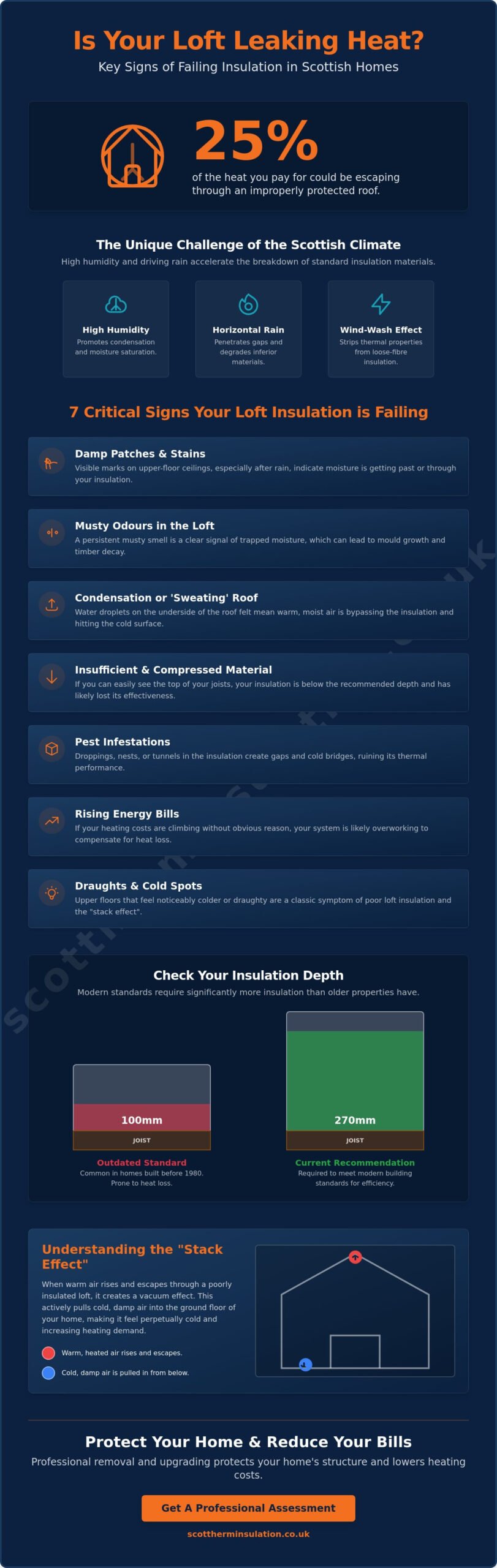
Bad loft insulation isn’t just a matter of age; it’s a failure of materials that have compressed, shifted, or become moisture-saturated over time. In a Scottish home, this failure triggers the “stack effect.” This process occurs when warm air rises and escapes through the roof, creating a vacuum that pulls cold, damp air into your ground-floor living spaces. Effectively, bad insulation is a total failure of both thermal resistance and moisture management. Understanding the foundational principles of Building insulation is vital for homeowners in our northern climate, where high humidity and relentless horizontal rain can penetrate small structural gaps and degrade inferior materials faster than in drier regions.
The unique challenges for Edinburgh and Fife properties
Edinburgh and Fife are home to a high concentration of traditional stone cottages and historic tenements. These buildings were originally designed to breathe, allowing moisture to move through the fabric of the building. When modern synthetic insulation is incorrectly installed in these spaces, it often traps condensation against the stone or timber, leading to structural rot. Many Central Belt homes built before 1980 still rely on original materials that have long since lost their effectiveness. One of the most common signs of bad loft insulation in these older properties is a persistent musty smell amongst the rafters or damp patches that appear on top-floor lath and plaster ceilings after a heavy storm.
Why “standard” insulation often fails in the North
Standard glass wool batts often suffer from “wind-wash” in Scotland. This occurs when high winds enter the loft through eaves vents and blow through the loose fibres, stripping away their thermal properties. Whilst 100mm of insulation might have been the norm decades ago, it falls far short of the 270mm depth currently recommended to meet 2026 Scottish building standards. For existing homes, the target U-value is now 0.16 W/m²K, a figure that older, degraded materials simply cannot achieve. Ignoring “just okay” insulation carries a hidden cost; your heating system must work significantly harder to compensate for the constant thermal bridging, leading to accelerated wear on your boiler and higher monthly outgoings. Identifying the signs of bad loft insulation early is the only way to prevent these mounting financial and structural liabilities.
- Compression: Insulation that has been stepped on or used for storage loses the air pockets required to trap heat.
- Shifting: Gaps created by wind or pests allow heat to bypass the thermal barrier entirely.
- Saturation: Wet insulation doesn’t just stop working; it actively transfers cold into your home and encourages mould growth.
Visible Physical Indicators: Damp, Mould, and Material Decay
Identifying the signs of bad loft insulation often starts with a simple visual inspection. Look specifically for damp patches appearing on the ceiling directly below the loft hatch or around the eaves. These marks suggest that moisture is bypassing the insulation or that the material itself has become a bridge for damp. If you notice a persistent musty smell whilst standing amongst the rafters, it’s a clear signal that moisture is trapped within the insulation layer. This trapped humidity is a primary precursor to structural damage in Scottish attics.
You should also perform the “joist test” to determine if your material is still functional. In a well-protected home, insulation should be significantly deeper than the wooden joists. If the material sits level with or below the top of the timber, it has likely compressed over time. According to the Energy Saving Trust, an uninsulated home loses approximately 25% of its heat through the roof. Compressed material facilitates this loss by removing the air pockets required to trap warmth. Additionally, keep an eye out for rodent droppings or “tunnels” in the material. Pests destroy the thermal bridge by displacing fibres, creating cold spots that make your home significantly harder to heat during winter.
Condensation and the “sweating” roof
Droplets forming on the underside of your roof felt indicate a ventilation-insulation mismatch. This “sweating” occurs when warm, moist air from the living spaces hits the cold roof surface because the insulation barrier is failing. Over time, this leads to black spot mould on timber joists, which compromises the health of your home. In our damp climate, persistent moisture can eventually trigger dry rot. This is a devastating structural issue that is far more expensive to fix than simply upgrading your loft insulation to a more resilient material.
Material degradation: When to bin the glass wool
Old glass wool often turns a dull grey or brown when it’s reaching the end of its lifespan. This discolouration usually indicates that the fibres have absorbed years of dirt, dust, and moisture. Compressed mineral wool can lose up to 50% of its R-value, meaning you’re only getting half the thermal protection you’re paying for. Whilst traditional materials might have a theoretical lifespan of 20 to 30 years, they often sag or degrade much sooner in high-humidity environments. Recognising these signs of bad loft insulation early allows you to transition to modern sustainable alternatives that offer superior moisture management.
- Soggy Material: If insulation feels heavy or damp to the touch, it must be replaced immediately.
- Dust Accumulation: Excessive dust on top of batts can settle into fibres and reduce thermal performance.
- Gaps and Voids: Areas where the floorboards are visible through the insulation indicate significant heat escape routes.
Performance Red Flags: Rising Energy Bills and Cold Spots
Rising energy bills are often the first performance-based warning that your home’s thermal barrier is failing. Whilst Scottish price caps offer some protection against market volatility, they cannot mask the high cost of a roof that leaks heat. If your gas or electricity consumption is significantly higher than the regional average for your property size, you are likely witnessing one of the most expensive signs of bad loft insulation. Your boiler might be working overtime to maintain a thermostat setting of 21 degrees, yet the rooms still feel chilly. This happens because failing insulation allows the ceiling to become a cold radiator, sucking the warmth out of the air through thermal bridging.
You can verify this using the “cold ceiling” touch test. On a frosty morning, place your hand against the ceiling of an upper-floor room. If the surface feels icy compared to the walls, your insulation isn’t doing its job. This failure often creates a “chimney effect” in Scottish homes. Warm air rushes through gaps in the loft hatch or poorly fitted batts, creating a vacuum that pulls cold draughts into hallways from the ground floor. This constant cycle of air movement makes a home feel unsettled and difficult to keep warm despite your best efforts to manage the heating.
Inconsistent temperatures between rooms
Inconsistent temperatures between rooms are a classic red flag. You might find the lounge is perfectly cosy whilst the spare room or bathroom remains freezing. This usually points to patchy coverage or heat “leaking” through uninsulated loft knees and eaves. According to the Energy Saving Trust guide, heat loss through an uninsulated roof can account for 25% of a property’s total thermal leakage. Detecting these signs of bad loft insulation early prevents your heating system from working in a permanent state of overcompensation, which leads to premature component failure.
The financial cost of bad insulation in 2026
The financial impact of degraded insulation is particularly acute in 2026. For a typical detached home in Perth or Stirling, the annual loss from wasted heat can run into hundreds of pounds. However, investing in high-quality loft insulation scotland can often pay for itself in under three years through reduced utility bills. Beyond immediate savings, there is a strong correlation between EPC ratings and property values. With Scottish legislation moving towards stricter Band C requirements for landlords and potential buyers prioritising efficiency, failing to address bad insulation is a long-term capital risk. Taking action now secures your home’s structural health and its market value.
- High Consumption: Usage patterns that don’t match your lifestyle or the external temperature.
- Cold Spots: Specific areas of a ceiling that feel significantly colder than others.
- Draughty Hatches: Feeling a breeze when standing directly under the loft entrance.
- Short Cycling: A boiler that turns on and off frequently to keep up with rapid heat loss.
The “Snow Melt” Test and External Warning Signs
During a cold Scottish winter, your roof provides a visible report card on your home’s thermal efficiency. One of the most reliable external signs of bad loft insulation is how snow behaves on your slates or tiles. In a well-protected property, the roof should remain cold enough to keep snow frozen for as long as the ambient temperature allows. If your house is the first in the street to show bare tiles, it’s a clear indicator that expensive heat is migrating from your living space into the atmosphere. You might also notice “hot spots” where snow melts in specific patches, revealing exactly where insulation has shifted or thinned over time.
Icicles hanging from the guttering are another significant warning. Whilst they might look picturesque, they often signal a dangerous combination of heat loss and blocked ventilation. As escaping warmth melts the snow from underneath, the water runs to the cold eaves and refreezes, potentially damaging your roofline and creating “ice dams.” Similarly, observing your roof during a heavy frost can be revealing. Clear patches amongst the white frost indicate thermal bridges where failing insulation is letting warmth through. If you observe these patterns, it’s time to book a professional loft assessment to prevent further energy waste and structural strain.
Conducting a DIY loft health check
Safety is paramount if you decide to investigate the loft yourself. You’ll need a dust mask, gloves, and a sturdy headlamp to navigate the rafters safely. The most critical measurement is the depth of your material. Current 2026 standards suggest a minimum of 270mm to 300mm for optimal performance. If you can see the tops of your wooden joists, you’re likely 150mm short of what’s required for a truly efficient home. Look closely for “tunnelling,” which are small gaps where air moves underneath the batts. This wind-wash effect, common in coastal or high-altitude Scottish areas, allows cold air to bypass the thermal barrier entirely.
The role of loft boarding in insulation failure
Loft boarding is a frequent culprit in insulation failure. Many homeowners squash high-performance mineral wool under heavy chipboard to create storage space. This compression removes the air pockets that provide thermal resistance, effectively destroying the material’s ability to hold heat. It also creates a “cold deck” where moisture-laden air hits the underside of the boards and condenses, leading to damp and timber rot. If you need storage, you must use raised loft boarding systems. These sit above the full 270mm depth, allowing for essential airflow whilst protecting the insulation’s integrity and your home’s structural health.
- Hot Spots: Uneven snow melt that reveals the location of gaps in your insulation.
- Ice Dams: Thick ridges of ice at the eaves that prevent meltwater from reaching the gutters.
- Clear Frost Patches: Areas where heat is leaking through the roof faster than the surrounding surface.
- Boarding Compression: Any area where insulation has been flattened to accommodate storage.
Professional Solutions: Upgrading for the Scottish Climate
Once you’ve identified the signs of bad loft insulation, the next step is a professional upgrade tailored to our specific climate. Simply adding new material over old, damp, or compressed batts is rarely effective. A comprehensive solution begins with the safe removal and disposal of degraded materials, especially if they show signs of rodent contamination or moisture saturation. We then focus on sealing the “top plate” and loft hatch. These often-overlooked areas are major sources of air bypass, where warm air escapes through gaps in the wall structure itself. By addressing these leaks before laying new material, we create a truly airtight thermal envelope that keeps warmth where it belongs.
Maintaining a balance between a thick thermal blanket and healthy airflow is critical for the longevity of your roof timbers. We ensure cross-ventilation remains unobstructed at the eaves to prevent the “sweating” roof issues mentioned earlier in this guide. For many Scottish properties, wool insulation provides the ideal solution for moisture management. Natural sheep’s wool can absorb up to 33% of its weight in moisture without losing its insulating properties. This unique behaviour makes it a premium choice for the humid conditions found from the Borders to the Highlands, as it helps regulate the internal environment of the attic space.
Mineral Wool vs Sheep’s Wool: The expert verdict
Sheep’s wool is often the superior choice for breathable Scottish homes, particularly traditional stone buildings. It’s naturally fire-resistant and offers excellent acoustic properties, which is a significant benefit in busy Central Belt neighbourhoods. Whilst mineral wool remains a cost-effective and highly efficient industry standard, sheep’s wool excels at handling high humidity amongst the rafters. It actively protects the timber frame of your home by regulating moisture levels in the air, preventing the damp and rot often associated with synthetic materials that have reached the end of their lifespan.
Accessing funding via ECO4 Scotland
Many households in the Central Belt qualify for free or heavily subsidised upgrades through government-backed initiatives. The ECO4 Scotland grant scheme, which runs until December 2026, specifically targets low-income households to improve energy efficiency and reduce fuel poverty. ScotTherm is a proactive leader in delivering these certified installations, ensuring every project meets rigorous professional standards. If you’ve identified the signs of bad loft insulation, checking your eligibility for these grants is a smart way to secure a warmer, more cost-effective home without the full upfront expense.
- Safe Removal: Professional extraction of old, dusty, or contaminated insulation materials.
- Top Plate Sealing: Preventing air bypass by sealing gaps in the wall-to-ceiling junctions.
- Sustainable Materials: Choosing sheep’s wool for its superior moisture-handling capabilities.
- Grant Eligibility: Checking for ECO4 or Warmer Homes Scotland funding to offset installation costs.
Securing Your Home’s Future and Efficiency
Identifying the visual and performance-based signs of bad loft insulation is the first step towards a healthier, more cost-effective living space. Whether you’ve noticed damp patches amongst the rafters or inconsistent room temperatures, these markers indicate that your home’s thermal barrier is no longer fit for purpose. Upgrading your property isn’t merely about immediate warmth; it’s a long-term investment in your home’s structural health and market value.
Our team of certified Scottish installers provides the specialist knowledge required to navigate the complexities of our local climate. We specialise in high-performance, breathable sheep’s wool and possess the expertise to help you access ECO4 grant funding where eligible. Don’t let heat escape through a failing roof when a professional solution is within reach.
Book your specialist free insulation inspection with ScotTherm today
Taking proactive steps now will ensure your home remains a cosy, efficient sanctuary regardless of the Scottish weather.
Frequently Asked Questions
How many years does loft insulation actually last?
Modern insulation materials are designed to last up to 40 years, though the harsh Scottish climate can shorten this lifespan significantly. High humidity and wind-wash often cause traditional glass wool to sag or lose its thermal properties after 20 to 30 years. It’s vital to check for compression or shifting, as these are common signs of bad loft insulation that indicate the material is no longer protecting your home effectively.
Can I just put new insulation on top of the old stuff?
You can top up your insulation if the existing layer is dry, clean, and hasn’t been compressed. This is a practical way to reach the recommended 270mm depth without the cost of a full extraction. However, you must never lay new material over damp or mouldy batts. Doing so traps moisture against your ceiling joists and can lead to structural rot that is far more expensive to repair than a professional replacement.
Why is there condensation in my loft after I added more insulation?
Condensation often occurs because the new insulation has made your loft space much colder whilst unintentionally blocking eaves ventilation. When warm air from your home escapes into this freezing attic, it hits the cold underside of the roof and turns into water. You must ensure that your professional installer maintains a 50mm air gap at the eaves. Proper cross-ventilation is the only way to keep the space dry and healthy.
Is sheep’s wool insulation worth the extra cost in Scotland?
Sheep’s wool is an exceptional choice for Scottish homes due to its natural breathability and moisture-handling capabilities. It can absorb a third of its weight in moisture without losing its ability to trap heat, which is a major advantage in our damp environment. Whilst the upfront cost is higher than mineral wool, the long-term protection it offers for traditional stone and timber buildings makes it a superior investment for many homeowners.
Does the ECO4 scheme cover loft insulation in 2026?
The ECO4 scheme is fully active until December 2026 and provides significant funding for energy efficiency improvements, including loft insulation. To qualify, households typically need to be in receipt of specific benefits and live in a property with an EPC rating of D to G. This initiative is designed to help vulnerable households reduce their energy bills whilst supporting the Scottish Government’s wider carbon reduction targets.
How deep should my loft insulation be to meet current UK standards?
Current building standards for existing homes recommend a total depth of 270mm to achieve optimal thermal efficiency. If you live in a new-build property, the requirements are often even more stringent to reach lower U-values. Many older properties in the Central Belt still have only 100mm of outdated material. Increasing this to the 270mm threshold can prevent up to 25% of your home’s heat from escaping through the roof.
What happens if I don’t fix my damp loft insulation?
Leaving damp insulation in your loft is a recipe for serious structural damage, including wet and dry rot in your roof timbers. Saturated material doesn’t just stop working; it actively draws heat out of your rooms and encourages the growth of black spot mould. Over time, this moisture can compromise the integrity of your ceiling and roof, eventually leading to a much larger and more costly renovation project.
Can bad insulation affect my home’s EPC rating?
Insufficient or degraded insulation is one of the quickest ways to lower your property’s EPC rating. Energy assessors look for specific signs of bad loft insulation, such as inadequate depth or evidence of moisture, when calculating your home’s efficiency score. With Scottish regulations moving toward stricter standards for landlords and buyers, maintaining a high-quality thermal barrier is essential for protecting your property’s long-term market value.