
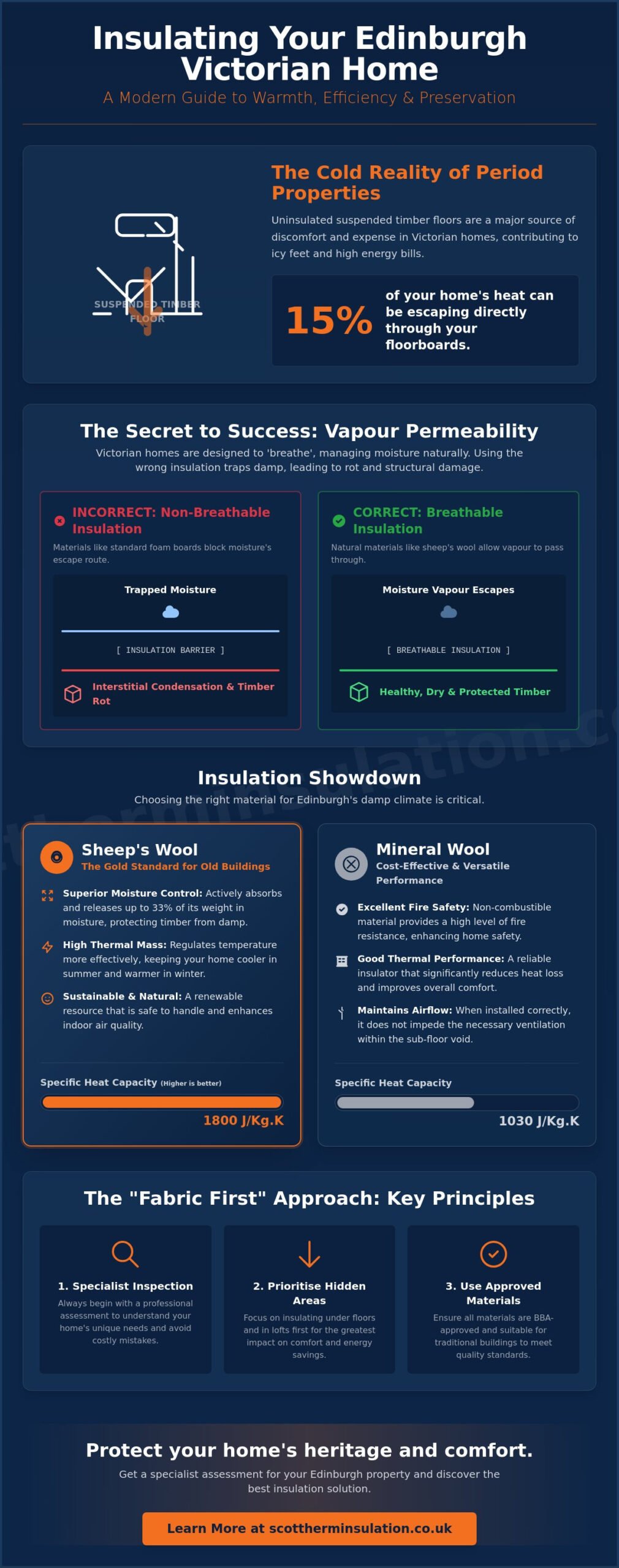
Did you know that up to 15% of your home’s heat is escaping directly through your floorboards, leaving you with icy feet and soaring energy bills? If you live in one of Edinburgh’s iconic period properties, you’ve likely felt those persistent draughts rattling through your high-ceilinged rooms. It’s frustrating to balance the desire for a warm home with the fear of trapped moisture and timber rot. Finding reliable information on underfloor insulation for victorian houses edinburgh can be difficult, especially when you’re faced with conflicting advice on breathable versus non-breathable materials.
We understand that preserving the historic fabric of your property is just as important as reducing your monthly outgoings. This guide shows you how to insulate your Victorian home effectively, ensuring your suspended timber floors stay dry and your living spaces stay cosy. We’ll explore the benefits of natural materials like sheep’s wool, clarify the current 2026 Scottish grant landscape, and provide a clear path to a lower carbon footprint without compromising your building’s structural integrity.
Key Takeaways
- Understand the vital role of vapour permeability in traditional Scottish architecture to prevent moisture build-up and protect your home’s structural integrity.
- Compare the thermal benefits of natural sheep’s wool against mineral wool to identify the most effective moisture-wicking materials for our damp climate.
- Learn how to navigate the Edinburgh City Council planning portal and identify when Listed Building Consent is required for your insulation project.
- Discover the “Fabric First” approach to thermal efficiency, from optimising loft depths to correctly installing underfloor insulation for victorian houses edinburgh.
- Gain insight into the importance of specialist inspections and BBA-approved materials to ensure your energy-saving upgrades meet Home Energy Scotland standards.
The Challenge of Insulating Victorian Homes in Edinburgh
Edinburgh’s Victorian terraces are architectural masterpieces, but they weren’t designed with 21st-century energy costs in mind. Most homes across the Lothians rely on solid sandstone walls and suspended timber floors that allow air to circulate freely. While this ventilation kept the building dry in the 19th century, it now leads to significant heat loss and uncomfortable draughts. Installing underfloor insulation for victorian houses edinburgh is a primary step in making these properties liveable, yet it requires a nuanced understanding of how traditional buildings “breathe” to avoid long-term structural damage.
Why Victorian Properties Lose Heat Faster
Victorian architecture prioritised grandeur, resulting in high ceilings and large sash windows that act as major thermal bridges. These features create a large volume of air to heat, which often escapes through unsealed gaps. In Edinburgh, our proximity to the coast introduces the “hairst”, a cold maritime fog that spikes internal humidity. When damp air enters through original floor vents or chimneys, it makes the home feel significantly colder than the thermostat suggests. Research indicates that uninsulated floors alone account for up to 15% of a property’s heat loss, making them a critical area for thermal improvement.
The Importance of Breathable Traditional Fabric
Unlike modern homes built with cavities and damp-proof membranes, Victorian houses use porous materials like sandstone and lime mortar. These materials manage moisture by absorbing and releasing it naturally. Breathability is the ability of a material to transfer moisture vapour. If you use non-permeable building insulation materials, such as standard modern foam boards, you risk trapping moisture against the original timber joists. This leads to interstitial condensation, which is the primary cause of dry rot and structural decay in older Edinburgh tenements.
Effective thermal improvement must balance energy savings with the preservation of period features. You don’t have to sacrifice ornate cornicing or ceiling roses to stay warm. By focusing on a “fabric first” approach, we can address the hidden areas, such as the void beneath your floorboards, to create a draught-free environment that respects the building’s history. Choosing the right material, such as sheep’s wool or mineral wool, ensures that your home remains thermally efficient whilst allowing the original structure to function as intended. It’s about protecting the investment you’ve made in your home’s heritage whilst securing your future comfort.
Comparing Insulation Materials: Sheep’s Wool vs Mineral Wool
Selecting the right material for underfloor insulation for victorian houses edinburgh involves more than just comparing thermal resistance. You must choose a product that survives the specific humidity levels found in the Lothians. Traditional Scottish homes rely on a delicate balance of airflow and moisture management. Whilst modern synthetic boards might offer high R-values on paper, they often fail in the damp environments found beneath suspended timber floors. We focus on materials that complement the building’s original design, ensuring your home stays warm without risking the health of its timber frame.
Sheep’s Wool: The Gold Standard for Old Buildings
Sheep’s wool is the premier choice for Edinburgh’s period properties because of its unique relationship with moisture. It possesses a high specific heat capacity of 1800 J/Kg.K, which comfortably outperforms mineral wool at 1030 J/Kg.K. This means wool can absorb up to 33% of its weight in moisture without losing its insulating performance. This natural moisture-wicking property protects your original timber joists from the dampness often found in Scottish sub-floor voids. We frequently recommend wool insulation for Victorian lofts and floors because it’s sustainable, breathable, and locally sourced. It provides a level of protection that standard materials simply cannot match.
Mineral Wool: Cost-Effective Performance
Mineral wool remains a highly popular, versatile alternative for homeowners looking for a balance between performance and budget. It offers excellent non-combustibility and high fire safety ratings, providing peace of mind alongside thermal comfort. When installed correctly, it maintains the essential airflow required in older buildings. Following Energy Saving Trust advice, we ensure that mineral wool is fitted securely between joists to eliminate draughts whilst keeping ventilation paths clear. It’s an effective way to achieve significant energy savings, especially when combined with the 0% VAT rate on energy-saving materials currently available until March 2027.
Your choice between these materials depends on your specific property requirements and long-term goals. Sheep’s wool offers a lower carbon footprint and superior moisture management, making it a wise investment for the building’s longevity. Mineral wool provides a reliable, fire-safe solution that fits most budgets. Both options significantly reduce the 15% of heat typically lost through uninsulated floors. To determine which material best suits your home’s unique structure, you can book a specialist inspection with our team to evaluate your sub-floor condition and ventilation needs.
Priority Areas for Thermal Improvement in Victorian Houses
Adopting a “Fabric First” approach is the most effective way to improve a Victorian property’s energy rating. This strategy prioritises the building’s envelope, ensuring that the walls, roof, and floors are properly sealed before you consider upgrading heating systems. By focusing on where your home loses the most heat, you create a stable internal climate that requires less energy to maintain. Following Historic Environment Scotland guidance on insulation ensures your project respects the building’s heritage whilst meeting modern thermal standards.
Loft and Attic Spaces
Heat rises, making the loft the first place to check for efficiency gaps. Current building standards recommend a total insulation depth of 270mm to achieve maximum savings. In many Edinburgh villas, achieving this depth is complicated by narrow joists and awkward eaves. It is vital to maintain a 40mm ventilation gap between the insulation and the roof sarking boards to prevent timber decay. We also prioritise insulating water tanks and pipework. Uninsulated pipes in a newly cold loft space are prone to freezing during harsh Scottish winters. For a deeper look at specific requirements, read our loft insulation scotland guide.
Suspended Timber Floors
Cold winds whipping through sub-floor air bricks often result in icy floorboards and persistent draughts at the skirting boards. Installing underfloor insulation for victorian houses edinburgh targets this specific problem, significantly improving ground-floor comfort. We use breathable membranes to support the insulation material between the joists. This method prevents the material from sagging whilst allowing the timber to shed moisture naturally. Maintaining clear sub-floor ventilation is essential. If airbricks are blocked or insulation is packed too tightly, you risk creating the damp conditions that invite dry rot. Our specialised approach to under floor insulation ensures your home stays draught-free without compromising the health of your floorboards.
Room-in-Roof and Coomb Ceilings
Many Victorian homes feature “room-in-roof” designs with coomb ceilings that follow the slope of the roof. These areas are notorious for being the coldest spots in a house because they often lack any thermal barrier. Insulating these spaces requires precision to avoid disturbing the original plasterwork or reducing the room’s height. We focus on using high-performance materials that provide maximum heat retention in slim profiles. This protects the internal volume of your rooms whilst stopping the “chimney effect” that pulls warm air out through the roof fabric. Addressing these priority areas collectively can lead to annual energy bill savings of up to £730 for a fully insulated home.
Planning and Local Regulations in Edinburgh
Edinburgh’s architectural heritage is a source of regional pride, but it brings specific regulatory challenges for homeowners. Before starting your project, you must verify your property’s status through the Edinburgh City Council planning portal. Most internal energy efficiency measures don’t require full planning permission. However, if your home is a Category A, B, or C listed building, you will likely need Listed Building Consent (LBC) for any work that affects its historic character. This is particularly true when specifying underfloor insulation for victorian houses edinburgh if the process involves lifting original encaustic tiles or rare timber floorboards.
Conservation Areas and Listed Building Consent
Edinburgh has over 50 conservation areas affecting insulation choice. In these designated zones, the council’s focus remains on preserving the visual and structural integrity of the streetscape. Loft insulation is typically permitted development because it’s an internal, reversible change that doesn’t alter the building’s exterior. For listed villas and townhouses, we advocate for non-invasive installation techniques. These methods allow us to install high-performance materials whilst leaving original skirting boards and decorative features intact. It’s a balance of modern comfort and historic preservation.
Working with Edinburgh Tenements
Shared living in traditional tenements requires a collaborative approach to thermal improvement. Top-floor residents must coordinate with their factor and neighbours regarding shared roof access for loft or room-in-roof projects. When managing internal wall insulation, we use specialised systems that don’t require the removal of original lath and plaster. This preserves your home’s historic soul whilst drastically improving heat retention. Identifying shared responsibilities is also a key part of the process. Under the Tenement Management Scheme (Scotland), some energy efficiency works can be progressed with a majority agreement amongst owners. We ensure all our installations comply with the latest Scottish Building Standards and Historic Environment Scotland guidelines.
Proper planning prevents legal complications and ensures your home remains a valuable asset. Our team understands the local nuances of Edinburgh’s New Town and Old Town regulations. We can help you choose the right approach for your specific property type. Book an expert survey with ScotTherm Insulation to ensure your project meets all local planning and building standards.
Professional Installation with ScotTherm Insulation
A successful project begins with a detailed technical assessment. Victorian properties in the Lothians possess unique structural quirks that require more than a “one size fits all” approach. Our specialist inspections evaluate the specific moisture levels and airflow patterns of your sub-floor void before any materials are selected. By adhering to BBA-approved standards and Historic Environment Scotland guidelines, we ensure that your underfloor insulation for victorian houses edinburgh provides long-term thermal efficiency without compromising the building’s structural integrity.
Organising an installation in the heart of the city requires precise logistics. Edinburgh’s narrow streets and permit-controlled parking zones can make home improvements feel daunting. We manage the entire process to minimise disruption to your daily routine and your neighbours. Part of our professional service involves checking your eligibility for insulation grants scotland. Homeowners in Scotland can receive a grant of up to £1,500 for insulation, with an additional £500 available as an interest-free loan. We help you navigate these financial incentives to maximise your return on investment.
Our Local Expertise in the Lothians
We’ve spent years working with the specific challenges of Edinburgh’s stone-built heritage. Our team understands that a New Town townhouse requires a different moisture management strategy than a suburban villa. We focus on high-performance, breathable materials like sheep’s wool to maintain the building’s natural equilibrium. Every installation undergoes professional verification to ensure it meets current UK Building Regulations, specifically the required U-value of 0.15 W/m2K for ground floors. This disciplined approach provides the peace of mind that comes from using certified specialists who take pride in their regional community.
Get Your Specialist Free Insulation Inspection
Our surveyors conduct a comprehensive assessment of your Victorian property to identify hidden thermal bridges and ventilation risks. We look for blocked air bricks, signs of dampness, and the condition of existing joists. This data allows us to design a customised thermal solution tailored to your home’s unique architectural style. You’ll receive a clear, functional plan that prioritises your comfort and financial efficiency. Don’t let another winter pass with icy floors and high bills. Book your free specialist inspection today and take the first step towards a warmer, more sustainable home.
Secure Your Home’s Future and Comfort
Edinburgh’s Victorian homes are a testament to our city’s rich history, but they don’t have to be cold or expensive to run. By choosing breathable materials that respect the original stonework and timber, you can transform your living space into a warm, energy-efficient sanctuary. We’ve explored how a fabric-first approach, combined with natural materials like sheep’s wool, protects your property from damp whilst significantly lowering your carbon footprint.
Investing in underfloor insulation for victorian houses edinburgh is a proactive step toward long-term financial efficiency and domestic well-being. As BBA Approved Installers and specialists in traditional Scottish properties, we provide the technical proficiency needed to navigate Edinburgh’s unique planning landscape and grant schemes. Whether you prefer the sustainable performance of sheep’s wool or the cost-effective fire safety of mineral wool, our team ensures a seamless installation that honours your home’s heritage.
Book your specialist free insulation inspection with ScotTherm Insulation today to discover the best solution for your property. You deserve a home that’s as cosy as it is historic.
Frequently Asked Questions
Is sheep’s wool insulation better than glass wool for Victorian houses?
Sheep’s wool is superior for Victorian properties because of its natural moisture-regulating properties. Unlike standard glass wool, sheep’s wool can absorb moisture without losing its thermal efficiency, which is vital for the damp Lothian climate. This prevents condensation from settling on original timber joists, ensuring the long-term health of your home’s historic structural fabric.
Do I need planning permission for loft insulation in an Edinburgh conservation area?
Loft insulation is typically considered “permitted development” in Edinburgh conservation areas, so full planning permission is not usually required. However, if your property is Category A, B, or C listed, you must apply for Listed Building Consent before making any internal changes. It is always best to check the status of your specific address on the Edinburgh City Council planning portal before starting work.
Will insulating my floorboards cause them to rot?
Proper installation of underfloor insulation for victorian houses edinburgh will not cause rot; it actually helps protect your timber. The key is using breathable materials and ensuring that sub-floor air bricks remain completely unobstructed. This allows air to circulate freely beneath the insulation, preventing the stagnant, damp conditions that lead to dry rot or woodworm infestations.
How much can I save on heating bills by insulating a Victorian terrace?
Homeowners can see significant reductions in their annual energy costs by addressing the heat loss that occurs through uninsulated floors. While exact savings vary by property size, combining floor insulation with loft and wall upgrades often results in substantial annual savings. This makes it one of the most cost-effective ways to manage energy prices in large-volume Victorian rooms with high ceilings.
Can I get a grant for insulating my old house in Edinburgh?
Yes, several financial incentives are available to Edinburgh residents in 2026. Home Energy Scotland currently offers grants of up to £1,500 for insulation, with an additional £500 interest-free loan to cover remaining costs. For households with an income of £36,000 or less, the Warmer Homes Scotland scheme may provide fully funded improvements to help reduce your carbon footprint.
What is the recommended thickness for loft insulation in 2026?
The current 2026 recommendation for loft insulation is a total depth of 270mm. This often involves topping up existing insulation to meet modern thermal standards. If your current insulation is only at the joist level, adding a second layer perpendicular to the first will drastically reduce heat loss and improve your home’s Energy Performance Certificate (EPC) rating.
How do I insulate a room-in-roof with coomb ceilings?
Insulating coomb ceilings in room-in-roof spaces requires a specialised approach using high-performance breathable materials. We install insulation between the rafters whilst maintaining the essential 40mm ventilation gap behind the roof sarking boards. This prevents moisture build-up in the roof structure whilst making these notoriously cold upper rooms much more comfortable throughout the year.
Is mineral wool breathable enough for traditional stone walls?
Mineral wool is a vapour-permeable material, making it suitable for use with traditional stone walls when installed correctly. It allows moisture to pass through the building fabric rather than trapping it against the stone. To maintain this breathability, it must be used alongside lime-based finishes and without non-permeable synthetic vapour barriers that can lead to damp issues.