
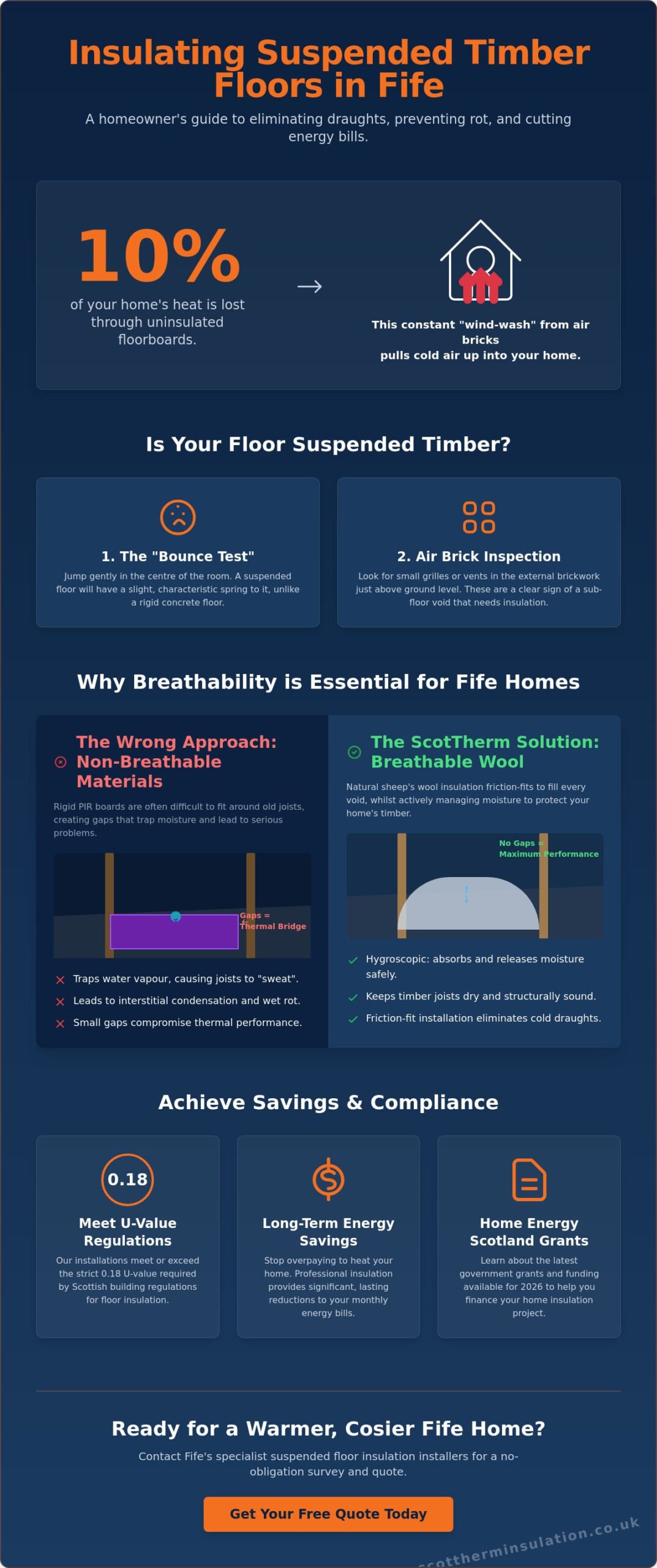
Did you know that at least 10% of your home’s heat is escaping directly through your floorboards? If you live in a traditional Fife property, those icy draughts aren’t just an annoyance; they’re a clear sign that your heating budget is literally falling through the cracks. Installing professional underfloor insulation for suspended timber floors fife is the most effective way to reclaim that lost energy whilst protecting the structural integrity of your home.
You’ve likely already topped up your loft insulation and upgraded your windows, yet your feet still feel the chill every winter. It’s frustrating to pay rising energy bills when your living room never feels truly warm, and it’s natural to worry that sealing those gaps might trap moisture and cause wet rot in your original joists. We understand that Fife homeowners need solutions that respect the age and construction of their buildings.
This guide explains how to eliminate draughts using breathable, high-performance materials like sheep’s wool that keep your timbers safe and your house cosy. You’ll discover how to meet the strict 0.18 U-value requirements set by Scottish building regulations and learn about the latest Home Energy Scotland grants available to help fund your project in 2026.
Key Takeaways
- Learn how to identify your property’s specific floor construction using simple diagnostic methods like the “bounce test” and air brick inspections.
- Discover why breathable materials such as sheep’s wool are essential for underfloor insulation for suspended timber floors fife to prevent moisture build-up and rot.
- Understand the professional installation process, including how specialists gain access to crawl spaces with minimal disruption to your daily life.
- Explore the 2026 financial landscape, including available grants and the long-term energy savings achieved by reducing heat loss through your floorboards.
- Find out why regional expertise is vital for selecting high-performance insulation that addresses the specific climate challenges found across Fife.
Understanding Suspended Timber Floors in Fife Properties
A suspended timber floor is a traditional construction method where wooden joists are laid across the external walls, creating a hollow void beneath the floorboards. This design was standard in UK housebuilding for decades because the gap allows air to circulate, which keeps the timber dry and prevents decay. However, this same air movement is responsible for the icy draughts that plague many households. For homeowners considering Building insulation, understanding this balance between ventilation and thermal retention is the first step toward a warmer home.
Identifying this floor type is usually straightforward. You can perform a “bounce test” by jumping gently in the centre of the room; a suspended floor will have a slight, characteristic spring, whilst a solid concrete floor will feel completely rigid. Externally, you should look for air bricks or small grilles set into the brickwork just above the ground level. These vents are the primary entry points for cold air, and they’re a telltale sign that you’ll benefit from underfloor insulation for suspended timber floors fife.
Common Property Types in Fife with Timber Floors
Fife’s architectural heritage means many residents live in properties that were never designed for modern energy efficiency. The grand Victorian and Edwardian villas found in Kirkcaldy and Dunfermline almost exclusively feature suspended timber joists. Similarly, the historic coastal cottages in the East Neuk, such as those in Anstruther and Pittenweem, rely on these ventilated voids to manage the high levels of ground moisture common near the sea. Even mid-century suburban homes across the Kingdom often utilise this structure, leaving a significant portion of the local housing stock vulnerable to heat loss.
The Problem: Why Floorboards Feel Like Sieves
The main reason your feet feel like they’re on ice is a phenomenon known as wind-wash. In coastal Fife, the wind blows cold air through the air bricks and into the sub-floor void. This air doesn’t just sit there. Because of the “chimney effect,” warm air rising through your house creates a vacuum that pulls this freezing air up through the gaps in your floorboards. It’s a constant cycle of cold air infiltration that makes your heating system work harder and drives up your monthly energy costs.
Many people try to solve this with thick carpets or heavy underlay, but these are insufficient thermal barriers. They don’t stop the air movement; they only mask it. Without dedicated underfloor insulation for suspended timber floors fife, you’re essentially trying to heat a room with a window permanently left open. Professional installation ensures that the void remains ventilated to protect the wood, whilst the living space above stays sealed against the cold.
Choosing the Right Materials: Why Breathability Matters
Thermal performance isn’t the only factor to consider when selecting materials for underfloor insulation for suspended timber floors fife. In the damp, maritime climate of the Kingdom, moisture management is critical for the long-term health of your property. Timber is a natural, porous material that needs to maintain a specific equilibrium of moisture to remain structurally sound. If you block this process with non-breathable synthetic materials, you risk creating “sweating” joists. This happens when water vapour is trapped against the cold surface of the timber, leading to interstitial condensation and, eventually, wet rot.
Whilst rigid PIR boards are often marketed for their high thermal resistance, they’re notoriously difficult to install perfectly between old, irregular joists. Any slight gap between the board and the wood becomes a thermal bridge where cold air and moisture can congregate. According to the Energy Saving Trust floor insulation advice, choosing the correct material is vital for both energy efficiency and building safety. For traditional Fife homes, flexible, breathable fibres are almost always the superior choice because they friction-fit into place, eliminating the air gaps that cause draughts.
The Benefits of Sheep’s Wool in the Scottish Climate
Sheep’s wool is a “hygroscopic” material, meaning it can absorb up to 33% of its own weight in moisture without losing its ability to insulate. This natural regulation actively draws dampness away from your floor joists, acting as a buffer against the humid Fife air. It’s also an incredibly sustainable option for environmentally conscious homeowners. Beyond thermal benefits, wool has excellent acoustic properties that reduce the “hollow” sound often associated with timber floors. You can learn more about why Wool Insulation is the sustainable choice for homes in Edinburgh and Fife.
Mineral Wool: A High-Performance Alternative
Mineral wool provides a fantastic balance between cost-effectiveness and thermal efficiency. It’s naturally fire-resistant and meets stringent safety standards for residential properties. Unlike some lower-grade foams that can degrade or shrink, high-quality mineral wool is designed to stay in place without sagging, ensuring your energy savings remain consistent for decades. If you want to ensure your home stays warm whilst protecting your original floorboards, our team can recommend the best Sheep’s Wool Insulation or mineral wool options for your specific needs.
The Installation Journey: How We Insulate Your Fife Home
A successful installation of underfloor insulation for suspended timber floors fife requires a disciplined, multi-stage approach that prioritises building health alongside thermal comfort. We follow a logical sequence to ensure every centimetre of your floor is protected without compromising the necessary airflow beneath your home. This process is designed to be efficient, technical, and respectful of your domestic environment.
The journey begins with a specialist insulation inspection and moisture survey. This step is vital. Our technicians assess the current condition of your joists to ensure there are no pre-existing issues with damp or timber decay. Once the survey is complete, we determine the best method for gaining access. If your property has a sufficiently deep crawl space, our team works from below to avoid disturbing your living area. In homes with shallow voids, we carefully lift a selection of floorboards to facilitate the installation from above.
Securing the material is a precise task. We use breathable netting or specialised membranes to hold the insulation snugly against the underside of the floorboards. This prevents the material from sagging over time and ensures consistent thermal contact. We then focus on sealing the perimeter. This eliminates the “edge-draught” effect where cold air leaks through the gap between the floor and the skirting boards. Finally, we conduct a rigorous check of your sub-floor ventilation to ensure that all air bricks remain clear and functional.
Maintaining Critical Sub-Floor Ventilation
We never block your air bricks. Doing so would trap stagnant air and significantly increase the risk of dry rot. Our installers are trained to work around sleeper walls, which are the internal low walls that support the joists. By maintaining clear cross-ventilation, we ensure that air continues to circulate freely beneath the new insulation layer. This professional discipline keeps your joists healthy whilst the living space above remains draught-free and warm.
Minimal Disruption for Fife Homeowners
Most underfloor projects in Fife are completed within 1-2 days. We operate a strict “clean-site” policy to protect your furniture and floor finishes throughout the process. If you have original parquet or high-value flooring that cannot be easily lifted, we prioritise access through the crawl space whenever possible. Our goal is to deliver a transformative improvement to your home’s energy efficiency with as little impact on your daily routine as possible.
Energy Savings, ROI, and Available Grants in Fife
Investing in energy efficiency is as much about financial discipline as it is about domestic comfort. When you address the 10% of heat loss that typically escapes through your floorboards, you’re making a calculated decision to lower your overheads. According to the Energy Saving Trust, professional underfloor insulation can lead to annual energy bill reductions of up to £110. In a climate where energy prices remain volatile, these savings provide a reliable buffer against the rising costs of gas and electricity.
There’s also the “Comfort Factor” to consider. Cold air rising through the floor creates a temperature gradient that makes a room feel chilly, even if the thermostat is set high. By installing underfloor insulation for suspended timber floors fife, you eliminate those icy draughts at the source. This means a room heated to 19°C with insulated floors often feels significantly warmer and more inviting than the same room at 21°C without insulation. It’s a physical improvement that enhances your daily well-being whilst reducing the strain on your heating system.
ECO4 and Local Funding for Fife Residents
Navigating the current funding landscape is essential for maximising your return on investment. The Scottish government continues to prioritise energy efficiency through Home Energy Scotland, offering homeowners grants of up to £7,500. If you live in a more remote part of the Kingdom, you might even be eligible for an additional £1,500 in rural grant funding. These schemes are designed to help properties in EPC bands D to G reach modern standards. For those in lower-income households, the ECO4 Scotland: The Complete 2026 Guide to Free Home Insulation provides a detailed roadmap for accessing 100% funding for whole-house retrofits.
- Home Energy Scotland Grant: Up to £7,500 available for insulation measures.
- Interest-Free Loans: Additional borrowing of up to £7,500 to cover project costs.
- Great British Insulation Scheme (GBIS): Available for single-measure upgrades until March 2026.
Calculating Your Payback Period
The speed at which your insulation pays for itself depends on several factors, including your current heating system and the size of your property. Using breathable, high-performance materials adds long-term value by protecting the structural integrity of your timber, which prevents the astronomical costs associated with rot repair. Improving your EPC rating also makes your property more attractive in the competitive Fife housing market, as buyers increasingly prioritise energy-efficient homes.
For a typical mid-terraced Fife home in 2026, the combination of annual energy savings and available grant funding often results in a payback period of less than five years.
If you’re ready to see how these savings apply to your property, you can check your eligibility for underfloor insulation and speak with our local specialists today.
ScotTherm Insulation: Fife’s Specialist Suspended Floor Insulation Installers
ScotTherm Insulation stands as the Kingdom’s dedicated partner for enhancing domestic thermal performance through technical proficiency and regional pride. We recognise that Fife’s geography, from the exposed coastlines of the East Neuk to the urban centres of Dunfermline and Kirkcaldy, presents specific challenges for traditional properties. Our approach to underfloor insulation for suspended timber floors fife is built on a deep understanding of these local conditions. We don’t just install materials; we provide a technical solution that respects the age and construction of Scottish homes whilst delivering immediate financial relief.
Our commitment to quality is evidenced by our choice of high-performance, certified materials. We exclusively utilise Sheep’s wool and Mineral wool insulation because these products offer the breathability and fire safety required by modern building standards. By choosing ScotTherm Insulation, you’re opting for a team that prioritises building health and long-term thermal efficiency over quick, synthetic fixes. Every project we undertake is backed by the ScotTherm Insulation guarantee of safety, reliability, and precision, ensuring your investment remains effective for the lifetime of your property.
Our Local Track Record in Fife
We have a verified history of working within the unique architectural landscape of Fife, serving homeowners in Dunfermline, St Andrews, Glenrothes, and the surrounding coastal villages. Our installers are experts in traditional Scottish building techniques, which is vital when working with the irregular joists and ventilated voids found in older properties. You can explore our broader regional insights in our Under Floor Insulation in Edinburgh, Fife & Stirling: The 2026 Homeowner’s Guide. This local expertise ensures that your property’s structural health remains our primary concern throughout the installation process.
Ready to Stop the Draughts?
With energy prices remaining a significant concern in 2026, there’s never been a better time to secure your home’s thermal envelope. Our straightforward 3-step process is designed to provide clarity and peace of mind. First, you contact our Fife-based team for an initial technical consultation. Second, we arrange a free, no-obligation home survey to assess your floor’s specific needs and moisture levels. Finally, we provide a detailed, transparent quote tailored to your property’s requirements. This steady, logical path allows you to transition from a draughty house to a warm, energy-efficient environment. Contact us today to book your survey and take the first step toward a more comfortable, cost-effective home.
Secure Your Home’s Future Comfort Today
Securing your home against the Scottish elements requires a solution that balances thermal performance with architectural preservation. By addressing the specific needs of your property’s sub-floor, you can finally reclaim rooms that have felt cold for years. The transition to a warmer, more energy-efficient environment doesn’t just lower your bills; it provides the long-term peace of mind that your home’s timber structure is protected by breathable, high-performance materials.
As a Trustmark Government Endorsed Quality provider, ScotTherm Insulation brings specialised expertise to every project. Our local Fife-based installation teams understand the nuances of underfloor insulation for suspended timber floors fife, ensuring that every installation meets the highest safety and ventilation standards. We are committed to helping Kingdom residents achieve a better standard of living through proven, sustainable insulation methods.
Take the final step toward a draught-free home by visiting our website to Book Your Specialist Free Insulation Inspection in Fife Today. Our team is ready to help you transform your living space into a sanctuary of warmth and efficiency.
Frequently Asked Questions
Will underfloor insulation cause my timber floor to rot?
No, professional installation prevents rot by using breathable fibres that allow moisture to move naturally through the structure. By choosing materials like sheep’s wool or mineral wool, you maintain the timber’s natural equilibrium. Our technicians ensure that air continues to circulate beneath the insulation layer, which protects your joists from the risks of interstitial condensation.
How much can I save on my heating bills in Fife with floor insulation?
The Energy Saving Trust estimates that you can save up to £110 per year on your energy bills. This is achieved by stopping at least 10% of your home’s heat from escaping through the ground. These savings are particularly significant for Fife properties exposed to coastal winds, where cold air infiltration often forces heating systems to work much harder.
Do I need to lift all my furniture and floorboards for the installation?
You don’t always need to lift floorboards or move furniture to complete the project. If your property has a crawl space with sufficient depth, our team carries out the work entirely from beneath the floor. For properties with shallow voids, we only lift a selection of boards to ensure full coverage whilst keeping domestic disruption to an absolute minimum.
Can I get a grant for underfloor insulation in Fife in 2026?
Yes, several funding streams are active in 2026, including the Home Energy Scotland grant which offers up to £7,500 for energy efficiency measures. Homeowners may also qualify for the GBIS or ECO4 schemes depending on their circumstances. These grants are designed to support the installation of underfloor insulation for suspended timber floors fife in properties that currently have poor energy ratings.
Is sheep’s wool better than mineral wool for suspended floors?
Both materials are high-performance options, but sheep’s wool offers superior moisture regulation for traditional buildings. It is a hygroscopic material that can absorb a third of its weight in water vapour without losing its thermal properties. Mineral wool remains an excellent, cost-effective alternative that provides high fire resistance and long-term durability for modern Fife homes.
How long does the underfloor insulation process take to complete?
Most Fife installations are completed within one to two days. The exact timeframe depends on the total area of your ground floor and the ease of access to the sub-floor void. Our specialist team provides a clear, documented timeline following your initial home survey so you know exactly what to expect during the project.
What happens to the ventilation under my house once it is insulated?
Your sub-floor ventilation remains fully functional and clear after the work is finished. We never block air bricks or grilles, as constant airflow is essential for preventing the conditions that lead to dry rot. The insulation is secured directly against the underside of your floorboards, leaving the void below clear for air to move freely.
Is my Fife home suitable for underfloor insulation if I have a small crawl space?
Almost all homes with timber joists are suitable for underfloor insulation for suspended timber floors fife, regardless of the void depth. If the crawl space is too tight for physical entry, we simply work from above by lifting the floorboards. This ensures that every section of your floor is properly insulated, even in properties with restricted sub-floor access.