
What if the most effective way to combat Stirling’s damp, biting winters has been grazing on our local hillsides for centuries? You probably already feel the frustration of watching heat escape through your roof, especially when up to 25% of a home’s warmth is lost through an uninsulated attic. In our unique climate, the challenge isn’t just about temperature; it’s about managing the moisture that often plagues older stone properties. Choosing professional sheep wool insulation installers in Stirling allows you to address both issues at once with a material that naturally breathes and regulates humidity.
We understand that you want a home that is both environmentally responsible and genuinely cost-effective. By reading on, you will discover why sheep’s wool is the superior, non-toxic choice for Scottish households and how professional installation can transform your living space into a warmer, drier sanctuary. We will also guide you through the latest energy efficiency standards and the financial incentives currently available, such as the removal of VAT on home insulation until 31 March 2027, ensuring your investment delivers long-term value and the peace of mind that comes from using a local specialist.
Key Takeaways
- Learn why sheep’s wool is becoming the preferred carbon-sequestering material for both traditional stone villas and modern builds across the Central Belt.
- Understand the science of hygroscopy and how natural fibres protect your home’s structural integrity by managing moisture in Stirling’s humid climate.
- Compare the real-world thermal performance and safety advantages of sheep’s wool against standard mineral wool alternatives.
- Discover the precise site survey and preparation steps taken by professional sheep wool insulation installers in Stirling to guarantee long-term efficiency.
- Find out how to maximise your investment by utilising the current VAT removal on home insulation for projects completed by local specialists.
Why Stirling Homeowners are Choosing Sheep Wool Insulation in 2026
Residents across the Central Belt are increasingly prioritising environmental responsibility alongside home comfort. In 2026, the demand for carbon-sequestering building materials has moved from a niche interest to a mainstream requirement. Stirling homeowners are leading this change, recognising that sheep’s wool offers a unique combination of sustainability and high-performance protection. Whether you live in a draughty Victorian villa near the castle or a modern build in a new development, the strategy for efficiency must be tailored to the local environment.
Stirling’s Climate and the Need for Thermal Efficiency
The microclimate of the Forth Valley presents specific challenges for property maintenance. High humidity levels rising from the River Forth often penetrate the building envelope, leading to a damp chill that central heating struggles to overcome. In older stone cottages, this moisture often causes a “cold bridge” effect, where heat is rapidly lost through the masonry. To understand the technical advantages, one can examine the specific sheep wool insulation properties that allow it to outperform standard mineral wool. While traditional synthetic batts can sag and lose efficacy in wet conditions, sheep’s wool remains physically stable and thermally active even in environments with 90% humidity.
The Economic Case for Natural Fibres
Investing in natural insulation is a strategic decision for the long-term health of your property. Professional sheep wool insulation installers in Stirling are frequently consulted by homeowners in Bridge of Allan and Dunblane who want to increase their property value while reducing monthly overheads. Natural wool is exceptionally durable, resisting settling or degradation over decades. This longevity ensures that the initial investment pays for itself through significantly lower energy bills. Many residents are now opting for wool insulation to future-proof their homes against rising energy costs. By maintaining a consistent indoor temperature, you can reduce your reliance on the boiler, which is particularly vital as Scottish building standards continue to tighten.
Choosing sheep’s wool also supports a healthier indoor environment. Unlike mineral wool, which can release irritating particulates, sheep’s wool is non-toxic and safe to handle. It actually filters the air by absorbing harmful chemicals like formaldehyde, ensuring your family breathes cleaner air whilst staying warm during the harshest Scottish winters. As dedicated sheep wool insulation installers in Stirling, we ensure every project meets the highest standards of safety and efficiency.
The Science of Breathability: Why Natural Wool Suits Stirling’s Architecture
Stirling’s historic skyline is defined by traditional masonry and timber-framed structures. These buildings were originally designed to “breathe,” allowing moisture to move through the walls and dissipate naturally. When modern, non-breathable materials like plastic or foam are used to “seal” these homes, they can trap moisture against the stone. This often leads to structural rot or “spalling,” where the stone face begins to crumble. Professional sheep wool insulation installers in Stirling recommend natural fibres because they work in harmony with these heritage materials.
The technical secret lies in hygroscopy. Sheep’s wool can absorb up to 33% of its weight in moisture without losing its thermal efficiency or R-value. Whilst synthetic alternatives become damp and lose their ability to hold heat, wool manages the humidity, releasing it safely when the air dries out. This creates a “breathable envelope” that protects your home’s structural integrity.
Protecting Stirling’s Traditional Stone Buildings
Traditional Scottish masonry relies on the constant movement of air and vapour. In Stirling’s historic conservation areas, maintaining this balance is essential for long-term preservation. Sheep’s wool is the perfect partner for lime mortar; both materials allow water vapour to pass through without getting trapped. By avoiding the “plastic wrap” effect of modern synthetics, you prevent the accumulation of damp behind the insulation layer that can cause hidden decay.
Managing Condensation and Mould
Many Stirlingshire properties suffer from interstitial condensation, where moisture gets trapped within the roof rafters. This is a primary cause of mould growth and the respiratory health issues common in older homes. Wool manages this risk by regulating the dew point within the structure. It also offers a surprising benefit during rare Scottish heatwaves. With a high specific heat capacity of 1800 J/Kg.K, wool absorbs heat during the day and releases it at night. This keeps your loft space comfortable year-round.
Safety is another critical factor. Sheep’s wool is naturally fire-resistant and self-extinguishing. It doesn’t melt or release toxic fumes like petroleum-based products. Additionally, the proteins in wool actually neutralise harmful chemicals such as formaldehyde, acting as a natural air purifier for your family. If you’re concerned about the health of your home, contacting local insulation specialists can help you determine the best fit for your property’s specific needs. As expert sheep wool insulation installers in Stirling, we see how natural fibres protect the character of local homes whilst providing modern levels of comfort.
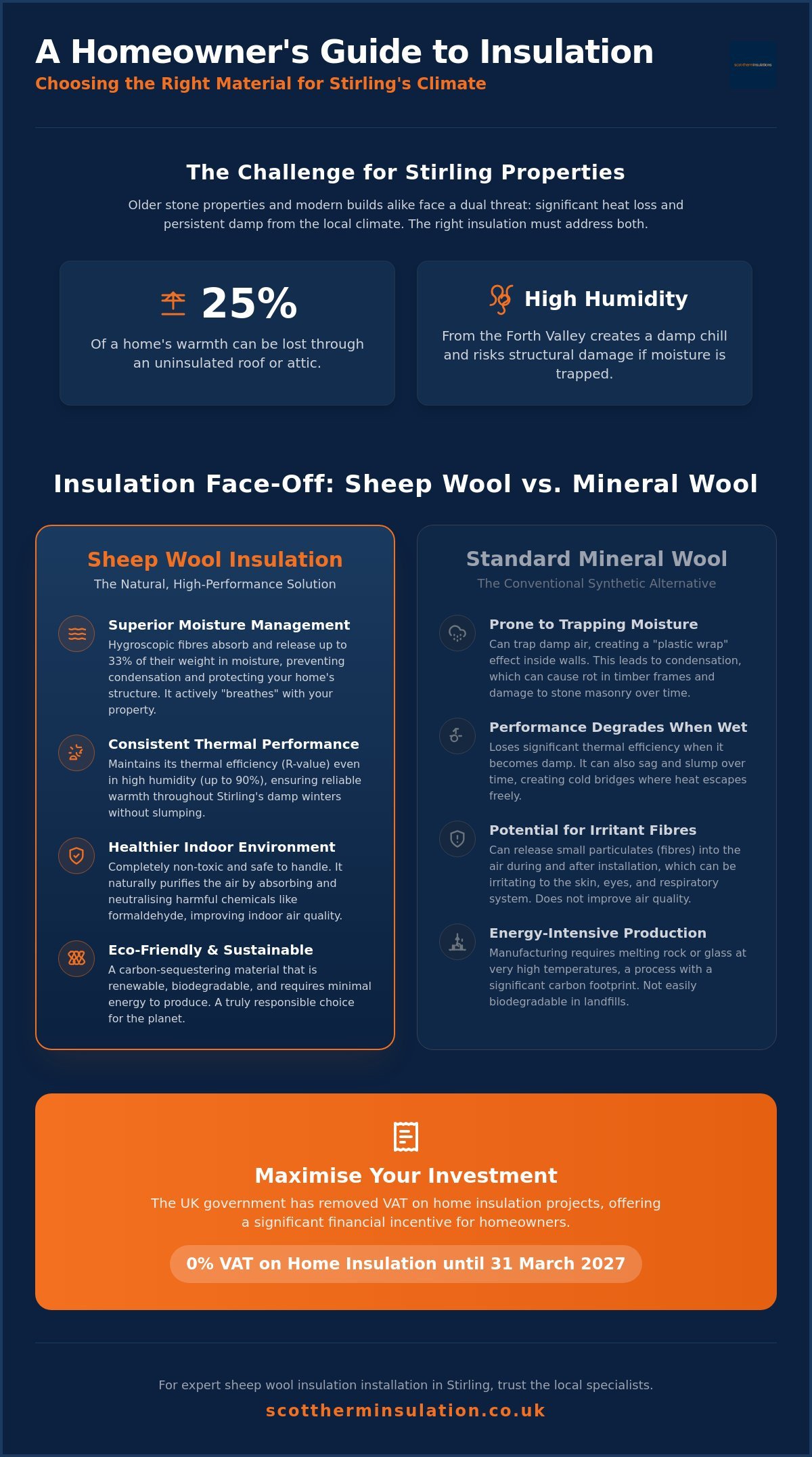
Comparing Sheep Wool with Mineral Wool for Stirling Properties
While mineral wool is often the default choice for budget-conscious projects, it rarely accounts for the specific atmospheric challenges of the Forth Valley. Professional sheep wool insulation installers in Stirling often replace slumped mineral wool that has lost its effectiveness due to moisture absorption. In a region where the “haar” and persistent mist are common, the material you choose must do more than just sit in your loft; it must actively manage the environment. Understanding the technical differences between these materials is essential for any homeowner looking for long-term reliability.
Performance in Damp Conditions
Stirling’s high humidity levels can be devastating for synthetic insulation. When mineral wool becomes damp, the tiny air pockets that provide its thermal resistance fill with water. This causes the material to compress and sag, creating significant gaps where heat can escape. It stays wet for a long time, which can lead to timber decay in your roof structure. Sheep’s wool behaves differently because it possesses a unique chemical property known as the “heat of sorption.” As the wool fibres absorb moisture from the air, they release a small amount of energy. This actually generates heat, helping to keep the insulation layer and the surrounding timbers dry. This makes it a far safer choice for local loft spaces that are prone to dampness.
The “Itch Factor” and Air Quality
Anyone who has ventured into a loft insulated with glass fibre knows the “itch.” This is caused by microscopic shards of glass or rock irritating the skin and respiratory system. These particulates can migrate into the living areas of your home, affecting the air your family breathes. Sheep’s wool is entirely natural and safe to handle without specialist protective gear. It doesn’t shed harmful fibres, making it the ideal choice for homes with children or allergy sufferers. This safety also makes future maintenance much easier. If you need to access your loft for plumbing or electrical work, you won’t have to worry about disturbing toxic dust.
The environmental contrast is equally stark. Manufacturing mineral wool requires massive amounts of energy to melt rock or glass in high-heat furnaces. Conversely, sheep’s wool is a renewable resource that naturally sequesters carbon. It’s a disciplined, quality-conscious choice that aligns with Scotland’s net-zero goals. Because wool fibres are naturally elastic, they don’t lose their “spring” over time. Whilst mineral wool often requires topping up after fifteen years due to compression, sheep’s wool maintains its full depth and performance for the life of the building. As experienced sheep wool insulation installers in Stirling, we prioritise materials that offer this kind of enduring value.
The Professional Installation Process in Stirling
A successful installation begins with a rigorous technical assessment. Stirling’s housing stock varies from 19th-century tenements to contemporary timber-framed homes, each requiring a specific approach to thermal management. Professional sheep wool insulation installers in Stirling do not simply lay material; they design a bespoke insulation plan that accounts for existing ventilation paths and structural nuances. This process ensures your home complies with the latest Scottish building standards and PAS 2035 requirements, which are essential for maintaining property value and ensuring long-term safety.
Our surveyors examine your attic for debris and damp before any material arrives. We prioritise the removal of old, degraded insulation that may be trapping moisture against your joists. Precision is vital in Scottish attic spaces, which often feature irregular shapes and tight corners. We ensure a continuous thermal layer, cutting the wool to fit perfectly around rafters and joists to eliminate the cold spots that often lead to condensation. This disciplined approach prevents the thermal bridging that compromises your home’s efficiency.
Specialised Loft and Underfloor Techniques
Stirling features many “room-in-roof” configurations, particularly in Victorian and Edwardian properties. These spaces require careful handling to ensure insulation is tucked into the “kneewalls” without blocking essential airflow. For residents in ground-floor flats or traditional cottages, we also provide under floor insulation to stop rising damp and cold draughts from the solum. We always maintain eaves ventilation; this prevents the stagnant air that leads to timber decay, ensuring your roof structure remains dry and healthy for decades.
What to Expect on Installation Day
A typical installation for a semi-detached or terraced home in Stirling usually takes one to two days. We take immense regional pride in our work, which means we treat your home with the same respect as our own. Our team maintains a tidy workspace and ensures all debris is removed, leaving your property cleaner than we found it. Once the work is complete, we provide a post-installation briefing. This helps you understand how the wool is interacting with your home’s environment and what changes you can expect in your energy consumption and indoor air quality.
If you are ready to secure your property’s thermal future with a local specialist, you can contact our Stirling team for a professional assessment.
ScotTherm Insulation: Your Local Stirling Sheep Wool Specialists
ScotTherm Insulation operates as a specialised team with deep roots in the Central Belt. We have built our reputation serving homeowners in Stirling, Bridge of Allan, and Dunblane, providing solutions that respect the architectural heritage of our region. As leading sheep wool insulation installers in Stirling, we advocate for wool insulation because it offers the most robust long-term benefits for the Scottish housing stock. Our installers undergo rigorous training to ensure every project adheres to British Standards, providing a level of local accountability that national contractors often cannot match.
Expertise in Scottish Climate Solutions
Stirling’s weather requires a nuanced understanding of how moisture interacts with building materials. Unlike national firms that apply a one-size-fits-all approach, we recognise the specific thermal demands of properties located near the damp microclimate of the Forth Valley. Our primary focus is delivering high-performance loft insulation scotland wide, ensuring maximum savings and structural protection for our clients. Whilst national “van-and-man” outfits might overlook the importance of breathability in stone masonry, our team prioritises it to prevent structural decay. Your neighbours in Stirling and the surrounding villages frequently report a tangible difference in both their heating bills and the overall comfort of their homes.
Start Your Journey to a Warmer Home
Taking the first step towards a more efficient property is straightforward. We offer a specialist free insulation inspection to assess your home’s current performance and identify the most effective upgrades. Our experts also help you navigate the complex landscape of insulation grants scotland currently offers, ensuring you access any available funding to offset your investment. As disciplined sheep wool insulation installers in Stirling, we provide transparent, no-obligation quotes that clearly outline the financial and physical benefits of your project.
The ScotTherm guarantee acts as a signature of our reliability. It ensures that every installation is not just a transaction but a long-term partnership in home maintenance. We prioritise safety and domestic well-being, ensuring that the non-toxic, fire-resistant properties of sheep’s wool are maximised through professional fitting. Our team remains available for post-installation support, reinforcing our identity as a trusted regional expert who takes pride in the tangible impact of our work on the local community. You can rely on our verified history and technical proficiency to transform your home into a warmer, drier sanctuary.
Secure Your Home’s Thermal Future Today
Selecting the correct material for your property is a decision that impacts your comfort and energy bills for decades. Natural sheep’s wool is a structural necessity for Stirling’s historic masonry and humid climate. By prioritising breathability and moisture management, you protect your home from the damp-related issues common in the Central Belt whilst significantly reducing your heat loss.
Working with professional sheep wool insulation installers stirling ensures your project is handled with technical precision and local accountability. As PAS 2030:2019 Accredited Installers, we specialise in breathable natural fibres and take pride in serving Stirling and the Central Belt. We offer the security of a verified history and the peace of mind that comes from using certified specialists who understand the unique demands of Scottish architecture.
It’s time to transform your living space into a warmer, drier, and more sustainable environment. Book your free Stirling insulation survey with ScotTherm today and take the first step toward a more efficient home. We look forward to helping you achieve the cozy, cost-effective environment your family deserves.
Frequently Asked Questions
Is sheep wool insulation more expensive than standard glass wool in Stirling?
Sheep wool does have a higher upfront cost than glass wool; however, its lifespan and moisture-handling capabilities often make it more cost-effective over time. You won’t need to replace it as frequently because it doesn’t slump when damp. Additionally, the current removal of VAT on home insulation until 31 March 2027 helps offset the initial investment. Professional sheep wool insulation installers in Stirling can help you calculate the long-term savings for your specific property type.
Can sheep wool insulation help with damp and mould in older Stirling homes?
Yes, sheep’s wool is highly effective at managing damp and mould because it is a hygroscopic material. It can absorb up to a third of its weight in moisture without losing its thermal properties. This prevents interstitial condensation from forming against your home’s structural timbers. By regulating the dew point in older stone properties, it helps maintain a drier, healthier indoor environment that resists mould growth.
Does sheep wool insulation attract moths or vermin?
No, professional-grade wool insulation is treated during manufacturing to ensure it does not attract moths or vermin. Manufacturers typically use borate-based minerals to provide permanent protection against pests. These treatments are non-toxic to humans but highly effective at repelling insects. You can rest assured that your insulation will remain structurally sound and pest-free for the lifetime of the building.
How long does it take for a professional team to insulate a loft in Stirling?
A professional team can typically complete a loft insulation project in a standard Stirling home within one to two days. The timeline depends on the complexity of your roof structure and whether old, degraded material needs removing first. Because natural wool is safe to handle and doesn’t produce irritating dust, the process is efficient and causes minimal disruption. Our team ensures your home remains clean and functional throughout the installation.
Is there any government funding or ECO4 support for sheep wool in Scotland?
Funding is currently available through the Home Energy Scotland Grant and Loan, which offers up to £7,500 in grant funding for energy efficiency measures. For those in rural areas, an additional £1,500 uplift may be available. The ECO4 scheme and the Great British Insulation Scheme also provide support for qualifying households until March 2026. Consult with sheep wool insulation installers stirling to see which funding route best suits your circumstances.
Do I need to move out of my house during the insulation installation?
You don’t need to move out of your home whilst the installation takes place. Unlike some spray foam or chemical-based products, sheep’s wool is completely non-toxic and doesn’t release harmful volatile organic compounds. It is a clean, dry process that allows your family to remain in the property without any health risks. Our installers prioritise a tidy workspace and will leave your home ready for immediate use.
Can sheep wool be used for underfloor insulation in Stirling tenements?
Yes, sheep’s wool is an ideal choice for underfloor insulation in traditional Stirling tenements with suspended timber floors. Its breathability is crucial for protecting floor joists from the damp conditions often found in the solum. By fitting the wool between the joists, you eliminate the cold draughts that rise through floorboards. This significantly improves the comfort of ground-floor rooms whilst allowing the timber structure to breathe naturally.
Is sheep wool insulation actually fireproof?
Sheep’s wool is naturally fire-resistant and has a higher ignition temperature than many other common insulation materials. It is inherently self-extinguishing; if a flame is applied, the wool will char but won’t support combustion. Most professional wool products are also treated with fire retardants to meet stringent British safety standards. This provides an extra layer of security for your home without the toxic fumes associated with synthetic alternatives.