
What if your upstairs bedrooms didn’t have to feel like a walk-in freezer every time a Stirling winter sets in? It’s a common struggle for local homeowners who find heat vanishing through dormer windows and sloped ceilings, leaving them with astronomical energy bills. Understanding the room in roof insulation cost stirling residents can expect is the first step to securing a warmer, more efficient home. Whilst every property is unique, the combination of modern materials and regional expertise ensures your upper floors become truly liveable spaces again.
You probably feel the frustration of paying for heating that doesn’t stay where it’s needed, especially when those upstairs rooms remain drafty and uncomfortable. This article explains the specific factors that dictate your project’s price, including material choices like mineral wool or sustainable sheep’s wool. We’ll also provide a clear roadmap for the ECO4 grant ending on 31 December 2026, the Great British Insulation Scheme ending in March, and the current 0% VAT incentive. You’ll discover how to navigate the Stirling market and potentially access up to £7,500 in Home Energy Scotland funding to transform your home’s thermal performance.
Key Takeaways
- Understand why Stirling’s geography, especially near the Ochil Hills, requires a specialised approach to insulating sloping ceilings and ashlar walls.
- Identify the four critical thermal bridges in Scottish attic rooms and learn how vapour-permeable membranes protect your roof timbers from damp.
- Discover how to accurately estimate the room in roof insulation cost stirling residents pay by accounting for specific property features like dormer windows and scaffolding needs.
- Compare the thermal conductivity and health benefits of mineral wool versus sustainable sheep’s wool for your upper-floor living spaces.
- Check your eligibility for 100% funding through the ECO4 Scotland scheme or Home Energy Scotland grants before the 2026 deadlines.
Understanding Room in Roof Insulation in Stirling’s Climate
Many homeowners in Central Scotland find that their top-floor bedrooms are the most uncomfortable rooms in the house. This usually happens because of a fundamental misunderstanding of how heat behaves in 1.5-storey properties. Unlike a standard loft where insulation sits flat on the floor, a “room-in-roof” is a habitable space where the ceiling follows the line of the roof itself. Effective room-in-roof insulation targets a complex system of sloping ceilings, ashlar walls (the short vertical walls), and gable ends to create a thermal envelope. Without this specific treatment, your upstairs remains a “winter fridge” where heat escapes through the slates, and a “summer oven” where the sun’s energy radiates directly into your sleeping area.
Stirling’s geographical position, nestled beneath the Ochil Hills, creates a microclimate where wind-driven rain and plummeting winter temperatures are the norm. This exposure accelerates heat loss far more aggressively than in sheltered urban centres. When evaluating the room in roof insulation cost stirling residents face, it’s vital to recognise that this isn’t a simple “roll and lay” job. It requires a technical approach that respects the local climate and the physics of heat transfer. High-quality Building insulation is the only way to stabilise these temperatures and protect your home’s structural integrity from the harsh Scottish elements.
The Impact of Stirling’s Traditional Architecture
Stirling is home to a diverse range of historic Victorian sandstone villas and post-war 1.5-storey builds. These traditional structures weren’t designed with modern thermal efficiency in mind. In the King’s Park or Riverside areas, many older homes suffer because “cold roof” solutions fail in our damp, windy environment. If you don’t maintain a precise airflow behind the insulation material, moisture builds up against the roof timbers. Our approach ensures that we prevent heat transfer whilst allowing the building to breathe, which is essential for preserving Stirling’s architectural heritage.
Why Standard Loft Insulation Isn’t Enough
You can’t solve a room-in-roof problem by simply adding more rolls of quilt to the floor. On sloping surfaces, standard mineral wool eventually sags under its own weight, creating cold spots where condensation thrives. We’ve seen many cases where homeowners tried to “board over” existing insulation, only to find it led to structural dampness and rot. A true solution requires a comprehensive “envelope” approach. This means sealing every thermal bridge, from the eaves to the ridge, ensuring your upper storey stays warm in December and cool in July without the need for constant heating or fans.
Breaking Down the Components of a Room in Roof Project
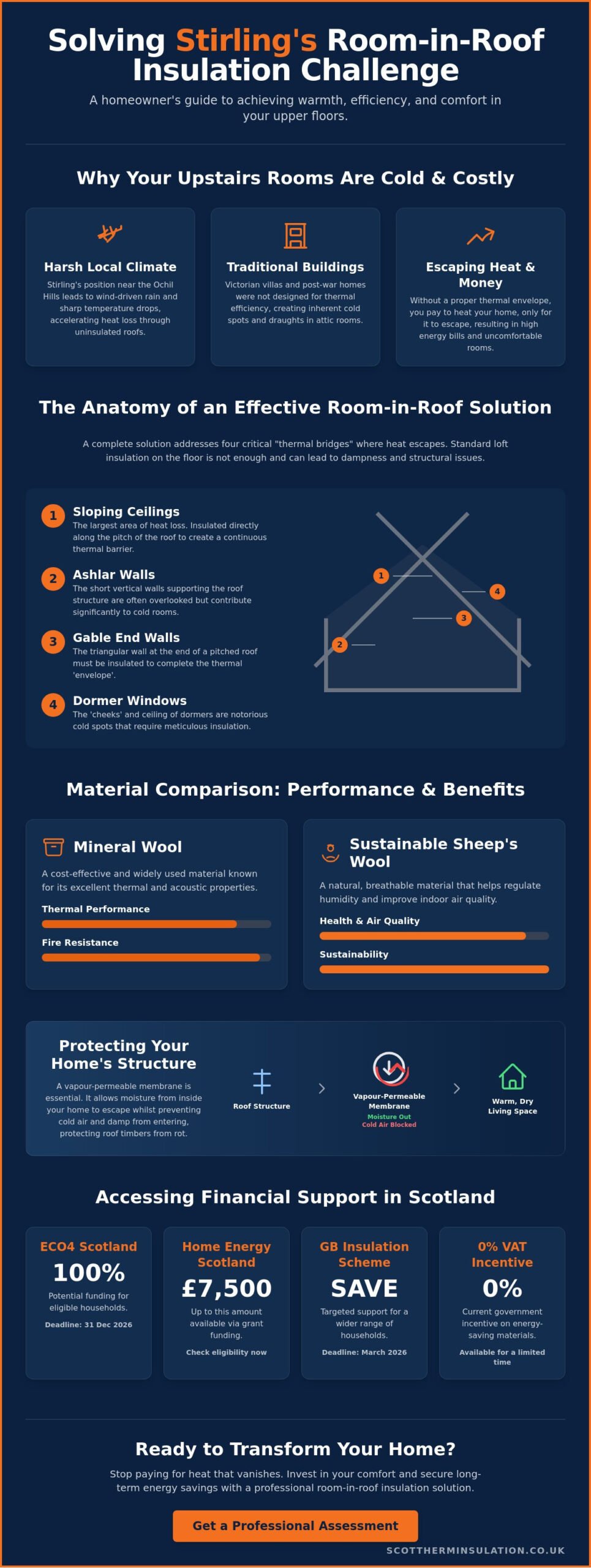
A professional room-in-roof project is a precision exercise in thermal engineering. In Stirling’s older properties, we identify four critical thermal bridges: sloping ceilings, ashlar walls, gable ends, and dormer windows. Missing just one of these areas renders the entire system inefficient. To combat this, we use a combination of high-performance rigid boards and flexible wool depending on the specific cavity depths available. This strategic integration ensures we don’t lose significant floor space in smaller attic bedrooms. Understanding these technical layers helps clarify why the room in roof insulation cost stirling homeowners invest in is a long-term value proposition rather than a simple DIY fix.
Protecting your roof timbers is our primary technical priority. We install vapour-permeable membranes that allow moisture to escape whilst blocking cold air from entering the living space. This is a standard requirement for many who apply for the Home Energy Scotland Grant and Loan. It prevents the structural rot often seen in poorly ventilated Scottish attics. By creating a sealed but breathable envelope, we protect the building’s skeleton whilst significantly reducing your monthly outgoings. If you’re unsure about your specific layout, exploring our room in roof insulation services can help clarify the best technical path for your property.
Insulating Sloping Ceilings and Ashlar Walls
Sloping ceilings are insulated along the pitch of the roof. We use specialised techniques that don’t require removing tiles, which keeps the room in roof insulation cost stirling residents encounter far more predictable. Ashlar walls, which are the short vertical walls at the eaves, are often the coldest spots in a Scottish home. We treat the “room-behind-the-wall” to create a continuous thermal barrier that connects the floor insulation to the roofline, eliminating the common draughts that settle at floor level.
Dealing with Gable Ends and Dormer Windows
Dormer windows are notorious for heat loss and draughts. We insulate the “cheeks” and “ceilings” of the dormer with slim, high-performance materials to maximise warmth without encroaching on the window opening. Gable stonework, particularly in Victorian builds, is treated from the inside to stop thermal bridging through the heavy masonry. We focus on ensuring absolute airtightness around window frames, yet we always design the system to allow for necessary ventilation to maintain healthy air quality in sleeping areas.
Calculating the Room in Roof Insulation Cost in Stirling
Estimating your investment requires a move away from generic “per square metre” online calculators. These figures are often misleading for Stirling’s 1.5-storey homes because they fail to account for the labour-intensive nature of insulating sloped ceilings and ashlar walls. Unlike a flat loft floor where rolls are simply laid out, a room-in-roof project involves precision cutting, fitting, and sealing between individual rafters. The room in roof insulation cost stirling homeowners actually pay is determined by the total surface area of the thermal envelope, the complexity of the roof’s geometry, and the accessibility of the work zones. For instance, if your property features multiple dormer windows, the time required to seal these specific thermal bridges increases the overall project duration.
Access is another significant factor that influences your final quote. Whilst many internal walls can be treated from within the room, dormer cheeks and ceilings sometimes require external scaffolding to ensure a safe and compliant installation. Material choice also plays a pivotal role in the initial outlay. Mineral wool remains the industry standard for cost-effective performance, whilst sustainable sheep’s wool attracts a higher price point due to its natural breathability and eco-credentials. You can often improve the overall value of the project by combining services. Integrating loft boarding packages during the insulation phase allows for a more efficient use of labour and ensures your storage space remains thermally separated from your living area.
Key Variables Influencing Your Investment
The number of dormer windows is the primary driver of complexity. Each window requires bespoke cutting and airtight sealing to prevent the draughts mentioned in previous sections. You must also consider the condition of existing materials. If your attic contains old, degraded, or damp fiberglass, removing and disposing of this safely adds to the project timeline. Finally, the requirement for internal decorative finishing will affect the price. A comprehensive installation usually involves fitting new plasterboard and a professional skim coat to return the room to a “ready-to-decorate” state. With the current 0% VAT rate on home insulation until 31 March 2027, many Stirling residents find this the ideal window to undertake these structural improvements.
Long-term ROI: Energy Bill Savings in Stirlingshire
Investing in your home’s thermal envelope provides immediate financial relief. Industry data suggests that insulating a roof or loft space can save up to £230 a year on heating bills. In the competitive Stirlingshire property market, a high EPC rating and a fully usable, warm upper floor significantly increase a home’s resale appeal. Buyers in the Central Belt increasingly prioritise energy efficiency to avoid future retrofit costs. Professional room-in-roof systems typically achieve full cost-neutrality through annual energy savings within five to seven years. This makes the project one of the most reliable home improvements for both immediate comfort and long-term financial security.
Material Choices: Mineral Wool vs Sustainable Sheep’s Wool
Selecting the correct material is a balance between immediate budget and long-term performance. The room in roof insulation cost stirling homeowners consider is primarily driven by the choice between industry-standard mineral wool and premium natural fibres. Mineral wool is a highly effective thermal barrier with a lambda value (thermal conductivity) ranging from 0.032 to 0.044 W/mK. It remains the most cost-effective solution for modern builds. However, for attic bedrooms where air quality is a priority, we often recommend sustainable sheep’s wool. This natural material contains no harmful chemicals or volatile organic compounds (VOCs). It provides a healthier environment in sleeping areas whilst offering a comparable lambda value of approximately 0.035 to 0.040 W/mK.
Both materials offer impressive longevity and fire safety. Mineral wool is naturally non-combustible, often carrying a Euroclass A1 rating. Sheep’s wool is also naturally flame retardant due to its high nitrogen and moisture content. It won’t support a flame and simply chars in the event of a fire. Because these materials don’t settle or degrade significantly over time, they are designed to last the entire lifespan of your property. When you invest in professional installation, you ensure these materials are fitted without gaps, maintaining their thermal integrity for decades to come.
Why Breathability Matters for Stirling Properties
Stirling’s traditional sandstone architecture requires materials that can manage moisture. Traditional buildings are designed to breathe. Using non-breathable synthetics can create a “plastic bag” effect, trapping moisture against the roof timbers and leading to interstitial condensation. Sheep’s wool is hygroscopic, meaning it can absorb up to 33% of its weight in moisture without losing its R-value (insulating power). It then releases this moisture when the air dries out. This natural moisture management prevents the mould growth often found in poorly ventilated attic rooms across Stirlingshire.
Performance Comparison: Thermal Efficiency and Longevity
While mineral wool costs approximately £13 per square metre, sheep’s wool sits at a higher price point of £18 to £25 per square metre for a 100mm thickness. This initial gap reflects the superior moisture handling and eco-credentials of the natural option. The following table highlights the key differences to help you decide which material suits your Stirling home.
| Feature | Mineral Wool Insulation | Sheep’s Wool Insulation |
|---|---|---|
| Installation Speed | Fast (Standard rolls/slabs) | Moderate (Precision cutting) |
| Eco-Credentials | High (Recycled glass content) | Exceptional (Renewable & Biodegradable) |
| Moisture Handling | Low (Needs vapour barrier) | High (Naturally breathable) |
| Typical Cost (per m²) | Approximately £13 | £18 to £25 |
Choosing the right material ensures your upper floor remains a comfortable, healthy space regardless of the weather. If you want to see which option fits your property’s specific needs, you can request a detailed quote for Stirling insulation today.
Professional Installation and Grant Funding in Stirling
Many Stirling residents are surprised to learn that the substantial room in roof insulation cost stirling homeowners face can often be completely covered by government-backed funding. The ECO4 Scotland scheme represents a significant opportunity for households to improve their energy efficiency at zero personal expense. This initiative specifically targets properties with lower energy performance, focusing on those with an EPC rating of E, F, or G. By utilising these grants, you can transition from a draughty, expensive living space to a thermally efficient home without the financial burden of a standard private installation.
A professional survey is the essential first step for any project in Stirlingshire. This assessment identifies the specific thermal bridges and material requirements that influence the room in roof insulation cost stirling residents pay. Because grant funding requires strict adherence to quality standards, using a TrustMark-registered installer is non-negotiable. This certification acts as a badge of reliability, ensuring that every component of your new insulation system meets national safety and performance regulations. At ScotTherm Insulation, our commitment to regional expertise means we understand the nuances of local building stock, ensuring your installation is both compliant and highly effective.
Navigating the ECO4 Scheme in Stirlingshire
Eligibility for the ECO4 scheme often depends on household income or the receipt of certain income-related benefits. However, even if you don’t meet these specific criteria, you can still access insulation grants in Scotland through Home Energy Scotland, which offers up to £7,500 for energy-saving improvements. Stirling Council and local energy advice hubs work to promote these programmes, but with the ECO4 scheme confirmed to end on 31 December 2026, time is a critical factor. We recommend applying through ScotTherm Insulation as early as possible to ensure your property is surveyed and processed before the funding window closes.
The ScotTherm Insulation Installation Process
We’ve refined our installation process to ensure minimal disruption to your daily life. Our team organises each site to protect your carpets and furniture whilst we work within the roof’s structure. The timeline is straightforward: following your initial survey, we schedule the work and typically complete the installation within a few days. Every project concludes with a final certification and a thorough post-installation review to confirm the thermal envelope is perfectly sealed. The ScotTherm Insulation team provides comprehensive post-installation support and a guarantee of workmanship to ensure your investment provides comfort and savings for the lifetime of your home.
Transform Your Stirling Home’s Thermal Performance
Securing a warm and energy-efficient upper floor requires a technical approach that respects Stirling’s unique climate and traditional building stock. By addressing the critical thermal bridges in your sloping ceilings and ashlar walls, you can eliminate the “winter fridge” effect and significantly reduce your annual heating expenditure. Whether you opt for the cost-effective performance of mineral wool or the superior breathability of sustainable sheep’s wool, the right material choice ensures your home remains healthy and comfortable for decades.
Navigating the room in roof insulation cost stirling homeowners face is simpler when you leverage available government funding before the 2026 deadlines. Our local Stirling-based expertise and status as TrustMark Registered Installers guarantee a compliant, high-quality result that adds tangible value to your property. As specialists in sustainable sheep’s wool, we prioritise long-term structural health alongside immediate thermal comfort and air quality.
Request your free, no-obligation insulation survey in Stirling today and take the first step towards a more cost-effective, cosy home. You don’t have to settle for frigid upstairs rooms when professional, grant-supported solutions are within reach.
Frequently Asked Questions
How much does room in roof insulation cost in Stirling on average?
The room in roof insulation cost stirling residents pay varies significantly based on roof geometry, the number of dormer windows, and the chosen materials. Unlike simple loft rolls, this project involves bespoke fitting between rafters and ashlar walls, which requires more labour and precision. Factors such as scaffolding requirements for external access and the necessity for internal plasterboarding will influence your final investment. A professional survey is the only way to get an accurate figure for your specific property layout.
Can I get a grant for room in roof insulation in Scotland in 2026?
You can still access several funding streams in Scotland throughout 2026, including the ECO4 scheme and Home Energy Scotland grants. The ECO4 scheme is confirmed to end on 31 December 2026, whilst the Great British Insulation Scheme concludes earlier on 31 March 2026. Home Energy Scotland provides grants of up to £7,500 for energy efficiency measures, with an additional £1,500 available for homeowners in rural or island areas.
How long does it take to insulate an attic room?
A standard room-in-roof installation typically takes between two and four days to complete. The exact timeline depends on the complexity of the roof shape and whether old, degraded materials need to be removed first. If your project requires external scaffolding for dormer access or extensive internal finishing, the process may take slightly longer. We organise each site to ensure your home remains functional and tidy throughout the work.
Will I lose a lot of room space if I insulate the sloping ceilings?
You won’t lose a significant amount of floor space when using modern, high-performance materials. We integrate slim rigid boards or high-density wools that provide maximum thermal resistance with minimum thickness. This approach is particularly effective in smaller Stirling attic rooms where preserving the original dimensions is a priority. By insulating between the rafters rather than just over them, we maintain the room’s usable area whilst creating a warm envelope.
Is sheep’s wool better than mineral wool for old Stirling houses?
Sheep’s wool is often the superior choice for older Stirling properties because of its natural breathability and moisture-wicking properties. Traditional stone buildings must manage moisture effectively to prevent timber rot and dampness. Whilst mineral wool is a cost-effective industry standard for modern builds, sheep’s wool can absorb and release moisture without losing its insulating power. This makes it an excellent investment for preserving the structural integrity of historic Scottish architecture.
Do I need to move out whilst the insulation is being installed?
You don’t need to move out whilst we install your insulation. We focus on one area at a time and use protective coverings to shield your furniture and flooring from any dust or debris. Our team organises the site to ensure you have continued access to your essential living spaces. Most homeowners find they can carry on with their daily routines with only minimal, localised disruption during the working day.
What is the ECO4 scheme, and how do I apply in Stirling?
The ECO4 scheme is a government-backed initiative that requires energy suppliers to fund efficiency improvements for eligible households. To apply in Stirling, you should contact a TrustMark-registered installer to verify your eligibility based on income-related benefits or your property’s EPC rating. Given that the room in roof insulation cost stirling can be fully covered by this scheme, it’s vital to apply before the 31 December 2026 deadline.
Will room in roof insulation stop my upstairs rooms from being too hot in summer?
Professional insulation is highly effective at keeping your upstairs rooms cool during the summer months. By blocking the sun’s radiant heat from penetrating the roof structure, the insulation prevents your attic space from becoming uncomfortably hot. This thermal barrier stabilises the internal temperature year-round. It significantly reduces the need for expensive electric fans or portable air conditioning units when the Scottish summer temperatures rise.