
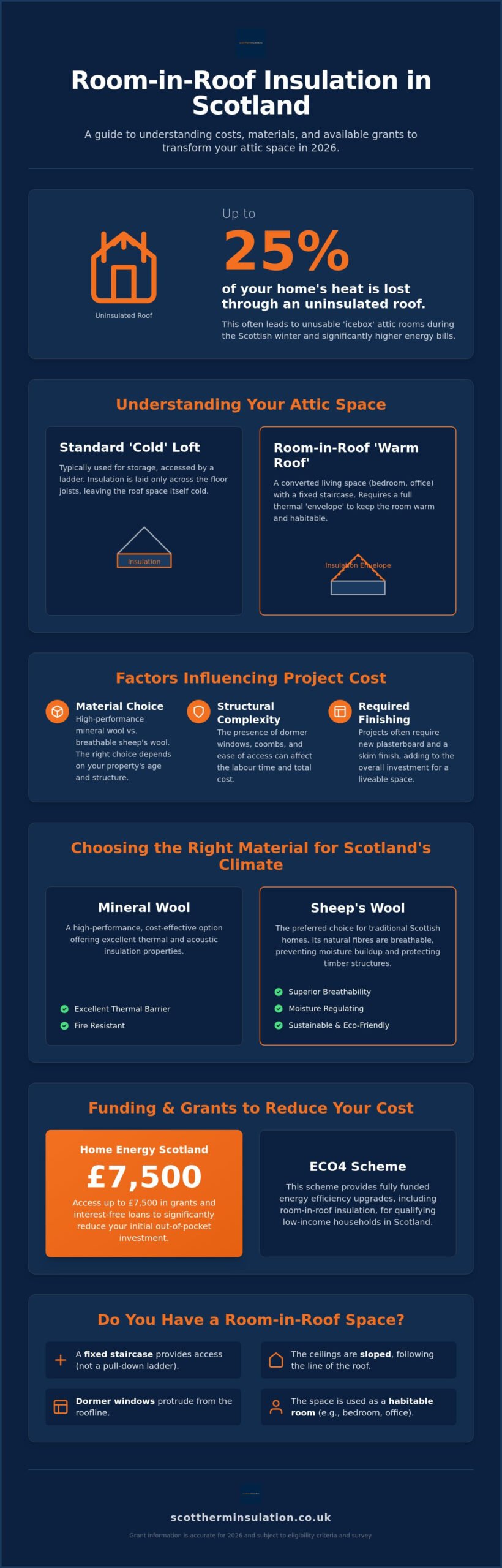
Did you know that up to 25% of your home’s heat is currently escaping straight through an uninsulated roof? It’s a frustrating reality for many homeowners across the Central Belt, especially when a prized attic conversion becomes an unusable icebox the moment the Scottish winter bites. If you’re researching the room in roof insulation cost scotland, you’ve likely noticed draughts through dormer walls or watched your energy bills soar while your upstairs rooms remain stubbornly chilly. We understand that the technical jargon surrounding thermal barriers can feel overwhelming when you just want a warm, comfortable home.
This guide provides a clear, professional breakdown of typical expenses and funding options for 2026. You’ll learn exactly how to transform your attic space into a year-round living area while securing long-term financial efficiency and physical comfort. We’ll preview the latest Scottish building standards, compare the benefits of breathable sheep’s wool against high-performance mineral wool, and explain how to access the £7,500 Home Energy Scotland grants that are currently available to help offset your investment.
Key Takeaways
- Learn how to accurately estimate the room in roof insulation cost scotland by considering material choices and the unique structural requirements of your attic conversion.
- Discover how to access up to £7,500 in Home Energy Scotland grants and interest-free loans to significantly reduce your initial out-of-pocket investment.
- Understand why breathable insulation materials, such as sheep’s wool, are the preferred choice for maintaining the structural health of traditional Scottish homes.
- Identify the specific project variables, such as dormer access and plasterboard finishing, that distinguish room in roof projects from standard loft insulation.
- Explore the eligibility criteria for the ECO4 scheme, which provides fully funded energy efficiency upgrades for qualifying low-income households in Scotland.
What is Room in Roof Insulation and Why Does it Matter in Scotland?
Understanding the structural layout of your home is the first step in addressing high heating bills. A “room in roof” refers to an What is Room in Roof Insulation that has been converted into a functional living space, such as a bedroom or home office. Unlike a standard cold loft where insulation is simply laid across the floor joists, a room in roof requires a comprehensive “envelope” approach. This involves insulating the sloping ceilings, often called coombs, the vertical stud walls or ashlar walls, and the flat ceilings directly above the room. By treating every surface that borders the outside world, we create a thermal barrier that keeps warmth where it belongs.
Many homeowners find that their attic rooms are virtually unusable during the winter months. This is usually because standard loft insulation is insufficient for these spaces. Because heat rises and meets the cold roof surface directly, it escapes rapidly through thin plasterboard and timber. By installing professional insulation, you create a “warm roof” environment. This keeps the heat inside the living area and prevents the common “icebox” effect. When calculating the room in roof insulation cost scotland, it is vital to remember that you are not just buying material. You are investing in the year-round usability of your home’s top floor and protecting the building’s fabric from extreme temperature fluctuations.
Identifying a Room in Roof Space
You can easily identify this type of space by looking for a fixed staircase rather than a pull-down loft ladder. If your upstairs rooms have sloped ceilings that follow the line of the roof or feature dormer windows that protrude from the roofline, you have a room in roof. In older Scottish properties, these spaces were often converted decades ago with little to no thermal protection. This leaves them as the coldest part of the house, where heat loss is most aggressive. Unlike a functional living space, a standard cold loft is typically used only for storage and does not require the same level of internal finish.
The Scottish Climate Factor
The Scottish climate presents specific challenges for thermal efficiency. High humidity levels and frequent wind-driven rain mean that insulation choices must be made with care. For traditional stone builds in cities like Edinburgh or Stirling, breathability is a non-negotiable requirement. Using non-breathable materials can trap moisture against the original masonry, leading to structural dampness and rot. We prioritise materials like mineral wool and sheep’s wool because they handle moisture effectively whilst providing superior warmth. Additionally, dormer windows are notorious for thermal bridging, where heat bypasses insulation through the timber frame. Professional installation ensures these gaps are sealed, protecting your home from the damp, biting winds common across the Central Belt. Understanding the room in roof insulation cost scotland involves looking at these climate-specific needs to ensure a long-lasting, safe result.
Breaking Down the Room in Roof Insulation Cost per m² in 2026
Calculating the room in roof insulation cost scotland involves looking beyond simple material volume. Unlike a standard loft project where rolls are simply laid on a floor, these installations involve complex structural work. Because we are working within a living space, the total investment includes stripping back existing surfaces and installing new plasterboard and skim finishes. This dual requirement for thermal expertise and interior finishing naturally increases the per-square-metre rate compared to uninhabited attics. According to the room in roof insulation advice from the Energy Saving Trust, professional installation is the most reliable way to ensure these complex areas meet modern thermal standards.
Most homeowners choose the ‘inside-out’ method, which involves working from within the room to secure the thermal envelope. The ‘outside-in’ approach, which requires removing roof tiles, is typically reserved for major reroofing projects. While working internally is often more convenient, it does require a complete redecoration of the space once the insulation is secured. Local labour rates also play a significant role in your final bill. Installers in Edinburgh and North Berwick often command a slight premium due to higher operational costs, whereas rates in parts of Fife or Perth may sit closer to the national average of approximately £250 per day for a professional installer.
Estimated Costs by Property Type
The layout of your home dictates the complexity of the job. A small dormer bungalow is often the most straightforward, focusing on a few vertical stud walls and sloping coombs. In contrast, a large Victorian villa in Stirling or Edinburgh presents challenges like high ceilings and intricate roof lines that require more labour-intensive cutting and fitting. For those in a mid-terrace conversion, shared wall considerations are vital to ensure that thermal gaps don’t persist at the boundaries of the property. Each of these factors will influence the total room in roof insulation cost scotland for your specific project.
Material Cost Comparison: Mineral Wool vs Sheep’s Wool
We typically work with two primary materials that offer distinct benefits for Scottish homes. Mineral wool is the budget-friendly, high-performance standard that provides excellent fire resistance and thermal retention. For homeowners prioritising sustainability or living in traditional stone builds, sheep’s wool is a premium choice. It naturally manages moisture and humidity, which is essential for protecting older timber rafters from rot. While mineral wool offers a faster return on investment through lower upfront costs, sheep’s wool provides a superior price-to-performance ratio when considering the long-term structural health of a heritage property. If you are unsure which material suits your budget, our specialists can help you choose the right room in roof insulation for your needs.
Factors Influencing Your Total Project Price: Materials and Labour
Every Scottish home presents a unique set of structural challenges that dictate the final quote. Whilst material volume is a primary driver, the physical environment of your attic room often carries the most weight in determining the total investment. For instance, homes with dormer windows frequently require external scaffolding to ensure installers can safely reach the dormer cheeks and roof sections. This logistical requirement can add several hundred pounds to a project, but it is essential for both safety and the integrity of the thermal seal. When evaluating the room in roof insulation cost scotland, you must consider these access requirements alongside the raw material prices.
The condition of your existing interior walls is another critical variable. Many traditional homes in areas like Edinburgh and Stirling still feature original lath and plaster finishes. If these surfaces are crumbling or unstable, they may need to be removed before we can install high-performance insulation. This preparation work increases the labour time significantly. Additionally, we must ensure the roof structure maintains adequate ventilation. We typically create a 50mm air gap between the insulation and the roof sarking to prevent moisture buildup and timber rot. Skipping this step might save money initially, but it risks catastrophic structural damage in the damp Scottish climate.
Labour Costs in the Central Belt
Specialist insulation fitters in 2026 typically command a daily rate of approximately £250. Unlike a standard loft roll-out, which can often be completed in a single morning, a room in roof project is a multi-day endeavour. It requires precise cutting, fitting around complex angles, and the installation of vapour control layers. Choosing a local specialist ensures you are working with a team that understands the specific building behaviours of Scottish masonry and timber. This accountability is invaluable for long-term peace of mind.
Hidden Costs to Budget For
Several secondary expenses can catch homeowners by surprise. If your dormer walls currently house electrical sockets or radiators, these will need to be professionally disconnected and moved forward onto the new, thicker insulated boards. You should also account for the following:
- Waste Disposal: Hiring a skip for the removal of old, degraded glass wool or lath and plaster debris.
- Redecoration: Once the new plasterboards are skimmed, the room will require a full professional paint finish.
- Finish Levels: Choosing a ‘ready-for-paint’ finish is more expensive than a basic insulation-only install but provides a far superior aesthetic result.
By identifying these variables early, you can develop a realistic budget for the room in roof insulation cost scotland without encountering unexpected financial hurdles mid-project.
Funding and Grants: Offsetting the Cost in Scotland
Whilst the initial investment for thermal upgrades can seem significant, Scottish homeowners have access to some of the most generous financial support packages in the UK. These initiatives are designed to help the nation meet its net-zero targets by 2045, specifically by improving the efficiency of older, hard-to-heat properties. By utilising these schemes, you can substantially reduce the room in roof insulation cost scotland and enjoy a much warmer home without the full upfront financial burden. Most residents find that a combination of grants and interest-free loans makes professional installation far more accessible than they first imagined.
The primary route for many is through Home Energy Scotland (HES). In 2026, homeowners can apply for a grant of up to £7,500 to cover energy efficiency improvements, including room in roof projects. If the grant doesn’t cover the entire balance, an additional interest-free loan of up to £7,500 is also available. For those living in designated rural areas, such as specific postcodes in rural Perthshire or Fife, an extra £1,500 grant uplift may be accessible. These insulation grants in Scotland are not means-tested, meaning they are available regardless of your household income, provided you meet the property criteria.
The ECO4 Scheme in 2026
For low-income households or those receiving certain benefits, the ECO4 Scotland scheme remains a vital resource until its scheduled conclusion in March 2026. This programme requires major utility companies to fund energy-saving measures for eligible residents. If your household income is under £31,000 or you receive qualifying benefits, you may be eligible for fully funded room in roof insulation. The scheme prioritises attic conversions because they represent such a high point of heat loss. The process typically begins with a professional survey to verify your property’s current EPC rating and structural needs before moving to a certified installation.
Calculating Your Energy Savings
Investing in your roof space provides a tangible return on investment through lower monthly outgoings. A typical semi-detached home in Scotland can save approximately £250 per year on heating bills by properly insulating a converted attic. Beyond the immediate financial gain, professional installation can significantly boost your Energy Performance Certificate (EPC) rating, which is increasingly important for property valuations. For most Scottish attic projects, the payback period is estimated at between five and seven years when considering current energy price trajectories. To see if your property qualifies for current funding, you can contact our team for a professional assessment today.
Choosing ScotTherm for Your Room in Roof Project
Selecting the right partner is just as critical as the choice of materials. At ScotTherm Insulation, we bring a wealth of regional expertise to every project across Edinburgh, Fife, Perth, and Stirling. We understand that your home is your most significant investment. That’s why we strike a balance between technical proficiency and your domestic well-being. Our team focuses on creating a cozy, cost-effective environment using only verified, high-performance materials. By choosing a specialist who understands the room in roof insulation cost scotland, you ensure that every penny spent contributes to long-term thermal efficiency. We take immense pride in our tangible impact on the local community, providing a service that is both reliable and rooted in regional accountability.
We are committed to using breathable solutions like mineral wool and sustainable wool insulation. These materials are specifically chosen for their ability to protect traditional Scottish masonry and timber from the moisture issues common in our climate. A professional survey allows us to identify specific heat loss points that a generic assessment might miss. This precision is what distinguishes our service from standard, retail-only companies. We act as both a primary service expert and a collaborative industry leader, ensuring your project meets the highest professional standards.
Our Sustainable Approach
We favour sheep’s wool for its natural moisture-regulating properties, making it an ideal choice for the damp Scottish climate. This material doesn’t just insulate; it actively manages humidity to protect your rafters from rot. We organise our projects to minimise disruption to your home life, ensuring a clean and efficient installation process. Our focus remains firmly on long-term thermal integrity rather than ‘quick fixes’ that might compromise your building’s health. This disciplined, quality-conscious approach ensures that your attic room remains a comfortable living space for decades to come. We believe in the security of a verified history and the peace of mind that comes from using certified professionals who prioritise safety over quick sales.
Get a Personalised Quote
Because every Scottish home has its own structural nuances, a site-specific survey is essential for accurate pricing. This visit allows us to account for access requirements, ventilation needs, and the condition of your existing walls, all of which influence the room in roof insulation cost scotland. We also provide guidance to help you navigate grant applications, ensuring you maximise any available funding from schemes like HES or ECO4. Taking this step removes the guesswork from your project budget and ensures a result that adds real value to your property. Contact ScotTherm today for a room in roof insulation quote and discover how we can transform the efficiency of your home.
Secure Your Home’s Thermal Future Today
Transforming your attic into a warm, year-round living space is one of the most effective ways to enhance your home’s comfort and value. As we have explored, accessing the £7,500 Home Energy Scotland grant can dramatically lower your initial investment. By choosing breathable materials like sheep’s wool, you protect your property’s structural health against the damp Scottish climate whilst ensuring maximum thermal retention. Understanding the typical room in roof insulation cost scotland allows you to plan your project with confidence and clarity, moving away from high energy bills and toward long-term financial efficiency.
Our fully certified and insured local Scottish team is ready to help you navigate the technical and financial aspects of your upgrade. We are specialist installers for Edinburgh, Fife, and Stirling, with deep expertise in high-performance and breathable sheep’s wool insulation. Book a professional insulation survey with ScotTherm today to receive a tailored assessment for your property. Take the next step toward a drier, more cost-effective home environment that keeps your family comfortable regardless of the weather outside.
Frequently Asked Questions
How much does room in roof insulation cost on average in Scotland?
The room in roof insulation cost scotland depends on the total surface area of your coombs and stud walls, alongside the level of interior finish you select. Unlike simple loft insulation, this work involves stripping back old surfaces and installing new plasterboard. Most homeowners find that the final quote reflects the dual nature of the project as both a thermal upgrade and a room renovation.
Can I get a grant for room in roof insulation in 2026?
Scottish households can access significant funding through the Home Energy Scotland grant and loan scheme throughout 2026. This provides a grant of up to £7,500 for energy efficiency measures, which doesn’t require the recipient to be on benefits. Additionally, the ECO4 scheme remains available until March 2026 for eligible low-income households, often covering the entire room in roof insulation cost scotland for the installation.
Is sheep’s wool insulation worth the extra cost for an attic room?
Sheep’s wool is highly recommended for traditional Scottish properties due to its unique ability to absorb and release moisture without losing thermal performance. Whilst the initial material price is higher than mineral wool, it protects original timber rafters from rot in our humid climate. It’s a sustainable, long-term investment that prioritises the structural health of your home alongside warmth.
How long does it take to install room in roof insulation?
A standard attic room typically takes between three and five working days to insulate and re-board. This timeline includes the removal of existing materials, fitting the new insulation and vapour barriers, and installing the plasterboard finish. Larger properties with multiple dormer windows or complex rooflines may require additional time for precise cutting and fitting.
Do I need to move out whilst the insulation is being installed?
You don’t need to move out during the installation, but the specific room being worked on will be out of bounds. The process involves some noise and dust, particularly during the removal of old lath and plaster. Our team organises the workspace to contain disruption, allowing you to remain in the rest of your home comfortably whilst the project is underway.
Will insulating my attic room prevent damp and mould?
Properly installed insulation is a primary defence against damp and mould by eliminating cold spots where condensation forms. By raising the internal surface temperature of your walls and ceilings, you prevent moisture in the air from turning into liquid. We always include essential ventilation gaps to ensure air continues to circulate behind the insulation, keeping your roof timbers dry.
Does room in roof insulation require building warrants in Scotland?
Building warrants are typically required in Scotland when you’re making material alterations to a roof space or converting a loft for the first time. Even for simple upgrades, it’s vital to ensure the work complies with Section 6 of the Scottish Building Standards regarding thermal performance. We recommend checking with your local council in Edinburgh, Fife, or Stirling before starting work.
What is the best material for insulating a dormer window?
Mineral wool is often the best material for dormer windows because it can be easily cut to fit the tight, irregular spaces within dormer cheeks. It provides excellent fire resistance and sound dampening, which is particularly useful for bedrooms. For older villas, using breathable sheep’s wool in these areas helps prevent moisture buildup within the timber frame of the dormer itself.