
If your loft insulation was installed twenty or thirty years ago, is it still shielding your home from the damp Highland winds, or is it simply taking up space? Many homeowners across the country believe that insulation is a “fit and forget” solution, yet persistent cold spots and rising energy costs often tell a different story. Understanding how long does loft insulation last scotland is essential for maintaining a cosy, cost-effective environment, especially as our unique climate presents specific challenges for thermal materials.
We recognise the frustration of paying high heating bills despite having a layer of wool in the rafters. This guide provides the clarity you need by detailing the expected lifespan of materials like mineral wool and sheep’s wool, while highlighting the clear signs of performance failure. You will learn about the latest Scottish regulations, such as the 270mm depth standard and the upcoming EPC requirements for properties. We also explain how you might access financial support through schemes like ECO4 or the Great British Insulation Scheme to ensure your home meets modern efficiency benchmarks and remains a sanctuary of warmth.
Key Takeaways
- Understand the difference between the theoretical 100-year lifespan of materials and the practical reality of how long does loft insulation last scotland when exposed to high humidity.
- Learn why the current 270mm depth standard means that insulation installed in the 1980s or 90s is likely failing to provide adequate thermal protection.
- Identify the specific Scottish climate factors, such as wind washing and moisture saturation, that can prematurely degrade loose-fill and mineral wool materials.
- Discover the clear indicators for when to top up existing layers versus when a full removal is necessary due to damp, compression, or pest activity.
- Compare high-performance solutions like sheep’s wool and modern mineral wool to secure long-term energy efficiency and domestic comfort for the next 40 years.
Understanding the Lifespan of Loft Insulation Materials
Most modern insulation products are engineered to provide thermal protection for several decades, with typical lifespans ranging from 40 to 100 years. However, when considering how long does loft insulation last scotland, the gap between a manufacturer’s laboratory test and the reality of a draughty attic in the Highlands can be significant. Whilst materials like mineral wool are technically durable enough to outlast a mortgage, their performance often degrades long before the material itself physically disintegrates. Understanding this distinction is the first step toward maintaining a truly energy-efficient home.
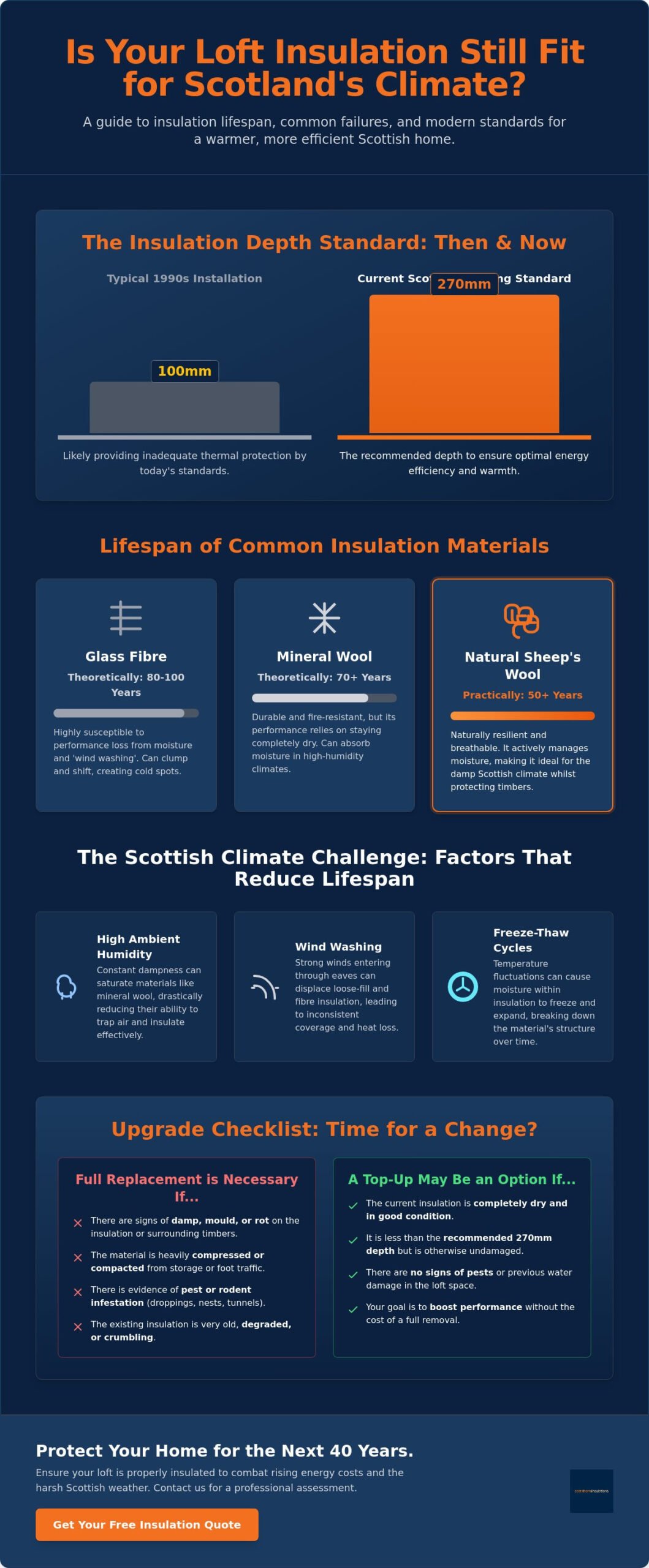
Glass fibre and mineral wool rolls are staples of Scottish housing. On paper, glass fibre can last a century. In practice, these synthetic materials are sensitive to air movement and moisture. If the installation isn’t perfect, or if the roof suffers from minor leaks, the fibres can clump or shift. This creates thermal bridges where heat escapes; this effectively ends the insulation’s useful life even if the material is still visible between the joists. Blown-in cellulose, whilst often made from recycled paper, tends to settle much faster than batts or rolls. It can lose up to 20% of its depth over the first few years, which rapidly diminishes its effectiveness.
Natural Sheep’s Wool Insulation offers a different longevity profile. It is inherently breathable and manages moisture better than synthetic alternatives. This makes it particularly suited to the damp Scottish climate, where humidity is a constant factor. It retains its “loft” or thickness for many decades, ensuring the air pockets required for heat retention remain intact without the same risk of clumping seen in cheaper alternatives.
Lifespan Breakdown by Common Material
- Glass Fibre (Fiberglass): Can theoretically last 80 to 100 years. It is prone to shifting if the loft is frequently accessed or if there is significant “wind washing” from eaves ventilation.
- Mineral Wool: A highly durable, fire-resistant option that typically lasts over 70 years. It maintains its structure well as long as it remains bone-dry.
- Sheep’s Wool: This premium material is naturally resilient. It can last 50 years or more whilst actively protecting the timber structure of your home by regulating moisture levels.
Factors That Cut Your Insulation’s Life Short
Compression is the most common cause of early failure in Scottish lofts. When you store heavy suitcases or Christmas decorations directly on top of your insulation, you squash the air pockets. This significantly reduces the insulation’s R-value, which is the measure of its thermal resistance. Once compressed, most materials do not “bounce back” to their original efficiency. It’s a permanent loss of performance.
Poor ventilation also plays a critical role. If your loft lacks adequate airflow, condensation will build up on the underside of the roof. Saturated insulation loses its ability to trap heat and can eventually lead to rot in your roof timbers. Additionally, in rural parts of Scotland, rodents often seek shelter in warm loft spaces. They nest in the material, create tunnels, and leave droppings that can lead to health hazards and severe material degradation.
The Scottish Factor: How Our Climate Affects Longevity
Scotland’s weather is notoriously demanding. It isn’t merely the cold that homeowners must combat; it’s the relentless humidity and high winds. When people ask how long does loft insulation last scotland, they often forget that geographical location is just as important as the material choice. A product that lasts fifty years in a dry, sheltered environment may fail much sooner when subjected to the damp conditions of the West Coast or the exposed gusts of the Cairngorms.
High ambient humidity levels can cause standard mineral wool to absorb moisture over time. This saturation is a silent killer for thermal efficiency. Once fibres become damp, they lose their ability to trap air, turning a protective barrier into a cold, heavy blanket. This is particularly problematic in coastal regions or the mist-heavy Highlands where the air remains saturated for long periods. Temperature fluctuations also play a role. The stress of freeze-thaw cycles in a Scottish attic can cause certain materials to become brittle or lose their structural integrity over several decades.
Wind washing is another regional challenge. Many Scottish lofts, especially in older properties, are highly ventilated to prevent rot. Whilst this airflow is necessary, strong gusts can displace loose-fill insulation or lift the edges of poorly secured rolls. This creates “cold spots” where heat escapes directly into the atmosphere, bypassing the thermal layer entirely. Traditional Scottish architecture, such as stone cottages and tenements, adds another layer of complexity. These buildings were designed to “breathe,” and installing modern, non-breathable materials can trap moisture against the stone, leading to interstitial condensation that degrades both the insulation and the building fabric.
Moisture and Damp: The Number One Enemy
Wet insulation is worse than having no insulation at all. Water conducts heat far more effectively than air, meaning damp material actively pulls warmth out of your home. This Energy Saving Trust guide notes that whilst products can last around 40 years, this assumes they remain dry and undisturbed. In a damp attic, that lifespan can be halved. If you suspect your current setup has been compromised by moisture, a professional inspection of your loft insulation is the most reliable way to verify its condition.
Local Pests and Wildlife
Wildlife often finds Scottish attics irresistible during the winter months. Squirrels, mice, and even birds can cause havoc in a matter of weeks. These intruders don’t just leave a mess; they physically destroy the insulation’s structure. Mice and squirrels are particularly known for “tunnelling” through older glass fibre rolls. This behaviour compresses the material and creates air gaps that bypass the thermal barrier. Once a nesting site is established, the material is often contaminated beyond repair, necessitating a full removal to ensure domestic hygiene.
Performance vs. Presence: Is Your Insulation Still Working?
Many homeowners in Scotland look into their attic, see a layer of grey or yellow wool, and assume their home is energy efficient. However, there is a vast difference between insulation being present and insulation actually performing its job. When evaluating how long does loft insulation last scotland, you have to look beyond the physical material and consider its thermal integrity. Over time, gravity and environmental factors cause materials to settle and lose their “loft,” which directly impacts their ability to trap heat.
The settling effect is particularly noticeable in mineral wool and glass fibre products. Over a period of 15 to 20 years, these materials can lose a significant portion of their original thickness. Because insulation works by trapping air within its fibres, any reduction in depth leads to a corresponding drop in its performance. If your insulation has compressed by just a few centimetres, you are likely losing far more heat than you realise. Once the material loses its spring, it can no longer hold the still air required to provide a thermal barrier.
Thermal bridging is another common issue in older Scottish properties. As old batts or rolls age, they can shrink or shift, leaving small gaps between the insulation and the wooden joists. These gaps act like chimneys, allowing warm air to bypass the thermal barrier entirely. This is why a house built or insulated in the 1990s might still feel cold despite having “full” loft coverage. The material is there, but the protection is compromised.
The 270mm Rule in Scotland
Current building regulations in Scotland recommend a minimum insulation depth of 270mm to achieve the required U-value of 0.16 W/m²K. This is a significant increase from the 100mm or 150mm standards common in the 1980s and 90s. In areas like Edinburgh and Fife, we frequently find homes that are under-insulated by more than half. When homeowners ask how long does loft insulation last scotland, they are often surprised to learn that a 30-year-old installation is thermally obsolete. For a detailed breakdown of these requirements, you can consult our loft insulation scotland pillar guide.
Signs of Hidden Performance Loss
You don’t always need to climb into the loft to know your insulation is failing. One of the clearest signs in a Scottish winter is the pattern of snow on your roof. If your roof is clear of snow whilst your neighbours’ roofs remain white, it means heat is escaping through your ceiling and melting the snow from beneath. This often leads to ice dams, where melting water refreezes at the eaves and causes structural damage. Other red flags include noticeable drafts around the loft hatch or significant temperature differences between upstairs rooms and the rest of the house.
When to Replace vs. When to Top Up
Deciding whether to scrap your existing insulation or simply add to it is a critical financial decision for any homeowner. Whilst some materials can survive for decades, their condition often dictates whether they remain an asset or become a liability. When assessing how long does loft insulation last scotland, the primary factor is whether the material has maintained its structural integrity and hygiene. If your existing layer is dry, clean, and hasn’t been squashed by heavy storage, it can often serve as a perfectly valid base for a modern upgrade.
Topping up is generally the most cost-effective route. It involves laying new rolls of mineral wool or sheep’s wool perpendicular to the existing joists until you reach the current 270mm standard. This “cross-laying” technique is highly effective at reducing thermal bridging through the wooden timbers. However, this strategy only works if the original material is in good health. If the base layer is failing, adding more weight on top will only accelerate its degradation and trap problems beneath the surface.
The Replacement Checklist
There are several scenarios where a full removal is the only safe and effective option. Damp is the most common deal-breaker. If you find patches of mould or if the material feels heavy and sodden, it must be removed immediately. Wet insulation cannot be dried out effectively in a Scottish attic; it will simply rot and damage the ceiling below. You should also be cautious in properties built or renovated before the 1980s. Some older homes still contain traces of asbestos-based materials which require specialist handling.
Electrical safety is another vital consideration. Modern high-load cables, such as those for electric showers or cookers, can overheat if they are buried too deeply under multiple layers of insulation. During a full replacement, these cables can be safely rerouted or left exposed to ensure they don’t become a fire hazard. If you are unsure about the safety of your current setup, booking a professional loft insulation assessment is the best way to ensure your home remains both warm and safe.
Topping Up for Efficiency
If your loft passes the health check, topping up is a straightforward way to slash your heating bills. The goal is to reach that 270mm benchmark mentioned earlier. When installing the new layer, it is essential to maintain a 50mm air gap at the eaves. Blocking this ventilation is a common DIY mistake that leads to condensation and timber rot. Whilst you are improving the thermal envelope of your roof, it is often wise to consider under floor insulation as a complementary project. Addressing both the top and bottom of your home creates a complete thermal seal, preventing the “stack effect” where cold air is pulled in through the floorboards as heat rises and escapes through the roof.
Choosing Your Next 40 Years: Why Material Choice Matters
When you decide to upgrade, you aren’t just buying a product; you’re investing in your home’s thermal security for the next four decades. When homeowners ask how long does loft insulation last scotland, they often focus on the physical degradation of the material itself. In reality, the winning material is the one that maintains its performance despite the high humidity and temperature swings common in the Perthshire hills or the coastal winds of Fife. Choosing the right material now prevents the need for another costly intervention in ten or fifteen years.
Modern Mineral Wool remains the industry standard for a reason. It’s cost-effective, fire-resistant, and provides excellent thermal resistance. If installed correctly in a dry environment, it easily meets the 40-year lifespan target. However, in older stone properties where moisture is a persistent concern, synthetic fibres can sometimes struggle to cope with the damp air. This is where material choice becomes a strategic decision based on your specific property type and local micro-climate.
The Case for Sheep’s Wool in Scotland
For those seeking a premium, sustainable solution, wool insulation is increasingly popular across Edinburgh and the Lothians. Unlike cellulose or glass fibre, sheep’s wool is naturally breathable. It can absorb up to 33% of its own weight in moisture without losing its thermal efficiency or structural loft. This unique ability to regulate humidity makes it the ideal choice for traditional Scottish builds that require a breathable envelope. It doesn’t settle or clump like cheaper loose-fill materials, ensuring that the protection you pay for today is still functioning for decades to come.
Professional Installation vs. DIY
The lifespan of any material is only as good as the person installing it. DIY projects often fail prematurely because essential details are overlooked. We frequently see lofts where the insulation has been pushed right into the eaves, cutting off the vital airflow that prevents roof rot. A professional installation ensures that every roll is fitted with precision, avoiding the thermal bridges and compression that shorten a material’s effective life. Small gaps or squashed sections might seem minor, but they significantly reduce the overall performance of the system.
At ScotTherm Insulation, we begin every project with a specialist survey. This allows us to identify any structural issues, such as existing damp or pest activity, before the new material is laid. By choosing a certified professional team, you ensure your insulation lasts the full 40-year term. It’s the difference between a quick fix and a permanent solution for your domestic comfort. Understanding how long does loft insulation last scotland ultimately comes down to the quality of the material and the expertise of the installer.
Securing Your Home’s Thermal Future
Your loft insulation is the primary defence against rising energy costs and the biting Scottish winter. Whilst many materials are designed to last for decades, their real-world performance depends heavily on moisture management and installation quality. We have explored how the 270mm depth standard and the choice between modern mineral wool or sustainable sheep’s wool can determine the long-term comfort of your property. Understanding how long does loft insulation last scotland is the first step toward transforming your home into a high-performance, energy-efficient sanctuary.
As specialists in Scottish climate solutions, we provide tailored advice and expert installation across Edinburgh, Fife, and the Central Belt. Whether you are interested in the natural moisture-wicking properties of sheep’s wool or require a precise top-up to meet modern standards, our team ensures your investment remains effective for its full term. Don’t leave your domestic well-being to chance or outdated 1990s standards. Book your free specialist insulation inspection today and take control of your home’s thermal health. A warmer, more cost-effective future is well within reach.
Frequently Asked Questions
How do I know if my loft insulation needs replacing?
You can identify failing insulation by looking for visible damp patches, a heavy “clumped” appearance, or significant compression. If your heating bills remain high despite the heating being on, or if you notice persistent cold spots and drafts in upstairs rooms, the material has likely failed. A quick physical check for “tunnelling” by pests or a depth below 270mm are also clear indicators that an upgrade is necessary.
Can I put new loft insulation over the old stuff?
You can certainly lay new insulation over your existing material provided the original layer is dry, clean, and free from mould. This “topping up” process is a common way to reach modern energy standards efficiently. However, you must ensure that you don’t block eaves ventilation or bury high-load electrical cables, which can lead to overheating and fire risks in your attic space.
Does loft insulation lose its effectiveness over time?
Insulation does lose its effectiveness as gravity causes the material to settle and compress over 15 to 20 years. This reduction in thickness means there is less trapped air to provide a thermal barrier. In our experience, environmental factors like high humidity are major contributors to how long does loft insulation last scotland, as moisture can cause fibres to lose their spring and thermal resistance prematurely.
How much loft insulation do I need in Scotland in 2026?
The current recommended depth for loft insulation in Scotland is 270mm to meet established energy efficiency standards. This thickness is required to achieve a target U-value of 0.16 W/m²K in existing domestic properties. Achieving this depth can save a typical three-bedroom semi-detached home approximately £355 per year on energy bills, making it one of the most effective ways to combat rising fuel costs this year.
Is it worth replacing 20-year-old insulation?
Upgrading 20-year-old insulation is highly beneficial because standards have shifted significantly since the early 2000s. Most installations from that period only provide 100mm to 150mm of coverage, which is less than half of the modern requirement. Bringing your home up to the 270mm standard is essential for meeting the Scottish Government’s goal of reaching EPC Band C for many properties by the end of 2026.
What is the best type of loft insulation for the Scottish climate?
Sheep’s wool is widely regarded as the superior choice for the Scottish climate due to its unique ability to manage high humidity. It can absorb moisture without losing its R-value, which helps protect the structural integrity of your roof timbers. For homeowners seeking a balance of performance and value, modern mineral wool is a reliable, fire-resistant standard that effectively handles the temperature fluctuations common in the Central Belt.
Can damp loft insulation be dried out and reused?
Damp insulation should never be dried out and reused because the moisture causes permanent structural damage to the fibres. Once materials like mineral wool or glass fibre become saturated, they clump together and lose the air pockets required for heat retention. Even after drying, the material will not return to its original thickness, meaning its thermal performance is compromised and it may still harbour dormant mould spores.
Are there grants available in Scotland to replace old insulation?
Several financial assistance programmes are available, including the ECO4 scheme and the Great British Insulation Scheme, which run until December 2026. These grants often cover the full cost of an upgrade for low-income households or those in council tax bands A to D. Additionally, the Warmer Homes Scotland scheme provides support for homeowners looking to improve their energy efficiency and reduce their long-term heating expenses through professional insulation.