
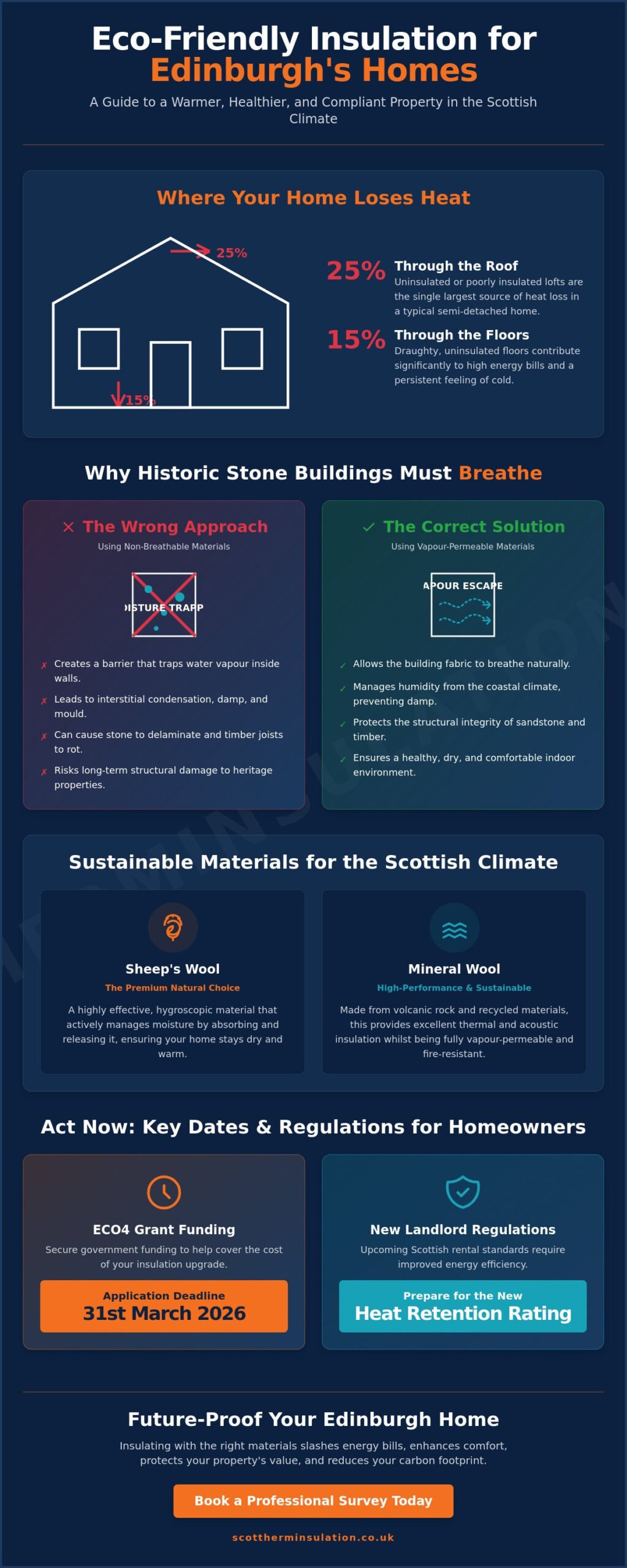
Did you know that a typical semi-detached home loses roughly 25% of its heat through the roof and up to 15% through the floors? For those living in Edinburgh’s iconic stone properties, these figures often translate into staggering energy bills and a persistent chill that no amount of heating seems to fix. It’s a common concern amongst local homeowners. You want to modernise your living space without risking the structural integrity of a heritage building or trapping moisture behind the walls.
This guide helps you discover how to secure a warmer, more comfortable environment using eco friendly home insulation edinburgh specialists recommend for the unique Scottish climate. You’ll learn about breathable, sustainable materials like sheep’s wool and mineral wool that protect your home’s fabric whilst slashing your carbon footprint. We also cover the urgent March 31, 2026 deadline for ECO4 funding and the new Heat Retention Rating standards that landlords must prepare for before the autumn rollout.
Key Takeaways
- Understand why vapour-permeable materials are essential for Edinburgh’s historic stone properties to manage humidity and prevent structural damp.
- Discover the specific benefits of sheep’s wool and mineral wool as high-performance, sustainable alternatives to traditional insulation.
- Learn how to navigate the 2026 grant landscape, including the ECO4 scheme and Home Energy Scotland funding, before critical deadlines pass.
- Identify the best eco friendly home insulation edinburgh solutions for your specific property type, from traditional tenements to modern developments.
- Prepare for upcoming Scottish rental regulations by upgrading your property’s Heat Retention Rating to ensure long-term compliance.
Why Eco-Friendly Home Insulation is Vital for Edinburgh’s Unique Climate
Eco-friendly insulation represents a shift away from synthetic, oil-based products toward materials that are renewable, low-carbon, and vapour-permeable. In the context of the Scottish capital, these properties are not merely “nice to have” features. They are essential requirements for maintaining the structural integrity of our buildings. Selecting eco friendly home insulation edinburgh homeowners can rely on involves choosing materials that work in harmony with the local environment rather than fighting against it. These sustainable options provide a dual benefit: they significantly reduce the energy required to heat a home whilst ensuring the building fabric remains dry and healthy.
The link between sustainable materials and building longevity is clear. Conventional insulation often focuses solely on thermal resistance, but this narrow approach can be detrimental to older properties. Natural fibres, such as sheep’s wool and mineral wool, offer a more sophisticated thermal performance. They manage heat effectively but also allow for the movement of air and moisture. This prevents the stagnation that leads to rot and structural decay. For a deeper look at how different materials function, you can consult this comprehensive guide to building insulation which details the physical properties required for various climates.
The Challenge of Insulating Edinburgh’s Historic Stone Buildings
Edinburgh’s architectural identity is defined by its pre-1920 stone tenements and villas. These structures were built using porous sandstone, designed to absorb moisture from the outside and release it through natural ventilation. Unlike modern cavity-wall builds that rely on a physical gap to stop damp, solid stone walls act as a thermal sponge. They store and release heat slowly over time. The primary risk for Edinburgh homeowners is “trapping” moisture. If you apply non-breathable synthetic foams to these walls, you create a barrier that prevents water vapour from escaping. This leads to interstitial condensation, a hidden build-up of moisture within the wall itself that can cause the stone to delaminate and timber joists to rot.
Tackling the Firth of Forth’s Humidity
Our proximity to the Firth of Forth brings specific weather patterns, including high coastal humidity and frequent wind-driven rain. This external moisture constantly tests the limits of a building’s exterior. In such a damp climate, the “breathability” or vapour permeability of insulation becomes the most important factor for comfort. Many sustainable materials are hygroscopic; they can actually absorb moisture when humidity is high and release it when the air dries out. This natural regulation prevents the damp, “musty” smell common in poorly insulated Scottish homes and discourages the growth of mould. By choosing materials that manage moisture naturally, you ensure your insulation remains effective even during the wettest Edinburgh winters.
Sustainable Insulation Materials: From Sheep’s Wool to Mineral Wool
Selecting the correct material for your property involves more than just looking at a price tag. It requires an understanding of how different fibres interact with heat and moisture. Whilst synthetic materials have dominated the market for decades, eco friendly home insulation edinburgh residents now prefer materials that offer a lower carbon footprint and better long-term protection. When researching various types of insulation, it’s clear that natural and mineral-based options provide the most balanced performance for the Scottish climate. These materials offer high R-values, which measure thermal resistance, whilst remaining entirely vapour-permeable.
The choice often comes down to the specific needs of the building. For historic properties, wool insulation is frequently regarded as the premium solution. However, for those seeking a balance between sustainability and budget, mineral wool serves as a high-performance alternative. Both materials outperform traditional petrochemical-based foams in terms of fire safety and environmental impact. If you aren’t sure which material suits your attic space best, you can explore our guide to loft insulation in Scotland for more tailored advice.
Why Sheep’s Wool is the Gold Standard for Breathability
Sheep’s wool is a remarkable natural resource. It is the only insulation material capable of absorbing and releasing up to 33% of its own weight in moisture without losing its thermal efficiency. This makes it ideal for Edinburgh’s humid coastal air. By using sheep’s wool, you aren’t just installing an insulator; you’re installing a natural humidity regulator. Most of the wool used in these products is locally sourced from Scottish sheep, making it a renewable and low-carbon choice. It also possesses unique air-purifying qualities. It can actually absorb and neutralise harmful chemicals like formaldehyde, which are often found in modern furniture and carpets. It’s also naturally fire-retardant, which provides an extra layer of safety for your family.
Mineral Wool: A High-Performance Sustainable Alternative
Mineral wool, often called stone wool, is made from volcanic rock and recycled slag. It typically contains high percentages of recycled content, which minimises its environmental footprint. When choosing eco friendly home insulation edinburgh specialists suggest, mineral wool is often the preferred choice for its combination of safety and value. Whilst it lacks the air-purifying qualities of sheep’s wool, it is an exceptionally cost-effective option for large-scale projects. It provides excellent acoustic insulation, which is a major benefit for those living in busy city-centre locations. Mineral wool’s fire rating is A1 non-combustible, representing the highest level of fire safety available in the industry.
Selecting the Right Eco-Insulation for Your Edinburgh Property Type
Addressing the fear of damp is the first step in choosing eco friendly home insulation edinburgh. Many owners of older properties worry that modern materials will trap moisture within their walls. However, when you use vapour-permeable natural fibres, you actually enhance the building’s ability to breathe whilst staying warm. We categorise the city’s housing stock into three distinct eras: Pre-1920 Tenements, Inter-war Terraces, and Post-war Developments. Each requires a specific technical approach to ensure long-term protection. For ground-floor tenement flats, under floor insulation is often the most effective way to eliminate drafts without disturbing decorative wall finishes.
The technical requirements for these buildings vary significantly. Whilst a modern terrace might only need a simple loft top-up, a Victorian villa may require a more complex strategy. You should also investigate the various Scottish Government grants for home insulation that are available to help homeowners transition to these sustainable materials. These funds are designed to help you meet modern energy standards without compromising the historic character of your property.
Eco-Solutions for Traditional Tenements and Stone Villas
Stone buildings rely on “breathability” to stay dry. Internal wall insulation (IWI) using breathable natural fibres is the favourite amongst owners of Category B listed buildings because it respects the original masonry. These natural fibres manage humidity whilst allowing you to maintain original cornices and period features. Victorian attics present a unique challenge; they often require specialist materials for a “Room in Roof” conversion. Standard rigid boards can be too stiff for irregular rafters, but flexible wool batts fit snugly into these spaces, preventing cold spots and drafts. This ensures that even the highest rooms in the house remain comfortable throughout the winter.
Modern Efficiency for Edinburgh’s Newer Developments
Properties built from the 1990s onwards often have cavity walls, but their loft insulation is frequently inadequate by 2026 standards. We recommend loft insulation top-ups using recycled mineral wool or sheep’s wool to reach the current recommended depth of 270mm. A common mistake in newer builds is blocking the eaves with too much material, which restricts airflow and leads to condensation. It’s vital to maintain a clear ventilation path whilst achieving that 270mm depth. Many 1990s to 2010s builds suffer from heat loss due to “thermal bridging,” where gaps in the original insulation allow heat to bypass the barrier. Correcting these minor installation errors with eco friendly home insulation edinburgh residents trust can lead to immediate reductions in heating expenditure.
The Installation Journey: Surveying, Grants, and Professional Standards
The transition to eco friendly home insulation edinburgh is often accelerated by understanding the financial support available in 2026. Many residents feel overwhelmed by the technical requirements and funding applications involved in upgrading an older property. However, the process is highly structured to protect the homeowner. It begins with a rigorous thermal survey and ends with an installation that meets the latest PAS 2030 standards. These professional certifications act as a guarantee of quality, ensuring that your investment delivers the promised energy savings whilst maintaining the health of your building’s fabric.
It is vital to work with installers who understand the specific requirements of the Scottish market. This includes navigating the complex insulation grants Scotland offers to homeowners and private tenants. By following a proven installation journey, you can avoid the common pitfalls of DIY projects and ensure your home is future-proofed against rising energy costs and stricter environmental regulations.
Navigating Scottish Insulation Grants in 2026
The grant landscape has changed significantly as we approach the March 31, 2026 deadline for the ECO4 scheme. This programme remains a primary source of funding for households with an EPC rating of D or lower who receive qualifying benefits. It’s important to note that the Great British Insulation Scheme (GBIS) stopped accepting new applications on January 31, 2026. However, Home Energy Scotland still provides substantial support, offering up to £7,500 in grants for energy efficiency improvements. Sustainable materials like sheep’s wool are frequently covered under these frameworks if they achieve the required thermal targets. For those with a household income of £36,000 or less, the Warmer Homes Scotland grant provides an additional route to funding.
What to Expect from a Professional Local Survey
A modern insulation inspection is entirely non-invasive. Surveyors use thermal imaging and moisture sensors to identify “cold bridges” and ventilation gaps that are common in Scottish attics. These are the specific areas where heat escapes and where condensation is most likely to form. The surveyor will calculate current U-values and perform a moisture risk assessment to ensure that eco friendly home insulation edinburgh specialists install will not trap damp. A professional survey is the only way to guarantee a lifetime of energy savings. This detailed plan ensures that materials like mineral wool or sheep’s wool are placed with precision, maintaining the necessary airflow at the eaves. If you are ready to begin, you can book a professional survey with ScotTherm Insulation to identify the best solutions for your loft space.
Future-Proofing Your Home with ScotTherm Insulation
Investing in eco friendly home insulation edinburgh residents choose provides more than just a warmer living room. It’s about a dual return on investment. You’ll see immediate reductions in monthly energy expenditure whilst enjoying the physical ease of a home that stays at a consistent temperature year-round. As a regional specialist for loft insulation Scotland homeowners trust, ScotTherm Insulation provides a comprehensive service that looks beyond the immediate thermal barrier. We focus on creating a sustainable environment that protects your property for decades.
There are several secondary benefits to high-performance insulation that are often overlooked. Natural and mineral-based fibres act as an effective acoustic barrier, which is a significant advantage for those living near busy Edinburgh bus routes or city-centre hubs. These materials also provide exceptional fire safety ratings, offering peace of mind that synthetic alternatives don’t match. Additionally, a well-insulated home with a high Heat Retention Rating is increasingly attractive to buyers, directly increasing your property’s market value as Scottish energy regulations tighten.
Beyond Warmth: Adding Value with Loft Boarding and Storage
We provide a “complete package” approach that ensures you don’t have to choose between a warm home and a functional loft. ScotTherm Insulation organises professional loft boarding to ensure you don’t lose valuable square footage. A common mistake is laying boards directly onto joists, which compresses the material and destroys its thermal effectiveness. We use raised loft legs to create a sturdy platform above the full 270mm insulation depth. This maintains the thermal envelope whilst providing safe, accessible storage for your belongings. To complete the transformation, we offer aluminium or telescopic loft ladders, which are perfect for Edinburgh urbanites who need quick, reliable access to their storage space without the clutter of traditional step ladders.
Why Local Expertise Matters for Scottish Homeowners
Our team takes immense pride in being a Scottish-owned and operated specialist. We don’t just understand the materials; we understand the specific building codes and architectural quirks of our regional community. Choosing eco friendly home insulation edinburgh experts ensures that your installation is tailored to the stone tenements and terraces that define our city. This local knowledge provides the security of knowing your home is in the hands of certified professionals who prioritise safety and long-term value over quick sales. Choosing sustainable, high-quality materials is a long-term commitment to the health of your home and the comfort of your family. It ensures that your property remains a sanctuary, regardless of how the Scottish weather behaves outside.
Secure Your Edinburgh Home’s Thermal Future
The decision to upgrade your property is about more than just immediate warmth; it’s a commitment to the long-term health of Edinburgh’s unique architectural heritage. By choosing eco friendly home insulation edinburgh residents ensure their homes remain breathable, dry, and compliant with the evolving 2026 energy standards. We’ve seen how materials like sheep’s wool and mineral wool offer superior moisture management and fire safety, providing a level of protection that standard synthetics simply can’t match.
As specialist local experts, we bring technical proficiency and regional pride to every project. Our team is fully vetted and certified for PAS 2030 standards, ensuring that every installation is safe, efficient, and eligible for available funding. Don’t let the upcoming grant deadlines pass without securing your home’s future. Book your specialist free insulation inspection with ScotTherm Insulation today to begin your journey toward a more sustainable, cost-effective environment. We’re ready to help you transform your home into a warmer, healthier sanctuary.
Frequently Asked Questions
Is eco-friendly insulation more expensive than standard glass fibre in Edinburgh?
Natural materials like sheep’s wool generally carry a higher initial price point than standard mineral wool or glass fibre. However, the removal of VAT on home insulation until March 31, 2027, makes eco friendly home insulation edinburgh more accessible than in previous years. These materials also offer superior longevity and moisture management. This protects the structural value of your property and reduces the need for future damp-related repairs.
How does breathable sheep’s wool insulation prevent damp in old stone walls?
Sheep’s wool is naturally hygroscopic, meaning it absorbs and releases water vapour without losing its ability to trap heat. In the porous sandstone walls common across Edinburgh, this breathability is vital. It prevents interstitial condensation by allowing moisture to move through the wall fabric rather than becoming trapped. This process actively discourages the growth of mould and rot in historic timber joists.
Can I get a grant for sustainable home insulation in Scotland in 2026?
Homeowners can still access significant funding through the Home Energy Scotland grant, which offers up to £7,500 for energy efficiency improvements. The ECO4 scheme also remains open until March 31, 2026, for those meeting specific eligibility criteria. It’s important to note that the Great British Insulation Scheme (GBIS) stopped accepting new applications on January 31, 2026, so you should check current availability through official channels quickly.
Which insulation is best for an Edinburgh tenement flat on the ground floor?
Underfloor insulation is the most effective choice for ground-floor tenements. It targets the 15% of heat typically lost through the floorboards into the solum or basement below. Using breathable mineral wool or sheep’s wool between the joists creates a warm thermal barrier whilst allowing the sub-floor to remain ventilated. This significantly reduces drafts and makes the living space feel much cosier during the winter months.
How long does it take to install loft insulation in a standard Edinburgh terrace?
A standard loft insulation installation in an Edinburgh terrace usually takes between one and two days. This timeframe includes the initial preparation, the laying of materials to the recommended 270mm depth, and any necessary ventilation adjustments. If you choose to include professional loft boarding or storage solutions, the project may extend slightly. Our team focuses on efficiency to ensure minimal disruption to your daily routine.
Do I need to move my belongings before the insulation installers arrive?
The workspace must be entirely clear of stored items to ensure the insulation provides a continuous, effective thermal envelope. Having a clear loft allows installers to reach every corner and maintain the required airflow at the eaves. If you’re concerned about moving heavy items, it’s best to discuss this during your initial survey. A well-prepared space ensures the installation meets the highest professional standards.
Will sustainable insulation help keep my home cooler during Scottish summers?
Sustainable insulation provides excellent thermal regulation throughout the year. Whilst we often focus on keeping heat in, materials with high thermal resistance also slow the transfer of heat from the outside during warmer spells. This helps maintain a stable, comfortable temperature inside your home during the Scottish summer months. It ensures your eco friendly home insulation edinburgh investment delivers comfort and value in every season.
Is mineral wool considered an eco-friendly material for home insulation?
Mineral wool is a sustainable choice because it is manufactured using abundant volcanic rock and recycled blast furnace slag. Most products contain a high percentage of recycled content and are themselves fully recyclable at the end of their lifespan. It offers exceptional fire safety with an A1 non-combustible rating and provides high-performance thermal protection. This makes it a popular, eco-conscious alternative to traditional petrochemical-based insulation boards.