
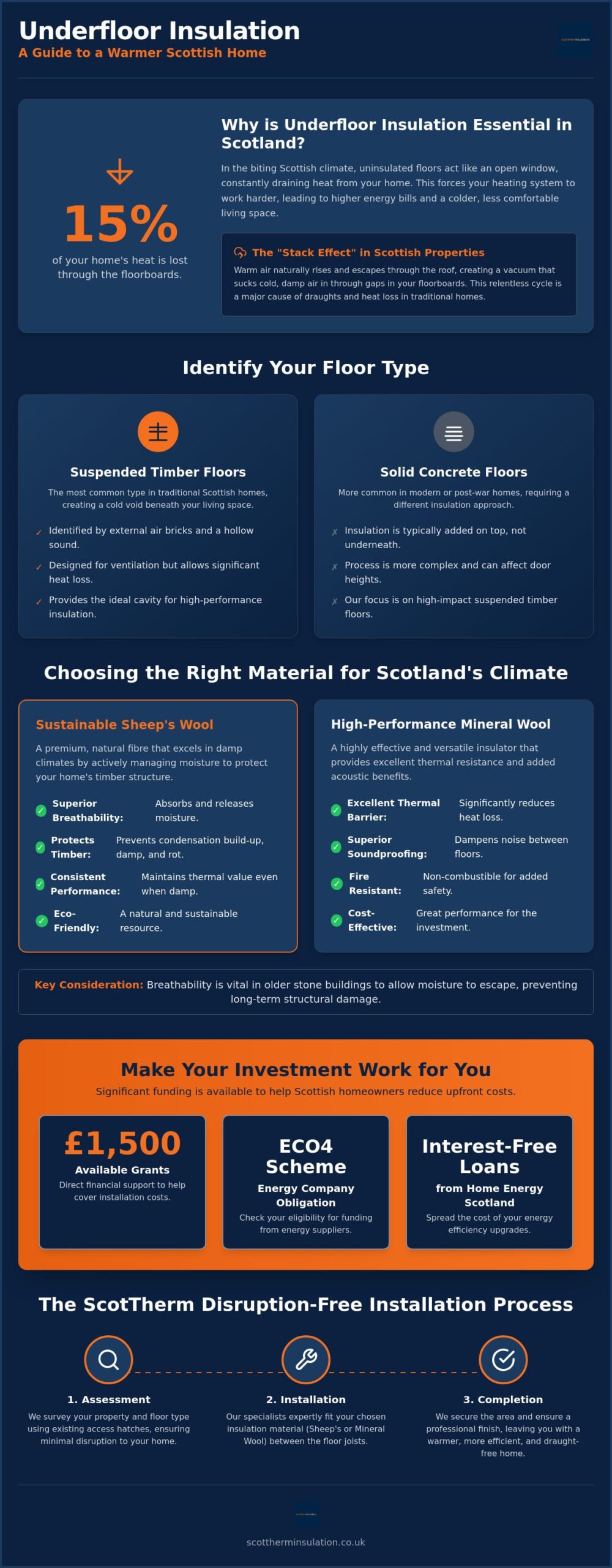
Did you know that as much as 15% of your home’s heat is escaping right through your floorboards? In the biting Scottish winter, that’s the equivalent of leaving a window wide open all season long. Most homeowners in Edinburgh or Fife focus on double glazing or loft rolls, yet they still find themselves shivering over draughty floorboards and worrying about the cost of underfloor insulation scotland. It’s frustrating to pay for heating that simply vanishes into the crawlspace while your energy bills continue to climb.
Understanding these expenses doesn’t have to be confusing, especially with new 2026 standards and generous grant schemes now in play. We’ll help you identify the factors that influence pricing for suspended and solid floors, explain how breathable materials like sheep’s wool protect your property from damp, and highlight the £1,500 grants available to help you secure a warmer home. From ECO4 eligibility to the impact of the new Heat Retention Rating, here’s everything you need to know to make an informed investment in your property’s comfort and long-term value.
Key Takeaways
- Learn how underfloor insulation acts as a vital thermal barrier to stop heat loss and eliminate draughts caused by the “stack effect” in traditional Scottish properties.
- Compare the benefits of high-performance mineral wool against sustainable, breathable sheep’s wool to protect your floorboards from damp and rot.
- Discover the current 2026 cost of underfloor insulation scotland with a detailed breakdown of material and labour rates for terraced, semi-detached, and detached homes.
- Identify your eligibility for 2026 funding through the ECO4 scheme or interest-free loans from Home Energy Scotland to significantly reduce your initial investment.
- Understand the ScotTherm installation process, which uses existing access hatches to ensure a professional, disruption-free upgrade to your home’s efficiency.
Why Underfloor Insulation is Essential for the Scottish Climate
Underfloor insulation acts as a vital thermal barrier between your heated living spaces and the cold, damp void beneath your home. In Scotland, the ground temperature remains significantly lower than the air inside your house for most of the year. Without a proper shield, your floorboards become a primary source of heat loss. This installation involves placing high-quality materials between the floor joists to stop warmth from escaping into the crawl space or soil below. It’s a proactive measure that secures your home’s thermal integrity from the ground up.
Scottish properties are uniquely susceptible to the “stack effect.” This physical phenomenon occurs when warm air rises through the house and escapes through the roof, creating a vacuum that pulls freezing air in through gaps in the floorboards. This cycle forces your heating system to work twice as hard to maintain a steady temperature. As we move through 2026, energy prices remain a significant concern for households across the Central Belt. Homeowners are increasingly prioritising the Underfloor Insulation Materials that offer the best return on investment. Beyond simple heat retention, this upgrade provides a dual benefit by reducing the ingress of dampness from the Scottish soil, which helps protect the structural timber of your property.
The “Draughty Floorboard” Problem in Older Scottish Homes
Edinburgh tenements and Victorian villas are famous for their character, yet they’re equally notorious for being difficult to heat. These older buildings often feature gaps between original floorboards that allow cold air to whistle into the room. This isn’t just a matter of high bills; it’s a matter of physical ease. In the context of Scottish flooring, thermal comfort is the state where the temperature at floor level is consistent enough to prevent a perceptible chill against your feet or ankles. When you eliminate these draughts, you create a more stable indoor environment that feels cosy even when the wind is howling off the North Sea.
Suspended vs Solid Floors: Identifying Your Home Type
Determining your floor type is the first step in calculating the potential cost of underfloor insulation scotland. Most traditional Scottish homes use suspended timber floors. You can identify these by looking for air bricks on your external walls or by the hollow sound made when you tap the floorboards. These systems are designed for ventilation, but they also provide the perfect cavity for professional insulation. Solid concrete floors are more common in modern builds or post-war housing. Insulating a solid floor is usually more complex and expensive because it requires adding a layer of rigid insulation on top of the existing concrete, which can affect door heights and skirting boards. Because of these challenges, the majority of energy-saving projects in Scotland focus on the high-impact results found in suspended timber installations.
Material Choices: Mineral Wool vs Sustainable Sheep’s Wool
Selecting the right material is the most critical decision in any insulation project. Whilst many generic guides suggest a one-size-fits-all approach, the unique humidity and construction of Scottish homes require a more nuanced strategy. We primarily utilise mineral wool and sustainable sheep’s wool for our installations. Both materials provide a high level of thermal resistance, but they serve different structural needs. When evaluating the cost of underfloor insulation scotland, it’s helpful to consider the long-term value and protection each material brings to your specific property type.
Breathability remains the most important factor for preserving traditional Scottish floor joists. In older stone buildings, moisture naturally migrates through the structure. If you install a non-breathable barrier, you risk trapping condensation against the timber, which eventually leads to dry or wet rot. For homeowners in flatted dwellings or tenements, mineral wool offers an additional advantage by providing superior soundproofing between floors. This helps to dampen the sound of footsteps and voices from neighbouring properties. You can find more technical details on these performance standards in the Energy Saving Trust guide to floor insulation.
The Benefits of Sheep’s Wool in Damp Climates
Sheep’s wool is a remarkable natural fibre that excels in the Scottish climate. It possesses the unique ability to absorb and release moisture without compromising its thermal performance or R-value. This hygroscopic property helps to regulate humidity levels within the crawl space, protecting your floor joists from the damp soil typical of the Central Belt. Whilst the initial investment for natural fibres is higher than synthetic alternatives, the protection it offers to your home’s structural timber is invaluable. For a deeper look at why this is a favourite amongst eco-conscious homeowners, view our sustainable sheep’s wool insulation guide.
Mineral Wool: The Versatile All-Rounder
Mineral wool is the standard choice for most modern Scottish renovations due to its versatility and fire-resistant properties. It is manufactured from molten rock or glass, resulting in a dense mat that fits snugly between joists. Our team secures these batts using specialist netting to ensure they remain in place for decades without sagging. It provides excellent thermal performance and is a cost-effective way to meet current building regulations. If you are unsure which material fits your budget and property needs, you can speak with our local specialists to arrange a professional survey of your floor type.
2026 Cost Breakdown: What to Budget for Underfloor Insulation
Budgeting for home improvements in Scotland requires an understanding of local property archetypes. Unlike generic national estimates that often overlook the complexity of our traditional builds, the cost of underfloor insulation scotland is influenced by specific regional labour rates and the unique construction of our tenements and villas. As of 2026, the 0% VAT rating on energy saving materials remains a significant benefit for homeowners. This government incentive effectively reduces the total invoice by a fifth compared to standard home renovations, making high performance upgrades more accessible for the average household.
It’s vital to account for preparatory work when calculating your investment. If your project requires lifting original floorboards or moving heavy furniture in a traditional Edinburgh flat, labour time will naturally increase. Professional installers also look for structural issues like timber rot or damp during the initial survey. Repairing these underlying problems is essential before any material is laid, as sealing in moisture can lead to long term structural damage. While these “hidden” costs can be frustrating, addressing them ensures the longevity of your home.
Estimated Costs by Property Type in Scotland
The following table provides a general guide for 2026 pricing based on standard Scottish house types. These figures include both material and professional labour, though premium choices like sustainable sheep’s wool will sit at the higher end of these ranges.
| Property Type | Estimated Price Range (2026) | Typical Installation Time |
|---|---|---|
| 2-Bed Mid-Terrace | £1,400 – £1,900 | 1 Day |
| 3-Bed Semi-Detached | £2,000 – £3,100 | 1–2 Days |
| Large Detached Bungalow | £3,500 – £4,800 | 2–3 Days |
Labour rates in major hubs like Glasgow or Edinburgh typically range between £150 and £200 per day. For material costs, you should budget approximately £5 per square metre for standard mineral wool rolls, whereas premium sheep’s wool typically costs between £18 and £25 per square metre.
Factors That Increase or Decrease Your Quote
Access is the primary variable in any quote. If a property features a generous crawl space, installers can work from below via a single access hatch. This “bottom-up” approach is far less disruptive and usually more affordable. Conversely, if there is no crawl space, the team must lift the carpets and floorboards from above, which adds significant labour time. Your geographic location also plays a role; while we cover the Central Belt, Fife, and Perth, projects in more remote Highland regions may incur additional travel fees for the installation team. Finally, the current condition of your joists determines if “pre-insulation” repairs are needed to ensure a safe and effective fit.
Grants, Funding, and ROI: Making the Investment Work
Investing in thermal efficiency is a strategic financial decision for any Scottish property owner. Whilst the initial cost of underfloor insulation scotland might seem substantial, the landscape of government support in 2026 makes this upgrade more affordable than ever. Multiple funding streams exist to offset the price, ranging from non-means-tested grants to comprehensive support for low-income households. By leveraging these opportunities, you can significantly reduce your out-of-pocket expenditure and accelerate the return on your investment.
Home Energy Scotland (HES) remains a primary resource for residents in Edinburgh, Fife, and the Central Belt. They currently offer a grant of up to £1,500 specifically for underfloor insulation. This particular grant is not means-tested, making it accessible to all homeowners regardless of income. For those who require further financial flexibility, HES also provides interest-free loans that can be used in conjunction with the grant. These loans allow you to spread the remaining cost of the installation over several years, ensuring the monthly energy savings help cover the repayments.
Claiming ECO4 Funding in Scotland
The ECO4 scheme is a UK-wide initiative running until December 2026 that provides deep retrofits for qualifying households. In Scotland, this programme is particularly robust, targeting properties with low Energy Performance Certificate (EPC) ratings. To be eligible, residents typically need to receive certain benefits, such as Pension Credit or Child Benefit, or meet specific household income thresholds. You can find a detailed breakdown of these requirements in our ECO4 Scotland guide. Our team acts as a bridge between homeowners and these funding bodies, managing the technical surveys and paperwork required to secure the maximum possible subsidy for your project.
Energy Bill Savings: The Real-World Return
With uninsulated ground floors responsible for up to 15% of a room’s heat loss, the impact on your annual bills is immediate. For a typical Scottish semi-detached home, professional underfloor insulation can save approximately £70 to £120 per year at 2026 energy prices. If you are planning to transition to a heat pump, this upgrade is essential; low-temperature heating systems require a highly insulated building envelope to operate at peak efficiency. Beyond the ledger, the “comfort factor” provides a daily benefit. By eliminating the stack effect draughts mentioned earlier, you can often turn your thermostat down by one or two degrees whilst feeling warmer than before.
Improving your home’s EPC rating also has a tangible impact on property value. From 2026, new regulations in Scotland require private rental properties to reach a minimum of EPC Band C before a new lease is granted. Even for owner-occupiers, the upcoming Heat Retention Rating (HRR) metric will make well-insulated homes more attractive to future buyers. To see if your property qualifies for the current £1,500 grant or ECO4 support, contact our specialist team today for a professional assessment.
The ScotTherm Approach: Specialist Underfloor Installation
Our installation process begins long before a single roll of material is laid. Every project starts with a comprehensive technical survey designed to assess the specific health of your property’s timber. We prioritise identifying any existing issues with damp, rot, or restricted ventilation that could compromise the structure. Because Scottish homes often face high groundwater levels and coastal humidity, ensuring your floor joists are dry and structurally sound is our first priority. This diligent approach ensures that the cost of underfloor insulation scotland remains a one-time investment in the long-term health of your home.
We specialise in a non-invasive installation method that respects the integrity of your living space. Whenever a property features an adequate crawl space, our technicians access the floor from below through existing hatches. This “bottom-up” strategy means we don’t need to lift your carpets or original floorboards, which keeps your daily routine entirely uninterrupted. To ensure the insulation remains effective for decades, we use high-quality specialist netting and breathable membranes. These components secure the material firmly between the joists whilst allowing moisture to escape, preventing the condensation build-up that often plagues DIY or amateur installations.
What to Expect on Installation Day
A typical underfloor project usually takes between one and two days to complete, depending on the size of the ground floor and the ease of access. Our team arrives prepared to protect your home; we use floor coverings and maintain a clean workspace throughout the process. Once the insulation is securely netted, we perform a final inspection to verify full coverage and ensure all draught-prone gaps are sealed. This meticulous verification process is what distinguishes a professional installation from a generic service, as even small gaps can significantly reduce the thermal performance of the system.
Why Choose a Local Scottish Specialist?
Choosing a specialist with deep roots in Edinburgh, Fife, Perth, and Stirling is essential for navigating local building regulations and our unique climate. We understand the specific architectural challenges of Scottish tenements and villas, from the height of crawl spaces to the breathability requirements of traditional stone foundations. For a more detailed look at how we handle regional projects, you can read our Edinburgh and Fife underfloor guide. We take pride in delivering tangible results that improve the domestic well-being of our community. If you’re ready to eliminate draughts and secure a more energy-efficient future, you can book a specialist free insulation inspection with our team today.
Secure a Warmer, More Efficient Home for 2026
Eliminating floorboard draughts and protecting your property’s structural timber is one of the most effective ways to improve your home’s thermal performance. You’ve seen how the right material choice, particularly breathable sheep’s wool, preserves your joists whilst significantly lowering annual energy bills. With 2026 grant opportunities like ECO4 and Home Energy Scotland funding currently available, the actual cost of underfloor insulation scotland is often far more accessible than many homeowners realise. These schemes provide a clear pathway to a more sustainable and comfortable living environment.
As local Central Belt experts, our team understands the unique challenges of Scottish architecture. We are ECO4 funding specialists who pride ourselves on providing high-quality, disruption-free installations that deliver long-term value. Whether you choose mineral wool or our premium breathable sheep’s wool options, we ensure your home is protected from the ground up. Taking this step now secures your property against rising energy costs and upcoming efficiency regulations.
Book your specialist free insulation inspection with ScotTherm today and take the first step toward a cosier, more efficient future. You’ll soon enjoy the peace of mind that comes from a professionally insulated, draught-free home.
Frequently Asked Questions
Is underfloor insulation worth the cost in Scotland?
Underfloor insulation is a highly effective investment because it addresses the primary source of draughts in older Scottish properties. By creating a thermal barrier, you can reduce heat loss by up to 15%. This improvement not only lowers your energy bills but also significantly enhances the comfort of your living space. When you consider the long-term energy savings and increased property value, the initial expenditure is quickly offset by financial and physical benefits.
Can I get a grant for underfloor insulation in 2026?
Several funding options are available for Scottish homeowners in 2026. You may qualify for a fully funded installation through the ECO4 scheme if you receive certain benefits or meet income thresholds. Additionally, Home Energy Scotland provides a grant of up to £1,500 that is not means-tested. These incentives can dramatically lower the cost of underfloor insulation scotland, making it a viable upgrade for most households across the Central Belt.
Will underfloor insulation cause my floorboards to rot?
Professional installation using breathable materials prevents rot by allowing moisture to escape. We prioritise the use of sheep’s wool and breathable membranes to ensure that timber floorboards can regulate humidity naturally. Rot only becomes a risk when non-breathable materials trap condensation against the joists. Our comprehensive pre-installation survey identifies any existing damp issues to ensure the structure remains healthy and dry for decades.
How much can I save on my heating bills with floor insulation?
You can save between £70 and £120 per year on heating bills in a typical semi-detached home. These savings are achieved by stopping the stack effect, where warm air escapes through the roof and pulls cold air up through the floor. By sealing these gaps, your heating system operates more efficiently. These annual reductions are particularly valuable as energy prices remain a concern for households in Edinburgh, Fife, and Stirling.
Do I need to lift my floorboards to install insulation?
Lifting floorboards is often unnecessary if your property has a crawl space accessible via a hatch. Our technicians specialise in a bottom-up installation method that allows them to secure insulation from beneath the floor. This approach is far less disruptive and avoids damage to your carpets or original timber. If your home has a solid floor or no crawl space, we discuss alternative methods during your initial specialist survey.
What is the best insulation material for a suspended timber floor?
Breathable sheep’s wool is widely considered the best material for suspended timber floors in the Scottish climate. Its ability to absorb and release moisture protects joists from dampness whilst providing excellent thermal retention. Mineral wool is another high-quality option that offers superb fire resistance and soundproofing. Both materials are secured with specialist netting to prevent sagging, ensuring they maintain their performance levels for the lifetime of the property.
Does underfloor insulation help with damp and condensation?
Underfloor insulation helps manage damp by keeping the floor surface warmer and preventing condensation from forming. When warm indoor air meets a cold, uninsulated floor, moisture can settle and lead to mould. By warming the floorboards and using moisture-regulating membranes, you create a drier indoor environment. This process is essential for maintaining air quality and protecting the structural integrity of traditional stone-built homes across Scotland.
How long does it take to install underfloor insulation in a typical house?
A typical installation is usually completed within one to two days. This timeline includes the initial setup, the securing of insulation materials, and a final inspection to verify coverage. Our team works efficiently to minimise disruption, often completing the work through external access hatches. Because we prioritise a clean workspace, your home remains tidy throughout the process. This quick turnaround allows you to feel the thermal benefits almost immediately.