
Did you know that up to 25% of your home’s heat escapes directly through an uninsulated roof? For many homeowners across the country, calculating the cost of room in roof insulation scotland is a priority when faced with rising energy bills and bedrooms that feel like ice boxes by November. It’s frustrating to pay for heating that disappears into the atmosphere whilst your upper floor remains largely unusable during the coldest months of the year.
We understand that you want a home that stays warm without draining your bank account, yet the conflicting information regarding grants and 2026 building standards often makes the path forward feel overwhelming. This guide clears the confusion by detailing exactly how professional installation transforms your living space into a comfortable, energy-efficient sanctuary. You’ll learn about the factors influencing your total investment, from material performance to the current 0% VAT incentives available until 2027. We also preview how the latest ECO4 eligibility and Home Energy Scotland grants, which can provide up to £3,000 in funding, significantly reduce your out-of-pocket expenses. This ensures your home remains a cosy, cost-effective retreat for years to come.
Key Takeaways
- Understand how insulating “coomb” ceilings and dormer windows creates a complete thermal envelope to stabilise temperatures in your attic living space.
- Identify the specific structural variables, such as roof pitch and the number of roof lights, that influence the overall cost of room in roof insulation scotland.
- Discover why breathable materials like sheep’s wool or mineral wool are essential for protecting traditional Scottish masonry from long-term damp issues.
- Learn how to navigate 2026 funding routes, including the ECO4 scheme, to potentially reduce or eliminate your out-of-pocket installation expenses.
- Recognise the importance of professional installation in avoiding the common pitfalls of interstitial condensation and structural damage.
What is Room in Roof Insulation and Why Does it Matter in Scotland?
Room-in-roof insulation is a specialised thermal solution designed for homes where the attic has been converted into a functional living space. Unlike standard loft insulation, which sits on the floor of an unused attic, this process involves creating a comprehensive thermal envelope around the room itself. In Scotland, many older properties and Edinburgh tenements feature “coomb” ceilings—those distinctive sloping sections that follow the roofline. These areas are primary culprits for heat loss because they often consist of little more than lath and plaster separated from the slates by a thin pocket of air.
When homeowners evaluate the cost of room in roof insulation scotland, they’re investing in a dual-purpose climate control system. High-quality Building insulation keeps your home significantly warmer during our harsh winters by reflecting heat back into the room. Conversely, it prevents the sun’s energy from baking the attic space during the summer, ensuring your bedrooms remain comfortable year-round. This structural upgrade also provides a measurable boost to your Energy Performance Certificate (EPC) rating, which is increasingly vital for property valuations and meeting the Scottish Government’s 2026 energy standards.
The Anatomy of a Room-in-Roof Project
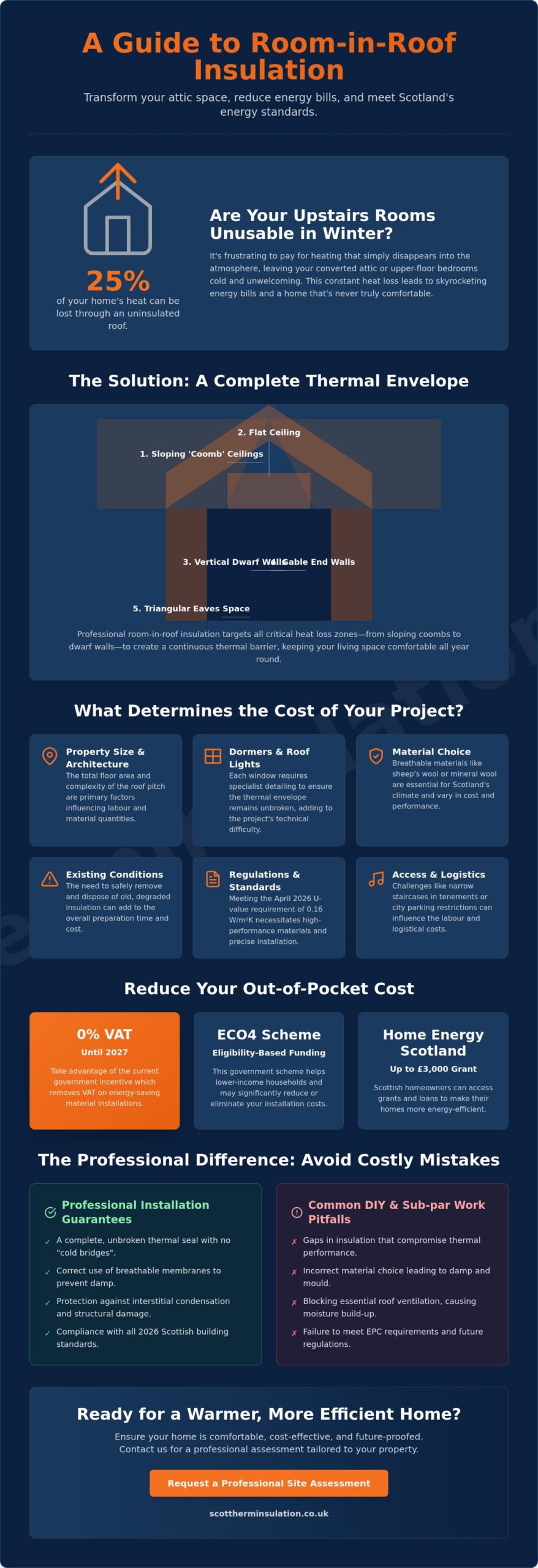
A professional installation addresses several critical zones to ensure no heat escapes. We focus on the sloping coombs and the flat ceiling sections above the room. However, the project also covers the vertical dwarf walls and the triangular eaves spaces behind them. For detached or end-terrace Scottish homes, insulating the gable end walls is essential. This comprehensive approach eliminates the “chimney effect” where cold air pulls heat from the rest of your house, ensuring every penny spent on heating stays within your four walls.
Scottish Climate Factors and Thermal Performance
Our local climate demands more than just basic materials. High humidity and driving rain mean that moisture management is a priority for any Scottish retrofit. We select breathable materials that allow traditional masonry to shed moisture whilst preventing “cold bridges”—specific points where heat leaks out and causes mould to grow. Since the April 2026 building standards now require a U-value of 0.16 W/m²K for roof retrofits, using the right materials is a legal necessity as much as a comfort one. Choosing a solution tailored to the cost of room in roof insulation scotland ensures your home remains dry, healthy, and exceptionally efficient for decades.
Factors Influencing the Cost of Room-in-Roof Insulation
Every home is unique, and the cost of room in roof insulation scotland isn’t a fixed fee. The architecture of your property dictates the complexity of the job. A modern semi-detached house in Stirling presents different challenges than a Victorian villa in North Berwick. Total floor area is the most obvious factor, but the complexity of the roof pitch often dictates the labour required. A steep, intricate roofline demands more precision cutting and secure fixing than a shallow, uniform pitch. These structural details directly affect how much time our specialists spend on-site.
Dormer windows and roof lights add character but also increase the technical difficulty of the project. Each window requires individual detailing to ensure the thermal envelope remains unbroken. If these areas aren’t handled by experts, they become significant cold spots that allow heat to bleed out. We also evaluate your existing setup. If old, degraded insulation needs removing before we start, that adds to the disposal fees and preparation time. When calculating the cost of room in roof insulation scotland, it’s vital to consider these structural variables alongside material prices.
Access requirements are a major variable in Scottish cities. High-ceilinged Edinburgh tenements or homes on narrow, cobbled streets in Stirling or Perth present unique logistical hurdles. We consider several factors:
- The width of internal staircases for moving bulky materials.
- Local parking restrictions for delivery and waste removal vehicles.
- The height of the rooms and the need for internal safety platforms.
If you’re unsure which factors apply to your property, you can request a professional site assessment to get a clear, transparent picture of the requirements.
Material Choice: Mineral Wool vs. Sheep’s Wool
Your choice of material significantly impacts the upfront investment. Synthetic mineral wool is a popular, cost-effective choice that provides excellent thermal performance. However, many of our clients prefer sustainable sheep’s wool for its natural moisture-regulating properties. Whilst the raw material cost for natural fibres is higher, they offer long-term value by protecting timber rafters from damp. As noted in the Energy Saving Trust insulation guide, choosing the right material is about balancing budget with the specific needs of your property’s structure. Cheaper, non-breathable options might seem attractive but often require expensive additional ventilation modifications to prevent rot.
Structural and Access Considerations
Labour intensity is often driven by the physical layout of the room. Sloping ceilings require more time to finish correctly than flat surfaces, often resulting in higher material waste during the cutting process. We also assess whether the work can be done entirely from the inside. If gable end work is required on a detached property, scaffolding may be necessary to ensure safety and quality. The condition of your existing plasterboard matters too. If the current boards are failing or damp, they must be replaced to provide a secure, fire-rated finish for your new insulation. Investing in these repairs now prevents costly remedial work in the future.
Comparing Material Costs: Making the Right Investment
When you evaluate the cost of room in roof insulation scotland, it’s beneficial to view the expenditure as a long-term structural investment rather than a one-off expense. High-quality insulation materials are designed to last for 40 years or more, meaning the initial price is spread across decades of energy savings. Choosing the cheapest material often leads to “hidden costs” later, particularly in traditional Scottish masonry buildings. Non-breathable synthetic materials can trap moisture against stone walls or timber rafters, leading to rot and damp that require expensive remedial work. Thermal conductivity, often expressed as a U-value, measures how quickly heat passes through a specific thickness of material; a lower value represents superior insulating performance.
Material thickness also plays a practical role in your home’s layout. Less efficient materials require greater depth to meet the 2026 Scottish building standards of 0.16 W/m²K. This extra thickness can eat into your usable living space, reducing headroom and making the room feel smaller. By selecting higher-performing materials, you maintain a larger room volume whilst achieving the required thermal protection. This balance between material performance and physical space is a key factor in the overall cost of room in roof insulation scotland.
The Case for Natural Fibres in Scotland
Sheep’s wool has become a favourite amongst Scottish homeowners due to its unique hygroscopic properties. It can absorb and release moisture without losing its ability to insulate, which is vital for the longevity of older roof timbers in our humid climate. Installation speed is another factor to consider. Flexible wool batts are often faster to fit into the irregular spaces of an older home compared to rigid boards. Because natural fibres help regulate the internal environment, they often reduce the need for installing expensive mechanical ventilation systems, saving you money on both hardware and running costs.
Mineral Wool: The Cost-Effective Standard
Mineral wool remains the industry standard for those seeking a balance between budget and high performance. It’s particularly effective for larger projects where the scale of the area makes synthetic fibres more financially viable. Beyond thermal efficiency, high-density mineral wool provides excellent fire safety ratings and superior acoustic insulation. This is a significant benefit for attic bedrooms, as it effectively dampens the sound of heavy rain or street noise. For many households, mineral wool offers a reliable way to meet modern efficiency standards without the premium price tag of specialty natural materials.
Grants and Funding: Reducing Your Out-of-Pocket Cost
The actual cost of room in roof insulation scotland is often significantly reduced or even completely covered by various government-backed initiatives. For many households, the ECO4 Scotland scheme offers a pathway to 100% funding, meaning the entire installation could be delivered at no cost to the homeowner or tenant. These programs are designed to combat fuel poverty and help Scotland reach its net-zero targets by 2045. Even if you don’t qualify for full funding, the current 0% VAT rate on insulation materials, which remains in effect until March 31, 2027, provides an immediate saving on the total project price.
Homeowners and private tenants can access a range of insulation grants in Scotland, including the Home Energy Scotland Grant which offers up to £3,000 for room-in-roof improvements. For those living in remote areas, an additional rural uplift of £1,500 is available to offset the higher logistical costs of island or highland installations. We help you navigate these options to ensure your home becomes warmer and more efficient without unnecessary financial strain. You can check your grant eligibility today to find out how much you could save on your installation.
Qualifying for ECO4 in 2026
Eligibility for the ECO4 scheme is primarily based on two factors: your household income or receipt of specific benefits, and the current efficiency of your property. If your home has an Energy Performance Certificate (EPC) rating of D, E, F, or G, you’re likely eligible for substantial support. Scottish residents receiving Pension Credit, Universal Credit, or Child Benefit often trigger automatic eligibility. For those who don’t receive benefits but still struggle with high heating costs, the “LA Flex” route allows local councils to nominate households for funding based on specific low-income criteria.
The Application Process and Timelines
The journey to a warmer home begins with a professional assessment. We organise a specialist inspection to verify the technical requirements of your roof and confirm your eligibility status. You’ll need to provide proof of ownership or tenancy and documentation of any qualifying benefits for a successful claim. In the Central Belt, the average timeline from the initial survey to the completed installation is typically between four and eight weeks. This structured approach ensures that all technical standards are met and your funding is secured before any work commences on your property.
Why Professional Installation by ScotTherm Insulation Saves You More
Attempting to reduce the cost of room in roof insulation scotland through DIY methods often leads to expensive structural failures. Interstitial condensation is a significant risk when materials aren’t fitted with absolute precision. This occurs when warm, moist air from your living space meets a cold surface within the roof structure. Without professional vapour control, this moisture traps itself against your timber rafters, leading to hidden rot and damp. ScotTherm Insulation eliminates these risks by using proven techniques that protect the skeleton of your home whilst ensuring maximum thermal retention.
We bring specialised local expertise to every project across Edinburgh, Fife, Perth, and Stirling. Our solutions are climate-specific; we understand how the high humidity and driving winds of the Scottish coast affect building fabrics. By choosing ScotTherm Insulation, you’re investing in a team that prioritises safety and long-term value over quick sales. We use only high-performance, certified materials that meet the rigorous 2026 building standards. This professional approach doesn’t just lower your bills; it provides a tangible increase in property value. A fully insulated, professionally boarded room-in-roof is a major selling point for future buyers who prioritise energy efficiency.
Precision Installation for Maximum ROI
Our approach focuses on creating a complete thermal envelope. We don’t believe in “quick fix” solutions that leave gaps for heat to escape. We achieve high levels of air-tightness whilst maintaining the essential breathability your property needs to stay healthy. This balance is critical for traditional Scottish masonry. Every installation by ScotTherm Insulation is carried out by disciplined specialists who take pride in their craft. For your peace of mind, we provide insurance-backed guarantees. This ensures that your investment is protected and your home remains a cosy, cost-effective sanctuary for decades.
Your Next Steps to a Warmer Home
Securing a fixed-price quote is the most effective way to manage the cost of room in roof insulation scotland. Every roof has its own quirks, so we provide bespoke assessments rather than generic estimates. You can book a survey with our Edinburgh-based team to get expert advice on whether sheep’s wool or mineral wool is the best fit for your specific property. Once your project is scheduled, we’ll provide clear instructions on how to prepare your home. This ensures a smooth, professional installation with minimal disruption to your daily routine. Contact our specialists today to start your journey toward a warmer, more efficient home.
Secure Your Home’s Thermal Future Today
Investing in a professional thermal envelope is the most effective way to achieve long-term comfort and financial stability. By selecting high-performance materials like breathable sheep’s wool or durable mineral wool, you protect your property’s structure whilst significantly reducing annual energy expenditure. Navigating the cost of room in roof insulation scotland is straightforward when you leverage the robust support from ECO4 and Home Energy Scotland grants, which often provide substantial funding for qualifying residents.
We are a Scottish Government ECO4 Approved Installer specialising in bespoke solutions for homes across Edinburgh, Fife, Perth, and Stirling. Our certified team ensures every project adheres to the latest 2026 building standards, providing you with a warm, usable living space and total peace of mind. You don’t have to tolerate a cold attic or rising bills any longer.
Book your specialist free insulation inspection today to discover the best funding options for your property. We look forward to helping you create a cosier, more efficient home for years to come.
Frequently Asked Questions
How much can I realistically save on my heating bills with room-in-roof insulation?
You can realistically save up to £230 per year on your heating bills by insulating your roof correctly. Since up to 25% of a property’s heat is lost through an uninsulated roof, this structural upgrade provides immediate financial relief. These savings are especially significant for Scottish households where upper floor rooms often struggle to retain heat during the long winter months, making the investment highly cost-effective.
Is room-in-roof insulation messy to install in a finished bedroom?
Professional installation is designed to be as clean and non-disruptive as possible. Our teams use heavy-duty protective floor coverings and dust extraction systems to safeguard your furniture and carpets. Whilst any structural work involves some activity, we prioritise a tidy workspace and clear all debris daily. This ensures your finished bedroom remains in excellent condition throughout the duration of the project.
Can I get a grant for room-in-roof insulation if I am a private landlord in Scotland?
Private landlords in Scotland can often access funding through the ECO4 scheme or Home Energy Scotland grants and loans. Eligibility typically depends on the tenant’s circumstances or the property’s current EPC rating. This is an excellent way to manage the cost of room in roof insulation scotland whilst ensuring your rental property meets the 2026 energy efficiency standards and provides a comfortable environment for your tenants.
What is the difference between loft insulation and room-in-roof insulation?
Loft insulation involves laying materials on the floor of an unused attic space to prevent heat escaping from the rooms below. In contrast, room-in-roof insulation creates a comprehensive thermal envelope around the walls and sloping “coomb” ceilings of a converted attic living space. It’s a more complex procedure that treats the attic itself as a warm room rather than a cold, unheated storage area.
How long does the installation process typically take for a standard semi-detached house?
A standard semi-detached house typically takes between three and five working days to complete. The exact timeline depends on the number of dormer windows and the complexity of the roof pitch. Our specialists work efficiently to ensure your home returns to normal as quickly as possible without compromising on the precision required to meet the 0.16 W/m²K thermal finish required by 2026 building standards.
Will insulating my roof coombs make the room feel much smaller?
Insulating your roof coombs has a minimal impact on the usable volume of the room when using high-performance materials. Because modern products achieve superior thermal resistance at thinner depths, the reduction in floor space or headroom is often barely noticeable. The result is a room that feels much larger and more inviting because it is finally warm enough to use comfortably throughout the entire year.
Do I need to move out of my house whilst the insulation is being installed?
You don’t need to move out of your house whilst the work is being carried out. We organise our installation process to be as contained as possible, typically working on one section of the roof at a time to minimise disruption. Whilst there will be some noise during the day, your home remains fully functional, and our teams ensure that all living areas are safe each evening.
What happens if I have existing damp issues in my roof space?
Existing damp issues must be fully resolved before any insulation can be installed. Our initial survey identifies potential problems such as leaking slates or poor ventilation that could lead to interstitial condensation. We recommend addressing these structural repairs first to ensure that your new cost of room in roof insulation scotland remains a sound investment that protects the long-term health of your property’s timber frame.