
Did you know that roughly 10% of your home’s heat is escaping right through your floorboards? For many homeowners across the Central Belt and beyond, this thermal loss manifests as icy feet in winter and skyrocketing energy bills that never seem to drop. If you live in a traditional property with suspended timber floors, you’ve likely worried that sealing those gaps might lead to trapped moisture and structural rot. Finding the best underfloor insulation for scottish homes isn’t just about choosing the thickest material; it’s about selecting a solution that respects the unique breathability requirements of our damp climate.
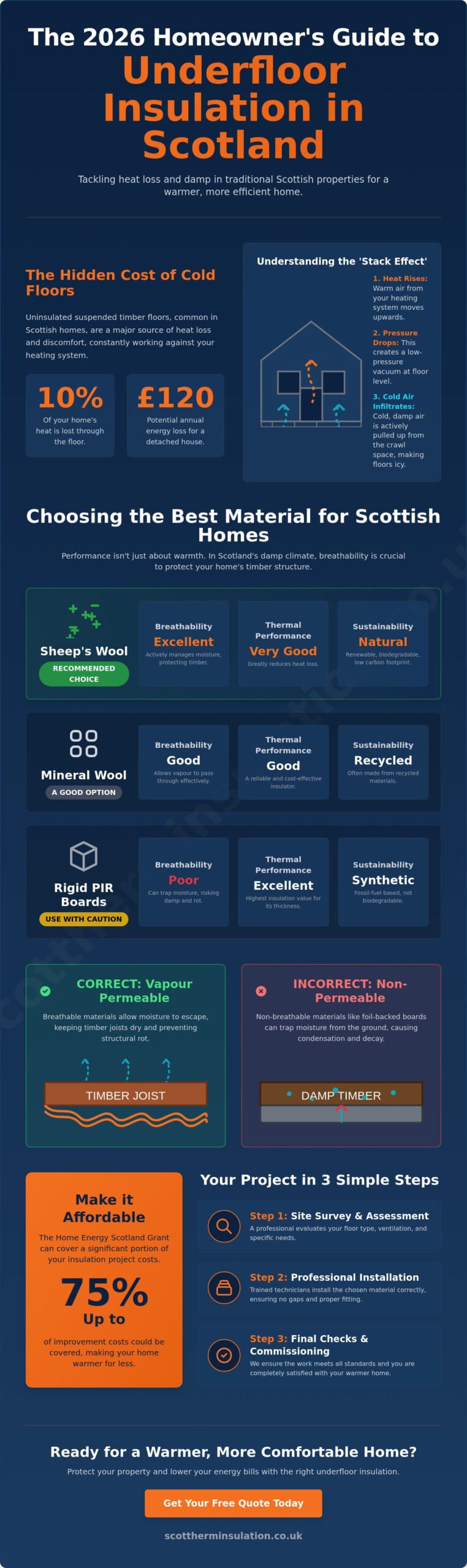
We understand that you want a warmer house without compromising the integrity of your building’s fabric. This 2026 guide identifies the most effective, breathable, and cost-efficient materials designed to tackle Scotland’s specific challenges. You’ll learn how to leverage current support, such as the Home Energy Scotland Grant which can cover up to 75% of improvement costs, to protect your property. We’ll preview the top material choices, from mineral wool to specialist sheep’s wool, ensuring you achieve lasting peace of mind and a noticeably cosier home.
Key Takeaways
- Understand why traditional Scottish suspended timber floors lose significant heat and how regional humidity impacts your home’s thermal performance.
- Identify the best underfloor insulation for scottish homes by comparing mineral wool, sheep’s wool, and rigid PIR boards based on U-values and cost-efficiency.
- Learn why vapour permeability is essential for protecting older properties from damp and preventing structural rot in timber joists.
- Discover the step-by-step process for organising a professional insulation project, from the initial site survey to the final commissioning.
- Explore how to access current Scottish government funding and grants to offset the cost of your energy efficiency improvements.
The Challenge of Cold Floors in the Scottish Climate
Scottish weather is defined by its relentless humidity and coastal winds. Whilst we often focus on double glazing or loft lagging, the ground beneath our feet remains a major source of thermal discomfort. Many properties across the country feature suspended timber floors, a design choice rooted in historical building standards meant to manage moisture. However, in our modern quest for the best underfloor insulation for scottish homes, we must address how these traditional structures interact with our specific environment. High humidity levels in the Central Belt and along our coastlines mean that cold air feels sharper and more invasive, penetrating floorboard gaps and cooling the very fabric of the building.
This cooling effect is exacerbated by the physics of heat movement. Most homeowners are familiar with the idea that heat rises, but fewer understand the vacuum this creates. As your heating system warms the air, it ascends toward the ceiling and eventually escapes through the roof or walls. This displacement creates a low-pressure zone at the floor level, which actively sucks cold, damp air up from the crawl space through every crack and gap in the timber. This stack effect ensures that your floors remain icy, even when the rest of the room feels warm, leading to a significant drop in overall domestic thermal comfort.
Why Suspended Timber Floors Dominate Scottish Homes
Scottish architecture has long prioritised airflow to protect structural integrity. Suspended timber floors involve a crawl space beneath the joists, designed to allow air to circulate and prevent damp from settling into the wood. Whilst effective for timber preservation, these voids often turn into subterranean wind tunnels. During a typical winter, the pressure difference between the warm interior and the cold exterior turns your floorboards into a primary entry point for drafts. The house literally breathes in the cold from below, making it nearly impossible to maintain a consistent temperature without professional intervention.
The Hidden Cost of Uninsulated Floors
Ignoring the space beneath your feet carries a heavy financial price. Research from the Energy Saving Trust in May 2026 confirms that approximately 10% of a home’s heat is lost through uninsulated ground floors. For a detached house, this can lead to annual losses of up to £120. This isn’t just about cold toes; it’s about mechanical strain. Your heating system has to work significantly harder to compensate for the constant influx of cold air, which shortens its lifespan and inflates your monthly outgoings. By selecting the correct building insulation materials, you can seal these thermal bridges and stabilise your indoor temperature. If you’re concerned about the initial investment, check our guide on reducing energy bills to see how current grants can assist. Finding the best underfloor insulation for scottish homes is about more than just warmth. It’s about protecting your property and your wallet from the unique demands of our northern climate.
Comparing the Best Underfloor Insulation Materials for 2026
Selecting the best underfloor insulation for scottish homes requires a balance between thermal resistance and moisture management. In 2026, building standards have shifted toward a “fabric first” approach, which prioritises high-quality materials that protect the structure whilst keeping the interior warm. The primary contenders for Scottish properties are mineral wool, sheep’s wool, and rigid PIR boards. Each material offers distinct advantages depending on your budget, the age of your property, and your sustainability goals. Whilst rigid PIR boards provide excellent thermal performance in a thin profile, they often struggle in the irregular, high-humidity crawl spaces common in our regional architecture. For those with modern properties featuring concrete bases, you may wish to consult the government’s best practice for solid floor insulation to understand the different requirements for non-timber structures.
In 2026, we see a clear trend favouring natural fibres over traditional synthetics. This shift is driven by a better understanding of how non-breathable materials can trap moisture against timber joists, leading to costly repairs. When evaluating your options, consider the following factors:
- U-value Performance: How effectively the material resists heat flow (Scottish regulations now target a U-value of 0.18 W/m²K or lower).
- Vapour Permeability: The ability of the material to let moisture pass through without degrading.
- Sustainability: The carbon footprint and end-of-life recyclability of the product.
Mineral Wool: The Versatile All-Rounder
Mineral wool remains a popular choice amongst budget-conscious homeowners because it offers a solid balance of fire resistance and thermal performance. It is highly flexible, allowing installers to friction-fit the batts between uneven floor joists. This flexibility is crucial for eliminating the air gaps that often plague rigid board installations. Because it is made from molten glass or stone, it is naturally non-combustible and provides an additional layer of acoustic insulation, reducing the sound of footsteps between floors.
Sheep’s Wool: The Premium Choice for Older Homes
For traditional stone properties, sustainable wool insulation is the gold standard. Sheep’s wool is unique because it is naturally hydroscopic, meaning it can absorb and release moisture without losing its insulating properties. This moisture-wicking ability regulates humidity in the crawl space, protecting your timber joists from rot. It is also entirely non-toxic and safe to handle, making it the preferred choice for health-conscious families. If you are looking for a long-term solution that respects the heritage of your property, our team can help you choose the best underfloor insulation for scottish homes through a professional site assessment.
Why Breathability is Essential for Traditional Scottish Properties
In our northern climate, the term “breathability” is often misunderstood as simply letting air through. In technical terms, we are discussing vapour permeability. For a traditional Scottish tenement or cottage, the floor is part of a living, breathing system. When you install insulation, you change the thermal profile of that system. If you choose the wrong materials, you risk trapping moisture in places it was never meant to stay. The best underfloor insulation for scottish homes must facilitate the movement of water vapour to prevent it from settling on cold timber surfaces.
Many older properties in the Central Belt or the Highlands rely on the natural movement of moisture to stay healthy. Traditional building materials like stone and lime are porous. When we introduce modern, non-porous barriers, we often create a “bottleneck” for moisture. This is where the risk of interstitial condensation arises. This isn’t the surface damp you see on a window; it’s the hidden moisture that forms inside the floor structure itself, leading directly to dry rot and structural failure.
The Science of Moisture Management
Humidity naturally migrates from the warm, high-pressure environment of your living room toward the cold, low-pressure crawl space beneath. Breathable materials, particularly natural fibres like sheep’s wool, act as a thermal buffer. They can absorb significant amounts of water vapour when humidity is high and release it safely when conditions dry out. Vapour permeability is the ability of a material to allow water vapour to pass through its structure, ensuring that timber joists remain dry and free from the moisture-driven decay that compromises structural longevity. This natural regulation is why we often recommend natural fibres for the best underfloor insulation for scottish homes, as they actively protect the wood they sit against.
Avoiding the “Plastic Wrap” Effect
Using foil-faced rigid boards in a damp Scottish crawl space can sometimes create a “plastic wrap” effect. Whilst these boards have high thermal resistance, they are entirely vapour-impermeable. If moisture finds its way behind these boards through small gaps or around joist ends, it becomes trapped. Without a path to escape, this trapped water saturates the timber. To avoid this, it is essential to maintain clear sub-floor ventilation. Ensure your air bricks are never blocked by garden debris or new landscaping. A professional installation doesn’t just pack in insulation; it ensures that the necessary airflow remains at the edges of the structure to carry away any residual moisture that the breathable insulation has managed.
Organising Your Underfloor Insulation Project in Scotland
A successful insulation project begins with a logical, structured plan. Whilst the promise of warmer floors is enticing, we must first determine if your property is suitable for this specific upgrade. Most Scottish homes with suspended timber floors are ideal candidates, but the process requires more than simply laying down material. We follow a strict sequence of survey, preparation, and precision installation to ensure that your investment delivers the maximum thermal benefit without risking structural integrity. This professional approach distinguishes a high-performance installation from a quick fix that might cause issues later.
The first step is identifying the floor type and the available clearance. If your home has a solid concrete floor, the process is significantly more disruptive and involves raising the floor level. For suspended timber floors, we look for a crawl space that allows our team to work beneath the joists. If you don’t have an existing access hatch, we can often create a discreet opening in a cupboard or under a rug. This initial assessment ensures we select the best underfloor insulation for scottish homes based on the specific void depth and ventilation needs of your property.
Pre-Installation: The Timber Health Check
Before any insulation is fitted, a professional surveyor must inspect the condition of your joists. This is a critical safety step that many general contractors overlook. We look for active woodworm infestations, damp patches, or signs of wet and dry rot. Insulating over compromised timber is dangerous because it can hide and accelerate decay. We also verify that the ground within the crawl space is dry. If we find issues, they must be treated before we proceed. Our goal is to ensure that your home’s “bones” are healthy enough to support the new thermal layer for decades to come.
The Installation Process: Precision and Care
On the day of installation, our technical team focuses on eliminating thermal bridging. We secure materials like mineral wool or sheep’s wool tightly between the joists using high-tension netting or timber battens. This prevents the material from sagging, which would create air gaps and render the insulation ineffective. We pay close attention to the perimeter where the floor meets the walls, as these are primary sites for heat loss. By ensuring a snug fit, we stabilise the indoor temperature and reduce the strain on your heating system.
The final stage involves a commission check of your sub-floor ventilation. We never block air bricks. Maintaining a consistent flow of air beneath the insulation is the only way to carry away residual moisture and protect your timber. By choosing the best underfloor insulation for scottish homes and pairing it with expert fitting, you can achieve the annual energy savings of up to £120 reported by the Energy Saving Trust for detached properties. Ready to transform your home’s comfort? You can book a professional underfloor survey with our regional specialists to get started.
Why ScotTherm is the Premier Choice for Scottish Insulation
ScotTherm provides a level of regional insight that national, retail-only companies often lack. Our team specialises in under floor insulation for a variety of property styles, from traditional stone cottages to modern suburban builds. We prioritise the use of certified, high-performance materials like sheep’s wool because we understand the specific moisture challenges of the Scottish climate. By choosing a specialist who lives and works in the same conditions you do, you ensure that your home receives a solution tailored for long-term durability and warmth. We don’t just install insulation; we provide a professional consultation that respects the heritage and health of your property.
Identifying the best underfloor insulation for scottish homes is only half the battle; securing the necessary funding is the other. We help homeowners navigate the complexities of the ECO4 Scotland scheme and the Home Energy Scotland grant. As of June 2026, homeowners can access grants covering up to 75% of the cost of energy efficiency improvements, with a maximum grant of £7,500. For those in rural or island communities, an additional £1,500 is often available to help offset higher logistics costs. We ensure all our work meets PAS 2030/2035 standards, providing you with the peace of mind that your installation is fully compliant and professionally verified by TrustMark approved experts.
Trusted Local Experts in Edinburgh, Fife, and Beyond
Our bespoke approach respects the age and architectural style of your property. We don’t believe in quick sales that might compromise your home’s structural health. Instead, we focus on the intersection of financial efficiency and physical ease. Whether you own a Victorian tenement in Edinburgh or a modern semi-detached in Fife, our accredited installation team treats every joist and floorboard with precision. We take pride in being a disciplined, quality-conscious provider that understands the tangible impact our work has on local communities across the Central Belt and beyond.
Take the Next Step to a Warmer Home
Transforming your living environment starts with a specialist insulation inspection. When you book a survey with us, you receive a personalised thermal improvement plan that outlines the most effective materials for your specific floor structure. We identify thermal bridges, assess ventilation needs, and provide a clear path toward a more energy-efficient home. This isn’t just about lower bills; it’s about the security of knowing your property is protected for the future. Book your free underfloor survey today and discover why we are the trusted choice for the best underfloor insulation for scottish homes.
Secure a Warmer, Healthier Home for the Future
Choosing the best underfloor insulation for scottish homes is a decision that impacts both your immediate comfort and the long-term structural integrity of your property. We’ve explored how prioritising breathable materials like sheep’s wool protects traditional timber joists from the hidden dangers of interstitial condensation. By focusing on a fabric-first approach, you don’t just lower your energy bills; you create a more stable, resilient environment that stands up to the unique humidity of our regional climate. Professional installation ensures that every thermal bridge is sealed whilst vital sub-floor ventilation remains clear.
As an approved ECO4 installer with expert local knowledge of Scottish property types, ScotTherm is here to guide you through the process. Our specialists in breathable sheep’s wool insulation understand the nuances of tenements, cottages, and modern builds alike. We provide the technical proficiency needed to secure government funding and deliver lasting results. Don’t let another winter pass with icy floors and rising costs. Get a Professional Underfloor Insulation Quote for Your Scottish Home and take the first step toward a cosier, more efficient property. We look forward to helping you transform your home.
Frequently Asked Questions
Is underfloor insulation worth it in Scotland?
Yes, underfloor insulation is highly effective in Scotland due to our damp climate and the prevalence of suspended timber floors. By sealing the ground floor, you prevent the stack effect from pulling cold air into your living spaces. This leads to a more consistent indoor temperature and reduces the strain on your heating system, making it a vital component of any fabric-first home improvement strategy.
What is the best insulation for suspended timber floors?
Breathable materials such as sheep’s wool or mineral wool are considered the best underfloor insulation for scottish homes with suspended timber floors. These natural or mineral fibres allow moisture to pass through safely, preventing the joist rot associated with non-breathable synthetics. Sheep’s wool is particularly effective because it maintains its thermal properties even when damp, making it ideal for the high humidity levels found in regional crawl spaces.
Can underfloor insulation cause damp or rot?
Underfloor insulation only causes damp or rot if non-breathable materials are used or if sub-floor ventilation is blocked. If you trap moisture against timber joists with vapour-impermeable barriers, interstitial condensation can occur. Choosing a professional installer who understands vapour permeability and ensures that air bricks remain clear is the most effective way to protect your property’s structural health while improving its warmth.
How long does underfloor insulation take to install?
Most professional underfloor insulation projects are completed within one to two days, depending on the size of the property and the ease of access to the crawl space. If a new access hatch is required, this might add a small amount of time to the initial preparation. Our teams work efficiently to minimise disruption, ensuring that your home is back to normal quickly with noticeably warmer floors.
Will underfloor insulation stop draughts from my floorboards?
Yes, a professional installation significantly reduces draughts by creating a continuous thermal barrier beneath your floorboards. When materials are friction-fitted tightly between joists, they block the path of cold air that previously whistled through the gaps. This not only stops the chill at your feet but also prevents the vacuum effect that pulls cold air from the ground into the rest of your house.
Are there grants available for underfloor insulation in Scotland in 2026?
Several funding options exist in 2026, including the Home Energy Scotland Grant which covers up to 75% of costs for eligible homeowners. Additionally, the ECO4 Scotland scheme remains active until December 2026 for low-income households with poor EPC ratings. These initiatives are designed to help residents achieve the best underfloor insulation for scottish homes without bearing the full financial burden of the installation.
Do I need to lift my floorboards to install insulation?
You usually don’t need to lift your floorboards if your property has a crawl space with sufficient clearance. Installers can typically access the void through a small hatch or a discreet opening in an out-of-the-way area. If there is no subterranean access, some boards may need to be temporarily removed, but a professional surveyor will confirm the least disruptive method during your initial inspection.
How much can I save on my heating bills with floor insulation?
Homeowners can save approximately £70 per year on energy bills, with savings rising to £120 for detached houses, according to May 2026 data from the Energy Saving Trust. While these figures represent average annual savings, the actual impact is often felt more in the improved comfort levels and reduced boiler cycling. Over time, the cumulative savings and protection against rising energy costs provide a significant return on investment.