
What if the traditional methods used to “seal up” a modern property are actually the quickest way to damage your historic Edinburgh home? For many owners of our city’s iconic tenements and villas, finding the best insulation for victorian houses edinburgh feels like a balancing act between comfort and conservation. You likely value your property’s character but find yourself frustrated by freezing draughts and the high cost of heating rooms with soaring ceilings. The fear that modern insulation might trap moisture and cause timber rot is a valid concern that keeps many homeowners from making necessary upgrades.
We believe you shouldn’t have to choose between a warm house and a healthy building. This 2026 guide explains how to use breathable, hygroscopic materials that work in harmony with original stone and lime mortar. You’ll discover how to protect your home’s historic fabric while significantly reducing heat loss. We also preview the latest Scottish energy standards, including the new Heat Retention Rating (HRR) system, and show you how to access Home Energy Scotland grants to fund your journey toward a more efficient, cosy, and sustainable Victorian home.
Key Takeaways
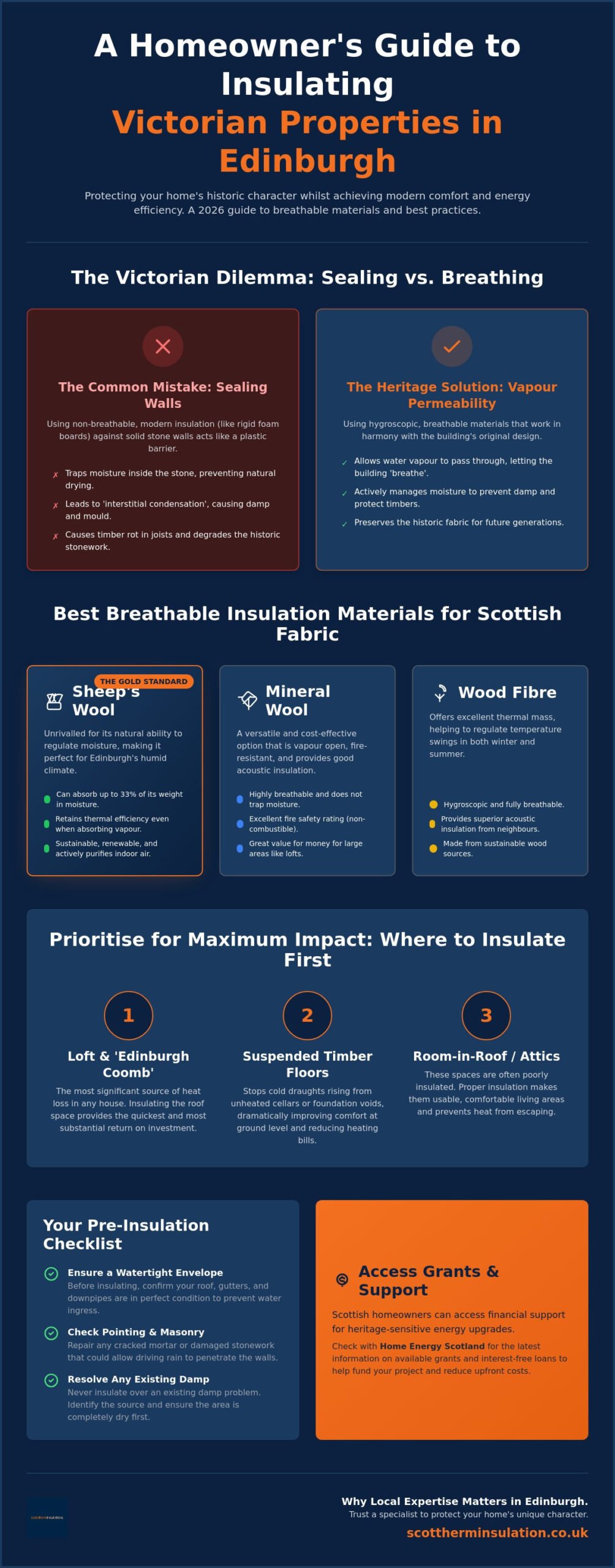
- Understand the critical role of vapour permeability in protecting Edinburgh’s solid stone tenements and villas from interstitial condensation.
- Discover why hygroscopic materials like sheep’s wool and mineral wool are the best insulation for victorian houses edinburgh due to their ability to regulate moisture.
- Learn how to prioritise high-impact areas like the Edinburgh Coomb and suspended timber floors to maximise your home’s thermal performance.
- Follow a professional pre-insulation checklist to ensure your property’s roof and gutters are watertight before installing any new materials.
- Find out how to access available grants and interest-free loans in Scotland to support your heritage-sensitive energy upgrades.
Understanding the “Breathability” of Edinburgh’s Victorian Tenements and Villas
Edinburgh’s Victorian architecture defines the city’s skyline; however, these buildings function very differently from modern homes. When you look for the best insulation for victorian houses edinburgh, you’re looking for a system that respects “breathability.” In heritage terms, this doesn’t mean “draughty.” It refers to the building’s ability to allow water vapour to pass through the walls rather than trapping it. Victorian tenements were constructed using porous sandstone and lime mortar, materials that naturally manage moisture through a cycle of absorption and evaporation. This process is vital for the health of the building fabric.
The local climate plays a significant role in how these homes behave. With Edinburgh’s high humidity and the frequent driving rain that hits sandstone facades, moisture ingress is a constant factor. Traditional buildings manage this by being “vapour open,” allowing moisture to escape as the building warms or as external conditions change. Furthermore, these properties rely on air movement through floor voids and chimneys to prevent stagnant air from causing dampness. Ignoring these original design principles when adding insulation can lead to structural damage that is expensive to repair.
The Physics of Traditional Scottish Stonework
Our local sandstone is a highly permeable material. During Edinburgh’s frequent periods of wet weather, the stone absorbs external moisture like a sponge. Once the weather clears, the wind helps this moisture evaporate harmlessly from the surface. This is why maintaining a “vapour open” envelope is essential. If you introduce non-permeable materials, you interrupt this natural drying process. Applying standard Building insulation principles designed for modern, moisture-sealed buildings can lead to “interstitial condensation.” This occurs when warm, moist air from your living room hits a cold, non-breathable surface behind the insulation, turning into liquid water that rots timber joists and degrades the stone.
Common Insulation Mistakes in Older Edinburgh Properties
A frequent error in Edinburgh renovations is the use of rigid synthetic foam boards against solid stone walls. While these products offer high thermal resistance, they act as a plastic barrier that prevents the stone from “breathing.” This often results in damp patches appearing on the interior décor or, worse, hidden decay within the wall itself. Sealing these properties too tightly without using the best insulation for victorian houses edinburgh, specifically hygroscopic materials, often leads to poor indoor air quality and mould growth. A specialist approach is required because traditional Scottish fabric doesn’t have the protective cavity found in modern housing. You must ensure that any upgrade allows the building to manage moisture just as it has for the last 150 years.
The Best Insulation Materials for Traditional Scottish Fabric
Selecting the right material is the most critical decision in your renovation journey. For a historic property to remain healthy, the insulation must be hygroscopic. This means the material doesn’t just resist heat; it actively manages moisture by absorbing and releasing water vapour in sync with the building’s original stone. When homeowners ask for the best insulation for victorian houses edinburgh, they’re looking for products that mimic the behaviour of lime mortar and sandstone. Modern synthetic foams often fail this test, but several traditional and mineral-based options excel in our specific climate.
While there are various products on the market, three primary materials stand out for their performance in Victorian contexts:
- Sheep’s Wool: The premium choice for moisture regulation and sustainability.
- Mineral Wool: A versatile, fire-resistant, and cost-effective breathable option.
- Wood Fibre: Excellent for thermal mass and acoustic insulation in solid wall applications.
Why Sheep’s Wool is the Gold Standard for Edinburgh Homes
Sheep’s wool is often considered the best insulation for victorian houses edinburgh because of its unique molecular structure. It can absorb up to 33% of its own weight in moisture without losing its thermal efficiency or feeling damp to the touch. This “buffering” effect is vital in Edinburgh’s humid environment. It protects your structural timbers by drawing moisture away from the wood and releasing it slowly when conditions improve. Beyond moisture management, wool fibres naturally absorb harmful gases like formaldehyde, helping to purify the air in your living spaces. For those seeking a renewable solution, wool insulation is a low-carbon choice that supports both your home’s health and the planet.
Mineral Wool: A Versatile and Breathable Alternative
Mineral wool remains a highly popular choice for loft spaces and floor voids due to its balance of performance and price. Unlike sheep’s wool, it’s made from molten rock or glass spun into a fibrous mat. It’s naturally non-combustible, providing an added layer of fire protection that is especially reassuring in densely packed tenement buildings. Because it is vapour-permeable, it allows moisture to pass through without becoming trapped against the ceiling or floorboards. It is a pragmatic, high-performance solution for budget-conscious projects that still require a breathable envelope. If you’re unsure which material suits your attic best, you can consult with our local specialists to find the most effective fit for your property’s specific layout.
Prioritising Your Project: Loft, Underfloor, and Room-in-Roof
Ranking your energy efficiency projects correctly ensures you get the best return on investment whilst preserving your home’s character. The first line of defence is almost always the loft. Since up to 25% of a home’s heat escapes through an uninsulated roof, addressing the attic space provides the most immediate impact on your energy bills. For those living in ground-floor tenements or detached villas, underfloor insulation is the next logical step. It directly solves the “draughty floorboard” syndrome that makes many Edinburgh rooms feel cold even when the heating is cranked up. Finding the best insulation for victorian houses edinburgh requires a tailored approach for each specific area of the building.
Insulating Suspended Timber Floors in Edinburgh
Suspended timber floors are a hallmark of Victorian construction, designed to allow air to circulate beneath the house to keep joists dry. However, this also allows freezing air to pull through the gaps in original floorboards. Installing under floor insulation is vital for ground-floor tenement flats to create a thermal barrier. We use breathable materials like sheep’s wool or mineral wool between the joists, secured with a vapour-permeable membrane. This setup stops draughts but maintains the essential sub-floor ventilation that prevents timber rot. It’s a practical way to achieve a warmer home without sacrificing your original floorboards.
Tackling the “Coomb” Ceiling and Room-in-Roof Challenges
The “Edinburgh Coomb” is a specific architectural challenge found in top-floor tenements and converted villas. It refers to the sloping section of the ceiling where the room follows the line of the roof. These areas are notorious for heat loss because they often have very little space between the plaster and the roof tiles. To insulate these effectively, we must maintain a 50mm air gap behind the sarking boards to ensure the roof stays ventilated. Using high-performance, breathable materials allows us to improve thermal comfort in attic bedrooms without significantly reducing head height. This specialist technique is a core part of finding the best insulation for victorian houses edinburgh, as it requires precision to avoid creating damp spots in hard-to-reach corners.
By focusing on these high-impact areas first, you can see a noticeable difference in how your home retains heat. Whether you are dealing with a drafty hall or a cold attic bedroom, the goal is to create a continuous thermal envelope that respects the building’s need to breathe.
The Breathable Checklist: Steps to Take Before You Insulate
Commiting to thermal upgrades is a significant step, but you must ensure your property is structurally prepared to receive them. Installing even the best insulation for victorian houses edinburgh will yield poor results if the underlying masonry is saturated. Start with a thorough external audit. Check your rhones and downpipes for leaks; Edinburgh’s sandstone is particularly vulnerable to penetrating damp from faulty guttering. If water enters the stone from the outside, internal insulation will merely trap that moisture, accelerating stone decay and timber rot. A building must be watertight before it can be made airtight.
Beyond the roof and walls, identify potential thermal bridges. These are specific points where heat escapes more easily than through the surrounding structure, such as window reveals or where internal walls meet the external stone. If these areas aren’t addressed, they become cold spots where condensation is likely to form once the rest of the room is warmed. To ensure your home is ready for an upgrade, you should book a professional survey to identify these hidden risks before work begins.
Damp Diagnosis: The Critical First Step
You must distinguish between rising damp, penetrating damp, and simple condensation before choosing your materials. Rising damp is less common in Edinburgh tenements than many believe, often it’s actually penetrating damp from high ground levels or leaking pipes. Insulating over damp walls is a recipe for structural disaster; it prevents the stone from drying inwards and forces moisture into the floor joists. Your stone must be sufficiently dry before any internal wall or loft insulation is applied. If you’ve recently repaired a leak, allow the masonry several months to dry out naturally before proceeding with your project.
Ventilation: Keeping the Air Moving
The golden rule of heritage retrofit is “Insulate Tight, Ventilate Right.” As you increase the airtightness of your home, you must also ensure stale, moist air can escape. This prevents the high humidity levels that lead to black mould on your cornicing or behind furniture. Ensure your loft hatch is both insulated and draught-stripped. This stops the “chimney effect” where warm air is sucked out of your living rooms and into the cold roof space. Finally, check that your eaves remain clear. Maintaining airflow at the edges of your loft protects your roof timbers from the moisture that naturally migrates upwards through the building.
Professional Installation: Why Local Expertise Matters in Edinburgh
Edinburgh’s architectural heritage requires more than just standard trade skills. It demands a deep understanding of how 19th-century materials react to 21st-century thermal upgrades. Identifying the best insulation for victorian houses edinburgh involves more than just reading a technical data sheet. It requires a specialist who understands how sandstone, lime, and timber interact under the pressure of the Scottish climate. ScotTherm Insulation provides this dedicated expertise across Edinburgh, Fife, Perth, and Stirling. We ensure that every installation respects the historic fabric of your property whilst delivering modern thermal performance and long-term peace of mind.
DIY insulation in traditional buildings often leads to costly repairs. We frequently encounter properties where well-meaning owners have used non-permeable materials that caused hidden rot in floor joists or attic rafters. These mistakes can compromise the structural integrity of a tenement or villa, often remaining hidden until the damage is significant. By trusting a regional expert, you avoid these pitfalls. Our team understands how to work around original features like ornate cornicing and sash windows without causing damage, ensuring your home remains as beautiful as it is warm.
Claiming Your ECO4 Grant in Scotland
Many homeowners are unaware that they may be eligible for significant financial support to improve their property’s efficiency. Navigating insulation grants in Scotland can be complex, but it is a vital step for Victorian homeowners facing high heating costs. The ECO4 Scotland scheme specifically targets energy-inefficient homes, including many older properties with low EPC ratings. Eligibility often depends on household income or specific benefits, but even for those who don’t qualify for ECO4, the Home Energy Scotland Grant and Loan offers up to £7,500 for energy efficiency measures. We provide a specialist free insulation inspection to help you determine which funding route is most appropriate for your specific Edinburgh home.
The ScotTherm Insulation Guarantee: Reliability and Regional Pride
Our commitment to the local community goes beyond simple installation. We take pride in being a specialised local expert that understands the unique challenges of our regional climate and building stock. Every project we undertake uses the highest quality breathable materials to ensure long-term building health and domestic well-being. We don’t believe in quick sales; we prioritise the safety and future value of your home. If you’re ready to transform your living environment into a warmer, more cost-effective space, contact our Edinburgh-based team for a bespoke thermal assessment. We’ll help you secure the future of your historic property with solutions that are certified, reliable, and built to last.
Secure the Future of Your Edinburgh Heritage Home
Protecting the structural integrity of your property requires a commitment to materials that respect the original building fabric. We’ve established that vapour permeability is essential for Edinburgh’s sandstone tenements and villas. By prioritising hygroscopic materials and targeting high-impact areas like underfloor voids and coomb ceilings, you create a warmer environment without the risk of interstitial condensation. Identifying the best insulation for victorian houses edinburgh is a strategic investment in both your comfort and the preservation of our city’s unique architectural history.
Our team provides expert guidance on the latest Scottish insulation grants and ECO4 funding. As approved installers for breathable sheep’s wool and mineral wool, we ensure your home receives a heritage-sensitive upgrade that meets modern energy standards. You don’t have to tolerate freezing draughts or soaring bills to live in a historic property. Take the first step toward a more efficient, sustainable future for your home.
Book Your Specialist Free Insulation Inspection in Edinburgh Today
Frequently Asked Questions
Is sheep’s wool insulation really better for Victorian houses?
Yes, sheep’s wool is superior because it is hygroscopic and manages moisture better than synthetic alternatives. It can absorb roughly 33% of its weight in water vapour without losing thermal efficiency. This protects the original timber in your Edinburgh home from damp. It is widely considered part of the best insulation for victorian houses edinburgh due to these unique properties.
Can I insulate my Edinburgh tenement myself?
DIY installation is generally discouraged for traditional properties due to the high risk of creating damp traps. Incorrectly fitted materials can block essential ventilation paths or lead to interstitial condensation. Professional installers understand how to maintain the vapour open nature of your building. This expertise prevents long term structural damage that is far more expensive than the initial installation cost.
Will insulation cause my floorboards to rot?
Insulation will not cause rot as long as sub floor ventilation is maintained. We install breathable materials between the joists whilst ensuring that air bricks remain clear. This allows air to circulate beneath the floor, keeping the timber dry. Problems only arise when non breathable materials are used or when the air void is completely sealed.
What is the best way to insulate a solid stone wall internally?
The most effective method is using breathable internal wall insulation that allows moisture to move through the masonry. Materials like wood fibre boards or sheep’s wool are ideal for this application. These systems prevent moisture from being trapped against the cold stone. It’s a specialist process that preserves the health of your sandstone walls whilst significantly improving warmth.
How much can I save on my energy bills in a Victorian house?
You can achieve substantial savings because uninsulated Victorian homes lose up to 25% of their heat through the roof and 33% through the walls. Insulating a suspended timber floor can save a detached house in Scotland around £100 per year on energy bills. The total saving depends on your heating system, but the reduction in heat loss provides a noticeable financial benefit every winter.
Do I need planning permission to insulate a listed Victorian building in Edinburgh?
You typically don’t need planning permission for internal insulation, but you must seek consent if your property is a listed building. Many Victorian houses in Edinburgh are located in conservation areas where specific rules apply to alterations. It is always best to check with the City of Edinburgh Council before starting work to ensure you comply with heritage regulations.
What is a “coomb” ceiling and how do you insulate it?
A coomb ceiling is the sloping section of a room where the ceiling follows the angle of the roof. To insulate it, we fit breathable materials between the rafters whilst leaving a 50mm air gap behind the sarking boards. This gap is crucial for ventilation. It allows the roof to stay dry and prevents condensation from forming against the underside of the roof tiles.
Are there grants available for insulating old houses in Scotland in 2026?
Several funding routes remain open in 2026, including the Home Energy Scotland Grant which offers up to £7,500 for efficiency measures. The ECO4 scheme also provides support for low income households until December 2026. However, the Great British Insulation Scheme is now closed to new applicants. We recommend checking your eligibility for the best insulation for victorian houses edinburgh through current Scottish government programmes.