
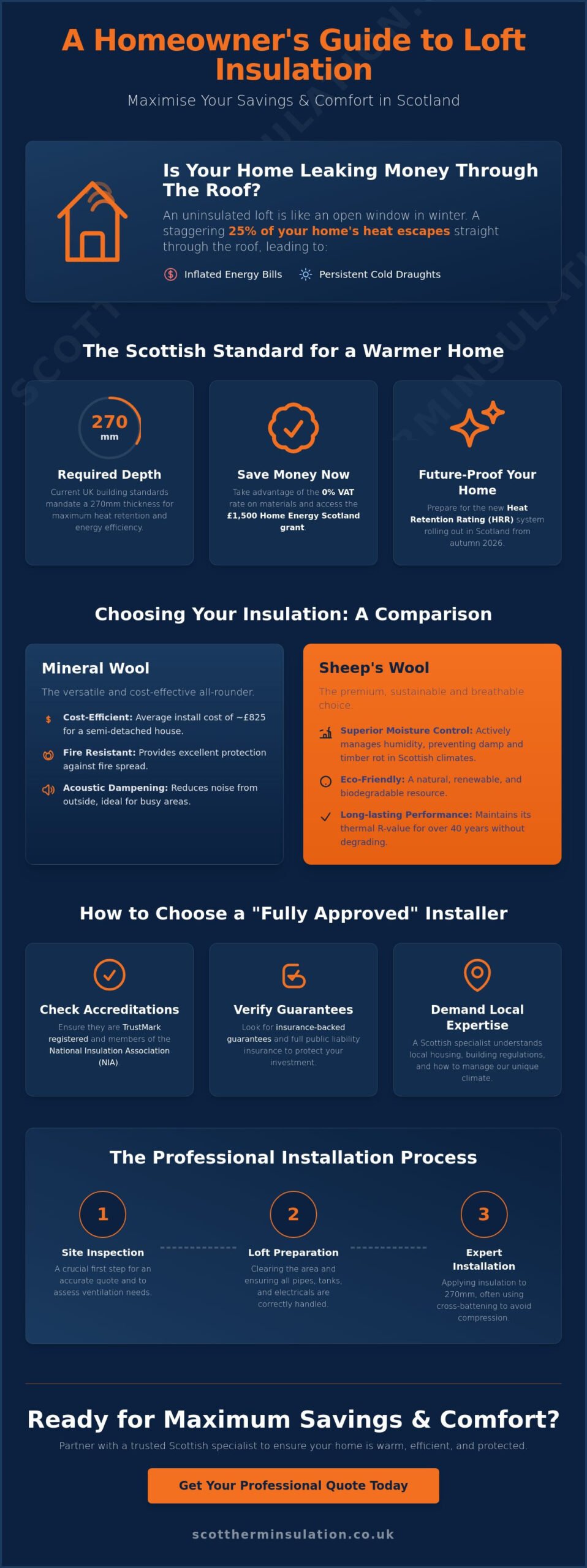
Did you know that 25% of your home’s heat is currently escaping straight through your roof? It’s a staggering figure that translates directly into inflated energy bills and persistent cold draughts. With the Scottish Government’s new Heat Retention Rating (HRR) system rolling out in autumn 2026, choosing the right loft insulation companies has never been more critical for homeowners and landlords alike. You deserve a property that retains heat efficiently, but the fear of poor workmanship often makes the first step the hardest.
We understand that you want a hassle-free installation that delivers maximum savings and comfort. This article provides a clear roadmap to help you evaluate the best installers in Scotland, ensuring they are fully approved and trade-verified. You’ll discover the thermal benefits of premium sheep’s wool compared to mineral wool, learn how to access the £1,500 Home Energy Scotland grant, and see why the 0% VAT rate on materials makes 2026 the ideal time to upgrade your home to the 270mm thickness standard.
Key Takeaways
- Learn how to identify the most reliable loft insulation companies by verifying their “Fully Approved” status and understanding the importance of local Scottish expertise.
- Compare the thermal performance and sustainability of sheep’s wool against cost-effective mineral wool to find the best material for your property’s specific needs.
- Discover why a professional site inspection is essential for an accurate quote and how to spot red flags that indicate potentially poor workmanship.
- Understand the technical installation process, including cross-battening techniques, to ensure your home reaches the 270mm insulation depth required for maximum heat retention.
- Find out how to secure “Maximum Savings & Comfort” by partnering with specialists who are accountable to the local community and the Scottish climate.
What Defines the Best Loft Insulation Companies in Scotland?
Scotland’s weather is notoriously harsh. Whether you’re in a coastal home in North Berwick or a sheltered spot near Stirling, the wind-driven rain and freezing winters demand a specific approach. The best loft insulation companies don’t just supply materials; they engineer solutions that account for high moisture levels and temperature extremes. At ScotTherm Insulation, we focus on a “Maximum Savings & Comfort” philosophy. This means we prioritise the long-term integrity of your roof space over a quick fix. We work alongside some of the best installers in the country to ensure every project meets our rigorous standards for thermal performance.
While national franchises often offer generic packages, local installers in regions like Edinburgh and Fife bring a nuanced understanding of the local housing stock. A national firm might use a one-size-fits-all method, but a local specialist knows how to handle the specific ventilation requirements of a traditional stone property versus a modern timber-frame build. This regional expertise is the difference between an attic that stays dry and one that develops costly damp issues due to poor airflow management.
Essential Accreditations and Certifications
Being “Fully Approved” isn’t a marketing slogan; it’s your primary safeguard. Any reputable contractor must be TrustMark registered and ideally hold membership with the National Insulation Association (NIA). These credentials ensure the team follows strict codes of conduct and technical standards. You should also check for:
- Insurance-backed guarantees that protect your investment even if the installer ceases trading.
- Professional indemnity and public liability insurance to cover any accidental damage during the fit.
- Evidence of a proven track record within the Scottish insulation industry.
We believe that peace of mind is just as important as the insulation itself. Selecting loft insulation companies with these verified markers ensures you aren’t left dealing with the fallout of poor workmanship.
Regional Knowledge: Why Local Matters
Traditional Scottish tenements and rural cottages present unique challenges that many general builders overlook. These buildings often require breathable solutions like Sustainable Sheep’s Wool to manage moisture effectively without damaging the masonry. Installers familiar with Perth and Stirling understand local building regulations and the nuances of the Heat Retention Rating (HRR) system starting in late 2026. The “Scot” prefix in a business name often serves as a badge of local accountability. It signals that the team is part of the community they serve, making them far more responsive than a faceless corporate office located hundreds of miles away.
Comparing Insulation Materials: Mineral Wool vs Sustainable Sheep’s Wool
Choosing between materials is the most significant decision you’ll make when vetting loft insulation companies. It isn’t just about the initial price; it’s about how the material interacts with your home’s structure over the next 40 years. Thermal performance, or R-value, measures how well a material resists heat flow. While many products offer high R-values, the Scottish climate introduces a variable that standard tests often miss: humidity. We see a growing demand for wool insulation because it manages moisture better than synthetic alternatives. This breathability is vital for preventing timber rot in the attic whilst ensuring your home reaches its maximum thermal potential.
Mineral Wool: The Versatile All-Rounder
Mineral wool remains the industry benchmark for cost-efficiency and reliability. For a semi-detached house in Scotland, the average cost for a 270mm install is approximately £825. It’s popular amongst loft insulation companies because it provides excellent fire resistance and acoustic dampening. If you live near a busy road in Dundee or Inverness, the sound-absorbing qualities of mineral wool are a major benefit for your domestic well-being. To meet current UK building standards, you need a thickness of 270mm. This often requires a professional installer to cross-batten the joists, ensuring the material isn’t compressed, which would otherwise significantly reduce its effectiveness and your potential energy savings.
Sheep’s Wool: The Premium Eco-Friendly Choice
For owners of older properties, Historic Environment Scotland provides specific advice for traditional buildings that highlights the benefits of natural fibres. Sheep’s wool can absorb up to 33% of its weight in moisture without losing its insulating properties. This natural regulation prevents condensation in the roof space, which is a common failure point in stone-built homes across the Central Belt. It’s also entirely non-toxic and free from VOCs, meaning no harmful chemicals or irritants enter your living space during or after the fit. Sheep’s wool is the superior choice for breathable roof structures in 2026 because it actively regulates attic humidity whilst maintaining a high thermal barrier against the Scottish winter. If you’re unsure which material fits your budget, you can request a technical survey to see what’s best for your specific roof type.
The Vetting Process: How to Evaluate Insulation Quotes
Finding the right loft insulation companies starts with a physical site visit, not a phone estimate. A “free insulation inspection” is the only way an installer can accurately assess your joist spacing, existing insulation levels, and ventilation needs. If a contractor offers a fixed price without looking in your loft, treat it as a significant red flag. The cheapest quote often hides shortcuts, such as using inferior materials or ignoring the 270mm depth requirement highlighted by the Energy Saving Trust. Quality workmanship ensures your “Maximum Savings & Comfort” aren’t compromised by cold spots or future damp issues caused by poor coverage.
We’ve seen many homeowners in Dundee and Inverness lured by “bargain” prices, only to find the installer didn’t include waste disposal or used thin, non-compliant rolls. A professional quote should be a comprehensive document that leaves no room for ambiguity. It’s your blueprint for a warmer home, and it should reflect the technical precision required for a successful installation in the Scottish climate. Working with certified loft insulation installers who understand Scottish building standards is the most reliable way to ensure your quote reflects the true scope of work required.
The Anatomy of a Professional Quote
A transparent quote must clearly separate the cost of materials from labour and waste disposal. Since VAT on energy-saving materials is 0% until 31 March 2027, ensure this saving is passed on to you and clearly reflected in the final figure. Check for specific mentions of BS 5250 compliance. If your installer doesn’t include eaves trays or lap vents to maintain airflow, your roof space could become a trap for condensation. A standard installation for a semi-detached home typically takes one full working day. If a company claims they can finish in two hours, they’re likely skipping the essential cross-battening needed to reach the full 270mm depth without compressing the base layer.
Verifying ‘Fully Approved’ Status
Always verify an installer’s “Fully Approved” status via the TrustMark website before signing any contract. TrustMark is the only government-endorsed quality scheme that vets loft insulation companies for their technical competence and customer service. Beyond official certifications, look for a “Proven Track Record” through local social proof. Reviews from homeowners in Edinburgh, Fife, and Perth provide a clearer picture of a company’s reliability than generic national ratings. Ask the installer for photos or case studies of recent projects involving properties similar to your own. Whether you own a traditional stone tenement or a modern detached villa, seeing evidence of similar successful fits provides the peace of mind you need before work begins.
Step-by-Step: What to Expect from Professional Installers
Once you’ve selected one of the leading loft insulation companies, the installation day should be a smooth, organised process. A professional team arrives with more than just rolls of mineral or sheep’s wool; they bring a commitment to protecting your property whilst transforming its thermal efficiency. The process begins with a clear plan to navigate your attic safely and ends with a final inspection that guarantees your new insulation won’t interfere with your home’s vital systems. This structured approach is what separates “Fully Approved” contractors from casual handymen.
Preparation and Safety Measures
The best loft insulation fitters near me prioritise safety and cleanliness from the moment they step through the door. They use heavy-duty floor protectors to shield your carpets and furniture in Dundee or Inverness homes. Inside the loft, the team installs temporary lighting and walkway boards to ensure they can work securely without risking a foot through your ceiling. Before laying any material, they seal air leaks around light fittings and chimney breasts using specialist sealants. This step is critical because without it, warm air bypasses the insulation, creating a “thermal bypass” that undermines your energy savings.
The Installation and Beyond
The technical phase involves laying a base layer between the joists, followed by a second layer laid at right angles. This cross-layering technique is essential for reaching the 270mm thickness standard whilst eliminating thermal bridging, where heat escapes through the wooden joists themselves. If you need storage space, your installer should use loft legs or stilts to raise the boarding. Never allow boards to be screwed directly onto joists over the insulation. Compressing the material can reduce its performance by 50%, leading to higher bills and cold spots.
Professional loft insulation companies also pay close attention to the details that homeowners often miss. This includes fitting an insulated draught-strip to your loft hatch and lagging any exposed pipework to prevent bursts during a Highland winter. The final step is a rigorous inspection to ensure electrical cables are clipped above the insulation to prevent overheating and that eaves ventilation remains completely clear. If you’re ready to upgrade your home’s thermal barrier, you can book your professional installation survey today to secure your home’s future comfort.
Why ScotTherm is the Trusted Choice for Scottish Homeowners
In a market crowded with generic loft insulation companies, ScotTherm stands out by combining technical proficiency with a deep-rooted sense of regional pride. We don’t just see ourselves as contractors; we are specialists dedicated to the domestic well-being of our neighbours across the Central Belt. Our “Maximum Savings & Comfort” philosophy isn’t a vague promise. It’s a proven framework we’ve used to help thousands of homeowners in Edinburgh, Fife, Perth, and Stirling secure their properties against the rising costs of energy and the unpredictability of the Scottish climate. Being local makes us inherently more accountable. Whilst national franchises often rely on distant call centres, our reputation is built on the tangible results we deliver in your local community.
Choosing a “Fully Approved” installer is the only way to ensure your home meets the rigorous standards required by the 2026 Heat Retention Rating (HRR) system. We take pride in our proven track record, ensuring every project is handled by experts who understand the structural nuances of Scottish housing. Whether you’re upgrading a modern villa or a traditional tenement, our team applies the same level of precision and care to every fit.
Our Specialist Insulation Range
We provide a versatile range of high-performance materials tailored to your specific goals and budget. Our expertise covers everything from cost-effective mineral wool to premium, sustainable sheep’s wool solutions. We specialise in a “fabric first” approach, often integrating loft insulation scotland with room-in-roof and underfloor projects to create a complete thermal envelope. This holistic strategy ensures that heat isn’t just blocked at the roof but retained throughout the entire property. By focusing on thermal improvements that actually reflect on your monthly energy bills, we provide long-term value that far outweighs the initial installation cost.
Get Your Specialist Free Insulation Inspection
The first step towards a more energy-efficient home is a comprehensive thermal assessment. Our experts don’t just measure your joists; they conduct a deep-dive audit into your property’s current performance. We identify hidden air leaks, assess moisture levels, and check for thermal bridging that could be costing you hundreds of pounds every year. Following the inspection, we provide a bespoke plan designed to stop heat loss and transform your home comfort. With 0% VAT on energy-saving materials available until March 2027 and loft insulation grants Edinburgh homeowners can access of up to £1,500 through Home Energy Scotland, there has never been a better time to act. Take the first step towards “Maximum Savings & Comfort” by booking your local survey with one of Scotland’s most trusted loft insulation companies today.
Secure Your Home’s Future Thermal Performance
The introduction of the Heat Retention Rating in autumn 2026 means that settling for “good enough” is no longer an option for Scottish homeowners. You’ve seen how the right material choice, whether it’s cost-effective mineral wool or sustainable sheep’s wool, can stop up to 25% of heat loss and significantly lower your monthly energy bills. Vetting loft insulation companies for their “Fully Approved” status and regional expertise ensures your installation meets the 270mm depth standard without compromising on vital roof ventilation.
As local specialists with a Proven Track Record Across Scotland, ScotTherm is here to help you achieve Maximum Savings & Comfort Guaranteed. Our team of Fully Approved Contractors understands the specific demands of our climate and traditional housing stock. We ensure your project is handled with the technical precision required for long-term durability and efficiency.
Take the first step towards a warmer home and Book Your Specialist Free Insulation Inspection with ScotTherm Today. Don’t let your hard-earned money escape through the roof; a well-insulated property is a smarter, more sustainable investment for the years ahead.
Frequently Asked Questions
How do I know if a loft insulation company is reputable?
Reputable loft insulation companies hold TrustMark registration and NIA membership as a baseline for quality. These credentials guarantee that the contractor follows strict industry codes and technical standards. You should also verify their public liability insurance and check for a proven track record through local reviews in Dundee or Inverness. A specialist who offers a physical site inspection rather than a phone estimate is always a more reliable choice for your home.
What is the recommended depth for loft insulation in Scotland in 2026?
The current recommended depth for mineral wool insulation in Scotland is 270mm to meet high thermal efficiency standards. This thickness is essential for achieving “Maximum Savings & Comfort” and complying with the Heat Retention Rating (HRR) system launching in autumn 2026. If your existing insulation is thinner than 100mm, we recommend a top-up to reach this 270mm target, which prevents up to 25% of your home’s heat from escaping through the roof.
Can I get a grant for loft insulation from a Scottish company?
Yes, homeowners can access grants of up to £1,500 through Home Energy Scotland for energy efficiency improvements. Households in rural or island areas may qualify for an additional £1,500 uplift to help cover the costs of a professional install. Low-income households might also be eligible for the ECO4 scheme, which runs until March 2026, providing free or heavily subsidised insulation to those meeting specific income or benefit criteria. Edinburgh residents can find out more about available funding options by reviewing the loft insulation grants Edinburgh 2026 guide to understand the full range of schemes available before the March deadlines.
Will new loft insulation cause condensation or damp in my roof?
New insulation won’t cause damp if your roof space remains properly ventilated according to BS 5250 standards. Professional loft insulation companies install eaves trays and lap vents to ensure airflow isn’t restricted by the new material. This ventilation is crucial for preventing moisture build-up that could lead to timber rot. Using breathable materials like sheep’s wool also helps manage humidity levels naturally in older Scottish properties.
How long does it take for a loft insulation company to complete the job?
A professional loft insulation project typically takes one full working day to complete for an average semi-detached home. This timeline includes preparing the space with walkway boards, sealing air leaks, and laying the double-layer insulation to the required 270mm depth. Whilst smaller lofts might be finished in four hours, complex projects involving cross-battening or storage stilts require a full day to ensure the workmanship meets our “Fully Approved” standards.
Is sheep’s wool insulation better than mineral wool for Scottish homes?
Sheep’s wool is often superior for traditional Scottish stone buildings because it can absorb up to 33% of its weight in moisture without losing thermal performance. Mineral wool is a more cost-effective industry standard for modern homes where moisture management is handled by existing vapour barriers. Whilst sheep’s wool costs more than mineral wool, its natural temperature regulation and non-toxic properties make it a premium choice for long-term domestic well-being.
Do I need to remove my old insulation before the new company arrives?
You don’t usually need to remove old insulation if it’s dry and in good condition. Most installers will simply lay the new material over the existing layer to reach the 270mm goal. However, if your old insulation is damp, compressed, or contaminated by pests, it must be removed to prevent mould growth. Our specialists assess the condition of your current insulation during the initial free survey to determine the best approach.
What areas do ScotTherm Insulation cover for loft projects?
ScotTherm Insulation provides comprehensive coverage across the Central Belt and northern regions, including Dundee, Inverness, Edinburgh, and Fife. We also serve homeowners in Perth, Stirling, and the surrounding rural areas. As local specialists with a proven track record, we tailor our installation strategies to the specific climate challenges and housing types found in each of these Scottish locations, ensuring maximum thermal efficiency for every client.