
Living in a top-floor Edinburgh flat shouldn’t mean choosing between historic character and a warm living room. While the iconic sloping ceilings, or “coomces,” define the charm of our city’s skyline, they are often the primary source of the biting winter chill that makes traditional homes so difficult to heat. If you are struggling with high energy bills and the fear of damp affecting your original rafters, you need a solution that respects the building’s heritage whilst delivering modern thermal performance. At ScotTherm Insulation, we specialise in the specific room in roof insulation edinburgh tenement properties require to stay efficient in the unpredictable Scottish climate.
You can achieve a draught-free, cosy home without compromising the structural health of your stone property. This 2026 guide provides a clear roadmap for upgrading your top-floor space effectively, ensuring you protect your rafters from moisture and meet the latest standards for energy efficiency. We promise to show you how to balance thermal gain with the essential breathability that traditional Edinburgh buildings demand.
We will examine the best breathable materials for the current year, detail the professional installation sequence for lived-in flats, and provide essential guidance on navigating Edinburgh’s strict building regulations. By the end of this guide, you’ll have the confidence to transform your tenement into a high-performance home that offers maximum savings and comfort.
Key Takeaways
- Learn why a “fabric-first” approach and breathable materials are essential for protecting the traditional stone structure of your home from damp and rot.
- Understand the technical requirements for room in roof insulation edinburgh tenement properties need to meet current 2026 thermal standards.
- Discover the specific legal triggers for a Building Warrant or Listed Building Consent when upgrading flats in Edinburgh’s historic New Town or Old Town.
- Follow a professional installation sequence that includes vital pre-checks for timber health and roof integrity to ensure long-term structural safety.
- Identify how to maximise your return on investment by balancing energy efficiency with the preservation of original architectural features.
What is Room in Roof Insulation for Edinburgh Tenements?
Room-in-roof insulation (RIRI) is a specialised thermal upgrade designed for properties where the attic space has been converted into living quarters. In the context of a traditional Edinburgh tenement, this typically involves the top-floor flat. Unlike a standard loft where you simply lay mineral wool across the floor joists, RIRI requires insulating the actual structure of the roof. This includes the “coomce”, which is the traditional Scottish term for the sloping ceilings that follow the line of the rafters. Because these rooms are built directly into the roof, they are often the coldest part of the building.
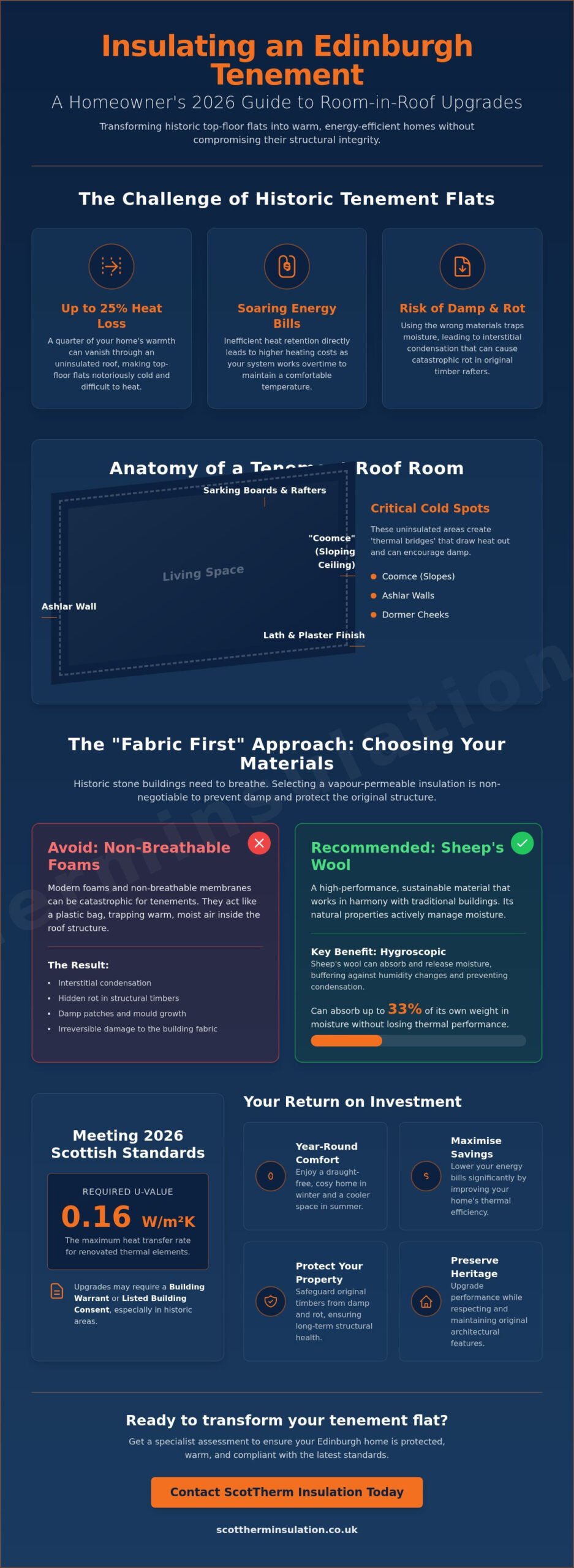
Tenements lose heat more aggressively than modern detached houses because of their height and exposure to the Scottish elements. Up to 25% of your home’s warmth can vanish through an uninsulated roof. Standard loft insulation isn’t enough for these spaces; you need a solution that covers the entire “thermal envelope” of the room. When installing room in roof insulation edinburgh tenement flats require a bespoke approach that respects the original lath and plaster whilst meeting modern thermal targets.
The Anatomy of a Tenement Roof Room
Traditional Scottish construction differs significantly from English methods. Most tenements feature timber rafters topped with sarking boards; these are thick wooden planks that provide structural rigidity. Beneath this, you’ll find the original lath and plaster finishes. This creates a complex series of voids. To meet the 2026 Building Regulations, which require a maximum U-value of 0.16 W/m²K for renovations, we must address specific cold spots. These include the “ashlar walls”, which are the short vertical walls at the base of the slope, and the “dormer cheeks” around windows. Failing to insulate these areas creates thermal bridges that draw heat out and encourage damp.
Why “Standard” Insulation Often Fails in Edinburgh
Using the wrong building insulation materials can be catastrophic for a historic stone building. Modern, non-breathable foams can trap moisture against the original timber rafters and sarking boards, leading to hidden rot. Edinburgh’s tenements were designed to breathe; moisture must be able to escape through the fabric of the building. Without proper ventilation and vapour control, you risk interstitial condensation. Interstitial condensation is the process where warm, moist air from the living space migrates into the roof structure and settles as liquid water on cold internal surfaces, eventually damaging the structural timbers.
Selecting the Right Materials: Why Breathability is Non-Negotiable
Protecting a historic tenement requires a “Fabric First” approach. This philosophy prioritises the building’s structural health alongside thermal gain. Breathability is non-negotiable. When you install room in roof insulation edinburgh tenement walls and ceilings must remain vapour-permeable. Traditional stone and lime mortar manage moisture through evaporation. If you block this process with non-breathable materials, you’re inviting damp into your home’s bones. ScotTherm Insulation recommends breathable solutions to ensure your flat stays dry and warm for decades.
The Scottish building standards for insulation highlight the necessity of correct installation to prevent condensation. Mineral wool is a common choice, but for many 2026 homeowners, sustainable sheep’s wool is the superior option. While mineral wool offers good thermal performance, it lacks the advanced moisture-handling capabilities of natural fibres. Using the right materials ensures you achieve maximum savings and comfort without risking the integrity of the original rafters.
The Benefits of Sheep’s Wool in Roof Rooms
Sheep’s wool is truly a high-performance material. It’s hygroscopic, meaning it can absorb up to 33% of its weight in moisture without losing its ability to insulate. This is a game-changer for Edinburgh’s humid climate. Choosing wool insulation provides a non-toxic, fire-retardant barrier that is safe to handle. It’s an eco-friendly choice that aligns with Scotland’s 2026 carbon-neutral goals, offering peace of mind alongside maximum comfort.
Rigid PIR Boards vs. Flexible Batts
Sometimes space is the biggest constraint. In tight tenement dormers, rigid PIR (Polyisocyanurate) boards offer high thermal resistance in a thin profile. These foil-backed boards are excellent for saving inches in small rooms. However, you must maintain a 50mm air gap between the insulation and the sarking boards to allow ventilation. Without this gap, moisture traps against the wood. When specifying room in roof insulation edinburgh tenement projects often require a mix of rigid and flexible materials to address thermal bridging in dormer windows. This hybrid approach ensures no cold spots remain. If you’re unsure which material fits your flat, our fully approved contractors at ScotTherm Insulation can provide a tailored assessment.
How-To: Insulating Your Tenement Slopes and Ceilings
When installing room in roof insulation edinburgh tenement owners should expect a structured, multi-stage process. A professional sequence ensures the work doesn’t compromise the building’s health or your daily life. Because these are lived-in flats, we recommend a room-by-room approach to manage dust and disruption effectively. Before any materials arrive, our team conducts a rigorous fabric check. We look for damp staining on sarking boards or “spongy” rafters that indicate active leaks. You can find detailed guidance on energy efficiency for traditional buildings through Scottish charities like Under One Roof, which highlight why these pre-checks are vital for shared tenement structures.
Step 1: Access and Fabric Inspection
The first task involves gaining access to the voids behind the “coomce” and ashlar walls. This sometimes requires removing old, failing lath and plaster, though over-boarding is possible if the original surface is sound. We pay close attention to the original rafters. If we identify timber rot or structural weakness, these must be repaired before insulation begins. We also clear decades of debris from the eaves. This ensures that ventilation paths remain open, allowing the building to breathe as intended by its 19th-century designers. Taking the time to verify the health of the timber now prevents costly repairs later.
Step 2: Fitting the Insulation and Air Gaps
Precision is essential during the fitting stage. We cut the insulation materials to fit tightly between the rafters. This prevents “cold bypass”, where freezing air travels around the edges of the insulation and cools the internal plaster. As of 2026, building standards demand high thermal performance, but we never sacrifice safety for heat. We maintain a 50mm air gap behind the insulation to allow constant airflow against the sarking boards. We also extend the insulation down the ashlar walls and into the floor voids to create a continuous thermal barrier. This eliminates the common cold spots that lead to mould growth in the corners of tenement bedrooms.
Step 3: Finishing and Plastering
Once the primary insulation for your room in roof insulation edinburgh tenement project is in place, we install a high-performance vapour control layer (VCL). This membrane is the final defence against damp; it stops warm, moist air from the flat reaching the cold roof timbers. We then fit insulated plasterboard to provide a secondary thermal break. If your flat features original cornicing or period mouldings, our specialists work to preserve or replicate these details carefully. The process concludes with a professional skim coat of plaster. Your project finishes with a smooth surface, ready for redecoration, leaving you with a home that’s significantly warmer and cheaper to run.
Navigating Edinburgh’s Building Regulations and Listed Status
Edinburgh’s skyline is a testament to centuries of architectural excellence, but its historic status adds significant layers of bureaucracy to modern energy upgrades. If you’re planning room in roof insulation edinburgh tenement projects, you must navigate a complex landscape of local authority permissions. You aren’t just insulating a room; you’re altering a piece of Scotland’s heritage. Failing to secure the correct consents can lead to legal complications and may even hinder future property sales. At ScotTherm, we prioritise the “Fully Approved” status of our work to give you peace of mind throughout this process.
The Building Warrant Process
Most thermal improvements to a tenement roof require a formal Building Warrant from the City of Edinburgh Council. This legal document confirms that your proposed work meets the current Scottish Building Standards. To secure a warrant, you must submit detailed section drawings and technical U-value calculations. Since 2026 regulations specify a maximum U-value of 0.16 W/m²K for renovations, your application must prove that the chosen materials can hit this target without compromising safety. Our team assists homeowners by providing the precise technical data required for these applications, ensuring your project is compliant from day one.
Conservation Area Sensitivities
There are 49 conservation areas across Edinburgh, including the New Town and Old Town World Heritage sites. In these zones, maintaining the external appearance of the building is the council’s primary concern. This usually makes internal insulation the only viable path. You must carefully manage the transition between the insulation and original features like sash and case windows. Insulating dormer cheeks requires a delicate touch to avoid creating cold bridges while respecting the building’s profile. It’s vital to use fully approved contractors for heritage projects to ensure that modern comfort doesn’t come at the cost of historic character.
If your tenement is Category A, B, or C listed, the requirements are even stricter. You will likely need Listed Building Consent in addition to a Building Warrant. Historic Environment Scotland (HES) provides guidance on fabric improvements, often favouring breathable, natural materials that don’t trap moisture against old stone. Carrying out unauthorised work on a listed building is a criminal offence, so professional advice is essential. We help you balance the need for maximum savings and comfort with the preservation of your home’s unique history. Book a survey with our Edinburgh team to discuss your tenement’s specific planning requirements today.
Maximising Savings and Comfort with ScotTherm
Investing in room in roof insulation edinburgh tenement properties is a strategic financial decision in the 2026 energy landscape. With energy prices remaining a primary household concern, the return on investment (ROI) is realised through both immediate bill reductions and long-term property value. By sealing the “coomce” and ashlar walls, you effectively wrap your top-floor flat in a thermal blanket. This work often goes hand-in-hand with loft insulation Scotland homeowners use to secure their entire roof space. Our approach ensures that every penny spent translates into tangible domestic well-being.
Energy Bill Impact
Top-floor tenement flats are notoriously difficult to heat. Because up to 25% of a home’s heat escapes through an uninsulated roof, RIRI can reduce your heating demand by approximately 20% to 30%. This isn’t just about the money. The “Comfort Factor” is immediate. You’ll notice the elimination of cold spots and draughts that previously made your rooms unusable during an Edinburgh haar or a winter gale. For landlords, this upgrade is essential. As of 2026, Scottish regulations require a minimum EPC rating of C for new tenancies. Achieving this rating is nearly impossible in an old tenement without addressing the roof rooms, making insulation a prerequisite for legal compliance and rental viability.
Why Choose a Specialist Scottish Installer?
Edinburgh’s building stock is unique. It requires installers who understand the delicate balance between thermal gain and moisture management. ScotTherm brings a proven track record to every project. We don’t just “supply and fit” materials; we provide a comprehensive service that respects the historic fabric of your home. Our use of eco-friendly, high-performance materials like sheep’s wool ensures your home remains healthy and breathable. For those living on the bottom floor, we also offer specialised under floor insulation to tackle the chill rising from the basement or solum.
Your journey to a warmer home starts with a professional assessment. Our fully approved contractors provide a specialist free insulation inspection to identify exactly where your flat is losing energy. We help you navigate the 2026 grant landscape and ensure your room in roof insulation edinburgh tenement project delivers maximum savings and comfort. Contact our local team today to secure your property’s future and enjoy a more cost-effective, cosy home.
Secure Your Tenement’s Thermal Future Today
Insulating your top-floor flat is about more than just lowering bills; it’s about preserving a piece of Edinburgh’s history whilst meeting 2026 energy standards. You now understand that breathability is non-negotiable for stone buildings and that navigating the Building Warrant process requires technical precision. By choosing the right materials, such as sustainable sheep’s wool, you protect your rafters from moisture whilst achieving a warmer, more cost-effective home.
Implementing room in roof insulation edinburgh tenement owners can trust requires local expertise. ScotTherm provides the security of a proven track record and the peace of mind that comes from working with fully approved contractors. We specialise in the unique construction of Scottish tenement properties, ensuring your thermal upgrade respects the building’s character and structural integrity. Our expertise in sustainable sheep’s wool ensures a high-performance finish that manages moisture naturally.
Don’t let another winter pass with uninsulated “coomces” and high heating costs. Take the first step toward maximum savings and comfort by speaking with our team. Book your specialist free insulation inspection in Edinburgh today and ensure your home is ready for the years ahead. We’re here to help you create a cozy, energy-efficient space that lasts for generations.
Frequently Asked Questions
Do I need a building warrant for room in roof insulation in Edinburgh?
Yes, you usually require a Building Warrant from the City of Edinburgh Council for thermal upgrades to your roof. This legal document ensures your project meets the 2026 Scottish Building Standards, specifically the 0.16 W/m²K U-value target for renovations. ScotTherm assists homeowners by providing the technical drawings and U-value calculations needed for a successful application.
Will insulating my tenement roof room cause damp or rot?
No, professional installation prevents damp by maintaining a 50mm air gap behind the insulation and using vapour control layers. Breathability is essential in traditional stone buildings to allow moisture to escape the fabric. Using non-breathable materials without proper ventilation is what leads to interstitial condensation and timber rot in original rafters.
Can I insulate my sloping ceilings without removing the original plaster?
Yes, you can insulate sloping ceilings without removing the original lath and plaster through a process called over-boarding. We fix high-performance insulation boards directly to the existing surface and then apply a new layer of plasterboard. This method is often preferred in lived-in flats because it significantly reduces dust and disruption during the project.
How much space will I lose by insulating the walls and slopes?
You will typically lose between 50mm and 100mm of internal space depending on the material selected. Rigid PIR boards offer the best space-saving performance for a room in roof insulation edinburgh tenement project. We balance the thickness of the material against the required thermal performance to preserve as much of your living space as possible.
Is there a grant available for room in roof insulation in Scotland?
Yes, funding is available through the ECO4 and Great British Insulation Scheme (GBIS) until March 2026. Eligibility often depends on your Council Tax band, which must be A-E in Scotland, or receipt of specific benefits. We can help you determine if your tenement flat qualifies for these government-backed energy efficiency measures during our initial survey.
What is the best insulation material for a listed tenement building?
Breathable, natural materials like sheep’s wool are the best choice for listed tenements. These materials manage moisture naturally, which is a key requirement for Historic Environment Scotland (HES). They prevent moisture from being trapped against historic timber rafters, ensuring the long-term preservation of your building’s fabric whilst providing excellent thermal performance.
How long does it take to insulate a standard two-bedroom tenement flat?
A standard two-bedroom tenement flat usually takes between 7 and 10 working days to complete. This timeline includes the initial fabric inspection, material installation, and final plaster skimming. We work room-by-room to ensure you can continue living in your property with minimal inconvenience while we install your room in roof insulation edinburgh tenement upgrade.
Will room in roof insulation help keep my flat cool in the summer?
Yes, high-quality insulation significantly reduces solar gain during the summer months. The same thermal barrier that keeps heat inside during winter prevents external heat from penetrating your roof in July and August. This creates a much more stable and comfortable temperature throughout the year, regardless of the Scottish weather outside.