
Did you know that Scotland’s domestic electricity consumption reached 8.8 TWh in 2024, yet our traditional solid-wall homes remain some of the least energy-efficient in Europe? If you’re living in a stone-built property in Edinburgh, Fife, or across the Central Belt, you’ve likely felt the bite of high energy bills and rooms that never quite stay warm. It’s a common struggle for many Scottish homeowners who want a cosy home but worry about the cost of upgrades or losing precious floor space.
The good news is that you don’t have to fund these improvements yourself. This 2026 guide explains how to secure internal wall insulation grants through the ECO4 and Great British Insulation Scheme (GBIS) before they expire on March 31, 2026. Whether your household income is below £31,000 or your home sits in Council Tax bands A to E with an EPC rating of D or lower, there’s a clear path to a warmer house. We’ll walk you through the eligibility rules, the whole-house approach favoured by regulators, and how to find a TrustMark-registered installer to transform your home’s comfort and value.
Key Takeaways
- Secure funding through ECO4 and the Great British Insulation Scheme before the March 31, 2026 deadline to upgrade your home’s efficiency.
- Check your eligibility based on property age and EPC ratings to see if you qualify for fully funded or subsidised upgrades.
- Discover how internal wall insulation grants can lower your energy bills whilst transforming the comfort of your solid-wall home.
- Compare standard mineral wool with sustainable sheep’s wool to find the best protective solution for your traditional Scottish property.
- Learn the exact steps of the application process, from your first enquiry to the essential technical survey by a local expert.
Understanding Internal Wall Insulation Grants in Scotland for 2026
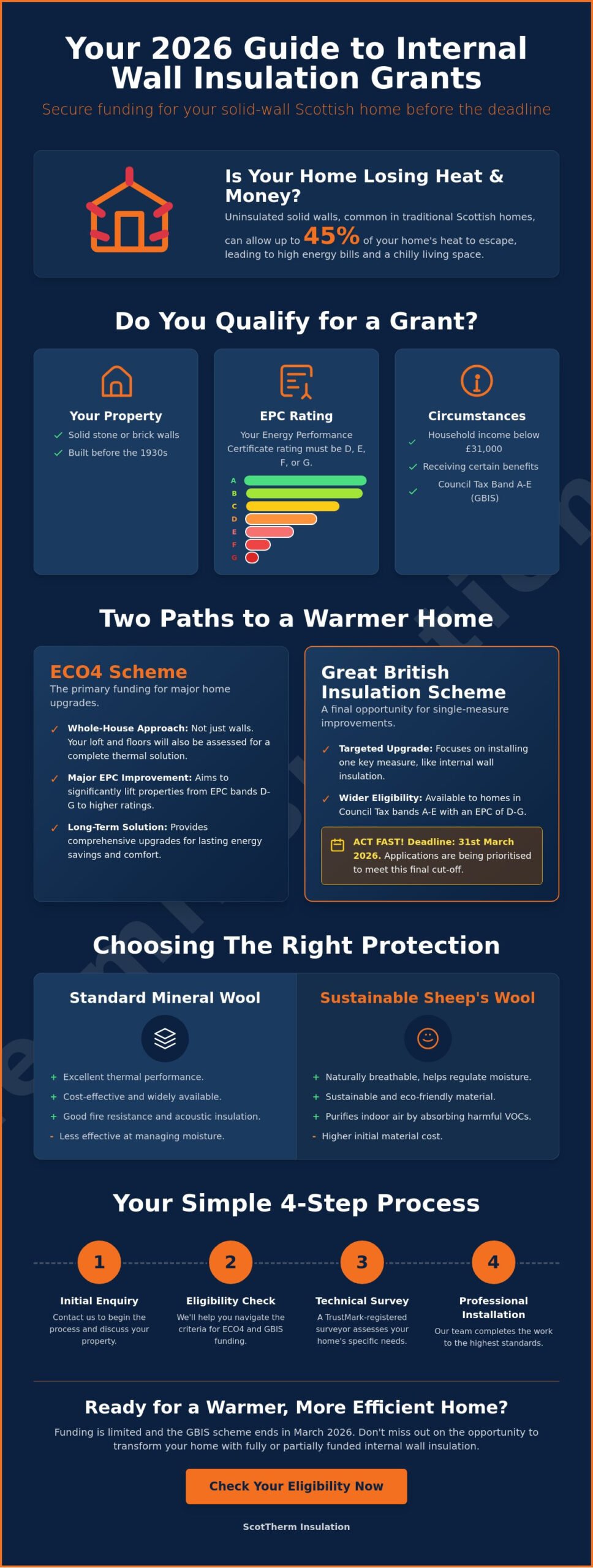
Internal wall insulation grants are government-backed financial packages designed to offset the cost of retrofitting solid-wall properties from the inside. These grants are essential for Scottish homeowners because our national housing stock is amongst the oldest in Europe. In fact, total electricity consumption in Scotland was 21.7 TWh in 2024; a figure we can only reduce by making our traditional buildings more efficient. Scotland remains a priority area for this funding because a significant portion of our homes were built before 1919, often with solid stone walls that lack any modern thermal barrier. As we move through 2026, the funding landscape is transitioning. The Great British Insulation Scheme (GBIS) is nearing its conclusion, leaving the Energy Company Obligation (ECO4) as the dominant force for comprehensive home upgrades.
Whether you receive a fully funded “free” installation or a subsidised one depends on your specific circumstances. Low-income households or those on means-tested benefits often qualify for the full cost of works. Others may need to provide a contribution if the property’s energy savings potential doesn’t cover the entire installation cost. ScotTherm Insulation works as a trusted local specialist to help you identify which pot of funding fits your property best, ensuring you achieve maximum savings and comfort. We help homeowners navigate the complexities of these schemes to ensure that traditional buildings are protected with the right materials whilst meeting strict government standards.
The ECO4 Scheme in Scotland
The ECO4 scheme is currently the primary engine for tackling fuel poverty across the Central Belt. It moves away from quick fixes by mandating a whole-house retrofit approach. This means that if you qualify for internal wall insulation grants, the surveyor will also assess your loft and floors. For residents in Edinburgh, Fife, and Perth, this holistic method ensures that heat isn’t simply escaping through another uninsulated area. By integrating various Building insulation materials, ECO4 Scotland aims to move properties with an EPC rating of D or lower into a much higher efficiency bracket, providing long-term security against energy price fluctuations.
Great British Insulation Scheme (GBIS) Update
The GBIS provides a final opportunity for those who don’t qualify for the full ECO4 package. It’s specifically targeted at homes in Council Tax bands A to E with an EPC rating of D to G. This scheme focuses on single-measure improvements, making it ideal if your home only requires internal wall insulation to meet modern standards. However, you must be aware of the timeline. The scheme is scheduled to end on March 31, 2026. Applications are currently being prioritised to ensure installations are completed before the deadline. It’s a final call for Scottish households to access this specific stream of funding before the window closes for good.
Eligibility Criteria: Do You Qualify for Funding?
Qualifying for internal wall insulation grants isn’t just about your income; it’s about the building you call home. If you live in a solid-wall property built before 1930, you’re already halfway there. These older homes, particularly the iconic tenements in Edinburgh or traditional villas in Stirling, were never designed with modern heat retention in mind. Research shows that uninsulated solid walls can allow up to 45% of a home’s heat to escape. Because Scotland has some of the oldest housing stock in Europe, the 2026 funding criteria specifically target these “hard-to-treat” buildings to make a tangible dent in national energy consumption.
EPC Ratings and Property Suitability
Your property’s Energy Performance Certificate (EPC) is the primary gateway to funding. To qualify for most schemes in 2026, your home must sit within the D, E, F, or G brackets. You can quickly check your status on the Scottish EPC Register. Whilst this gives you a starting point, a professional survey is essential. The team at ScotTherm Insulation often finds that older buildings have unique ventilation needs that standard online data might miss. For impartial advice on your property’s specific requirements, Home Energy Scotland remains a vital resource for local residents looking to understand their options.
Council Tax and Income Thresholds
Under the Great British Insulation Scheme (GBIS), eligibility extends to households in Council Tax bands A to E. This covers a vast majority of properties across Fife and the Central Belt. If you’re looking at the more comprehensive ECO4 route, the focus shifts towards tackling fuel poverty. You’re likely eligible if you receive Pension Credit, Universal Credit, or Child Benefit (subject to specific income limits). Older homeowners on a fixed income receiving Pension Credit may also want to explore loft insulation grants for pensioners in Scotland, which can be combined with wall insulation measures under a whole-house retrofit approach.
Don’t worry if you aren’t on benefits. Many Scottish councils, including Stirling and Perth, participate in “LA Flex.” This allows local authorities to refer residents with a gross annual income below £31,000 who struggle with high heating costs. You can see how these rules apply to your specific area by using our ECO4 eligibility checklist.
Navigating these criteria can feel complex, but it’s the first step toward a warmer, more efficient home. If you’re unsure where your property fits, speaking with an approved local installer can clarify your options quickly. ScotTherm Insulation takes pride in helping our community access the support they deserve, ensuring every installation meets the highest standards for safety and comfort.
Comparing Materials: Mineral Wool vs. Sustainable Sheep’s Wool
Choosing the right material for a traditional stone property is the most critical decision you’ll make during a retrofit. Whilst modern homes often use rigid foam boards, these can trap moisture against older stone walls, leading to dampness. Using internal wall insulation grants allows Scottish homeowners to access high-quality, professional-grade materials that respect the building’s original structure. For many projects, the choice comes down to industry-standard mineral wool or premium, sustainable sheep’s wool. Mineral wool is the cost-effective workhorse of the energy efficiency sector, typically costing between £5 and £10 per square metre for standard thickness batts. It offers excellent fire resistance and thermal performance, making it a reliable choice for meeting grant requirements.
Sheep’s wool represents a more premium, eco-friendly alternative. With costs ranging from £18 to £25 per square metre for a 100mm thickness, it’s a significant investment that pays dividends in breathability. This is particularly vital for the older housing stock found across the Central Belt. A common concern amongst homeowners is the loss of internal floor space. Whilst a 100mm layer of insulation does reduce room dimensions slightly, the trade-off is a dramatic increase in “Maximum Savings & Comfort.” Our team ensures that the installation is as slim as possible whilst still meeting the strict energy-saving targets required to secure your funding.
Thermal Performance and Breathability
In coastal areas like Fife and North Berwick, humidity levels are naturally higher. Sheep’s wool excels here because it’s hygroscopic; it can absorb and release moisture without losing its insulating properties. This prevents the interstitial condensation that often worries tenement owners. Mineral wool, whilst less breathable, is a fully approved, fire-retardant material that provides a robust thermal barrier. Both materials effectively stop heat from escaping through solid external walls, ensuring your home stays warmer for longer.
Installation Methods for Scottish Homes
We typically use two main methods for fitting insulation. A timber stud wall is often best for uneven stone surfaces, as it creates a level frame for the insulation and plasterboard. Alternatively, a “dot-and-dab” approach can be used on flatter surfaces, though it’s less common in traditional retrofits where breathability is a priority. The process concludes with professional plastering and the careful reinstatement of your original skirting boards. This ensures the finished room looks as good as it feels, providing a seamless transition to a more energy-efficient lifestyle.
The Application Process: How to Claim Your Grant
Securing internal wall insulation grants doesn’t have to be a complex bureaucratic struggle. We’ve refined the journey into a clear, four-step process designed to move you from a cold, expensive home to a high-efficiency living space with minimal stress. The first step begins with a simple enquiry and basic eligibility screening. During this initial chat, we’ll confirm if you meet the core criteria for ECO4 or the Great British Insulation Scheme, such as your property’s EPC rating and your household income or benefit status. This quick check ensures you don’t waste time on applications that aren’t a match for your circumstances.
Once the basics are confirmed, a technical survey is essential. A local specialist must visit your home to assess the wall structure and ventilation needs. This isn’t a generic tick-box exercise. In cities like Edinburgh, where stone tenements present unique challenges, a specialist survey prevents future damp issues and ensures the insulation performs as promised. After the survey, we handle the paperwork. This involves coordinating directly with energy suppliers to secure funding approval. Finally, our Fully Approved contractors carry out the installation, ensuring every board and seal meets the rigorous standards required for government-backed schemes.
Working with Local Installers
Choosing a specialist who understands the local climate is a significant advantage. Our team brings deep expertise in regional building styles, often combining wall upgrades with loft insulation in Scotland to achieve a “whole-house” retrofit. When you book a survey in Edinburgh or Stirling, you aren’t just getting a contractor; you’re getting an industry partner. ScotTherm Insulation coordinates with major energy suppliers to streamline funding on your behalf. This approach takes the pressure off the homeowner whilst ensuring all technical requirements are met for a successful claim. To get started, you can apply for your grant assessment online today.
Post-Installation and Quality Assurance
Quality doesn’t end when the installers leave your home. Every project completed under the ECO4 and GBIS schemes comes with robust guarantees and warranties for your peace of mind. Once the work is finished, the upgrade is officially logged on the Scottish EPC Register. This update often increases the property’s market value by moving it out of the lower efficiency brackets. Final inspections are conducted to verify that Maximum Savings & Comfort have been achieved. This ensures your home is not only warmer but that the installation will provide tangible financial benefits for decades to come.
Why Choose ScotTherm for Your Internal Wall Insulation?
ScotTherm stands out as a “Trusted Local Specialist” because we don’t just supply materials; we deliver long-term domestic well-being. Our proven track record across the Central Belt is built on a foundation of technical proficiency and local accountability. When you apply for internal wall insulation grants through us, you’re partnering with “Fully Approved” contractors who understand the unique challenges of the Scottish climate. We’ve spent years refining our processes to ensure that every project we undertake results in “Maximum Savings & Comfort” for the homeowner. Our identity as “Insulation Installers Scotland” is more than a label; it’s a commitment to quality that our neighbours can rely on.
We take immense pride in our technical versatility. Whether your property requires the industry-standard efficiency of mineral wool or the premium breathability of eco-friendly sheep’s wool, our teams have the skills to fit both to the highest standards. We ensure every installation adheres to strict Scottish building regulations, protecting the structural integrity of your home whilst achieving significant thermal gains. Our disciplined, quality-conscious approach means we never take shortcuts. We treat every home as if it were our own, prioritising safety and long-term value over quick sales.
Our Regional Expertise
Our regional crews are active daily in Edinburgh, Fife, Perth, Stirling, and North Berwick. This local presence means we understand the specific housing types in each area, from exposed coastal cottages to dense urban tenements. We also look at the bigger picture of home efficiency. Our expertise extends to other vital thermal improvements, such as under floor insulation, ensuring your home is protected from every angle. Helping Scottish communities reduce their carbon footprint is a core part of our identity, and we’re proud to lead the way in sustainable retrofitting.
Next Steps: Secure Your 2026 Grant
The window for current funding is closing fast. With the March 31, 2026 deadline for both ECO4 and the Great British Insulation Scheme approaching, taking action now is essential to avoid missing out on these government-backed opportunities. Don’t wait whilst these schemes are still available to fund your home improvements. Contact us today for a specialist free insulation inspection to confirm your eligibility and begin your journey toward a warmer, more cost-effective home. Our team will guide you through every piece of paperwork and technical requirement.
Apply for your Internal Wall Insulation Grant now and secure your home’s future with Scotland’s trusted insulation experts.
Transform Your Home Before the 2026 Deadline
Securing internal wall insulation grants is a practical way to protect your property against rising energy costs whilst ensuring a healthier living environment. With the ECO4 and Great British Insulation schemes scheduled to end on March 31, 2026, now is the time to act. You’ve seen how the right material choice, from industry-standard mineral wool to premium, breathable sheep’s wool, can stop heat loss through solid walls. By choosing a partner with a proven track record in Scotland, you ensure the installation meets the highest professional standards.
Our fully approved contractors are ready to help you navigate the application process from start to finish. We specialise in sustainable sheep’s wool solutions that are perfect for traditional Scottish stone buildings. Don’t let another winter pass in a cold, inefficient home. Check your eligibility for an Internal Wall Insulation Grant today and start enjoying maximum savings and comfort. We’re here to help you build a warmer, more resilient future for your community.
Frequently Asked Questions
Is internal wall insulation free in Scotland?
Internal wall insulation can be completely free for households that meet the ECO4 eligibility criteria, particularly those receiving means-tested benefits. For others, the Great British Insulation Scheme provides a substantial subsidy that covers a significant portion of the cost. We always clarify the exact funding level after your initial technical survey so you can make an informed decision without any surprises.
Can I get an IWI grant if I am a tenant in a tenement?
Tenants living in tenements are eligible for internal wall insulation grants provided they have written permission from their landlord. The property must still meet the standard EPC rating requirements of D to G to qualify for the funding. Private landlords can also apply directly to improve their property’s energy rating, which helps protect the building’s fabric from long-term damp issues.
How much floor space will I lose with internal wall insulation?
You will typically lose between 60mm and 100mm of floor space along the external walls being treated. This thickness is necessary to meet the strict thermal performance standards required by the 2026 grant regulations. We use high-performance materials to keep this profile as slim as possible whilst still achieving the maximum heat retention your home needs to stay warm.
What is the difference between ECO4 and the Great British Insulation Scheme?
ECO4 follows a “whole-house” approach that often requires multiple upgrades, such as pairing wall insulation with new heating controls or loft improvements. In contrast, the Great British Insulation Scheme focuses on a single measure, making it a faster route for homes that only require wall treatment. Both schemes are currently scheduled to run until the March 31, 2026 deadline. For a deeper understanding of how the fabric-first approach works in practice, our complete ECO4 Scotland guide for 2026 explains the full scope of funded upgrades available to eligible households.
Do I need to be on benefits to qualify for an insulation grant?
You don’t necessarily need to be on benefits to qualify for funding through the modern grant system. The Local Authority Flex (LA Flex) route allows councils to refer households with a gross annual income under £31,000. This ensures that residents who struggle with high heating costs but aren’t receiving traditional benefits can still access essential energy efficiency upgrades. Senior homeowners on a fixed income may also qualify through dedicated loft insulation grants for pensioners, which are tied to criteria such as receiving Pension Credit or having a property with an EPC rating of D or below.
How long does the installation process take for a standard semi-detached house?
A standard installation for a semi-detached house usually takes between three and five days to complete from start to finish. This timeframe includes the fitting of the insulation boards, professional plastering, and the reinstatement of fixtures like skirting boards and electrical sockets. We aim to minimise disruption by working room by room and maintaining a clean, disciplined workspace throughout the project.
Will internal wall insulation stop the damp in my stone walls?
Internal wall insulation stops dampness caused by surface condensation, but it isn’t a fix for structural issues like rising damp. Any existing penetrating damp or leaking gutters must be professionally repaired before the internal wall insulation grants work begins. Using breathable materials like sustainable sheep’s wool helps manage moisture levels in traditional stone buildings by allowing the walls to breathe naturally.
What happens if I don’t agree with the costs after the survey?
You are under no obligation to proceed if the survey identifies that a financial contribution is required and you don’t agree with the amount. The technical survey is a free, standard part of the process used to determine property suitability and exact funding levels. If the grant doesn’t cover the full cost of the works, you can simply choose not to move forward.