
Did you know that even with a thick layer of loft insulation, your home could still be losing a staggering amount of heat through the floorboards? For many residents in Fife, the charm of a traditional terraced property is often dampened by icy draughts and energy bills that continue to climb despite every effort to stay warm. Investing in specialist underfloor insulation for terraced house Fife homeowners is frequently the most effective way to bridge this gap in your home’s thermal performance.
We understand the frustration of wearing extra layers indoors and the worry that dampness might be affecting your original floor joists. This 2026 guide explains how you can eliminate those cold spots and slash your heating costs whilst ensuring your property remains breathable and secure. We will cover the latest Scottish funding routes, including the ECO4 scheme and Home Energy Scotland grants, and compare high-performance materials like mineral wool and sustainable sheep’s wool to help you make an informed choice for your home.
Key Takeaways
- Learn why uninsulated ground floors in Fife terraces can lose up to 15% of your home’s heat and how to eliminate uncomfortable “chimney effect” draughts.
- Compare the benefits of mineral wool against sustainable sheep’s wool to determine the most effective and breathable solution for your property.
- Gain a clear understanding of the professional installation process for underfloor insulation for terraced house fife properties, including how specialists protect your timber joists.
- Identify the 2026 financial incentives available to Fife homeowners, such as ECO4 and Home Energy Scotland grants, to significantly reduce your project costs.
Why Terraced Houses in Fife Lose So Much Heat Through the Floor
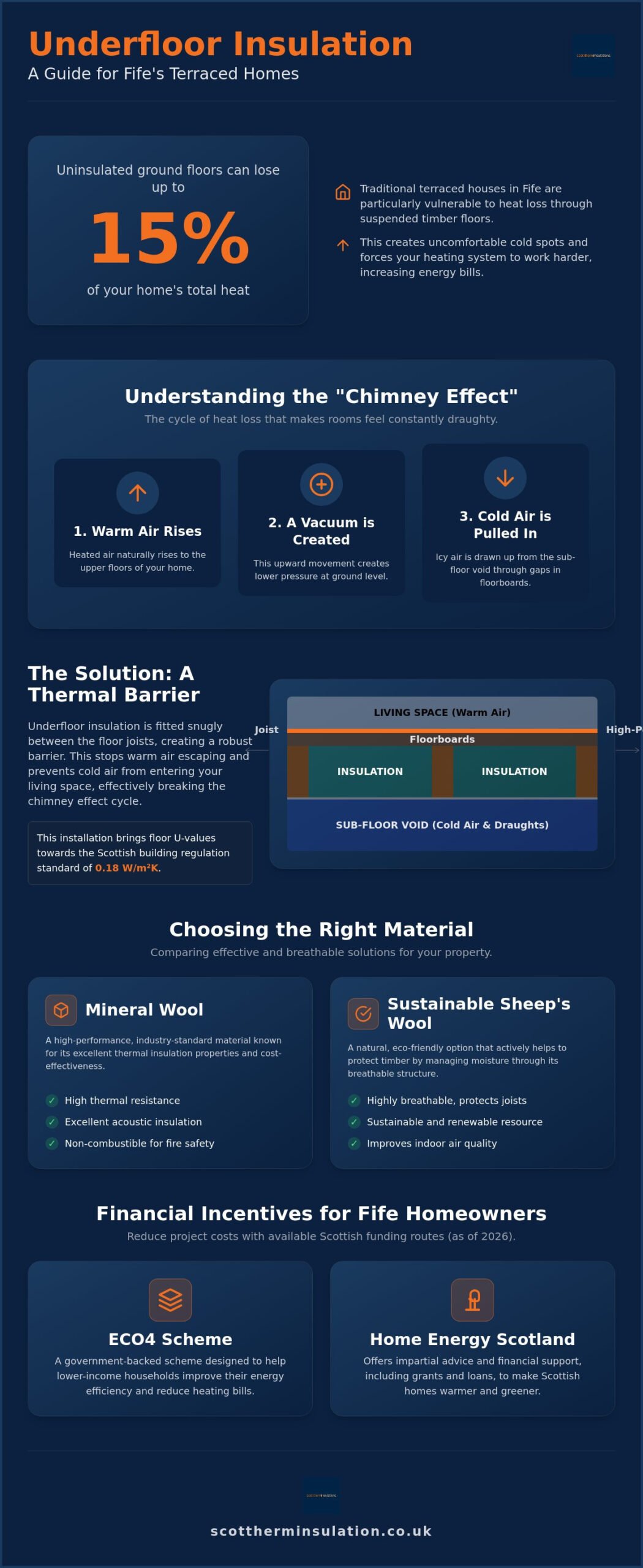
Many homeowners in Fife focus their energy efficiency efforts on the loft or windows. However, data suggests that up to 15% of a property’s heat is lost through uninsulated ground floors. In a traditional terraced house, this problem is often worsened by the “chimney effect.” As warm air rises through the upper floors, it creates a vacuum that pulls icy air through the gaps in your floorboards. This constant cycle makes your living room feel draughty, regardless of how high you set the thermostat. Investing in underfloor insulation for terraced house fife homes is the most effective way to break this cycle and create a stable indoor temperature.
Several factors contribute to this heat loss in Fife terraces:
- Large air voids beneath original timber joists that trap freezing air.
- Gaps between floorboards caused by decades of natural wood shrinkage.
- The lack of a thermal barrier between the living space and the damp earth below.
There is a distinct difference between thermal comfort and simply turning up the heating. You can heat the air in a room to 21 degrees, but if the floor surface remains at 12 degrees, your body will still feel the chill. This leads to “thermostat creep,” where you keep increasing the temperature to compensate for the cold feet, resulting in unnecessarily high energy bills.
The Problem with Suspended Timber Floors
Most Victorian and Edwardian terraces in towns like Dunfermline and Kirkcaldy feature suspended timber floors. These consist of wooden floorboards laid over joists, leaving a ventilated cavity underneath. Whilst this space is necessary for airflow to prevent rot, it often becomes a reservoir for cold air in the Scottish climate. Without a thermal barrier, this void acts like an ice pack beneath your feet. Gaps between old boards allow cold air to bypass your radiators entirely, which forces your heating system to work much harder. Applying standard building insulation principles to these floors is the only way to stop this energy drain.
Fife’s Coastal Climate and Your Home’s Thermal Performance
Fife’s coastal position brings high humidity and biting winds that penetrate older brick and stone terraces. When the wind blows off the Firth of Forth, it forces cold air into the sub-floor voids of exposed properties. Draught-proofing alone won’t solve this because it doesn’t address the thermal transfer through the wood itself. The psychological impact of “cold feet” shouldn’t be underestimated; it makes a home feel unwelcoming even when the radiators are on full. Professional underfloor insulation for terraced house fife services address both the physical heat loss and the overall comfort of your living space, ensuring your home remains a sanctuary against the elements.
How Underfloor Insulation Works in a Suspended Timber Structure
Suspended timber floors are essentially a platform of boards laid over a series of wooden joists, leaving a ventilated void beneath. To stop the heat loss discussed in the previous section, we must fill the gaps between these joists with high-performance material. The installation of underfloor insulation for terraced house fife properties typically involves securing flexible insulation batts directly between these wooden supports. If your home has a crawl space or cellar, we can often work from below. If not, we carefully lift a selection of floorboards to gain access to the cavity from above.
Once fitted, this material creates a continuous thermal envelope across your entire ground floor. It acts as a robust shield, preventing the warm air generated by your radiators from being sucked into the freezing sub-floor void. To keep the insulation in place indefinitely, we use high-strength netting or timber support laths. This prevents the material from sagging or shifting over time, which is vital for maintaining long-term thermal efficiency. By sealing these gaps, you effectively eliminate the draughts that make Fife winters feel so much colder indoors.
The Science of the Thermal Barrier
Insulation works by trapping millions of tiny air pockets, which significantly slows down conductive and convective heat loss. Following Energy Saving Trust advice ensures that the installation meets modern standards for energy conservation and home comfort. In Scotland, building regulations currently require a floor U-value of 0.18 W/m²K for new or renovated floors, which measures the rate of heat transfer through the structure. A snug fit is essential because even small gaps allow “thermal bridging,” where cold air bypasses the insulation and chills the joists directly, reducing the overall effectiveness of the project.
Protecting Your Floor Joists from Damp
Preserving the structural integrity of your Fife terrace is just as important as saving energy. Airbricks located on your external walls must never be blocked during the insulation process. These vents allow air to circulate in the void, which carries away moisture and prevents the timber from rotting. We prioritise the use of breathable materials like mineral wool or sheep’s wool because they allow moisture to pass through rather than trapping it against the wood. This professional approach to underfloor insulation for terraced house fife installations protects your home’s skeleton whilst keeping your toes warm. If you’re unsure about the current state of your sub-floor, it’s worth having a specialist assess your underfloor insulation options to ensure a safe and effective upgrade.
Choosing the Right Material: Mineral Wool vs. Sustainable Sheep’s Wool
Selecting the correct material is the most critical decision when installing underfloor insulation for terraced house fife. Whilst rigid synthetic boards are common in modern construction, they often lack the flexibility and breathability required for the irregular joist spacing found in older Scottish properties. We focus on soft-fibre solutions because they create a superior seal against draughts whilst allowing your home’s structure to “breathe.” Whether you prioritise eco-friendly credentials or budget-friendly performance, the choice between mineral wool and sheep’s wool will define the long-term comfort of your home. Both materials provide a significant upgrade over the empty, draughty voids currently sitting beneath your feet.
The Benefits of Natural Sheep’s Wool
For historic stone or brick terraces, wool insulation stands out as the premium choice. This natural fibre is uniquely suited to Fife’s coastal climate because of its moisture-regulating properties. It can absorb and release water vapour without losing its thermal efficiency, which prevents condensation from becoming trapped against your timber joists. This breathability is essential for protecting against rot in older buildings. Beyond its structural benefits, sheep’s wool is a sustainable, renewable resource that requires very little energy to produce. It also acts as a natural air purifier by absorbing indoor pollutants like formaldehyde, making it a healthy addition to any family home. The crimped nature of the wool fibres ensures the material stays springy and maintains its loft for the life of the building.
High-Performance Mineral Wool Solutions
If you are looking for a cost-effective route to warmth, mineral wool is an excellent alternative. Manufactured from molten rock or recycled glass, it is naturally non-combustible and offers the highest fire safety ratings available. This makes it a reassuring choice for terraced houses where fire protection between properties is a priority. Mineral wool batts are incredibly resilient and maintain their shape for decades, resisting pests and fungal growth amongst your floor joists. Its high density also provides significant acoustic insulation. This reduces the “echo” often found in uninsulated wooden floors and muffles the sound of footsteps between rooms. For many Fife homeowners, mineral wool provides the perfect balance of technical performance and financial value. It typically involves a lower initial outlay than natural alternatives whilst still providing a significant reduction in heat loss, allowing you to achieve a faster return on your investment through lower monthly energy bills.
The Installation Process: What Fife Homeowners Should Expect
Professional installation begins with a detailed site survey. We don’t just look at the floorboards; we examine the health of your sub-floor environment. This includes checking for existing dampness, signs of timber rot, and identifying the location of electrical cables or pipework. In many Fife terraces, these voids have remained undisturbed for decades. Ensuring the safety of your home’s infrastructure is our first priority before any material is fitted. Our local expertise allows us to identify common issues specific to the region’s housing stock, such as salt dampness in coastal towns like Anstruther or Pittenweem.
The logistics of the project depend on your property’s specific layout. If your home features a cellar or a significant crawl space, our team can often install the insulation from below. This is the least disruptive method. However, for many mid-terrace properties where access is restricted, we carefully lift a selection of floorboards. This allows us to fit the insulation between the joists from above. Our process for underfloor insulation for terraced house fife homes focuses on precision and respect for the building’s history. If you’re ready to secure your home’s thermal future, you can request a specialist survey with our Fife team today.
Lifting and Reinstating Historic Floorboards
Preserving original features is a hallmark of a professional Scottish installer. We use specialised tools to remove historic boards without splintering the timber or breaking the delicate tongues and grooves. Each board is marked and organised during the removal process. This ensures that every piece of wood returns exactly to its original position, maintaining the character and alignment of your floor. If you are planning a comprehensive energy upgrade, you might also consider our loft boarding packages to maximise your home’s storage and thermal performance simultaneously.
Timelines and Disruption Management
We understand that your home is a busy environment. A standard ground floor installation for a mid-terrace property typically takes between one and two days to complete. To prepare for our arrival, we ask that you clear the work area of smaller items and rugs. We can assist with moving larger pieces of furniture as part of our service. Our team employs a “clean-as-you-go” approach, using high-powered vacuums to remove dust and debris as we work. This minimises the impact on your daily routine and ensures your home is left tidy. Once the insulation is secured, we conduct final checks to verify that all draughts are sealed whilst ensuring your vital sub-floor airbricks remain completely unobstructed.
Maximising ROI: Costs, Grants, and Long-Term Savings in Fife
Investing in underfloor insulation for terraced house fife properties is one of the most effective ways to secure long-term financial returns. Unlike mechanical heating systems that require ongoing maintenance and electricity to run, insulation is a “set and forget” solution with zero operational costs. With the average annual energy bill in Scotland reaching £2,200, the potential for savings is significant. Research indicates that properly installed underfloor insulation can reduce heat loss through the floor by up to 79%. This directly translates into lower monthly outgoings and a home that retains its warmth for much longer after the heating is switched off.
Beyond immediate bill reductions, this upgrade significantly enhances your property’s Energy Performance Certificate (EPC) rating. Currently, 30% of homes in Scotland have an EPC rating of E or below. Improving this rating is becoming increasingly vital for homeowners, as it directly impacts property resale value and future-proofs the building against evolving energy regulations. By achieving the required Scottish building standard U-value of 0.18 W/m²K, you demonstrate to future buyers that the property is efficient, comfortable, and well-maintained.
Funding and Grants for Fife Residents
Many homeowners can offset the initial cost of installation through various insulation grants in Scotland. The national ECO4 Scotland scheme remains active until 31 December 2026, providing vital funding for households with an EPC rating of D or below who meet specific benefit criteria. Additionally, the Home Energy Scotland Grant offers up to £1,500 specifically for underfloor insulation, with optional interest-free loans available to cover remaining balances. For households with an income of £36,000 or less, the Warmer Homes Scotland scheme may even provide fully funded improvements. Navigating these options can be complex, but our team helps identify the most suitable route for your specific postcode and circumstances.
Why Choose ScotTherm for Your Fife Home?
We take pride in being a specialised local provider that understands the unique challenges of the Scottish climate. Our team doesn’t just install material; we provide a comprehensive service that respects the integrity of Fife’s traditional housing stock. We use only certified, high-performance materials like breathable sheep’s wool and fire-rated mineral wool to ensure your home remains safe and efficient for decades. Every installation is carried out by professional, local experts who prioritises domestic well-being and structural safety over quick sales. If you want to eliminate draughts and take control of your energy costs, book your specialist free insulation inspection today and discover the tangible benefits of a professionally insulated home.
Secure a Warmer, More Efficient Future for Your Fife Home
Transforming your living space starts from the ground up. By addressing the substantial heat loss through your floorboards, you can finally eliminate persistent draughts and create a home that remains comfortable regardless of the coastal winds. Selecting the most suitable underfloor insulation for terraced house fife properties ensures that your building’s structure remains protected whilst your heating costs decrease. Whether you prioritise the eco-friendly credentials of breathable sheep’s wool or the cost-effective performance of mineral wool, the long-term benefits for your comfort and property value are clear.
As ECO4 grant funding experts and specialist Scottish installers, we are committed to helping you navigate the available financial support to make these upgrades accessible. We understand the specific needs of Fife’s historic housing stock and provide the technical precision required for a lasting solution. Request your free, no-obligation underfloor insulation survey in Fife today and begin the journey toward a cosier, more sustainable home. You don’t have to settle for cold feet; professional help is just a click away.
Frequently Asked Questions
Do I need to lift all my furniture to have underfloor insulation installed?
You don’t always need to clear your entire ground floor for the installation to proceed. If your property has a crawl space or cellar with sufficient height, our team can often work from beneath the joists without disturbing your living area. For homes that require access from above, you only need to move furniture from the specific rooms being insulated. We can assist with larger items to ensure the work area is safe and accessible.
Will underfloor insulation cause my floor joists to rot?
Professional installation actually protects your joists from moisture-related issues. We use breathable materials like sheep’s wool or mineral wool that allow water vapour to pass through rather than trapping it against the wood. Our installers also ensure that your external airbricks remain completely unobstructed. This maintains the vital airflow in the sub-floor void that prevents timber rot and keeps the structure healthy.
How much can I actually save on my heating bills in a Fife terrace?
Savings vary based on your heating habits, but properly installed insulation can reduce heat loss through your floor by up to 79%. For many residents investing in underfloor insulation for terraced house fife properties, this leads to a significant reduction in monthly energy bills. The improvement in your home’s Energy Performance Certificate (EPC) rating also adds tangible value if you decide to sell your property in the future.
Is sheep’s wool insulation better than mineral wool for old houses?
Sheep’s wool is often considered the premium choice for older stone or brick terraces due to its superior breathability. It has a unique ability to absorb and release moisture without losing its thermal efficiency, which is ideal for Fife’s humid coastal climate. Whilst mineral wool is an excellent, fire-resistant alternative, sheep’s wool provides an extra layer of protection for historic timbers by regulating sub-floor humidity naturally.
Can I get a grant for underfloor insulation in Fife under the ECO4 scheme?
Yes, many homeowners qualify for funding through the ECO4 scheme, which is active until December 2026. This is a common route for underfloor insulation for terraced house fife residents to reduce or eliminate the cost of installation. To be eligible, your property must typically have an EPC rating of D or below, and a member of the household must be in receipt of a qualifying benefit.
How long does the installation take for a standard terraced house?
A standard ground floor installation for a mid-terrace property usually takes between one and two days. This timeframe includes the initial safety survey, the fitting of the insulation batts, and the careful reinstatement of any lifted floorboards. We use a clean-as-you-go approach to ensure your home remains tidy and to minimise any disruption to your household’s daily routine.
Does underfloor insulation help with noise reduction between rooms?
Underfloor insulation provides noticeable acoustic benefits alongside its thermal properties. The high density of soft-fibre materials like mineral wool helps to dampen the hollow “drum” effect often associated with original timber floorboards. This reduces the sound of footsteps and muffles noise transfer, creating a quieter and more peaceful environment on your ground floor.
What happens to the cables and pipes under my floorboards?
Our installers conduct a thorough survey of all electrical cables and pipework before any material is fitted. We carefully cut the insulation to fit around these services, ensuring they remain accessible for future maintenance. We follow strict building regulations regarding electrical cables to ensure they are not compressed or covered in a way that could lead to overheating.