
Did you know that from 31 October 2026, a standard EPC in Scotland will only be valid for five years instead of ten? This change, alongside the introduction of the new Heat Retention Rating, means that many homeowners are suddenly facing a stricter set of energy standards. Keeping a home warm in our unique Scottish climate is a constant battle against rising costs and damp, particularly if you own a traditional stone property or an older build. It’s understandable to feel concerned about how these evolving regulations might affect your property’s value or your ability to let it out in the future.
The good news is that improving epc rating scotland doesn’t have to be a confusing or overwhelming process. By prioritising the building fabric over complex mechanical upgrades, you can create a cosy, cost-effective environment that stands the test of time. In this 2026 guide, we’ll show you how insulation-led strategies like loft and underfloor upgrades can help you reach the crucial Band C target before the 2028 deadlines. You’ll discover the most effective ways to lower your energy bills whilst ensuring your home remains a safe, certified, and high-value asset for years to come.
Key Takeaways
- Understand how the 2026 transition to a five-year validity period and the new Heat Retention Rating change the landscape for improving epc rating scotland.
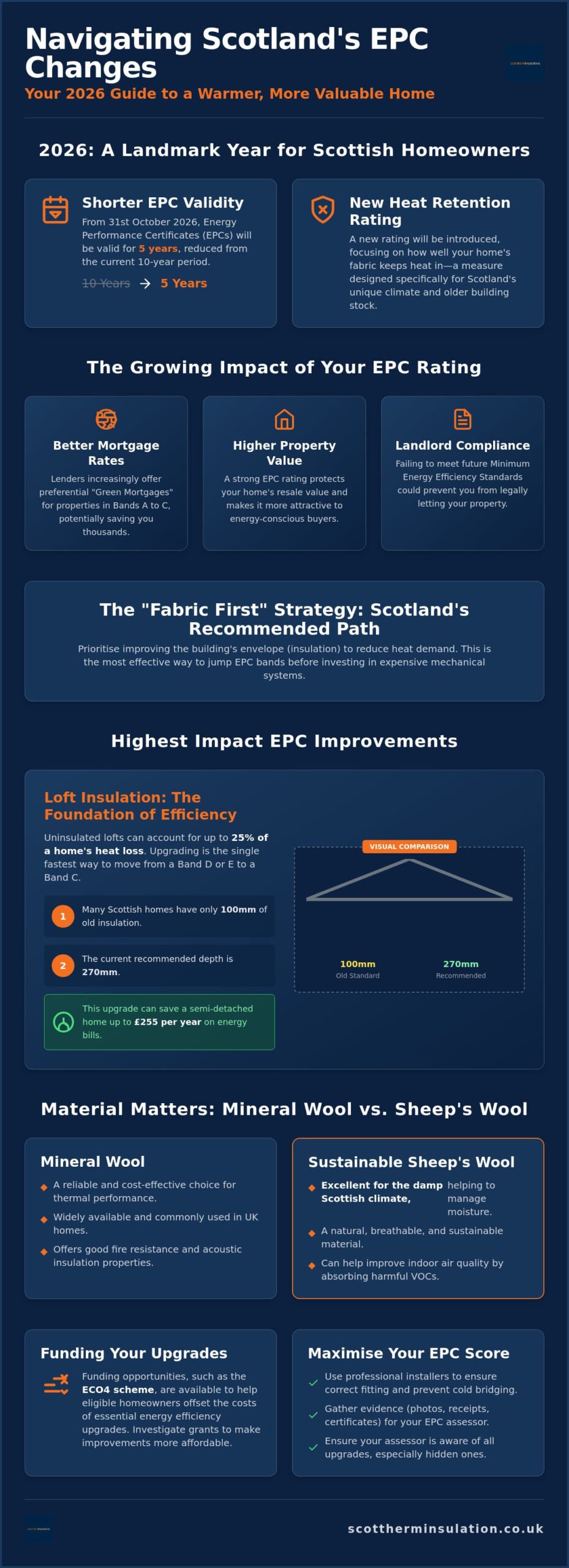
- Learn why a “fabric first” approach, such as upgrading loft insulation to the recommended 270mm depth, is the most reliable way to jump rating bands.
- Compare the benefits of mineral wool and sustainable sheep’s wool to determine which material best protects your property from the damp Scottish climate.
- Identify the latest 2026 funding opportunities, including the ECO4 scheme, to help offset the costs of essential energy efficiency upgrades.
- Recognise the importance of professional verification and evidence-gathering to ensure your insulation upgrades translate into the highest possible EPC points.
Understanding EPC Ratings in Scotland: Why 2026 is a Landmark Year
An Energy Performance Certificate is a document that records how energy efficient your property is. Most homeowners recognise the A to G rating scale, but few realise that Energy Performance Certificates (EPCs) actually calculate the predicted energy cost per square metre. This figure determines your band, which directly impacts your monthly outgoings and your home’s market appeal. It’s the primary benchmark used to compare the running costs of a modern flat in the Central Belt against a traditional cottage in the Highlands.
For anyone prioritising improving epc rating scotland, 2026 is the year the rules change. The Scottish Government has set ambitious targets for all domestic properties to reach a minimum of Band C. From 31 October 2026, new certificates will only be valid for five years instead of ten, and a new Heat Retention Rating (HRR) will be introduced. These changes reflect the unique challenges of our climate. Colder temperatures and older building stock, such as traditional Edinburgh tenements or Fife stone cottages, require a different approach to energy efficiency than properties in the south of the UK.
How the EPC Assessment Works in Scotland
The assessment relies on the Reduced Data Standard Assessment Procedure (RdSAP). This methodology allows surveyors to estimate the performance of a building without needing to tear into the walls. The assessor records specific data points, including the age of the property, the type of wall construction, and the current depth of your loft insulation. They also examine your primary heating source and glazing. You can always check your property’s current status and history by visiting the official Scottish EPC Register.
The Consequences of a Low EPC Rating
The impact of a low rating is increasingly financial. Lenders are now offering preferential rates on “Green Mortgages” for homes in Bands A to C. A poor rating could cost you thousands in interest over the life of your loan. Investing in improving epc rating scotland is no longer optional for those looking to protect their property’s resale value or secure better lending terms. For landlords, failing to meet upcoming Minimum Energy Efficiency Standards could prevent you from re-letting your property entirely. Beyond the legalities, a Band D or E rating is a primary driver of fuel poverty in the Central Belt, where high heating demands meet inefficient building fabrics.
The Insulation First Strategy: Highest Impact EPC Improvements
While many property guides suggest switching lightbulbs as a priority, the most effective path for improving epc rating scotland is a “fabric first” approach. This strategy focuses on the building’s envelope, ensuring heat stays inside before you invest in expensive mechanical upgrades. According to official Scottish Government guidance, prioritising the building fabric is essential for meeting the 2028 and 2033 targets. By reducing the overall demand for heat, you naturally lower energy costs and boost your rating more significantly than almost any other measure.
Uninsulated lofts can be responsible for up to 25% of a home’s heat loss. Addressing this is often the fastest way to move a property from a Band D or E into a comfortable Band C. However, the impact of insulation goes beyond the roof. In the unique Scottish climate, addressing draughts from below and heat loss through sloping ceilings is equally vital for a high-performing home.
Loft Insulation: The Foundation of Thermal Efficiency
Loft insulation remains the bedrock of energy efficiency. Many Scottish homes still rely on just 100mm of old material, which falls far short of the current recommended 270mm depth. Upgrading to this standard can save a semi-detached home up to £255 per year on energy bills. Professional installation ensures that critical details, such as insulating the loft hatch and preventing cold bridging at the eaves, are managed correctly. These small details often make the difference between gaining a few points and jumping an entire EPC band.
Underfloor Insulation: Stopping the Scottish Draught
Edinburgh tenements and Stirling cottages are frequently built with suspended timber floors. These structures often act like a giant vent, pulling cold air from the crawl space into your living areas. Installing under floor insulation between the joists creates a continuous thermal barrier. This process significantly improves your EPC score and eliminates the “cold feet” feeling common in older properties. It’s a high-impact upgrade that delivers immediate physical comfort alongside financial savings.
Room in Roof: Insulating the Sloping Ceilings
Traditional loft insulation is ineffective for homes with converted attics. These room-in-roof configurations feature sloping ceilings, often called “skeilings,” which are notorious cold spots. Insulating these areas requires specialist techniques to maintain necessary airflow whilst preventing heat from escaping through the roof. Professional installation is vital for these spaces. DIY attempts in confined attic areas often lead to poor coverage or condensation risks, which can negatively affect your EPC assessment. You can explore our range of specialist insulation services to see how these targeted upgrades protect your home’s structural integrity and thermal performance.
Material Matters: Mineral Wool vs Sustainable Sheep’s Wool
Choosing the right material is a critical step in improving epc rating scotland. Whilst the standard assessment primarily measures thermal resistance, it doesn’t always account for how a material handles the North Sea dampness or the unique needs of a 19th-century tenement. To achieve a lasting Band C rating, you must select an insulation type that balances cost, thermal performance, and the structural health of your property. The two most prominent contenders in the Scottish market are mineral wool and sheep’s wool, each offering distinct advantages depending on your building type.
Mineral wool is the most common choice for modern lofts and room-in-roof applications. It offers excellent thermal performance and is naturally fire-rated, making it a safe and reliable option for residential use. For homeowners looking for a cost-effective way to reach the recommended 270mm depth, mineral wool provides a straightforward solution. It’s a proven material that delivers the R-values required to satisfy EPC assessors and lower energy bills immediately.
However, for those looking for a premium, environmentally responsible alternative, sheep’s wool is often considered the gold standard. It matches the thermal efficiency of synthetic fibres whilst offering superior moisture management and durability. In our specific climate, these natural properties can be the difference between a successful upgrade and a costly mistake.
Why Breathability is Vital for Scottish Homes
Traditional stone properties, common across Edinburgh, Stirling, and Fife, were designed to be vapour-permeable. Using non-breathable materials in these structures can trap moisture within the walls or roof space, leading to interstitial condensation. This hidden damp can rot timbers and degrade stone over time. This is where wool insulation becomes invaluable. It manages moisture levels naturally, protecting the structural integrity of the building whilst improving indoor air quality. By reducing the risk of mould, you create a healthier living environment that feels warmer and stays drier.
Performance and Sustainability
Sustainability is a major factor for the modern homeowner. Mineral wool has a higher carbon footprint due to the intensive heat required during its manufacturing process. In contrast, sheep’s wool is a carbon-sequestering material that is fully biodegradable and renewable. Both materials meet strict fire safety standards, but sheep’s wool offers a unique advantage in our humid environment. Sheep’s wool can absorb up to 33% of its weight in moisture without losing its insulating power. This ensures that even during a particularly wet Scottish winter, your home’s thermal barrier remains effective. This resilience is a key component in improving epc rating scotland for the long term, ensuring your investment continues to deliver value for decades.
Funding and Grants: How to Pay for Your EPC Upgrades
The financial cost of thermal upgrades is a primary concern for many homeowners, but the 2026 landscape offers several robust funding routes. Whether you’re a landlord preparing for the 2028 regulations or a resident struggling with Central Belt heating costs, understanding these options is the first step toward improving epc rating scotland. Accessing these funds requires working with certified professionals, ensuring that every installation meets the rigorous standards demanded by official bodies.
Current policy focuses on a “fabric first” methodology. This means that government-backed schemes prioritise insulation measures that provide long-term value before considering heating system changes. By securing a grant or interest-free loan now, you can insulate your property against future energy price hikes whilst significantly boosting your EPC band.
ECO4 Scotland: Targeted Support for Low-Income Households
The Energy Company Obligation (ECO4) scheme is a major pillar of support, set to run until December 2026. This initiative targets households with a low EPC rating (typically D to G) who are in receipt of qualifying benefits. Unlike previous iterations, ECO4 utilises a “Whole House” approach. This means the scheme doesn’t just fund a single measure; it looks at the property holistically to provide a combination of loft, underfloor, or room-in-roof insulation to achieve the maximum possible band jump. You can check your eligibility and start the application for ECO4 Scotland through accredited partners who understand the specific requirements of the Scottish housing stock.
Home Energy Scotland: Support for All Homeowners
For those who don’t qualify for ECO4, Home Energy Scotland (HES) remains the primary funding route. HES provides a mix of grants and interest-free loans designed to make thermal improvements accessible to a wider demographic. Whilst the largest grants are currently focused on heat pump transitions, significant support remains for essential insulation measures. Homeowners and registered private landlords can access fixed-sum grants for loft and underfloor projects, often supplemented by optional interest-free loans to cover any remaining balance.
Navigating these applications can be complex, but it’s vital to secure your funding before starting any works. To ensure your project qualifies, you must use installers who carry TrustMark or MCS accreditation. This certification acts as a badge of reliability, guaranteeing that the work is safe and effective. If you’re ready to explore your options, you can check insulation grants Scotland to see which programmes align with your property’s needs. Taking action now allows you to benefit from the current 0% VAT rate on energy-saving installations, which is scheduled to remain in place until 31 March 2027.
If you want to know if your home qualifies for these upgrades, contact our specialist team today for expert guidance on the latest Scottish funding criteria.
Maximising Your EPC Score: Professional Installation and Verification
Precision is paramount when you are finalising your strategy for improving epc rating scotland. Whilst the materials you choose are vital, the quality of the installation and the subsequent verification process determine whether those upgrades actually translate into a higher band on your certificate. An EPC assessment is a data-driven exercise. If the assessor cannot see or verify the improvements you have made, they are often forced to use “standard assumptions” based on the age of your property, which rarely reflect the true thermal performance of a modernised home.
Professional installation bridges the gap between theoretical savings and actual results. At ScotTherm Insulation, we ensure that every project is documented with the level of detail required by RdSAP surveyors. This includes high-resolution photographs of the install, technical specification sheets for the materials used, and formal receipts. This evidence pack allows your assessor to override default values, ensuring your property receives every single point it deserves.
The Pitfalls of Improper Installation
Many homeowners attempt DIY loft insulation to save on initial costs, but improper fitting often leads to long-term structural issues. One of the most common mistakes is blocking eaves ventilation. In the damp Scottish climate, a lack of airflow in the roof space leads to interstitial condensation and, eventually, roof rot. Furthermore, gaps in the insulation layer are devastating to efficiency. Industry data suggests that even a 10% gap in insulation coverage can reduce overall thermal performance by as much as 50%. Professional installers focus on maintaining continuity and airtightness, ensuring that the thermal envelope is complete and your investment is protected.
Preparing for Your EPC Assessment
Organising your documentation is the final step in the process. Because much of your insulation—such as underfloor or room-in-roof materials—is “unseen” once the work is finished, the assessor needs proof of what lies beneath the surface. Beyond the insulation itself, you can secure a few “small wins” to pair with your thermal upgrades. Ensure that 100% of your fixed lighting uses LED bulbs and that any hot water cylinders are fitted with a modern, thick insulating jacket. These minor additions, whilst inexpensive, can sometimes provide the final few points needed to move from a high Band D to a solid Band C.
A post-installation survey is often the best way to verify that your home is performing as expected before the official EPC surveyor arrives. This proactive approach identifies any remaining draughts or cold spots that could negatively impact your score. If you are ready to secure your property’s future value, book your specialist free insulation inspection with ScotTherm today. Our team will help you identify the most effective path to a warmer, more efficient home that fully complies with the upcoming 2026 and 2028 Scottish standards.
Secure Your Property’s Thermal Future
The 2026 regulatory changes represent a significant shift for Scottish homeowners, but they also provide a clear roadmap for protecting your property’s value. By adopting a fabric first strategy and prioritising high-impact upgrades like loft and underfloor insulation, you can stay ahead of the 2028 targets whilst slashing your energy costs. It’s about moving beyond simple lighting changes to address the core efficiency of your home’s structure.
Improving epc rating scotland is a technical process that demands precision and verified expertise. As TrustMark Accredited Installers specialising in Scottish building archetypes, we provide the professional documentation and high-quality materials, such as breathable sheep’s wool, needed to satisfy even the strictest assessors. Book your free, no-obligation insulation survey with ScotTherm Insulation today to start your journey toward a warmer, more efficient home. You have the tools and the funding routes to make a lasting impact; now is the time to act. Your home will be more comfortable, and your finances will be better protected for the long term.
Frequently Asked Questions
How much can insulation improve my EPC rating in Scotland?
Insulation can significantly boost your score, often jumping one or two bands depending on your starting point. By reducing the heat demand of the building fabric, you lower the predicted energy cost per square metre. This reduction is the primary factor in improving epc rating scotland, as it targets the most significant source of heat loss in the home.
Will loft insulation alone get my home to a Band C?
Loft insulation is a powerful upgrade, but it might not reach Band C on its own if your property starts at a low D or E. Most Scottish homes require a combination of measures to reach the 2028 targets. Pairing roof work with underfloor or room-in-roof insulation creates a more effective thermal barrier that helps secure those higher points.
Is sheep’s wool insulation better than mineral wool for EPC ratings?
Both materials provide high thermal resistance, but they serve different building needs. Mineral wool is a cost-effective, fire-rated industry standard for modern builds. Sheep’s wool is often superior for traditional stone properties because it manages moisture naturally. It can absorb up to 33% of its weight in water without losing performance, protecting the structure whilst maintaining a high score.
Can I get free insulation in Scotland in 2026?
Yes, fully funded insulation is available through the ECO4 scheme until December 2026 for qualifying households. This programme targets residents on qualifying benefits who live in properties with an EPC rating between D and G. It provides a comprehensive “Whole House” solution, meaning you could receive multiple insulation types at no cost to you.
How long does a professional insulation installation take?
Most domestic insulation projects, such as a standard loft or underfloor installation, are completed within a single day. Larger properties or complex room-in-roof configurations might take slightly longer. Our team focuses on efficiency and minimal disruption, ensuring your home is warmer and more energy-efficient by the time we leave.
Do I need a new EPC certificate immediately after insulating?
You aren’t legally required to get a new certificate immediately unless you’re planning to sell or let the property. However, commissioning a fresh assessment is highly recommended to verify your improvements. This updated document is essential for accessing “Green Mortgages” or proving compliance with the upcoming 2028 rental regulations.
What building types in Scotland are most difficult to improve?
Traditional stone-built tenements and cottages are often the most challenging due to their need for breathable materials. These properties frequently feature sloping ceilings that require specialist room-in-roof techniques. Successfully improving epc rating scotland for these older archetypes requires a deep understanding of local building methods to avoid long-term damp issues.
Does underfloor insulation really make a difference to my energy bills?
Underfloor insulation makes a massive difference, particularly in older homes with suspended timber floors. It stops cold air from being drawn up through the floorboards, which is a common problem in Edinburgh and Stirling. By creating a continuous thermal barrier, you reduce the workload on your heating system and lower your annual bills significantly.