
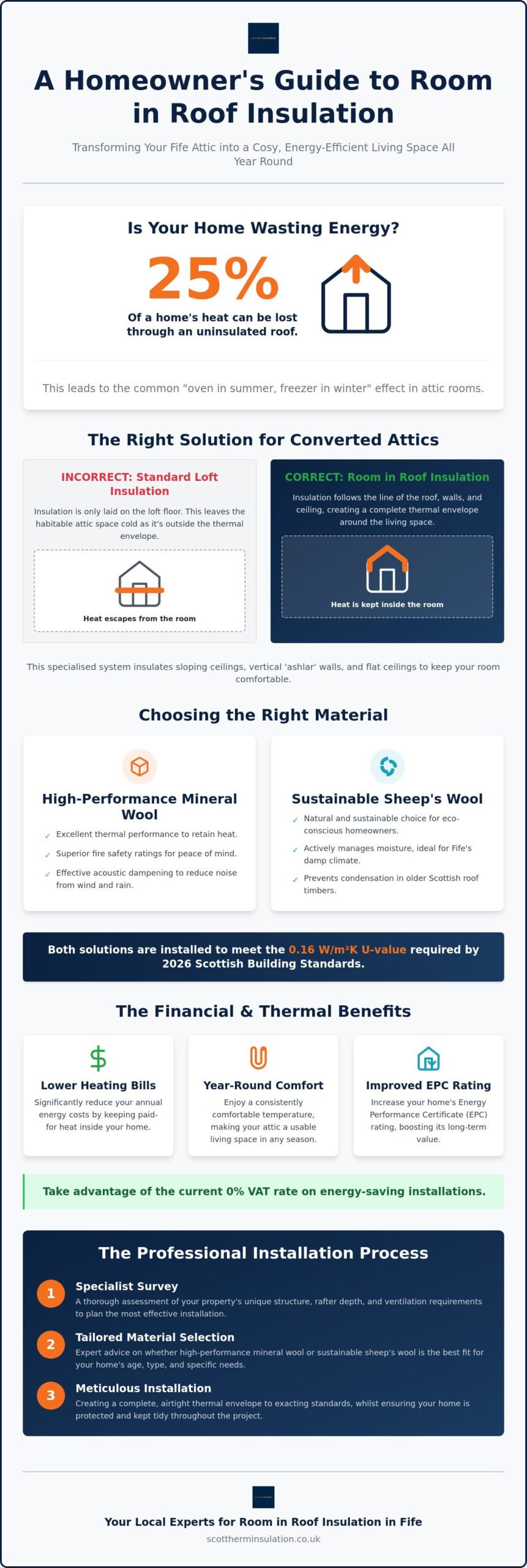
Did you know that up to 25% of your home’s heat is currently escaping straight through your roof? For many homeowners across the Kingdom, this isn’t just a statistic; it’s the reason why that top-floor bedroom feels like an icebox in January and a greenhouse in July. Investing in professional room in roof insulation Fife is the most effective way to reclaim that space and stop your hard-earned money from vanishing into the Scottish sky.
It’s frustrating to pay for heating that doesn’t stay where you need it, especially when standard loft rolls don’t address the complex slopes and dormer walls of a converted attic. You deserve a home that remains comfortable throughout the seasons without the constant worry of rising energy costs. This guide shows you how modern insulation techniques can transform your attic into a cosy, year-round living area whilst significantly lowering your annual heating bills.
We will examine the latest 2026 Scottish Building Standards, the performance of materials like sheep’s wool and mineral wool, and how the current 0% VAT rate on energy-saving installations makes this the ideal time to secure long-term value for your property.
Key Takeaways
- Learn how professional room in roof insulation fife transforms cold attic rooms into warm living spaces whilst complying with 2026 Scottish Building Standards.
- Compare the benefits of high-performance mineral wool against sustainable sheep’s wool to determine the most effective thermal material for your property.
- Understand how specialist insulation significantly reduces annual heating bills and improves your home’s Energy Performance Certificate (EPC) rating.
- Discover the professional installation process, including the importance of specialist surveys and protecting your home during the project.
- Identify why regional expertise is vital for navigating Fife’s unique housing requirements and ensuring long-term energy efficiency.
What is Room in Roof Insulation and Why Does Your Fife Home Need It?
Room in roof insulation refers to a specialised system designed for attic rooms reached by a fixed staircase. Unlike a standard “cold loft” where insulation sits on the floor to protect the rooms below, a room-in-roof setup treats the attic itself as a habitable thermal zone. In Fife, many traditional 1.5-storey homes and stone-built cottages suffer because their original construction didn’t account for modern energy standards. This leaves homeowners with draughty dormers and sloping ceilings that offer almost no resistance to heat loss. Investing in room in roof insulation Fife is the most effective way to turn these often neglected spaces into comfortable, energy-efficient living areas.
The primary challenge in these properties is the “oven in summer, freezer in winter” effect. Without a robust thermal barrier, the sun’s rays beat directly onto the roof tiles, overheating the room in July. Conversely, as soon as the heating goes off in January, the warmth rises and vanishes through the uninsulated roof. Effective Building insulation must also address the concept of thermal bridging. This occurs when heat bypasses insulation through structural elements like rafters or timber studs. By installing a continuous thermal layer, we ensure that heat stays inside during the winter and is kept out during the warmer months.
Identifying the ‘Room in Roof’ Structure
A functional attic room consists of several distinct sections: the sloping ceilings that follow the roofline, the vertical stud walls (often called ashlar walls), and the small flat ceiling at the very top. Standard loft rolls are designed for horizontal surfaces and simply cannot provide the necessary coverage for these vertical and angled planes. Gravity causes loose rolls to slump over time, leaving gaps that let heat escape. We focus on insulating the “residual” loft spaces behind the ashlar walls to create a complete, airtight thermal envelope that keeps the entire room warm.
The Impact of Fife’s Climate on Roof Spaces
Fife’s unique geography, stretching from the coastal winds of St Andrews to the damp inland areas near the Lomond Hills, presents specific challenges for property maintenance. Wind-driven rain and high humidity can penetrate the building fabric, making breathable insulation solutions essential to prevent moisture buildup. A correctly installed system ensures that insulation prevents condensation in older Scottish roof timbers by managing moisture transfer effectively and protecting the structural integrity of your home.
Choosing the Right Materials: Mineral Wool vs Sustainable Sheep’s Wool
Selecting the correct material for your room in roof insulation fife project involves balancing thermal performance against the physical constraints of your attic. Unlike the open space of a standard loft, attic rooms often have shallow rafters where every millimetre of headroom counts. At ScotTherm Insulation, we prioritise certified materials that help homeowners reach the 0.16 W/m²K U-value required under current Scottish Building Standards. Our installations follow official UK government best-practice guidance to ensure long-term structural safety and efficiency.
Beyond simple heat retention, you must evaluate how materials behave regarding fire safety and acoustic dampening. Living directly beneath the roof tiles means you are closer to the noise of wind and rain; a high-density material can significantly reduce this sound transfer. ScotTherm Insulation ensures all products meet rigorous fire-retardant standards, providing a secure environment for top-floor bedrooms. The choice of material ultimately dictates how much internal space is preserved whilst achieving maximum warmth.
The Benefits of Sustainable Sheep’s Wool
For those prioritising natural solutions, wool insulation is an exceptional choice for traditional Fife properties. Its unique ability to manage moisture is a natural defence against the damp conditions often found in older Scottish roofs. Sheep’s wool can absorb and release water vapour without compromising its thermal properties, which helps maintain a healthy timber structure. It represents a renewable, low-carbon alternative that aligns with modern environmental goals.
Mineral Wool: A Proven Thermal Performer
Mineral wool remains a staple in the industry due to its proven cost-effectiveness and high thermal resistance. It is naturally non-combustible, adding a vital layer of fire protection to the timber frames of a converted attic. Because the material is flexible, our installers can pack it tightly into irregular gaps between rafters, effectively eliminating the thermal bridges mentioned previously. If you are considering an upgrade, you can explore our specialist insulation services to determine which material best suits your property’s specific rafters.
The Financial and Thermal Benefits of Professional Insulation
Heating an uninsulated attic is expensive. According to the Energy Saving Trust, you can save up to £230 a year by properly insulating your roof space. In Fife, where coastal winds can strip heat from a building in minutes, these savings are often even more pronounced. By installing high-quality room in roof insulation fife, you stop the 25% of heat that typically escapes through an unprotected roof. This isn’t just a short-term fix; it’s a permanent upgrade to your home’s financial and thermal performance.
Improving your home’s thermal efficiency directly boosts its Energy Performance Certificate (EPC) rating. This is particularly vital for Fife landlords, as Scottish regulations now require a minimum Band C for new tenancies by 2026. A better rating doesn’t just satisfy legal requirements; it increases the market value of your property. Homes that are cheaper to run and more comfortable to live in are naturally more attractive to future buyers. You also play a role in reducing the 21% of UK CO2 emissions that originate from domestic energy waste.
Improving Home Comfort and Usability
Professional insulation eliminates the frustrating cold spots and draughts that make many attic rooms unusable. It creates a consistent temperature throughout the year. The acoustic benefits are equally important for top-floor living. High-performance materials dampen the sound of rain and wind on the roof tiles. This acoustic barrier transforms a noisy attic into a quiet, productive space for a home office or a peaceful bedroom. You gain a fully functional room that feels like a solid, integrated part of the house.
Grant Funding and Financial Support in Fife
The initial cost of upgrading your home can be offset by various government initiatives. The ECO4 Scotland scheme provides significant support for eligible households to improve their energy efficiency. Additionally, insulation grants Scotland offers funding to help homeowners meet the latest building standards. Even for those who don’t qualify for specific grants, the 0% VAT rate on energy-saving materials remains in effect until March 2027. The long-term reduction in monthly bills ensures a strong return on investment for every Fife resident.
The Professional Installation Process: What Fife Homeowners Should Expect
Every successful project begins with a comprehensive specialist survey to evaluate the structural integrity of your roof timbers. Our experts don’t just look at the space; they identify existing ventilation pathways and check for any signs of dampness that could compromise the project. This technical assessment ensures the design for your room in roof insulation fife installation is perfectly tailored to your home’s unique geometry. By identifying potential issues before the first roll of material arrives, we ensure that the thermal upgrade builds upon a healthy, stable foundation.
Once the project begins, our primary focus is the protection of your living space. We use industrial-grade floor protection and dust sheets to safeguard your carpets and furniture from debris. The installation itself involves fitting high-performance insulation boards or mineral wool rolls into the sloping ceilings and ashlar walls. A critical technical requirement is the maintenance of a 50mm air gap between the insulation material and the roof tiles. This gap allows for constant rafter ventilation, which is essential for preventing timber rot in the damp Fife climate. We finish the process by fitting insulated plasterboard or applying a fresh coat of plaster, leaving the room ready for you to decorate.
Minimising Disruption During Your Project
We understand that having tradespeople in your home can be intrusive. The ScotTherm Insulation teams organise their work schedules to minimise the impact on your daily routine. A typical room-in-roof project in Fife is usually completed within three to five working days. Our accredited installers are known for their disciplined approach and commitment to cleanliness. They ensure that all waste is removed and the work area is thoroughly cleaned at the end of every shift, providing you with a stress-free experience from start to finish.
The Importance of Proper Ventilation
Installing insulation without considering airflow is a significant risk for Scottish properties. An “over-insulated” roof that lacks ventilation will trap moisture, leading to condensation and eventual structural damage. ScotTherm Insulation uses specialised roof vents and breathable membranes to protect the building fabric whilst keeping the heat inside. This balance between thermal retention and moisture management is vital for the longevity of your home. You can have confidence in our work, as all our installs strictly adhere to current UK building regulations. If you want to ensure your attic is both warm and structurally sound, contact our team for a professional assessment of your roof’s requirements.
Why Choose ScotTherm Insulation for Your Room in Roof Project in Fife?
Choosing a partner for your home improvement project requires confidence in their technical ability and their understanding of the local landscape. ScotTherm Insulation brings a wealth of regional expertise to every project, particularly when navigating the diverse housing stock found throughout the Kingdom. We don’t just apply a one-size-fits-all solution; we recognise the specific requirements of Fife’s traditional stone cottages and modern 1.5-storey builds. Our status as a specialized local expert means we prioritise the long-term thermal health of your property over quick, high-volume installations. By focusing on quality and precision, we ensure your room in roof insulation fife project delivers the comfort you expect.
Our team consists of certified, professional installers who take pride in their tangible impact on the local community. We maintain a dual identity as both a primary service expert and a collaborative industry leader, often working alongside other high-tier professionals to ensure every installation meets rigorous safety standards. This disciplined approach guarantees that the technical proficiency we bring to your attic space is matched by a high level of domestic care. We are committed to using premium materials that provide lasting value, ensuring that your investment translates into a warmer, more energy-efficient home for decades to come.
Local Expertise You Can Trust
Our presence across Fife, from the historic centre of Dunfermline to the coastal reaches of St Andrews, allows us to provide a level of accountability that national firms simply cannot match. There is a unique peace of mind that comes from using a local, specialist contractor who understands the specific challenges of the Scottish climate. We rely on a verified history of success and high standards of social proof to build trust with our clients. When you work with ScotTherm Insulation, you’re choosing a team that is rooted in your region and dedicated to its environmental responsibility.
Take the Next Step Toward a Warmer Home
The journey from a draughty, unusable attic to a cosy living space is straightforward when you have the right guidance. We invite you to begin this transformation by requesting a specialist survey to identify your property’s specific thermal needs. Our structured process ensures that every phase, from the initial inspection to the final finish, is handled with absolute professionalism. Book your specialist free insulation inspection with ScotTherm Insulation today.
Secure Your Home’s Thermal Future in Fife
Reclaiming your attic space shouldn’t be a source of stress. By choosing the right materials and ensuring professional ventilation, you transform an unusable room into a comfortable, year-round living area. We’ve seen how high-performance solutions like sustainable sheep’s wool and mineral wool don’t just stop heat loss; they provide a quieter, more stable environment for your family whilst protecting the structural integrity of your roof.
Our team at ScotTherm takes pride in being TrustMark Registered Installers and specialists in Scottish housing types. We combine technical proficiency with a deep understanding of local building requirements to deliver lasting value. Investing in professional room in roof insulation fife is a proactive step toward lower energy bills and a significantly reduced carbon footprint. We’re ready to help you navigate the process with expertise in sustainable sheep’s wool and a commitment to quality craftsmanship.
Don’t let another winter pass with a cold attic and rising costs. Request Your Free Room in Roof Insulation Survey today and take the first step toward a cosier, more efficient home.
Frequently Asked Questions
What exactly is room-in-roof insulation?
Room-in-roof insulation is a specialised system designed for attic rooms accessed by a fixed staircase. It creates a complete thermal barrier by insulating the sloping ceilings, vertical stud walls, and the small flat ceiling at the top of the room. Unlike standard loft insulation that sits on the floor, this method ensures the living space itself remains warm. it’s essential for converting a draughty attic into a functional, energy-efficient room.
How much floor space will I lose when insulating my attic room?
Space loss is typically minimal and depends on the specific material thickness required to meet building standards. When installing room in roof insulation fife, high-performance insulation boards or dense wool rolls are fitted between or over the rafters. Whilst some internal dimensions may reduce by a few centimetres, the trade-off is a significantly more comfortable and usable living environment throughout the year.
Can I get a grant for room-in-roof insulation in Fife?
Yes, several funding options are available for eligible homeowners across the region. The ECO4 scheme and the Great British Insulation Scheme both provide grants for energy-efficient improvements until March 2026. Eligibility often depends on your household income, benefits status, and the current EPC rating of your property. We recommend a professional assessment to determine which specific funding routes apply to your home’s needs.
How long does the installation process typically take?
A standard installation typically takes between three and five working days to complete. The exact timeframe depends on the size of the room and the complexity of the roof structure. Our teams prioritise efficiency to minimise disruption to your home life. This period includes the initial preparation, the fitting of thermal materials, and the final finishing of the walls and ceilings to a professional standard.
Will I need to move out of my house during the work?
You won’t need to move out during the installation process. The work is contained within the attic space, and our installers take great care to protect the rest of your home with dust sheets and floor coverings. We maintain a clean and professional workspace to ensure your daily routine remains as normal as possible. Access is usually only required through the existing staircase leading to the room.
What is the best material for insulating a sloping ceiling?
High-performance mineral wool and sustainable sheep’s wool are both excellent choices for sloping ceilings. Mineral wool offers exceptional fire resistance and thermal density, whilst sheep’s wool provides natural breathability that protects older roof timbers from moisture. The best choice often depends on your property’s age and your personal preference for sustainable materials. Both options ensure a tight fit between rafters to eliminate draughts.
Does room-in-roof insulation help with noise reduction?
Yes, professional insulation significantly improves acoustic comfort within the attic. The added density of materials like mineral wool acts as a sound barrier, dampening the noise from heavy rain, wind, and external traffic. This creates a much quieter environment, which is particularly beneficial if you use your attic as a bedroom or a home office. It transforms the acoustic quality of the space along with its temperature.
How do I know if my attic room is already insulated?
You can often tell by the temperature of the room during extreme weather. If the space feels exceptionally cold in winter or hot in summer, it likely lacks adequate room in roof insulation fife. You might also check for insulation by looking behind the small access doors to the ashlar walls or checking your property’s EPC report. A specialist survey provides the most accurate assessment by checking the depth and condition of existing materials.