
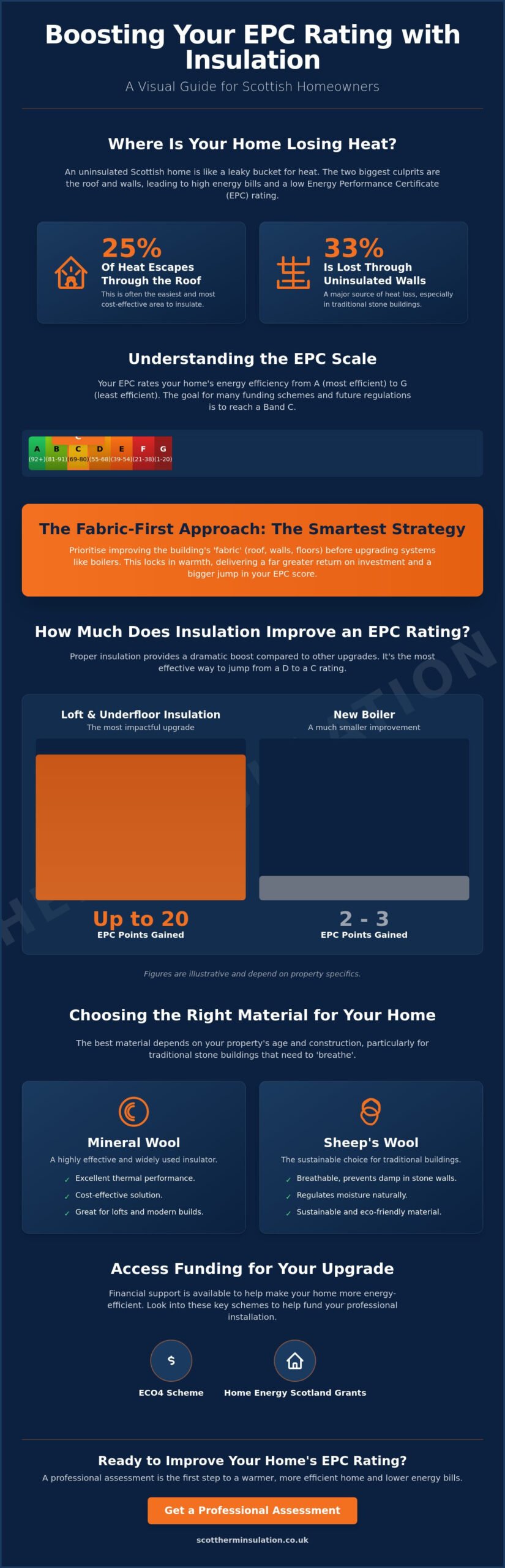
Did you know that an uninsulated home loses roughly 25% of its heat through the roof, and another third through its walls? In our cold Scottish climate, this isn’t just a comfort issue; it’s a financial drain that leaves many homeowners asking how much does insulation improve epc rating scotland. You’re likely tired of watching heating bills rise whilst wondering which upgrades actually move the needle on your certificate. It’s frustrating to face confusing regulations and the fear that modern materials might cause dampness in your traditional stone property.
We understand that you want a warm, cost-effective home that meets modern standards without compromising its structural integrity. By adopting a fabric-first approach using high-quality materials like sheep’s wool or mineral wool, you can strategically boost your rating by up to 20 points. This guide outlines a clear roadmap to reach a C rating, helping you access available Home Energy Scotland grants and lower your monthly outgoings. We’ll explore how specific solutions like loft and underfloor insulation provide the best return on investment for your home’s long-term value and your peace of mind.
Key Takeaways
- Stay ahead of Scottish Government regulations by understanding the shifting timelines for EPC reform and why 2026 remains a pivotal year for home energy planning.
- Discover exactly how much does insulation improve epc rating scotland by adopting a fabric-first strategy that focuses on high-impact areas like the loft and roof space.
- Evaluate the technical benefits of different materials, such as mineral wool and breathable sheep’s wool, to ensure your insulation choice aligns with your property’s age and construction.
- Learn how to navigate the specific challenges of insulating traditional Scottish stone walls and tenements whilst protecting the building’s fabric from moisture and damp.
- Access a clear guide to available funding, including the ECO4 scheme and Home Energy Scotland grants, to maximise your budget for professional insulation installations.
Understanding EPC Ratings in Scotland: The 2026 Landscape
An Energy Performance Certificate (EPC) acts as a standardised benchmark for a property’s energy cost efficiency, rated on a numerical scale that translates into bands from A to G. For Scottish homeowners, this document is no longer just a piece of paperwork required for a house sale. It’s a strategic asset that reflects the thermal health of your building. Whilst the Scottish Government recently announced a delay to the proposed October 2026 EPC reforms until late 2027, the underlying pressure to improve building fabric remains high. The current system relies on the Reduced Data Standard Assessment Procedure (RdSAP). This software calculates points based on the dwelling’s dimensions, heating systems, and thermal retention. In competitive markets like Edinburgh and Fife, a higher EPC band can influence resale value, as buyers increasingly prioritise properties with lower projected running costs.
Why EPC Ratings Matter More in Scotland
Scotland’s climate is notably harsher than Southern England’s, meaning heat loss has a more dramatic impact on your final score. Currently, you must provide a valid EPC to any prospective tenant or buyer. Beyond immediate legalities, the Scottish Government’s Heat in Buildings Bill signals a long-term shift toward net-zero targets. Improving your home’s fabric now future-proofs it against upcoming mandatory standards. Homeowners often ask how much does insulation improve epc rating scotland because it’s the most logical starting point for meeting these environmental goals. High-performing insulation helps maintain a stable internal temperature, which is essential for homes in exposed northern regions.
How to Read Your Current EPC Recommendation Report
Your EPC report contains a “Potential Rating” which shows the score your home could achieve after specific upgrades. The “Top Actions” list prioritises these based on cost-effectiveness. It’s a common mistake to focus on expensive secondary glazing or new windows first. While they help, professional loft or underfloor insulation typically offers a better “points per pound” return. Understanding how much does insulation improve epc rating scotland is essential for anyone looking to close the gap between their current and potential score. An assessor’s report might show that simple loft improvements can bridge a significant point gap, moving a property from a D to a C band far more efficiently than complex structural changes. Deciphering these recommendations allows you to invest your budget where it will have the most tangible impact on your bills and your rating.
The Fabric-First Approach: Prioritising High-Impact Insulation
The fabric-first approach prioritises the building’s physical structure before considering mechanical upgrades. It’s a philosophy favoured by Scottish assessors because it focuses on heat retention rather than just heat generation. By sealing the building envelope, you ensure that every pound spent on heating stays inside the home. According to the latest Scottish Government data, a significant portion of the housing stock still lacks the thermal protection needed to reach modern efficiency standards. Many homeowners mistakenly prioritise expensive double glazing or boiler replacements, yet these often yield fewer EPC points compared to professional insulation.
When asking how much does insulation improve epc rating scotland, it’s helpful to compare it against other measures. For example, replacing a functional boiler might only add 2 or 3 points, whereas insulating a loft and floor can jump a property from a D to a C rating. This represents far better value for money and provides immediate relief from high energy bills. If you’re unsure which measure to tackle first, a professional assessment from ScotTherm Insulation can help you prioritise the most impactful upgrades for your specific property type.
Loft Insulation: The EPC Quick Win
Upgrading your loft is often the fastest way to move up an EPC band. Moving from 0mm to the recommended 270mm of thickness can result in a typical point jump of 10 to 15 points for an average semi-detached home. If your property features a converted attic, addressing the Room in Roof challenge is vital. Insulating the sloping ceilings and dwarf walls of these rooms transforms the thermal performance and drastically improves the certificate score. When planning a loft insulation Scotland project, you’ll need to choose between materials like mineral wool or sustainable sheep’s wool. While mineral wool is a cost-effective standard, sheep’s wool offers superior moisture management for older Scottish lofts.
Underfloor Insulation for Traditional Scottish Homes
Heat loss through uninsulated floorboards is a major factor in the EPC heat loss perimeter calculation. In many older properties in Edinburgh and Fife, suspended timber floors allow cold air to circulate directly beneath the living space. You don’t need to lift every floorboard to fix this; professional installers can often access the void to install high-performance materials. This upgrade is particularly effective for ground-floor flats or detached villas. You can find more specific details in our guide on Under Floor Insulation in Edinburgh, Fife, and Stirling. Addressing these cold floors is a critical step in understanding how much does insulation improve epc rating scotland, as it directly impacts the comfort and efficiency of the primary living areas.
Choosing the Right Materials: Mineral Wool vs Sustainable Sheep’s Wool
Selecting the correct material is as vital as the installation itself. You aren’t just buying thermal resistance; you’re protecting your building’s longevity. Standard mineral wool and sustainable sheep’s wool both offer excellent thermal conductivity ratings, but they behave differently under the pressure of the Scottish climate. Whilst both materials help you reach the required R-values for a high EPC score, your choice impacts the home’s ability to manage moisture. This technical distinction is crucial for understanding how much does insulation improve epc rating scotland, as assessors now look closer at the “Environmental Impact” section of the certificate. Using natural, sequestered materials can positively influence your home’s CO2 rating whilst providing a healthier living environment.
Breathability remains the most significant factor for traditional Scottish properties. In a climate where humidity is consistently high, preventing interstitial condensation is a priority. This occurs when moisture becomes trapped within the building fabric, often leading to dampness and structural decay. Non-permeable materials can sometimes exacerbate these issues in older stone buildings. By choosing a material that allows for vapour transfer, you ensure the building stays dry and energy-efficient for decades. This proactive approach to material selection balances the need for a better EPC band with the practical requirement of a damp-free home.
The Case for Sustainable Sheep’s Wool in Scotland
Sheep’s wool is a powerhouse for the damp Scottish climate due to its hygroscopic properties. It can absorb up to 33% of its weight in moisture without losing its insulating performance, acting as a natural buffer against humidity. This makes it the superior choice for stone walls and older lofts where moisture management is a constant battle. Beyond thermal gains, natural wool fibres offer built-in fire safety and can even help purify indoor air by absorbing harmful chemicals. If you’re looking for a premium, eco-friendly solution, explore our resource for Wool Insulation to see why it’s the preferred choice for heritage homes in Edinburgh and Fife.
Mineral Wool: The Professional Standard for EPC Gains
Mineral wool remains the industry benchmark for cost-effective energy efficiency. It’s an ideal material for reaching the recommended 270mm loft insulation target without exceeding a strict budget. Because it’s non-combustible and offers excellent acoustic dampening, it’s a versatile choice for both modern builds and period renovations. When homeowners ask how much does insulation improve epc rating scotland on a budget, mineral wool is often the answer. It provides a reliable, high-density barrier that significantly reduces heat loss, making it the go-to professional standard for achieving maximum EPC points quickly and safely.
Navigating Scottish Building Challenges: Tenements and Stone Walls
Traditional Scottish architecture presents unique thermal challenges that modern building standards often struggle to address. Solid stone walls in Edinburgh, Perth, and Stirling possess high thermal mass but offer very little resistance to heat flow. This physical characteristic often results in lower initial scores on an energy assessment. When asking how much does insulation improve epc rating scotland, owners of these period properties must consider internal wall solutions. Since external alterations are often prohibited in conservation areas, Internal Wall Insulation (IWI) becomes the primary method for upgrading the building envelope. This targeted approach significantly reduces the heat loss perimeter, directly boosting your EPC band whilst maintaining the building’s historic facade.
Room in Roof projects are another critical upgrade for older villas and cottages. Many of these homes feature attic rooms that are notoriously difficult to keep warm due to thin plasterboard and lack of thermal barriers. By professionally insulating the sloping ceilings and stud walls, you can transform a cold storage space into a thermally efficient living area. This specific improvement often bridges the point gap needed to reach a C rating. If you live in a traditional property, book a survey with ScotTherm Insulation to discuss a tailored plan for your stone-built home.
Insulating Edinburgh Tenements and Period Properties
Tenement flats face specific EPC pitfalls, particularly regarding shared building elements and high ceilings. Whilst ground floor flats benefit most from underfloor insulation, top-floor residents must address the loft space above them. Even in shared buildings, insulating the top-floor loft improves the thermal performance of the entire block and reflects positively on individual certificates. It’s essential to use breathable materials like sheep’s wool in these settings. Traditional Scottish masonry needs to “breathe” to manage moisture effectively. Using non-permeable materials can lead to interstitial condensation, which eventually causes long-term decay in the stone and timber structure.
Draught Proofing and Secondary Measures
Small fixes often support larger insulation projects to improve the final efficiency score. Sealing gaps amongst floorboards and around loft hatches prevents “stack effect” heat loss, where warm air is sucked out of the top of the building. These minor secondary measures ensure the primary insulation performs at its maximum potential. Thermal bridging occurs when heat bypasses insulation through conductive materials like stone or timber, creating cold spots and potential damp. Addressing these bridges through comprehensive insulation coverage is vital for anyone wondering how much does insulation improve epc rating scotland in a traditional context. Properly managed ventilation ensures that whilst the home is airtight, the stone fabric remains protected from moisture build-up.
Securing Your Upgrade: Funding, Grants, and Professional Installation
Scottish homeowners have access to some of the most robust financial support in the UK for energy efficiency. The ECO4 scheme remains a primary driver for these improvements, specifically targeting properties with EPC ratings between D and G. While many believe this funding is reserved exclusively for those on qualifying benefits, the scheme includes local authority flexibility (LA Flex) for low-income households in specific postcode areas. This nuance is often missed in generic guides but is vital for anyone asking how much does insulation improve epc rating scotland on a restricted budget. By leveraging these funds, you can install high-impact measures like loft or underfloor insulation with little to no upfront cost.
For those who don’t qualify for ECO4, Home Energy Scotland provides a substantial grant covering up to 75% of the combined cost of insulation measures, capped at £7,500. Homes in rural or island communities may even be eligible for an additional £1,500 uplift. This funding structure makes professional installation accessible for a wide range of property types, from Edinburgh tenements to Stirling villas. Taking these steps now ensures you benefit from the 0% VAT rate on insulation, which is currently scheduled to remain in place until 31 March 2027. Using a professional service ensures that the work is not only performed to high standards but also correctly documented for your next assessment.
Accessing Insulation Grants in Scotland
To check your eligibility, you’ll need to provide details about your current EPC rating and household income. The difference between “free” insulation and “grant-funded” contributions often depends on your property’s current efficiency and your location. For a detailed breakdown of the application process, consult our Insulation Grants Scotland guide. Securing this funding allows you to prioritise high-performance materials like sheep’s wool or mineral wool without bearing the full financial burden yourself. This proactive approach helps you reach a C rating well ahead of future government deadlines.
Working with Professional Installers
Attempting DIY insulation might seem like a way to save money, but it often fails to meet the strict evidence requirements of RdSAP EPC assessors. An assessor needs verified proof of the material type, thickness, and installation date. Without professional certification, they may revert to “default” values based on the building’s age, which significantly lowers your potential score. TrustMark registered installers ensure that every project meets high technical standards and provides the necessary paperwork for your record. ScotTherm Insulation specialises in providing this evidence, ensuring your investment is reflected in your final certificate. You can book a specialist inspection to identify the best “points per pound” wins for your home before the 2027 regulations take effect. This professional oversight is the most reliable way to answer how much does insulation improve epc rating scotland for your specific dwelling.
Future-Proofing Your Scottish Home for 2026 and Beyond
Improving your home’s energy efficiency is a strategic investment that pays dividends in both comfort and compliance. By prioritising a fabric-first approach, you ensure your property retains heat effectively before you consider expensive mechanical upgrades. We’ve explored how choosing the right materials, particularly breathable sheep’s wool for traditional stone buildings, prevents damp whilst significantly boosting your certificate score. Understanding how much does insulation improve epc rating scotland is the first step toward a warmer, more efficient property that meets upcoming government standards.
Navigating the complexities of grants and technical requirements doesn’t have to be daunting. As TrustMark Registered Installers, we specialise in the unique challenges of Scottish stone and traditional buildings. Whether you require mineral wool for a standard loft or sustainable sheep’s wool for a period tenement, our team provides the expert guidance and certification needed to validate your improvements. Take the guesswork out of your energy upgrades and secure your home’s long-term value today.
Book your specialist free insulation inspection with ScotTherm today and start your journey toward a more cost-effective, cozy environment.
Frequently Asked Questions
What is the minimum EPC rating for landlords in Scotland in 2026?
There is currently no legal minimum EPC rating required for private rented properties in Scotland as of May 2026. While the Scottish Government previously proposed new standards, these reforms have been delayed until at least late 2027. Landlords must still provide a valid certificate to new tenants, but they aren’t yet legally mandated to reach a specific band like C or D.
How many EPC points does loft insulation usually add to a Scottish home?
Upgrading loft insulation from 0mm to the recommended 270mm typically adds between 10 and 15 points to an average semi-detached home’s score. This improvement is often enough to move a property up by an entire band. The exact gain depends on your home’s construction, but it remains the most effective “quick win” for thermal efficiency.
Can I improve my EPC rating without replacing my old boiler?
Yes, you can achieve significant point gains by prioritising the building’s fabric instead of the heating system. Improving your home’s thermal retention through professional loft or underfloor insulation often yields a better return on investment than a new boiler. Focusing on how well your home holds heat is a core principle of the current assessment procedure.
Is sheep’s wool insulation better than mineral wool for EPC points?
Both materials provide comparable EPC point gains because they both effectively lower the property’s U-value. Sheep’s wool is the superior choice for traditional stone buildings due to its natural breathability and moisture management. Mineral wool is a highly effective, non-combustible professional standard that helps homeowners reach their efficiency targets on a stricter budget.
How much does it cost to improve an EPC from D to C in Scotland?
The total investment depends on the size of your property and the specific measures required, but many Scottish homeowners qualify for substantial financial support. Grants from Home Energy Scotland can cover a significant portion of the costs for insulation projects. We recommend a specialist inspection to identify the most cost-effective path for your specific building type.
Does underfloor insulation really help with an EPC rating?
Underfloor insulation is an excellent way to improve your score, particularly in older homes with suspended timber floors. By reducing draughts and heat loss through the floorboards, this measure contributes several vital points to your certificate. It’s a significant factor when homeowners calculate how much does insulation improve epc rating scotland for ground-floor dwellings.
Are there specific EPC grants available for homes in Edinburgh or Fife?
Homeowners in Edinburgh and Fife can access several funding streams, including the UK-wide ECO4 scheme and Scottish-specific grants. These programmes prioritising properties with a D to G rating, offering funding for loft, room-in-roof, and underfloor insulation. Home Energy Scotland also provides interest-free loans to help residents meet the costs of professional energy upgrades.
How long does an EPC certificate last in Scotland before I need a new one?
An EPC certificate currently remains valid for 10 years in Scotland. Although there has been discussion about reducing this validity period to 5 years to ensure data accuracy, the current 2008 regulations still apply. You only need to commission a new certificate if you are selling or renting the property and the existing one has expired.