
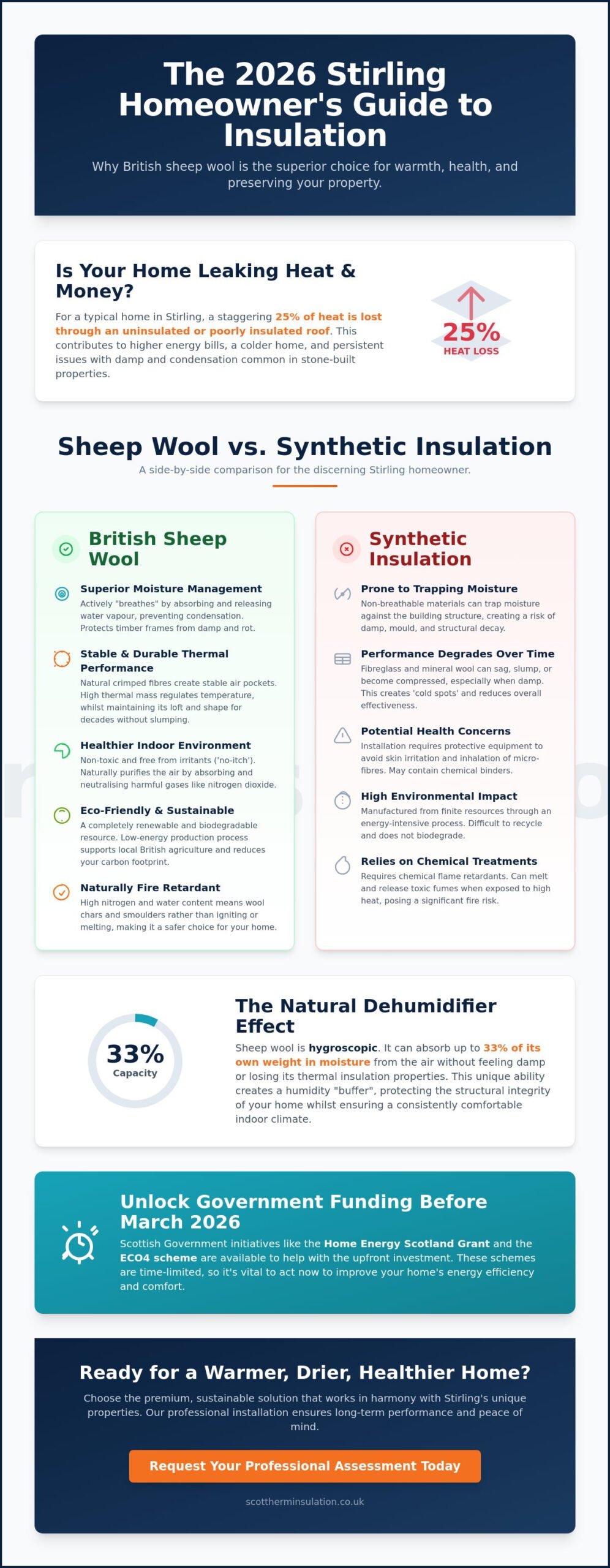
Did you know that approximately 25% of your home’s heat is currently escaping through your roof? You’ve likely felt this loss through rising energy bills whilst struggling with the damp and condensation typical of Stirling’s older stone buildings. It’s a frustrating cycle that standard synthetic materials often fail to break. By opting for sheep wool insulation stirling, you’re choosing a breathable, sustainable solution that works in harmony with your property’s structure.
This 2026 buyer’s guide explains why sheep wool is the superior choice for our unique climate and how it can transform your living space into a warm, dry sanctuary. We’ll cover the remarkable moisture-wicking properties of British wool and detail the latest Scottish government funding, including the Home Energy Scotland Grant and ECO4 schemes available until March 2026. You will learn how to identify professional installation that provides long-term thermal efficiency and peace of mind for your household.
Key Takeaways
- Understand how natural keratin-based fibres manage Stirling’s high humidity levels to actively prevent condensation and mould growth within your walls.
- Discover why sheep wool insulation stirling offers a cleaner, safer installation process compared to synthetic alternatives whilst providing superior thermal mass.
- Learn to distinguish between the requirements for traditional rafters and modern trusses when planning your loft or underfloor insulation project.
- Compare the upfront investment of premium wool against long-term energy savings and the preservation of your property’s structural health.
- Identify the specific 2026 professional standards and regional expertise needed to ensure your home remains breathable and warm year-round.
Why Sheep Wool Insulation is the Premium Choice for Stirling Homes
Stirling’s architectural heritage is beautiful but presents specific challenges for modern energy efficiency. Many residents find that standard fibreglass or mineral wool doesn’t quite manage the “damp chill” common in older stone-built properties. This is where sheep wool insulation stirling becomes a game-changer. It isn’t just a thermal barrier; it’s a high-performance keratin-based material that interacts with the air inside your home. Unlike synthetic options, wool is naturally designed to handle the variable conditions of the Scottish climate whilst protecting the building’s integrity. It offers a sophisticated solution for those who want to balance modern warmth with traditional building science.
The Stirling Climate Challenge
Stirling’s proximity to the Ochils and the resulting high rainfall creates a specific challenge for loft humidity. Traditional stone buildings in the city centre and surrounding villages were built to be vapour-permeable. When you seal these buildings with non-breathable synthetic insulation, you risk trapping moisture against the stone and timber. Sheep wool insulation can absorb up to 33% of its weight in moisture without losing thermal efficiency. This unique property ensures that your home remains warm whilst the structure itself stays healthy and dry.
Natural vs. Synthetic: The Health Perspective
Wool fibres contain amino acids that neutralise harmful gases like nitrogen dioxide and sulphur dioxide. Because it is a natural, sustainable, recyclable material, it provides peace of mind for those looking to avoid chemical-heavy synthetics. There is no “itch” factor with wool, making it a safer choice for households with allergies or respiratory sensitivities. By choosing British wool, you’re also supporting local agriculture and reducing your home’s carbon footprint through a low-energy manufacturing process.
Stirling homeowners are increasingly moving away from fibreglass because it often sags or loses performance when damp. In a climate as wet as ours, that’s a significant risk. Mineral wool can also be unpleasant to install and may release micro-fibres into the air. Wool provides a denser, more reliable alternative that stays in place and maintains its shape for decades. Investing in sheep wool insulation stirling ensures your property remains a warm, dry sanctuary for years to come. It is a premium choice that prioritises both your long-term comfort and the environment.
The Science of Comfort: How Wool Manages Heat and Damp
Stirling winters require more than just a thin layer of padding in the loft. True comfort comes from a material’s ability to regulate its own temperature and environment. This is why sheep wool insulation stirling is increasingly popular; it possesses a high thermal mass that absorbs and releases heat slowly. This process smooths out the temperature spikes and dips that often make traditional Scottish homes feel drafty or inconsistent. By choosing a material that works with physics rather than against it, you create a more stable, cosy atmosphere throughout the year.
Thermal Performance in the Scottish Winter
On sub-zero nights, the R-value of your insulation determines how hard your heating system must work. Wool is incredibly effective here because its crimped fibres trap millions of tiny air pockets. Recent scientific research into the competitiveness of sheep wool proves it performs just as well as synthetic alternatives in real-world conditions. Unlike mineral wool, which can slump and leave “cold spots” as it ages, sheep wool maintains its loft and structural integrity for the life of the building. This prevents the heat from escaping through gaps that typically form with lesser materials.
Moisture Regulation and Structural Protection
Condensation is the silent enemy of Stirling’s older roof structures. If moisture builds up in the loft space, it can lead to timber rot and mould. Sheep wool acts as a natural dehumidifier for your home. The fibres are hygroscopic, meaning they absorb water vapour when the air is damp and release it when the air dries out. Wool creates a “buffer” for humidity, stabilising the indoor environment and protecting your rafters from the damaging effects of trapped moisture. Whilst the inner core of the fibre absorbs vapour, the outer layer naturally repels liquid water, ensuring the material stays dry to the touch.
Safety and durability are built into the very DNA of the product. Many homeowners are surprised to learn that wool is naturally flame-retardant due to its high nitrogen content; it will char rather than ignite or melt like plastic-based insulations. To ensure long-term peace of mind, the wool we use is treated with a permanent, non-toxic solution that makes the fibres unpalatable to moths and other insects. This ensures your investment remains protected for decades. If you’re ready to see how these natural properties can improve your home’s efficiency, you can view our sheep wool insulation services to learn more about our professional installation process.
Sheep Wool vs. Mineral Wool: A Stirling Homeowner’s Buying Guide
Choosing sheep wool insulation stirling represents a shift from basic utility to high-performance building care. Whilst mineral wool is often the default choice for budget-conscious projects, it carries hidden trade-offs in Stirling’s damp climate. Mineral wool production is an energy-intensive process that involves melting stone or glass at extreme temperatures. In contrast, sheep wool is a carbon-sequestering material that requires minimal energy to manufacture. For homeowners prioritising environmental responsibility, the choice is clear. Wool isn’t just a thermal barrier; it’s a sustainable investment in the planet’s future.
Installation complexity is another area where these materials diverge significantly. Mineral wool can be difficult to handle, often requiring full protective gear to prevent skin irritation and respiratory discomfort. Sheep wool is safe to touch and doesn’t release harmful micro-fibres into your living space. This makes the fitting process faster and cleaner, especially in tight Stirling lofts where manoeuvrability is limited. Because wool is more resilient, it’s easier to friction-fit between rafters, ensuring a snug seal that eliminates the gaps where heat typically escapes.
The Investment Analysis for Stirling Properties
The financial argument for wool extends beyond simple monthly energy savings. In the local Stirling market, high-quality, sustainable upgrades can positively influence property resale value. Buyers in 2026 are increasingly savvy about building health and energy certificates. Whilst the initial outlay for wool is higher than synthetic alternatives, the “payback period” is offset by the material’s longevity and its ability to protect the roof’s timber structure. To understand the broader impact of this choice, you can read more about Wool Insulation: The Sustainable Choice for Homes in Edinburgh and Fife.
Durability and Maintenance
Durability is where sheep wool truly excels. Mineral wool is prone to slumping over time, particularly if it absorbs even a small amount of moisture from a minor roof leak or condensation. Once damp, its thermal efficiency drops dramatically. Sheep wool thrives in these conditions, maintaining its loft and R-value for the lifetime of the building. It also offers superior acoustic performance, which is a major benefit for homes near the busy Stirling city centre or under flight paths. When comparing sheep wool insulation stirling against standard rolls, the decision often rests on whether you want a temporary fix or a permanent solution for your home’s comfort.
- Choose Sheep Wool if: You live in a traditional stone building, prioritise air quality, or want a “fit and forget” solution that protects your timbers.
- Choose Mineral Wool if: You are working on a modern build with perfect vapour barriers and need to keep upfront costs to an absolute minimum.
Planning Your Stirling Installation: Costs and Practicalities
Planning your project involves more than just ordering materials. To ensure the best results for sheep wool insulation stirling, we first evaluate the specific structural needs of your property. Stirling’s housing stock ranges from historic stone villas to modern suburban developments, each requiring a tailored approach to thermal management. Our process ensures that the natural benefits of wool are maximised by fitting the material correctly within your specific roof type, whether you have traditional deep rafters or modern prefabricated trusses.
Surveying Stirling’s Diverse Architecture
In Stirling’s Victorian villas, we often encounter deep, traditional rafters that provide ample space for high-performance wool. Post-war housing might use narrower trusses, which change how we layer the material to avoid blocking essential airflow at the eaves. A professional survey identifies these nuances whilst checking for existing damp or blocked vents that could compromise your home’s health. For a broader look at national standards and how they apply to your property, consult our Loft Insulation in Scotland: The 2026 Homeowner’s Guide.
The Installation Day: What to Expect
Meeting Scottish Building Standards is essential for long-term efficiency. Current guidance recommends a total depth of at least 270mm for loft insulation to be fully effective. We achieve this through a structured 5-step process designed to minimise disruption to your daily routine:
- Site Preparation: Protecting your walkways and clearing the immediate work area.
- Cleansing: Removing old, degraded debris or failed synthetic insulation that no longer performs.
- Precision Fitting: Cutting and friction-fitting the sheep wool securely between the joists.
- Layering: Adding a second cross-layer to reach the 270mm target and eliminate thermal bridging.
- Technical Finishing: Insulating the loft hatch and water tanks to prevent winter freezing and heat loss.
A complete thermal envelope often involves more than just the loft space. Many Stirling residents find that combining roof work with under floor insulation provides the most significant boost to domestic comfort and energy savings. Before our team arrives, we simply ask that you clear the loft of personal items to allow full access to the eaves. This preparation ensures a smooth, professional installation that delivers immediate, tangible results for your heating bills. If you’re ready to secure your home’s future, you can book a professional survey with ScotTherm today.
Why Choose ScotTherm for Sheep Wool Insulation in Stirling?
ScotTherm isn’t just another national contractor; we’re a specialised team that understands the specific dampness challenges of Stirling’s unique climate. By choosing us for your sheep wool insulation stirling project, you’re partnering with local experts who prioritise the long-term structural health of your home. We’ve built our reputation on providing high-quality British wool that meets the rigorous demands of Scottish building regulations. Our focus remains fixed on delivering tangible results for your comfort and your wallet.
We believe that a warm home shouldn’t come at the cost of the environment. That’s why we exclusively use sustainable materials that offer superior performance whilst supporting local agriculture. Our team brings years of technical proficiency to every job, ensuring that every corner of your loft or underfloor space is sealed against the Scottish winter. This disciplined approach to quality is why homeowners across the region trust us with their most valuable asset.
Certified Excellence and Local Trust
Our team focuses exclusively on residential thermal improvements like loft, mineral wool, and underfloor insulation. We don’t distract ourselves with solar panels or boiler installations; we stick to the core services where we excel. Being local means we provide a level of aftercare that national conglomerates simply can’t match. Every installation we perform adheres to the latest Scottish energy standards, ensuring your home remains compliant and efficient for years to come. Our professional history is built on verification and trust, giving you the security of knowing the job is done right.
The ScotTherm Guarantee provides peace of mind for the lifetime of your Stirling home. Because sheep wool is a permanent, resilient solution that doesn’t slump or degrade, we stand behind our workmanship with complete confidence. It’s a commitment to your domestic well-being that ensures your property stays dry, quiet, and thermally stable regardless of the weather outside.
Start Your Journey to a Warmer Stirling Home
Transitioning to a sustainable, energy-efficient home is a straightforward process with the right partner. Our specialist inspections are designed to identify exactly where your home is losing heat and how natural fibres can solve the problem. You’ll receive a bespoke Stirling quote that reflects the specific needs of your building, whether you’re living in a historic Victorian villa or a modern suburban development. It’s time to stop overpaying for heating and start enjoying the natural, breathable warmth of British wool.
By acting now, you can take advantage of current Scottish government grants whilst securing a more comfortable future for your family. You’ll save money on energy bills and reduce your carbon footprint simultaneously. Don’t let another winter pass with a cold, draughty home. Book your free Stirling insulation survey with ScotTherm today and discover the difference that professional, local expertise makes.
Secure Your Home’s Future with Sustainable Comfort
Choosing sheep wool insulation stirling is more than a simple home improvement; it’s a strategic investment in the structural integrity and thermal comfort of your property. By utilising 100% natural British wool, you’re opting for a high-performance material that manages Stirling’s unique humidity whilst providing superior insulation. We’ve explored how this breathable barrier protects your rafters from damp and creates a stable, cosy indoor climate that synthetic alternatives often fail to provide. Our specialised local Stirling installers ensure every project meets the latest building standards, delivering a warm and dry home that stands the test of time.
We back our professional installations with a lifetime building guarantee, giving you the security that your investment remains protected for decades. It’s time to move away from itchy, chemical-heavy materials and embrace a cleaner, more sustainable way to live. Request your free Stirling sheep wool insulation survey today to begin your journey toward lasting comfort. We’re ready to help you create a more efficient, environmentally friendly home that you can take pride in.
Frequently Asked Questions
Is sheep wool insulation worth the extra cost for a Stirling home?
Sheep wool is a premium investment that pays for itself through enhanced structural protection and long-term energy efficiency. Whilst the initial cost is higher than synthetic rolls, it doesn’t degrade or slump over time. This makes it particularly valuable for Stirling’s older housing stock where moisture management is essential for preventing timber rot and maintaining the property’s value.
Does sheep wool insulation attract moths or vermin in the loft?
Professional-grade sheep wool is treated with a permanent, non-toxic salt-based solution that makes it unpalatable to moths and other insects. This treatment is bonded to the fibres during manufacturing and does not wash out or lose its potency. Additionally, wool doesn’t provide a food source for vermin, making it as secure as any other insulation material when correctly installed by specialists.
How thick should sheep wool insulation be to meet Scottish building regs?
To comply with current Scottish building standards for loft spaces, a total thickness of 270mm is recommended for optimal thermal performance. This is usually achieved by laying a base layer between the joists and a second layer at right angles across them. This specific depth ensures your home achieves the necessary U-value to maximise heat retention and reduce your monthly energy expenditure.
Can I use sheep wool insulation if my Stirling home has existing damp?
You should always identify and repair the source of any active leaks or rising damp before installing new insulation. Once the primary issue is resolved, sheep wool insulation stirling is the ideal choice for traditional buildings because it manages residual humidity. It allows the building fabric to breathe naturally, which helps prevent the return of surface condensation and mould growth.
Does sheep wool insulation have a natural smell?
High-quality wool insulation undergoes a rigorous scouring process to remove the majority of lanolin and natural oils. You might notice a very faint, earthy scent immediately after the bags are opened, but this dissipates within a few hours of installation. Once the loft hatch is closed and the material has settled, there is no detectable odour in the living areas of your home.
How long does sheep wool insulation last compared to mineral wool?
Sheep wool is designed to last for the lifetime of the building, often exceeding 50 years without losing its thermal properties. Mineral wool can lose efficiency if it becomes compressed or damp over time. Because wool fibres are naturally resilient and springy, they maintain their thickness and air-trapping capabilities far longer than most synthetic alternatives.
Is sheep wool insulation fire-resistant?
Wool is naturally flame-retardant and has a higher ignition temperature than many other common household materials. It contains high levels of nitrogen, which causes the fibres to char and self-extinguish rather than melting or spreading flames. This provides an additional layer of safety for your household without the need for the heavy chemical fire retardants found in some synthetics.
Can I install sheep wool insulation myself or do I need a Stirling professional?
Whilst wool is safe to handle, a professional installation ensures your property meets all safety and building regulations. Our Stirling-based team understands how to manage ventilation at the eaves and protect electrical wiring from overheating. Professional fitting also ensures that the recommended depth is achieved consistently across the entire loft space to eliminate the thermal bridging that causes cold spots.