
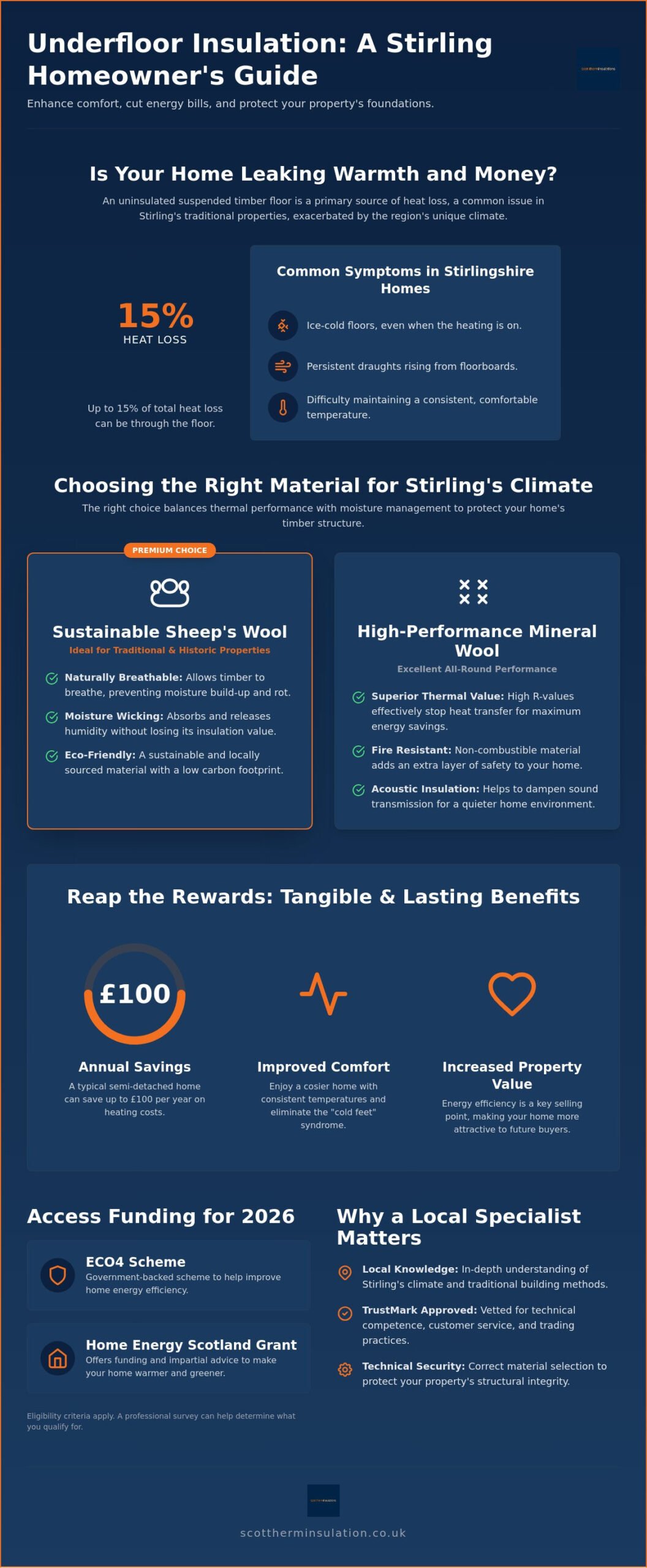
Did you know that an uninsulated suspended timber floor can be responsible for up to 15% of your home’s total heat loss? If you’ve already insulated your loft but still face ice-cold floorboards every morning, it’s a sign that your warmth is escaping through the foundations. Securing professional underfloor insulation stirling is the most reliable way to stop these draughts. We know that feeling a chill despite having the heating on is a common frustration for many in the Central Belt, especially when energy prices remain a primary concern.
This guide promises to show you how to transform your home’s comfort whilst reducing your monthly bills through expert, TrustMark approved installation. We’ll provide a clear overview of the 2026 grant options, such as the ECO4 scheme and the Home Energy Scotland grant, which can cover a substantial portion of your costs. You’ll also learn why using breathable, high-quality materials like sheep’s wool or mineral wool is essential for protecting the structural integrity of Stirling’s traditional properties. It’s time to make your floors work for you.
Key Takeaways
- Learn why the unique humidity and wind patterns from the Ochil Hills make professional underfloor insulation stirling essential for protecting your home’s foundations.
- Understand the vital importance of material breathability and how to choose between high-performance mineral wool and sustainable sheep’s wool for your specific floor type.
- Discover the simple methods used to identify suspended timber floors in pre-1970 Stirling properties to prepare for a professional survey.
- Navigate the 2026 funding landscape, including the latest eligibility criteria for the ECO4 scheme, to help offset the cost of your energy efficiency improvements.
- Find out why a regional specialist with local knowledge of the Central Belt provides greater technical security than generic national contractors.
Why Underfloor Insulation is Essential for Stirling’s Climate
Stirling’s geography creates a specific set of challenges for home comfort. Situated in the shadow of the Ochil Hills, the city often experiences higher-than-average humidity levels and biting winds that sweep across the Carse. Underfloor insulation involves the precise fitting of high-performance thermal material between the timber joists located beneath your floorboards. This process creates a robust barrier that prevents heat from descending into the cold, damp crawlspace. ScotTherm Insulation specialises in sealing this thermal envelope, stopping your ground floor from acting as a giant radiator for the earth beneath your home. This leads to the persistent “cold feet” syndrome that many local residents find impossible to cure with heating alone.
Professional installation ensures that the warmth generated by your heating system remains within the living areas rather than escaping into the foundations. This isn’t just about comfort; it’s about structural efficiency. Using the right Building insulation materials allows your home to maintain a consistent temperature, regardless of the seasonal shifts common in Central Scotland. By completing the thermal barrier at the lowest point of the building, you create a more stable indoor environment that is easier to manage year-round.
The Impact of Draughts in Stirlingshire Homes
Stirling’s older housing stock often features suspended timber floors. Areas like Kings Park or the historic centre are full of properties that, whilst beautiful, were built long before modern energy standards. These designs provide necessary ventilation but also allow wind-driven draughts to penetrate through gaps in the floorboards. This is especially noticeable in exposed locations where the wind pressure forces cold air upwards. Many homeowners find that loft insulation alone is insufficient because the thermal envelope remains open at the bottom. By investing in underfloor insulation stirling, you seal this lower boundary. This ensures that the warm air you pay for stays where it belongs, significantly improving the perceived temperature of the room.
Financial and Environmental Benefits for 2026
The financial argument for upgrading your home’s fabric is compelling. Data shows that an uninsulated suspended timber floor can account for 10% to 15% of a property’s total heat loss. By addressing this, a typical Stirling semi-detached home can save as much as £100 annually on heating bills. These savings are achieved by reducing the workload on your heating system. Beyond the immediate financial ease, there is a clear environmental benefit. Reducing energy consumption directly lowers your household’s carbon footprint, supporting the Scottish Government’s net-zero targets. Choosing breathable materials ensures your home remains energy efficient whilst protecting the timber from the damp Stirling air.
Choosing the Right Materials: Mineral Wool vs Sustainable Sheep’s Wool
Selecting the correct material is a technical decision that impacts both your immediate comfort and the long-term structural health of your floor joists. In Stirling’s damp climate, moisture management is just as vital as heat retention. Choosing the wrong material can trap moisture against the wood, leading to interstitial condensation and eventual timber rot. ScotTherm Insulation specialises in both high-performance mineral wool and sustainable sheep’s wool to ensure every home receives a tailored solution. We evaluate R-values and thermal conductivity to maximise heat retention whilst allowing the building to breathe. This technical balance is what separates a professional installation from a generic DIY attempt.
The Advantages of Sheep’s Wool in Older Properties
Natural sheep’s wool is the premium choice for Stirling’s traditional stone villas and Victorian terraces. These properties were designed to be vapour-permeable; using non-breathable materials can often cause more harm than good by trapping damp air. Sheep’s wool possesses unique moisture-wicking capabilities. It can absorb and release moisture without losing its thermal efficiency, which protects original timber floors from the damp conditions often found in Scottish crawlspaces. It’s a sustainable, locally sourced insulation solution that aligns with the environmental values of many Stirlingshire homeowners. For those seeking underfloor insulation stirling that protects historic fabrics, this natural fibre offers unparalleled safety.
When considering the Energy Saving Trust guide to floor insulation, the emphasis on choosing materials suited to your specific floor type is clear. For many, the natural resilience of wool provides peace of mind that their investment is protecting the very fabric of their home. If you’re unsure which material suits your property, you can request a specialist survey from our team to assess your home’s unique requirements.
Mineral Wool: A Cost-Effective, High-Performance Alternative
Mineral wool remains a staple for thermal upgrades due to its exceptional fire resistance and acoustic properties. It’s an ideal choice for modern Stirling builds where a consistent thermal barrier is required without the premium cost of natural fibres. This material is manufactured from molten rock or glass, spun into a fibre structure that traps air effectively. It provides a dense, reliable layer that fills the gaps between joists perfectly, leaving no room for cold air bypass. Unlike some synthetic alternatives that may degrade or shrink over time, mineral wool maintains its shape and performance for the life of the building.
It provides excellent acoustic insulation, which is a significant benefit for homes with high foot traffic or echoing crawlspaces. By choosing a high-density mineral wool, you ensure a durable solution that keeps your floors warm and your energy outgoings low. It’s a disciplined, results-oriented choice for homeowners who prioritise long-term value and safety. ScotTherm Insulation ensures that every mineral wool installation is fitted with precision to maintain the necessary sub-floor ventilation whilst eliminating the cold spots that cause discomfort.
Assessing Your Stirling Home: Suspended Timber vs Solid Floors
Identifying the floor construction of your property is the essential first step in any ScotTherm Insulation professional survey. Most Stirling homes built before 1970 feature suspended timber floors. These consist of wooden floorboards laid over joists, with a significant crawlspace underneath for air circulation. This design is common amongst Stirling’s Victorian tenements and mid-century council housing. Whilst effective for historical ventilation, this setup creates a direct path for the damp Stirling air to cool your living space. Our team specialises in identifying these structures accurately to ensure the underfloor insulation stirling homeowners receive is technically sound.
Maintaining sub-floor ventilation is a non-negotiable part of our process. We ensure that air bricks remain unobstructed to prevent moisture build-up. If ventilation is restricted, the resulting damp can lead to timber rot, compromising the safety of your home. We balance thermal performance with structural health, ensuring your property remains dry and secure for decades. It’s a disciplined approach that respects the architectural heritage of the Central Belt whilst delivering modern efficiency.
Insulating Suspended Timber Floors
The process for suspended floors involves securing insulation material between the joists using breathable netting. This supports the material whilst allowing the timbers to breathe naturally. We address access issues by using existing hatches or carefully lifting floorboards in discreet locations. A vital final step is sealing the gaps between floorboards and skirting boards. This eliminates the draughts that loft insulation alone cannot stop. It’s a precise method that transforms the comfort of your ground floor rooms.
Solutions for Solid Concrete Floors
For homes in newer Stirling developments or certain post-war properties, solid concrete floors are the standard. These require a different technical strategy. We typically use high-performance rigid insulation boards topped with a floating floor system. This method is highly effective but requires careful planning regarding existing door heights and floor levels. ScotTherm Insulation assesses the thickness required to maximise heat retention without creating trip hazards at thresholds. It’s a specialised service that ensures modern Stirling residents enjoy lower bills.
Navigating Grants and Professional Installation in Stirling
Stirling residents have access to significant financial support for home energy upgrades in 2026. The ECO4 scheme remains a primary route for those receiving qualifying benefits, provided the property has an EPC rating of D or lower. This scheme is scheduled to run until 31 December 2026, offering a vital lifeline for improving domestic efficiency. For homeowners who do not qualify for ECO4, the Home Energy Scotland Grant provides a robust alternative, offering up to £1,500 towards the cost of the project. Whilst the Great British Insulation Scheme (GBIS) closed to new applications in March 2026, these remaining funding streams ensure that professional underfloor insulation stirling remains an accessible investment for many households across the region.
Attempting a DIY installation is often a false economy that can lead to long-term structural issues. Without the technical knowledge of a TrustMark registered specialist, it is easy to inadvertently block essential air bricks or use non-breathable materials. This leads to restricted airflow, trapped moisture; and eventually, expensive timber rot. Professional installation ensures that the thermal envelope is sealed correctly whilst maintaining the delicate balance of sub-floor ventilation mentioned in our previous sections. Our disciplined approach prioritises the safety of your home’s foundations over a quick, unverified fix.
Eligibility for Insulation Grants in Stirling
Qualifying for support depends on several specific criteria. ECO4 eligibility is typically tied to household income or the receipt of specific benefits. For the Home Energy Scotland Grant, the property’s location and current EPC rating are the key factors. In certain rural Stirling postcodes, the grant can even cover up to 90% of the total costs. Using a TrustMark registered installer is a mandatory requirement for accessing these government-backed funds. This certification acts as a badge of reliability, ensuring your installation meets the highest industry standards for safety and performance.
What to Expect During a ScotTherm Installation
Our 5-step professional installation process is designed to ensure minimal disruption to your daily routine. It begins with a comprehensive technical survey where we measure moisture levels and assess the existing ventilation beneath your floorboards. Preparation is a straightforward task; our team assists in moving furniture and applies protective coverings to safeguard your home. The installation itself is carried out by specialists who understand the unique architectural challenges of the Central Belt. Once the work is completed, we conduct a thorough post-installation check and clean-up, ensuring your home is left tidy and significantly warmer. If you want to see if your property qualifies for current funding, you can check your grant eligibility today.
Why Stirling Homeowners Trust ScotTherm for Specialist Insulation
ScotTherm is a dedicated Scottish provider with deep roots in the Central Belt. We don’t take a “jack-of-all-trades” approach; instead, we focus exclusively on thermal insulation. This specialisation is vital for underfloor insulation stirling projects, where the specific moisture levels of the local climate require precision. We prioritise breathable, sustainable materials that are engineered to perform in Scottish conditions. Unlike national contractors who might use a one-size-fits-all method, we understand that a Victorian villa in Stirling requires a different technical strategy than a modern semi-detached home. Whether your property requires high-performance mineral wool or eco-friendly sheep’s wool, we ensure the material matches the architectural needs of your home.
We take immense pride in the tangible impact our work has on the Stirling community. By choosing a local specialist, you are opting for a team that understands the local wind patterns and humidity levels that national firms often overlook. Our technical proficiency is matched by our dedication to domestic well-being, ensuring that every project we undertake results in a noticeably warmer and more efficient living space. We aren’t just installers; we’re regional experts who live and work in the same climate as our customers. This geographic identity builds a level of trust and accountability that faceless corporations simply cannot match.
Our Commitment to Quality and Certification
Our TrustMark approval serves as a primary badge of reliability for our customers. This registration means we adhere to strict industry standards, providing you with peace of mind that your home is in safe hands. We use only certified, high-performance materials for every Stirling project, ensuring long-term value and thermal efficiency. Our team is disciplined and quality-conscious, prioritising the physical ease of the homeowner and the financial efficiency of the property. You can learn more about our Under Floor Insulation services in Stirling to see how our technical expertise benefits local properties. Every installation we perform is backed by our history of regional expertise and a commitment to environmental responsibility.
Start Your Journey to a Warmer Home
Taking the first step towards a warmer home is straightforward. You can book a specialist insulation inspection for your Stirling property to identify exactly where your heat loss is occurring. Our team provides personalised advice on how to maximise your energy savings. Often, combining underfloor work with loft insulation creates a complete thermal barrier that transforms your domestic comfort. This holistic approach ensures that heat is retained from the foundations to the rafters. Don’t wait for another cold winter to address ice-cold floorboards. Request a quote and check your grant eligibility today to secure a warmer, more cost-effective future for your home. We’re here to act as your partner in creating a cozy, sustainable environment.
Secure a Warmer, More Efficient Future for Your Stirling Home
Investing in professional underfloor insulation stirling is a proactive step towards long-term domestic well-being and financial efficiency. By choosing breathable materials like sustainable sheep’s wool, you protect the structural integrity of your floor joists whilst eliminating the draughts that loft insulation alone cannot stop. With the 2026 ECO4 and Home Energy Scotland grants currently available, there’s never been a better time to upgrade your property’s thermal envelope. It’s an investment that pays dividends in both physical comfort and reduced monthly outgoings.
Our team of TrustMark registered installers combines local Scottish expertise with high-performance materials to deliver results that last. We understand the specific architectural challenges of the Central Belt and prioritise quality-conscious installation with minimal disruption. Whether you have a traditional suspended timber floor or a modern development, we provide the technical security you need. Book Your Free Specialist Insulation Inspection in Stirling today to see how much you could save. It’s time to enjoy the comfort of a draught-free home and the peace of mind that comes from lower energy bills.
Frequently Asked Questions
Is underfloor insulation worth it in Stirling?
Underfloor insulation is a highly effective investment for Stirling homes because it addresses the 10% to 15% of heat loss that occurs through uninsulated ground floors. By sealing the thermal envelope, you reduce the workload on your heating system and eliminate persistent draughts. This results in tangible annual energy bill savings and a significant improvement in ground-floor comfort, making your home much easier to heat during the damp Stirlingshire winters.
Can I get a grant for underfloor insulation in Stirlingshire?
Stirling residents can access several funding streams in 2026, including the ECO4 scheme and the Home Energy Scotland Grant. ECO4 provides support for households on qualifying benefits with an EPC rating of D or lower until the end of the year. Alternatively, the Home Energy Scotland Grant offers up to £1,500 towards the cost of installation. These grants make underfloor insulation stirling a financially viable upgrade for many local families seeking lower bills.
Will underfloor insulation cause damp or rot in my floorboards?
Professional installation prevents damp by ensuring that sub-floor ventilation remains unobstructed. We use breathable materials like sheep’s wool or mineral wool that allow moisture to escape rather than trapping it against the timber. Maintaining airflow through existing air bricks is a critical part of our technical process. This disciplined approach protects your floorboards from interstitial condensation and the long-term risk of rot, ensuring the structural health of your home.
How long does it take to install underfloor insulation?
A standard underfloor insulation project typically takes between one and two days to complete. The exact duration depends on the size of your ground floor and the ease of access to the crawlspace beneath your boards. Our team works efficiently to minimise disruption, ensuring your home is left clean and tidy at the end of each day. We prioritise a structured workflow to deliver results quickly without compromising on technical precision.
Do I need to lift my floorboards for the installation?
Lifting your floorboards is not always necessary if there is sufficient access to the crawlspace beneath your home. If the space is too shallow for an installer to enter, we may need to lift boards in specific areas to ensure the insulation is fitted correctly between the joists. We assess access requirements during our initial technical survey to provide a clear plan that protects your flooring whilst ensuring a complete thermal seal.
What is the best type of insulation for a suspended timber floor?
Breathable materials such as sustainable sheep’s wool or high-performance mineral wool are the best options for suspended timber floors. These materials allow moisture to move through the floor structure naturally, which is vital for the health of Stirling’s older housing stock. They provide excellent thermal resistance whilst ensuring the joists remain dry. We help you choose the material that best suits your property’s age and specific construction type.
Can I install underfloor insulation myself?
DIY installation is not recommended because of the high risk of creating ventilation problems. Incorrectly fitted insulation can block air bricks or trap moisture; this leads to expensive timber damage over time. Additionally, you must use a TrustMark registered installer to access any government-backed grants. A professional installation ensures that your underfloor insulation stirling project is technically sound, safe, and fully compliant with current building standards.
Does underfloor insulation help with noise reduction?
Underfloor insulation provides significant acoustic benefits by dampening the sound of footsteps and reducing noise transfer from the crawlspace. Dense materials like mineral wool are particularly effective at absorbing sound waves. This creates a quieter, more peaceful domestic environment, especially in homes with echoing sub-floor voids or high levels of foot traffic. It is a secondary benefit that perfectly complements the primary goal of thermal efficiency.