
Could the insulation meant to lower your energy bills actually be damaging your home’s structure? For many living in Scotland’s iconic stone properties, choosing the wrong material leads to trapped moisture and expensive damp repairs. We know you’re looking for more than just a warm house; you want the peace of mind that comes from non-combustible materials and a breathable environment. According to the Energy Saving Trust, uninsulated walls lose roughly 33% of a home’s heat, making the right choice vital for both your wallet and your comfort.
In this guide, you’ll discover why mineral wool insulation is a leading choice for homeowners who prioritise fire safety and long-term durability. We’ll show you exactly how it compares to plastic foams and why its moisture-handling properties are essential for our damp winters. We’ll break down the technical benefits and the potential for maximum savings and comfort so you can make a fully approved decision for your property’s future.
Key Takeaways
- Understand why mineral wool insulation is the ideal choice for the Scottish climate, offering a breathable solution that prevents heat loss whilst protecting your home’s structure.
- Learn the critical differences between glass and stone wool to determine which density best suits your requirements for thermal performance or superior soundproofing.
- Compare mineral wool against PIR boards and natural sheep’s wool to find the perfect balance between thermal efficiency, breathability, and sustainability.
- Discover specific insulation strategies for Scottish properties, from reaching the recommended 270mm loft depth to retrofitting solid stone tenements in the Central Belt.
- Realise why professional installation is essential to avoid common gaps that can halve your efficiency, ensuring you achieve maximum savings and long-term fire safety.
What is Mineral Wool Insulation and Why Does it Suit Scotland?
Choosing the right material is the first step toward a more efficient home. Mineral wool is a highly resilient, fibre-based insulation manufactured by melting glass or volcanic stone at temperatures exceeding 1,000°C. Once molten, the material is spun into a dense web of fibres that mimics the structure of sheep’s wool. This unique composition serves a vital purpose: it traps millions of tiny air pockets that significantly slow the transfer of heat through your ceiling or walls.
For homeowners in Edinburgh and Stirling, the primary advantage of this material is its natural breathability. Many traditional Scottish properties are built from porous stone that needs to “breathe” to manage moisture effectively. Mineral wool insulation allows water vapour to pass through the material rather than trapping it against the masonry. This prevents the damp and interstitial condensation that often plagues older buildings when they are sealed with non-breathable plastics. It’s a reliable solution that balances thermal performance with long-term structural health.
There are two main types our fully approved installers fit across the country:
- Glass Mineral Wool: Created from recycled glass and sand, it’s lightweight and flexible, making it the standard choice for insulating loft floors.
- Stone (Rock) Mineral Wool: Made from volcanic basalt rock, this is a much denser product. It offers exceptional acoustic dampening and is often used in internal walls or high-performance renovations.
The Science of Thermal Resistance
To achieve maximum savings and comfort, we look at how materials perform under Scottish Building Standards, specifically Section 6 regarding energy. Thermal performance is measured using R-values (resistance to heat flow) and U-values (the rate of heat loss through a structure). Mineral wool’s intricate fibrous structure is particularly effective in cold climates because it disrupts convection currents. In a typical attic, air tends to circulate and carry heat away; the wool strands stop this movement, keeping the warmth where it belongs. Thermal conductivity is the rate at which heat passes through the wool. By installing the recommended 270mm thickness, you can drastically reduce your U-value and lower annual heating bills.
Fire Safety and Non-Combustibility
Safety is a non-negotiable part of every ScotTherm project. Mineral wool insulation carries a Euroclass A1 non-combustible rating, which is the highest safety standard achievable in the UK. This is a critical factor for room-in-roof projects in Perth and Fife, where fire barriers are a legal necessity for building warrants. Unlike combustible foam-based alternatives that can ignite or release toxic black smoke, mineral wool doesn’t burn. It can act as a fire stop, providing up to 120 minutes of resistance in specific applications. This gives Scottish families essential peace of mind, knowing their home is protected by a material that prioritises life safety alongside energy efficiency.
Glass Wool vs Stone Wool: Which Should You Choose?
Choosing the right mineral wool insulation depends on your home’s specific layout and your primary goals for comfort. Whilst both materials provide excellent thermal resistance, they are born from very different raw ingredients. Glass wool is manufactured from a mix of sand and recycled glass cullet, often containing up to 80 per cent recycled content. Stone wool, by contrast, is created by melting volcanic basalt rock and steel industry slag at temperatures exceeding 1,500°C. This difference in origin changes how the products behave once they are inside your walls or loft.
Density is the most striking physical difference between the two. Stone wool is significantly heavier and more rigid. This high density makes it the superior choice for homeowners looking to block out external noise or soundproof between rooms. Understanding these insulation materials is vital for Scottish properties where wind noise and rain can be a constant presence. Glass wool is lighter and more flexible, making it easier to fit into irregular gaps without leaving cold spots.
Many people remember the “itch factor” associated with older fibreglass products. Modern manufacturing has changed this. Leading brands now use bio-based binders rather than traditional formaldehyde. These improvements make the material softer to the touch and significantly reduce dust during installation. Whether you choose glass or stone, the result is a safer, more pleasant experience for anyone working in the attic space. This evolution in mineral wool insulation ensures that modern homes are both energy-efficient and comfortable to maintain.
Glass Mineral Wool (Fibreglass)
Best for: Loft floors and wide-span areas where weight is a factor. Because it’s lightweight, it won’t put undue stress on your ceiling joists. It’s highly compressible, which means more material fits into a single delivery van, lowering the carbon footprint of your project. Glass wool is typically the most cost-effective way to reach the recommended 270mm loft thickness. Typical brands include Knauf Earthwool and Isover. If you want to achieve maximum savings on a budget, this is often the go-to solution.
Stone Mineral Wool (Rock Wool)
Best for: Acoustic insulation between floors and high-heat areas like chimney breasts. Stone wool is naturally fire-resistant and can withstand temperatures over 1,000°C, providing a critical safety barrier. It’s also hydrophobic, meaning it repels water and won’t sag if it gets damp. This makes it ideal for the humid, misty conditions often found in coastal Scottish regions. Look for brands like Rockwool or Paroc. If you’re unsure which material suits your specific rafters, our fully approved installers can provide a tailored recommendation for your home.
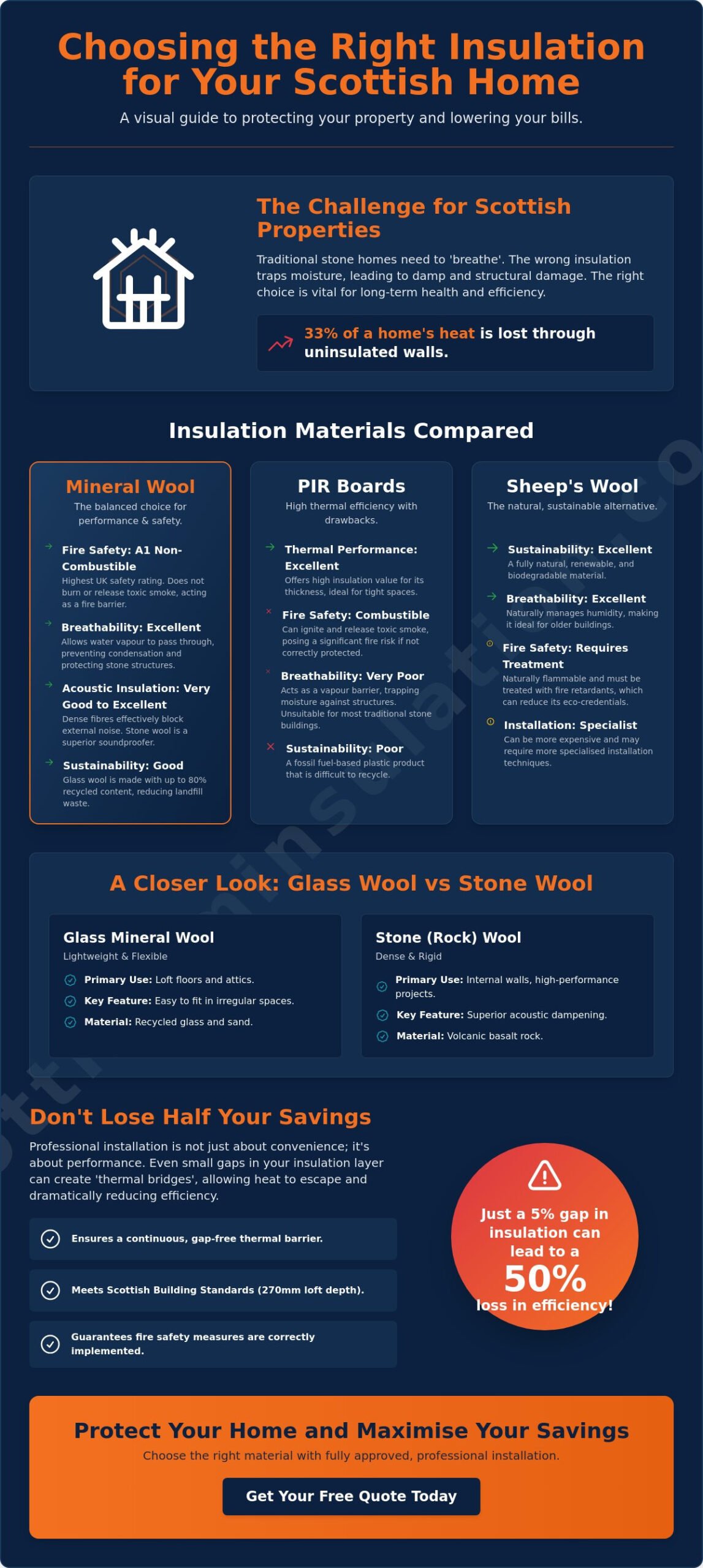
The Big Comparison: Mineral Wool vs Sheep’s Wool vs PIR Boards
Choosing the right material for a Scottish home requires more than just looking at a price tag. Our climate demands a balance between heat retention and moisture control. Whilst PIR (polyisocyanurate) boards offer the lowest thermal conductivity, usually around 0.022 W/mK, they often fail to address the high humidity levels found in coastal or highland regions. Mineral wool insulation provides a versatile alternative that balances cost, safety, and longevity.
If you’re looking for a broader overview of how these materials impact your energy bills, our guide on loft insulation in Scotland provides a deeper dive into the potential savings for 2026 and beyond.
Mineral Wool vs Natural Sheep’s Wool
Sheep’s wool is often viewed as the luxury eco-option. It is entirely natural and safe to touch without any protective equipment. It also has a unique ability to absorb nearly 33% of its weight in moisture without losing its insulating properties. This makes it excellent for insulating traditional buildings in Scotland where breathability is vital for stone masonry.
- Sustainability: Sheep’s wool is renewable, but mineral wool uses up to 70% recycled glass or stone content.
- Price: Mineral wool is significantly more budget-friendly, often costing 50% less than sheep’s wool per square metre.
- Safety: Mineral wool requires PPE during installation to avoid skin irritation, whereas sheep’s wool is completely inert.
Mineral Wool vs Rigid Foam (PIR)
PIR boards are popular because they’re thin, but they have a significant weakness in timber-frame Scottish homes. These boards are rigid. If an installer leaves a gap as small as 5mm between the board and the joist, it creates a thermal bridge. This allows heat to bypass the insulation entirely. Mineral wool insulation batts use a “friction fit” design. They’re flexible enough to be compressed into spaces, ensuring a tight seal against the timber frame.
Longevity is another factor where wool-based products win. PIR boards can “off-gas” over time. This is a process where the gases trapped inside the foam escape, potentially reducing the board’s thermal efficiency by 10% over two decades. Mineral wool doesn’t suffer from this. It remains stable and effective for the entire lifespan of your home, provided it stays dry. It doesn’t shrink or degrade, ensuring your comfort remains consistent year after year.
Practical Applications for Homes in Edinburgh and the Central Belt
Scottish homes require a robust approach to thermal management. In Edinburgh, many suburban lofts still rely on thin, outdated layers that don’t meet current building standards. To achieve the 270mm depth recommended for modern energy efficiency, our installers typically use a cross-layered pattern. This method blankets the joists and reduces heat loss through the roof by approximately 25%. It’s a straightforward upgrade that delivers immediate results for properties in the Lothians.
For mid-terrace houses in Perth and Stirling, the acoustic properties of this material provide a dual benefit. Mineral wool is significantly denser than glass fibre alternatives, making it the ideal choice for soundproofing party walls. It dampens the transfer of airborne noise between neighbours, ensuring your home remains a quiet sanctuary. Whilst many homeowners focus on the roof, underfloor insulation is equally vital for comfort. We fit flexible batts between suspended timber joists to stop cold draughts from rising through the floorboards, which is a common issue in older Central Belt properties.
Insulating Traditional Scottish Properties
North Berwick and the surrounding coastal areas are famous for their sandstone and granite tenements. These traditional buildings must breathe to remain structurally sound. Vapour permeability is non-negotiable here; using non-breathable foam can trap moisture and lead to rot in historic floor joists. By allowing moisture to pass through the building fabric rather than trapping it, mineral wool insulation prevents interstitial condensation from forming within the structural layers of Scottish homes during the cold, humid winter months. This keeps the stone dry and the internal environment healthy.
Room-in-Roof and Attic Conversions
Converting an attic into a bedroom requires clever space management. We use high-density mineral wool insulation slabs between the rafters because they offer excellent thermal resistance without the bulk of traditional rolls. It’s vital to maintain a 50mm ventilation gap behind the wool to prevent moisture build-up against the roof felt. Beyond warmth, these slabs create a superior acoustic envelope. This setup creates a peaceful sleeping space, even if your home is located near a busy commuter road in the Central Belt.
Ensure your property achieves Maximum Savings & Comfort by choosing a specialist team. Contact us today for a Fully Approved mineral wool installation tailored to your home.
Why Professional Installation is Essential for Maximum Savings
Cutting corners on installation often costs more than the initial labour savings. Industry data reveals that a mere 10% gap in coverage can trigger a 50% drop in thermal efficiency. These small air pockets allow heat to bypass the barrier, making your investment far less effective. Professional installers ensure every corner is tightly fitted, preventing the convection currents that steal warmth from your rooms.
Fire safety is another critical factor. Whilst mineral wool insulation is non-combustible, it must be installed with precision around recessed light fittings and electrical cables. Our teams use specific spacing and fire-rated covers to prevent heat build-up. We also take care to insulate pipes correctly, preventing bursts during harsh Scottish winters whilst maintaining proper ventilation to stop dampness from taking hold in your roof space.
Identifying these technical issues starts with a specialist free insulation inspection. This survey pinpoints heat loss hotspots that homeowners often miss, such as unsealed hatches or thin spots in the eaves. It’s the only way to guarantee your home achieves the “Maximum Savings & Comfort” we promise. ScotTherm provides these “Fully Approved” services across Edinburgh, Fife, and Perth, ensuring your home meets modern energy standards.
The ScotTherm Professional Process
We don’t believe in a one-size-fits-all approach. Every project begins with a detailed survey to determine if mineral wool or sheep’s wool is the best fit for your property’s specific needs. Our expert fitters focus on eliminating thermal bridging, which occurs when heat escapes through the structural elements of your building. Once the job is finished, we handle all waste removal and conduct “Peace of Mind” checks to ensure the installation meets our rigorous quality standards.
Local Expertise You Can Trust
ScotTherm has built a “Proven Track Record” across the Central Belt and the Highlands. We understand that Scottish building codes are distinct, and our local knowledge ensures every project is fully compliant with regional regulations. Being based in Scotland means we’re familiar with the unique challenges of the local climate, from coastal humidity to sub-zero mountain temperatures. We’ve helped thousands of households reduce their energy bills through high-quality mineral wool insulation services.
Ready to secure your home’s warmth? Book your professional mineral wool installation with ScotTherm today and start seeing the difference in your heating bills.
Secure Your Home’s Thermal Future Today
Selecting the correct material for the Scottish climate is the first step toward a more efficient and resilient property. Whether you choose stone wool’s superior fire resistance or the cost-effective versatility of glass wool, mineral wool insulation provides the essential breathability required for Edinburgh’s historic tenements and the Central Belt’s modern builds. Data from the Energy Saving Trust indicates that properly insulating a loft can save a typical semi-detached household up to £255 annually on energy bills. These financial benefits only materialise when materials are installed with precision to eliminate thermal bridging and moisture traps.
ScotTherm Insulation operates as a team of Fully Approved Scottish Contractors with specific expertise in both mineral and sheep’s wool applications. We focus on your property’s long-term health; we ensure every project delivers Maximum Savings & Comfort Guaranteed. Our proven track record across Scotland provides the peace of mind that comes from technical proficiency and local accountability. Don’t leave your home’s efficiency to chance when specialist help is available.
Get a Free Specialist Insulation Inspection in Scotland
Take the first step toward a warmer, more sustainable home and start seeing the benefits on your next energy statement.
Frequently Asked Questions
Is mineral wool insulation better than fibreglass?
Mineral wool offers superior fire resistance and acoustic performance compared to fibreglass. It boasts a melting point above 1,000°C, whereas fibreglass typically melts at around 600°C. For Scottish homes, its higher density provides better sound dampening against wind and rain. This makes mineral wool insulation a premium choice for homeowners seeking maximum safety and comfort. It’s a proven solution for our local climate.
Does mineral wool insulation cause cancer or health issues?
Modern mineral wool is classified by the International Agency for Research on Cancer (IARC) as Group 3, meaning it’s not classifiable as carcinogenic to humans. This follows a 2002 review that updated its status from earlier assessments. Whilst it can cause temporary skin irritation during installation, using fully approved contractors ensures safe handling. We always recommend wearing gloves and masks to maintain a healthy working environment.
How long does mineral wool insulation last in a typical loft?
Mineral wool insulation typically lasts for the entire lifespan of a building, often exceeding 50 years. It’s a durable, inorganic material that doesn’t degrade or lose its thermal properties over time if kept dry. Since it doesn’t settle or shrink like some loose-fill options, it maintains its 0.032 to 0.044 W/mK thermal conductivity for decades. This longevity ensures long-term value for Scottish property owners.
Can I install mineral wool insulation myself in my Edinburgh home?
You can install mineral wool yourself, but hiring a fully approved specialist ensures the job meets building standards. Professional installers understand the complexities of Edinburgh’s traditional tenements and modern builds, specifically regarding ventilation and cold bridging. Incorrect DIY installation often leads to damp issues or reduced efficiency. Choosing an expert guarantees you achieve maximum savings and comfort without the risk of structural damage.
Is mineral wool insulation waterproof if my roof leaks?
Mineral wool is naturally water-repellent and vapour-permeable, but it’s not completely waterproof. If a leak occurs, the material won’t absorb water through capillary action, though its thermal performance will drop whilst wet. According to Eurima, mineral wool retains its structure and will regain its full insulating properties once dried out. You must repair any roof leaks immediately to protect your home’s structural integrity.
What is the recommended thickness for mineral wool in a Scottish loft?
Current UK Building Regulations recommend a minimum thickness of 270mm for loft insulation to achieve a U-value of 0.16 W/m²K. In the harsher Scottish climate, many homeowners opt for 300mm to maximise thermal retention. This depth usually consists of a 100mm layer between the joists and a 170mm or 200mm layer laid perpendicularly over the top. This cross-layering technique effectively eliminates heat loss through timber joists.
How much can I save on my energy bills with mineral wool insulation?
According to the Energy Saving Trust 2023 data, insulating a previously uninsulated loft in a detached house can save up to £445 per year. Even topping up existing insulation from 60mm to 270mm can result in annual savings of approximately £25. These figures demonstrate the clear financial benefit for Scottish households. Proper installation of mineral wool insulation by an approved contractor ensures you reach these maximum savings targets quickly.
Does mineral wool insulation attract vermin or mice?
Mineral wool does not provide a food source for vermin or mice because it’s made from molten rock or slag. Whilst it doesn’t attract pests, its soft texture can still be used for nesting if rodents gain access to your loft. Unlike sheep’s wool or some cellulose products, it contains no organic matter that would encourage infestations. Maintaining a secure, pest-proof roof remains the best defence for your home.