
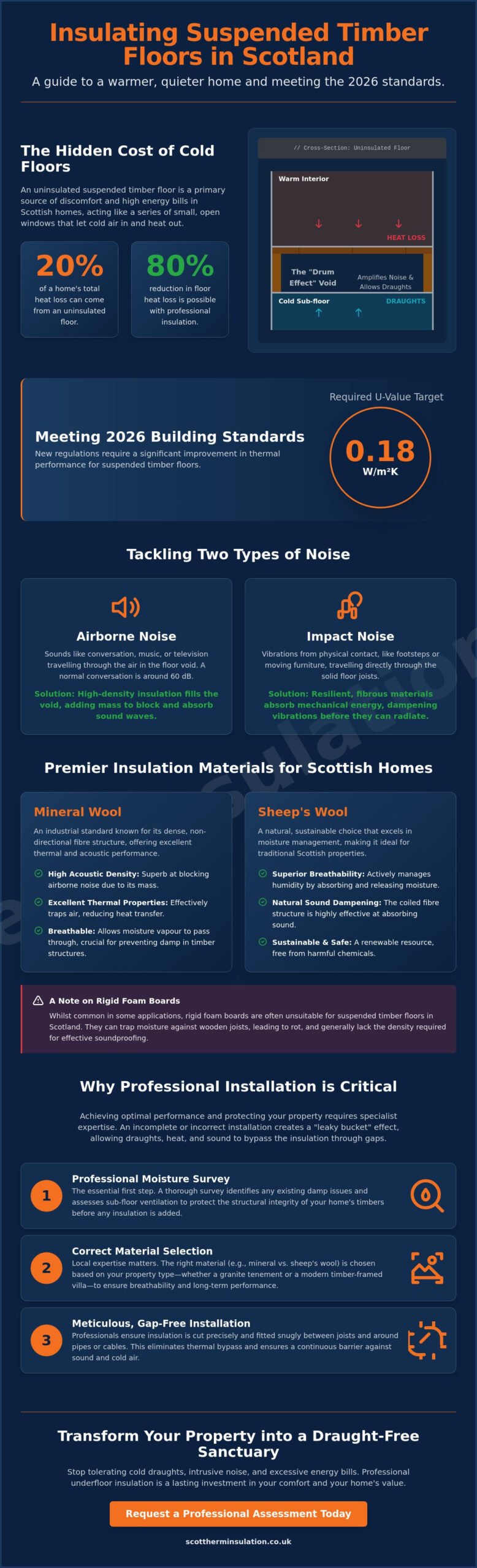
Did you know that an uninsulated suspended timber floor can account for up to 20% of your home’s total heat loss? In the biting Scottish winter, those gaps between your floorboards act like a series of tiny, open windows; they let icy draughts in and allow your expensive heating to escape. It’s frustrating to keep the thermostat high only to feel a chill creeping across the living room or to hear every conversation and footstep from the rooms below. You want a home that feels solid, quiet, and consistently warm without the burden of eye-watering energy bills.
This guide explains exactly how to insulate suspended timber floors scotland to meet the strict 0.18 W/m²K U-value standards required by 2026 regulations. By choosing the right professional approach, you can reduce heat loss through your floor by as much as 80% whilst significantly dampening both impact and airborne noise. We will preview the most effective materials, such as mineral wool and sheep’s wool, and detail the technical steps to eliminate thermal bypass. Whether you are looking to lower your carbon footprint or simply want to walk barefoot in January, we’ll show you how to transform your property into a draught-free sanctuary.
Key Takeaways
- Learn how filling the “drum effect” void under your floorboards with high-density materials reduces both airborne noise and heat loss.
- Understand the specific technical requirements for how to insulate suspended timber floors scotland to achieve the 2026 U-value target of 0.18 W/m²K.
- Discover why a professional moisture survey is the essential first step to protect your home’s structural integrity before adding insulation.
- Compare the acoustic and thermal benefits of sheep’s wool and mineral wool to choose the right material for your specific property type.
- Identify why professional installation is required to eliminate the “leaky bucket” effect, ensuring no gaps remain for sound or draughts to bypass.
Understanding Suspended Timber Floors and Noise in Scottish Homes
Many Scottish homes, particularly those built before the 1940s, rely on suspended timber floors. These structures consist of wooden floorboards laid over joists, leaving a ventilated void between the floor and the ground. While this gap is vital for airflow, it often creates a “drum effect.” This hollow space acts as a resonance chamber, effectively amplifying the sound of footsteps and voices while allowing heat to vanish. Understanding how to insulate suspended timber floors scotland requires a balance between blocking these acoustic paths and maintaining thermal efficiency.
Scottish Building Standards are quite specific regarding domestic comfort. Mandatory Standard 5.1 focuses on noise, requiring that buildings are designed to limit sound transmission between rooms and floors. In our damp climate, neglecting this void doesn’t just lead to cold toes; it creates a structural vulnerability where moisture can settle if the airflow is restricted incorrectly. Proper insulation must address both the chill and the clatter of daily life without compromising the health of the building.
The Science of Sound and Heat Loss
Sound moves in two distinct ways: through the air and through the structure itself. When you hear a television from the room below, that’s airborne noise vibrating through the air in the floor void. Impact noise, like a heel striking a floorboard, travels directly through the solid timber joists. Uninsulated floors also suffer from “thermal bypass,” where cold air from sub-floor vents is pulled through gaps in the boards. Applying fundamental building insulation principles helps to decouple these surfaces and fill the air gaps. For context, a normal conversation sits around 60 decibels (dB), but in an uninsulated Scottish home, that sound can feel significantly more intrusive as it echoes through the floor structure.
Why Traditional Scottish Construction Needs Specialist Care
Scotland’s housing stock is incredibly varied. A granite tenement in Aberdeen faces different challenges than a modern timber-framed villa in the Central Belt or Stirling. Traditional buildings were designed to “breathe,” meaning any insulation must manage moisture effectively to prevent rot in the joists. Our local climate is notoriously wet and windy, which increases the risk of dampness in sub-floor voids. Using breathable materials like sheep’s wool or high-quality mineral wool ensures that while you’re stopping the draughts, you aren’t trapping harmful moisture against your home’s structural timbers. This regional expertise is essential to ensure the long-term safety of your property.
Airborne vs Impact Noise: Selecting the Right Insulation Materials
Understanding the difference between airborne and impact noise is the first step in deciding how to insulate suspended timber floors scotland effectively. Airborne noise refers to sounds like televisions, music, or conversation that vibrate through the air. To block these, you need high-density materials that provide mass. Conversely, impact noise is the sound of physical contact, such as footsteps or furniture being moved, which travels through the solid structure of the joists. Dampening these vibrations requires resilient, fibrous materials that can absorb mechanical energy before it radiates into the room above or below.
In the damp Scottish climate, material choice isn’t just about acoustics; it’s about building health. While many generic guides suggest rigid foam boards, these often lack the acoustic density required to stop noise and can trap moisture against timber. High-density fibrous batts, such as mineral wool or sheep’s wool, are the premier choices for Scottish homes. They provide the necessary mass to deaden sound whilst remaining breathable, which is a critical factor when insulating traditional Scottish homes. If you’re unsure which material suits your property’s specific age and construction, ScotTherm Insulation can provide a professional underfloor insulation assessment to ensure long-term performance.
Mineral Wool: The Industrial Standard for Sound
Mineral wool is favoured for its dense, non-directional fibre structure, which is exceptionally efficient at trapping sound waves. Beyond its acoustic performance, it is naturally fire-resistant. This makes it a vital safety component for multi-occupancy flats in cities like Edinburgh or Stirling, where fire separation between levels is a legal priority. It’s a cost-effective solution for large-scale underfloor projects, providing a high level of thermal resistance alongside its sound-dampening qualities. Because it is flexible, it can be friction-fitted tightly between joists to eliminate the air gaps that allow noise to bypass.
Sheep’s Wool: The Sustainable Specialist for Older Homes
For those living in period properties in Perth or North Berwick, sheep’s wool offers a unique advantage. Its complex protein fibres naturally absorb high-frequency noise, creating a noticeably quieter domestic environment. More importantly, wool can absorb up to 33% of its weight in moisture without losing its insulating properties. This moisture-regulating ability is a “safety net” for older timber joists, as it helps prevent the build-up of dampness in the sub-floor void. You can read more about why this is the wool insulation specialist choice for traditional builds in our dedicated guide. It’s an environmentally responsible material that combines high-tier acoustic performance with superior breathability.
The Dual Benefit: Why Thermal Insulation is Key to Soundproofing
Homeowners often view thermal efficiency and soundproofing as separate renovations, but in practice, they are two sides of the same coin. When we look at how to insulate suspended timber floors scotland, the goal is to create a multi-functional barrier. By installing dense insulation, you don’t just block the path of rising noise; you also eliminate the convection currents that pull heat from your rooms into the cold earth below. This dual approach ensures that every pound invested delivers a double return, improving both the financial efficiency of your household and the physical comfort of your living environment.
The psychological impact of this upgrade is immediate. Removing the resonance issue within the floor void creates a “solid” feel to the room that was previously missing. You’ll notice that the floor no longer feels like a cold, hollow drum underfoot. Instead, it becomes a stable thermal and acoustic shield that protects your privacy whilst keeping your living space consistently warm, regardless of the weather in Fife or Perthshire.
Lowering Energy Bills Whilst Silencing Neighbours
An uninsulated ground floor is responsible for roughly 10% to 15% of your home’s total heat loss. According to Floor insulation guidance, this can cost a typical semi-detached household up to £100 per year in wasted energy. Acoustic slabs are specifically engineered to be denser than standard thermal rolls, which means they are significantly more effective at trapping heat where it belongs. For a detailed breakdown of the savings available for your property type, see our under floor insulation guide. Silencing a noisy neighbour and cutting your energy bills can be achieved in a single, professional visit.
Improving EPC Ratings for Scottish Properties
With the Scottish Government’s 2026 energy efficiency targets approaching, the Energy Performance Certificate (EPC) has become a vital asset for homeowners in Edinburgh, Stirling, and North Berwick. Improving your floor’s thermal performance can move your property into a higher EPC band, which is increasingly important for both resale value and compliance with future rental regulations. ScotTherm Insulation helps homeowners achieve the mandatory U-value of 0.18 W/m²K, demonstrating that your home is prepared for the transition to a low-carbon future. This proactive upgrade is a priority for residents who want to protect their property’s value whilst enjoying a warmer, more peaceful home.
How to Insulate a Suspended Floor: A Best Practice Step-by-Step
Executing a successful retrofit requires more than just placing material under floorboards. To understand how to insulate suspended timber floors scotland, you must follow a structured technical process that respects the building’s need to breathe. A professional installation ensures that the thermal and acoustic barriers are continuous, leaving no room for “thermal bypass” or sound leakage. This disciplined approach protects the structural integrity of your home whilst delivering immediate comfort.
- Step 1: Moisture and Timber Survey. Before any material is installed, we conduct a thorough inspection of the sub-floor. In the damp Scottish climate, it is vital to check joists for wet or dry rot and ensure air bricks are clear to maintain essential ventilation.
- Step 2: Access and Preparation. Floorboards are carefully lifted to expose the joist voids. This stage allows for the inspection of any existing services, such as pipework or wiring, which must be managed safely during the process.
- Step 3: Membrane Installation. We install a breathable, vapour-permeable membrane between the joists. This acts as a “hammock” to support the insulation whilst allowing moisture to escape, preventing the damp issues often caused by non-breathable plastic alternatives.
- Step 4: Friction-Fitting Insulation. High-density mineral wool or sheep’s wool is cut slightly wider than the joist gap. This ensures a tight friction-fit that eliminates gaps where sound or cold air could travel.
- Step 5: Sealing and Securing. The membrane is sealed at the perimeter to stop draughts. Finally, floorboards are securely replaced, which often helps to reduce existing squeaks and creaks in the timber.
If you want to ensure your home meets the 2026 Scottish energy standards with a precision fit, you can request a professional underfloor survey from our local team today.
Managing Voids in Edinburgh Tenements
Traditional tenements often feature high ceilings and large sub-floor voids that act as acoustic chambers. Noise from a downstairs neighbour can echo up through these empty spaces, making privacy difficult to maintain. Installing dense insulation between the joists breaks this resonance, effectively silencing the “drum effect.” This method is particularly effective in Edinburgh’s historic districts, where preserving the quiet character of the home is as important as saving on heating bills.
Modern Timber-Framed Homes and “Creak” Reduction
Many modern villas in Fife and across the Central Belt use lightweight timber frames that can feel “drummy” underfoot. These structures often lack the mass required to block impact noise from footsteps. By fitting high-density slabs, we add significant mass to the floor structure, which dampens vibrations and reduces the “hollow” sound. Professional fitting is essential here to eliminate “sound bridges” where the timber frame might otherwise carry noise directly into adjacent rooms.
Professional Installation in Scotland: Why Local Expertise Matters
Precision in the fitting stage is the final and most critical hurdle when considering how to insulate suspended timber floors scotland. Even the highest-quality materials will underperform if there are minor gaps around the joist ends or along the room’s perimeter. Think of your floor as a “leaky bucket”; if there is even a tiny hole, the acoustic and thermal performance drains away, allowing sound and cold air to pour through. ScotTherm Insulation specialises in this level of detail, ensuring that the friction-fit is absolute and that no “flanking paths” remain for noise to travel between levels.
Our team understands the nuances of the regional housing stock in Stirling and Perth. Unlike generic national contractors, ScotTherm Insulation recognises how traditional Scottish sub-floors interact with the specific ground conditions of the Central Belt. We offer a Specialist Free Insulation Inspection that goes beyond a simple visual check; we look for the specific noise leaks and thermal bridges that are common in these local property types. Using certified Scottish installers ensures that your project adheres to the highest safety standards, protecting the structural longevity of your home for decades to come.
What to Expect During a ScotTherm Insulation Installation
We prioritise the preservation of your home’s original features. Our technicians use non-invasive methods to lift floorboards, ensuring they’re replaced securely without damaging the timber or the surrounding decor. We take pride in our cleanliness and professional conduct, treating every property in Edinburgh or Fife with the utmost care. Because we use high-performance mineral wool and sustainable sheep’s wool, you can be confident that the materials won’t slump or lose their effectiveness. This durability ensures that the quiet, warm environment we create on day one remains a permanent feature of your home.
Funding and Grants for Scottish Homeowners in 2026
As we approach the 2026 energy efficiency deadlines, there are several funding routes available to help Scottish homeowners upgrade their properties. Many dual-purpose projects that solve both noise and heat issues may qualify for support through current government schemes. If your household is eligible, you could access 2026 ECO4 funding or the Great British Insulation Scheme (GBIS) to offset the cost of your installation. We recommend consulting our comprehensive guide to insulation grants scotland to explore the current funding landscape. Acting while these 2026 allocations are available is the best way to secure a high-performance home at a lower personal cost.
Future-Proofing Your Scottish Home for 2026 and Beyond
Transforming your property into a warm, tranquil sanctuary requires a technical approach that respects the unique construction of our local housing stock. By addressing the “drum effect” and meeting the 0.18 W/m²K U-value standards, you secure both the structural health and the financial efficiency of your home. Deciding how to insulate suspended timber floors scotland is a vital step toward creating a quieter, more efficient living space that stands up to the demands of the modern climate.
Since 2022, our team of trusted local experts has helped homeowners across Edinburgh, Fife, Perth, and Stirling achieve significant energy savings and noise reduction. We specialise in high-performance mineral wool and sustainable sheep’s wool to ensure every installation is breathable and durable. Don’t let heat escape or neighbour noise disrupt your peace of mind any longer. Request your free specialist insulation inspection from ScotTherm today and take the first step toward a more comfortable future. You’ll soon enjoy a home that’s consistently warm, remarkably quiet, and cheaper to heat.
Frequently Asked Questions
Does floor insulation really reduce noise from neighbours?
Yes, floor insulation is highly effective at reducing noise from neighbours by filling the air gaps that allow sound to travel. By adding mass and absorption to the floor structure, it prevents airborne sounds like voices or television from resonating in the sub-floor void. This creates a much-needed acoustic barrier between living levels.
What is the best insulation for suspended timber floors in Scotland?
The best choice for the Scottish climate is a breathable, high-density fibrous material like sheep’s wool or mineral wool. These materials offer the necessary acoustic damping while managing the moisture levels common in our damp environment. Unlike rigid foam, these flexible batts can be friction-fitted to ensure there are no gaps for cold air or sound to bypass.
Can I insulate my floor without lifting the floorboards?
You can insulate from below if your property has a crawl space with at least 400mm of clearance. This allows installers to work from the sub-floor without disturbing your carpets or furniture. However, if there is no crawl space access, lifting a selection of floorboards is the only way to ensure the insulation is fitted securely and correctly between the joists.
Is sheep’s wool better than mineral wool for soundproofing floors?
Both materials provide excellent soundproofing, but sheep’s wool has a unique protein fibre structure that is particularly effective at absorbing high-frequency noise. Mineral wool is often favoured for its superior fire resistance and cost-effectiveness in larger projects. The choice often depends on your property’s age and your specific priorities regarding sustainability and budget.
How much noise reduction can I expect from floor insulation?
You can expect a significant reduction in noise, particularly airborne sounds, which are often reduced by several decibels. While it won’t make a home completely soundproof, it noticeably “softens” the environment by removing the echo chamber effect. Impact noise, such as heavy footsteps, is also dampened as the insulation reduces the vibration of the timber structure.
Are there specific Scottish building regulations for floor soundproofing?
Yes, Section 5 of the Scottish Building Standards provides specific guidance on noise transmission. When learning how to insulate suspended timber floors scotland, it’s important to know that any major renovation must meet these standards to ensure adequate sound separation. Our installations are designed to comply with these local regulations whilst also hitting the 2026 thermal U-value targets.
Will floor insulation help stop my floorboards from creaking?
Floor insulation can indirectly reduce creaking by providing a more stable environment for the timber and allowing for the boards to be re-secured during the process. When we replace the boards after fitting the insulation, we can often tighten the fixings to eliminate the movement that causes squeaks. The added mass of the insulation also helps to dampen the vibrations that amplify these sounds.
How long does it take to install acoustic floor insulation?
A typical installation for a ground floor or a single level usually takes between one and two days to complete. The timeframe depends on the size of the area and the ease of access to the joist voids. Our team works efficiently to minimise disruption, ensuring your home is returned to a clean and tidy state at the end of each day.