
Did you know that up to 15% of your home’s heat is quietly escaping through your floorboards? For many families in Edinburgh, Fife, and across the Central Belt, the reality of a Scottish winter means dealing with icy draughts and rising energy bills that never seem to plateau. If you are researching how much does underfloor insulation cost scotland, you are likely looking for a way to balance the immediate expense against the long-term comfort of a truly warm home.
It’s natural to feel uncertain about the investment, especially when you’re unsure if your property has suspended timber or solid concrete floors. We promise to clarify these technical hurdles by providing a transparent look at material choices, such as sustainable sheep’s wool and mineral wool, whilst explaining how different floor types impact the complexity of the work. This guide previews the 2026 funding landscape, including Home Energy Scotland grants and interest-free loans that could significantly reduce your out-of-pocket expenses, ensuring your path to a more efficient home is both clear and affordable.
Key Takeaways
- Learn why the distinction between suspended timber and solid concrete floors is the primary driver of your final project quote.
- Understand how much does underfloor insulation cost scotland by comparing the thermal performance and moisture-management benefits of sustainable sheep’s wool versus mineral wool.
- Discover how to access 2026 Home Energy Scotland grants and interest-free loans that can cover a substantial portion of your installation investment.
- Identify critical structural considerations, such as maintaining sub-floor ventilation and addressing potential rot, to ensure a safe and long-lasting result.
- Find out how professional fitting can secure annual energy savings whilst protecting your home from the damp, draughty conditions common across the Central Belt.
Estimating the Cost of Underfloor Insulation for Scottish Homes
Underfloor insulation acts as a vital thermal seal between your living space and the damp, cold Scottish earth. It is a core component of Building insulation strategy, designed to stop the 15% of heat loss that typically occurs through uninsulated ground floors. Unlike simple loft top-ups, floor projects in Scotland require a keen eye for moisture management. Our regional archetypes, from granite cottages to sandstone tenements, often sit on ground that remains damp year-round. This makes the choice of material and installation method critical for the health of your home’s timber structure.
Determining how much does underfloor insulation cost scotland requires looking beyond the price tag of the insulation itself. Whilst DIY material costs might seem lower initially, professional installation ensures that sub-floor ventilation remains clear and that the insulation is fitted without gaps. This professional approach prevents future issues like wood rot or damp, which can be far more expensive to rectify than the initial installation cost. A specialist team will also identify whether you have a suspended or solid floor, which is the single biggest factor in your final quote.
Typical Price Per Square Metre in 2026
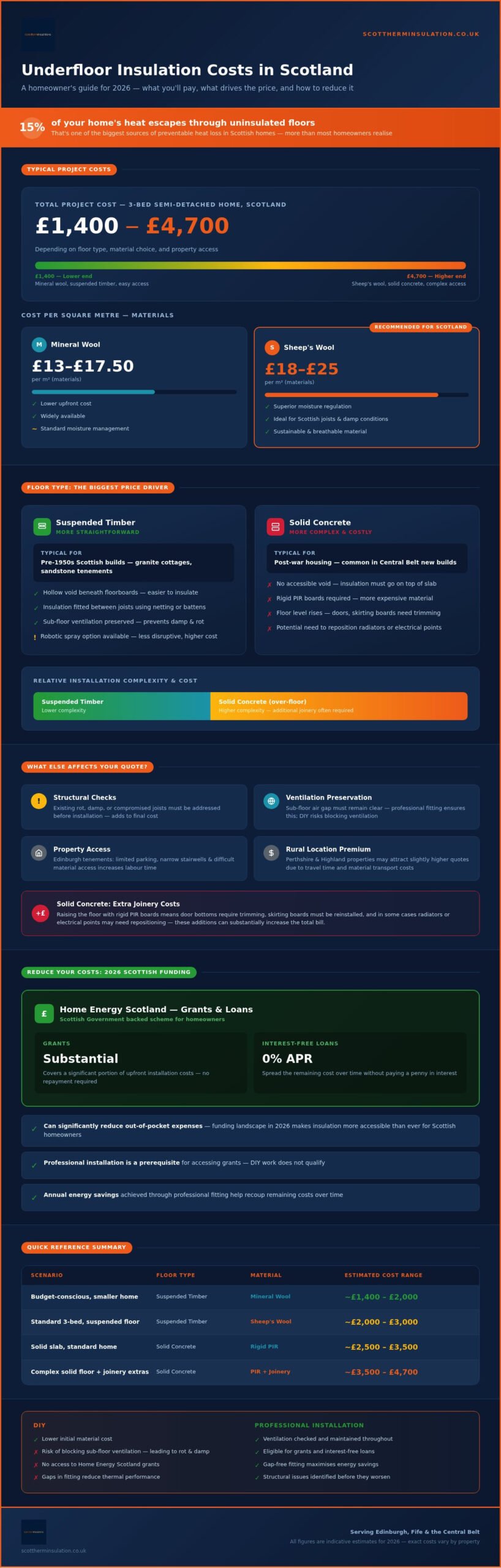
Industry data for 2026 suggests that standard mineral wool installations typically range from £13 to £17.50 per square metre for materials. However, the total floor area is only one part of the equation. For a standard three-bedroom semi-detached home in Scotland, the total project cost often sits between £1,400 and £4,700 depending on the floor type and material choice. Premium options like sustainable sheep’s wool, which offers superior moisture regulation for Scottish joists, generally command a higher price point of £18 to £25 per square metre.
Why Regional Location Affects Your Quote
Your specific postcode can influence the final bill due to logistical requirements. Projects in the Central Belt, including Edinburgh and Fife, benefit from a higher density of specialist installers and lower travel overheads. Conversely, properties in Perthshire or more rural Highland locations may see slightly higher quotes to account for extended travel time and the transport of bulky materials. Edinburgh tenement projects also present unique challenges; limited parking and difficult access for bringing materials into traditional flats can increase the labour time required compared to a modern suburban villa with easy sub-floor access.
Suspended Timber vs. Solid Concrete: The Primary Price Drivers
Scotland’s diverse housing stock means that two neighbours on the same street could face very different quotes. The primary driver is whether your home sits on a suspended timber frame or a solid concrete slab. Understanding your property’s anatomy is the first step in calculating how much does underfloor insulation cost scotland accurately. Suspended floors, typical of pre-1950s Scottish builds, offer a hollow space beneath the boards that is relatively straightforward to fill. Solid floors, common in post-war housing, require a more intensive over-floor approach that often involves structural adjustments.
Insulating Suspended Timber Floors
This method is highly effective for heat retention because it targets the void where cold air circulates. Installers carefully lift the floorboards and secure insulation between the joists using netting or support battens. This preserves the essential air gap below the insulation, which is vital for preventing damp in the Scottish climate. Whilst lifting boards is the traditional route, some homeowners opt for robotic spray insulation, which is less disruptive but often carries a higher price tag. For a detailed breakdown of the materials used in this process, see our under floor insulation guide.
The Cost of Insulating Solid Concrete Floors
Concrete floors lack an accessible void, meaning insulation must be laid on top of the existing slab. This process typically uses rigid PIR boards, which are efficient but more expensive than roll-based materials. The real cost increase comes from the knock-on effects of raising the floor level. You will likely need to pay for joinery work to trim the bottoms of doors and reinstall skirting boards. In some cases, even radiators or electrical points may need to be moved to accommodate the new height. Research suggests that solid floor insulation can be considerably more expensive per square metre than suspended timber alternatives due to these secondary requirements.
The existing floor finish also dictates the labour time. Lifting and relaying original Victorian floorboards requires a specialist touch to avoid splitting the timber. Homes with fitted carpets are often the quickest and cheapest to prepare, as the carpet can be easily rolled back and refitted. If you are unsure which category your home falls into, a professional site survey can provide a definitive answer before you commit to a full installation.
Choosing Materials: Comparing Mineral Wool and Sustainable Sheep’s Wool Costs
Selecting the right material is a decision that impacts your home’s thermal efficiency and its structural longevity. While the question of how much does underfloor insulation cost scotland is often answered with a single figure, the reality depends on whether you prioritise a lower initial outlay or the superior moisture management of natural fibres. Both mineral wool and sheep’s wool provide excellent thermal barriers, but their behaviour in the specific Scottish climate differs significantly. Material choice is a long-term investment in the health of your building, affecting everything from internal air quality to the protection of your floor joists against the elements.
Mineral Wool: The Budget-Friendly Standard
Mineral wool remains the most common choice for homeowners looking for a balance between performance and price. With material costs typically ranging from £13 to £17.50 per square metre, it is the most accessible entry point for professional insulation. This material offers high thermal resistance, known as a high R-value, which effectively traps heat within your rooms. It also provides excellent fire safety and acoustic dampening, making it a practical choice for terraced homes or busy suburban areas. Because of its cost-efficiency, mineral wool is the standard material used for many ECO4 funded projects across Scotland.
Sheep’s Wool: The Premium Sustainable Choice
For those living in traditional Scottish properties, sheep’s wool represents a premium but highly effective alternative. It generally costs between £18 and £25 per square metre, reflecting its status as a sustainable, high-performance product. The primary benefit of sheep’s wool is its natural breathability. In a climate as damp as ours, timber joists are susceptible to moisture buildup. Sheep’s wool can absorb and release moisture without losing its insulating properties, which actively protects your home’s structural timber from rot. You can learn more about these benefits on our sustainable wool insulation page.
Beyond moisture regulation, sheep’s wool is a favourite for the carbon-conscious homeowner. It requires significantly less energy to manufacture than synthetic alternatives and is completely compostable at the end of its life. Choosing this material isn’t just about heat; it is about creating a healthy, breathable environment whilst supporting sustainable practices. When calculating how much does underfloor insulation cost scotland, consider the value of this material in preventing future timber repairs and enhancing the overall air quality of your living space. Investing in quality materials now ensures your home remains resilient against the damp conditions common in Edinburgh and Fife.
Factoring in Hidden Costs and Structural Considerations in Scotland
When calculating how much does underfloor insulation cost scotland, homeowners must look beneath the surface at the practical realities of traditional building maintenance. Beyond the core materials, several variables can influence the final invoice. One of the most critical factors is the preservation of sub-floor ventilation. In our damp climate, air bricks are essential for allowing air to circulate under your joists. A professional installer will ensure these aren’t blocked during the process, as failing to maintain this airflow can lead to catastrophic moisture buildup. You might also consider “while we are at it” improvements, such as draught-proofing skirting boards, which adds a small amount to the labour bill but significantly enhances the overall thermal seal of the room.
Preparation work often forms a distinct part of the project quote. If your rooms are currently furnished or have fitted carpets, the time taken to move heavy items and carefully roll back flooring adds to the labour hours. Whilst some homeowners choose to clear the space themselves to save money, professional carpet refitting ensures a pristine finish once the insulation is secure. These structural variables are why a flat-rate estimate rarely tells the whole story of how much does underfloor insulation cost scotland for a specific property.
Dealing with Joist Rot and Damp
Scottish homes, particularly those in coastal areas like North Berwick or older parts of Stirling, are frequently prone to sub-floor damp. A pre-installation inspection is vital because it identifies wet or dry rot before work begins. Insulating over compromised timber is a mistake that leads to much higher costs in the future; it traps moisture and accelerates decay. If rot is discovered, joist repairs or replacements will be necessary. Depending on the extent of the damage, structural repairs can add several hundred pounds to a project, but addressing these issues early protects the long-term integrity of your home.
Access and Labour Day Rates
The physical layout of your sub-floor space dictates the speed of the installation. A generous crawl space allows installers to move freely and work efficiently. Conversely, a cramped or shallow void requires more time and effort, naturally increasing the cost. This is particularly relevant for ground-floor flats in Edinburgh tenements, where logistics are often more complex due to restricted access and the proximity of neighbouring pipes or services. In Scotland, the typical day rate for a professional two-person insulation team generally ranges between £300 and £400, covering the expertise required to handle these challenging environments safely.
The most effective way to avoid unexpected financial surprises is to start with a specialist assessment. You can book a professional site survey to get an accurate, no-obligation breakdown of your specific requirements.
Reducing Your Outlay: Scottish Grants and Professional Installation
The final calculation of how much does underfloor insulation cost scotland is often transformed by the generous funding landscape available to residents. Scotland maintains a distinct advantage over the rest of the UK with more robust support systems designed to combat our specific climate challenges. By leveraging these opportunities, you can bridge the gap between the initial quote and a comfortable, energy-efficient home. Beyond the immediate financial help, professional installation provides the peace of mind that your property remains compliant with Scottish Building Standards, which typically require a U-value of 0.18 W/m²K or lower when replacing more than half of a floor.
Choosing a certified installer is also a critical factor for building insurance. DIY attempts that fail to maintain proper sub-floor ventilation or use unverified materials can sometimes complicate future claims or property surveys. A professional team ensures that high-performance materials, like the 150mm mineral wool standard, are fitted precisely to meet thermal regulations whilst protecting the structural integrity of your joists. This long-term security, combined with annual energy savings of between £55 and £85, makes the investment a logical step for any homeowner in the Central Belt or beyond.
Home Energy Scotland (HES) Funding
The primary route for most homeowners is the Home Energy Scotland scheme. In 2026, this programme continues to offer a substantial grant of up to £1,500 specifically for underfloor insulation, with the option of an interest-free loan of £500 to cover the remaining balance. This combination significantly lowers the barrier to entry, often covering a large portion of the total project cost for a typical semi-detached home. For a step-by-step breakdown of how to secure this funding, consult our insulation grants Scotland guide.
ECO4 and Local Authority Flex
For low-income or vulnerable households, the UK-wide ECO4 scheme remains active until March 2026. This initiative can often provide fully funded underfloor insulation as part of a whole-house approach to energy efficiency. Eligibility is generally based on receiving certain benefits or having a total household income of £36,000 or less. At ScotTherm Insulation, we take the stress out of the paperwork by helping you navigate the eligibility process and identifying whether you qualify for local authority flexible eligibility (LA Flex). Over a ten-year period, the combination of zero upfront costs and reduced heating bills can result in total savings exceeding £800, making it one of the most effective ways to future-proof your home against rising energy prices. Understanding how much does underfloor insulation cost scotland becomes much simpler when you realise that, for many, the net cost is zero.
Secure a Warmer Future for Your Scottish Home
Navigating the variables of floor construction and material performance is the essential first step toward a more efficient property. Whether you are insulating a traditional suspended timber floor in Edinburgh or a solid concrete slab in Fife, the right technical approach protects your home’s long-term structural health. Whilst determining how much does underfloor insulation cost scotland involves several factors, the generous 2026 funding landscape through HES grants ensures that high-performance upgrades remain within reach for most households.
As local experts serving the Central Belt and North Berwick, we specialise in breathable sheep’s wool and use only Scottish Government (HES) approved materials. Our team understands the specific requirements of regional archetypes and the importance of moisture management in our damp climate. We are ready to help you transition from a draughty living space to a warm, cost-effective environment that stands the test of time.
Book Your Specialist Free Insulation Inspection Today to receive a tailored assessment for your property. Taking this proactive step today ensures your home remains a resilient and comfortable haven for many winters to come.
Frequently Asked Questions
How much does underfloor insulation cost for a standard Scottish house?
The total investment depends primarily on your floor type and the total square footage of your ground floor. Suspended timber floors are generally the most cost-effective to insulate; solid concrete floors require a more intensive process that involves raising the floor level and adjusting joinery. When calculating how much does underfloor insulation cost scotland, you must also factor in the material choice, as premium options like breathable sheep’s wool carry a higher price point than standard mineral wool. Most homeowners find that available government grants significantly offset the initial professional installation fees.
Does the Scottish Government provide grants for underfloor insulation in 2026?
Yes, there is robust support available through Home Energy Scotland (HES). In 2026, homeowners can apply for a grant of up to £1,500 to cover underfloor insulation, with the option of an interest-free loan for any remaining balance. For households with an income of £36,000 or less, the Warmer Homes Scotland scheme may provide fully funded installations. Additionally, the ECO4 scheme remains a vital resource for low-income and vulnerable residents, often covering the entire cost of the work.
Is underfloor insulation worth the cost if I already have a thick carpet?
Carpets and underlays provide a small amount of surface insulation, but they don’t stop the significant heat loss occurring through the floor structure itself. Research indicates that as much as 15% of a room’s heat escapes through uninsulated ground floors. Professional insulation creates a continuous thermal barrier that stops draughts and prevents your heating system from working overtime. This results in a more consistent ambient temperature that a carpet alone cannot achieve.
Will insulating my floors cause damp or rot in my floor joists?
Damp only becomes a risk if the installation is handled incorrectly or if ventilation is blocked. We prioritise the preservation of sub-floor airflow by ensuring air bricks remain completely clear. Using moisture-regulating materials like sheep’s wool is a strategic choice for the Scottish climate, as it allows timber joists to breathe. A professional survey before work begins is essential to identify any existing damp issues, ensuring the insulation protects your home rather than trapping moisture.
How much can I save on my energy bills with underfloor insulation in Scotland?
Typical annual savings for a household in Great Britain range from £55 to £85. While these figures vary based on your heating habits and fuel type, the real value lies in the increased thermal efficiency of the property. By reducing the demand on your boiler, you extend the lifespan of your heating system and protect your home against future energy price spikes. It’s a reliable way to lower the cost of maintaining a comfortable home in the Central Belt.
Can I stay in the house while the underfloor insulation is being installed?
You can stay in your property throughout the installation. Our team generally works room by room to ensure you always have access to your living space. If we are insulating a suspended floor by lifting boards, that specific area will be restricted for a few hours. We aim to complete most standard installations within one to two days, leaving your home tidy and secure at the end of each shift.
How long does it take for underfloor insulation to pay for itself?
The payback period is remarkably short when you utilise the 2026 Scottish grant schemes. If a grant covers the majority of the installation, the energy savings can see the project pay for itself in just a few years. Beyond the financial return, the immediate improvement in domestic well-being and the prevention of costly structural issues like wood rot provide value that far exceeds the initial outlay. It’s an investment in the long-term resilience of your property.
Do I need to lift all my furniture for the insulation to be fitted?
We recommend clearing the floor area of the rooms being treated to allow our installers to work efficiently. For suspended timber floors, we need clear access to the floorboards to fit the insulation between the joists. If you have particularly heavy items, please mention this during your initial inspection. We can then plan the logistics to ensure the process is as smooth and stress-free as possible for your household.