
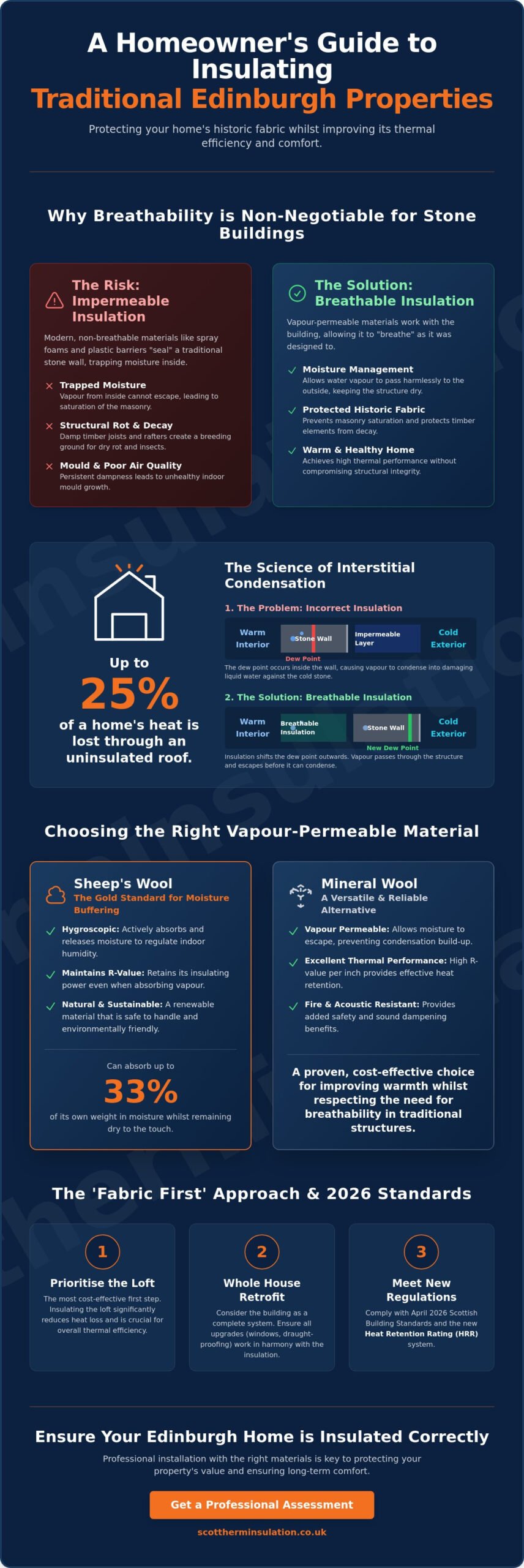
Insulating a traditional stone property with modern, impermeable materials is often the quickest way to trap moisture and cause structural rot. Breathability isn’t a luxury for Edinburgh’s older homes; it is a vital structural requirement to prevent the “suffocation” of historic stone masonry. Choosing the correct breathable insulation for older homes edinburgh is essential to ensure you respect the unique construction of your property whilst improving thermal efficiency. You likely already know the frustration of heating a draughty, high-ceilinged flat only to watch the warmth vanish through the roof. It is natural to worry that standard insulation might lead to interstitial condensation, especially with uninsulated roofs accounting for up to 25% of a home’s heat loss.
This 2026 guide explains how to achieve a warmer, more efficient home without compromising your property’s health. We will explore the April 2026 updates to the Scottish Building Standards and the new Heat Retention Rating (HRR) system arriving this autumn. You will discover how vapour-permeable materials like sheep’s wool and mineral wool protect your masonry whilst reducing energy bills. We will also cover the “whole house” retrofit approach required to meet modern regulations and how to properly insulate your Edinburgh home for long-term comfort and value.
Key Takeaways
- Discover why vapour-permeable materials are essential for protecting the historical fabric of Edinburgh’s stone tenements from moisture damage.
- Compare the benefits of sheep’s wool and mineral wool to find the best breathable insulation for older homes edinburgh.
- Learn how the “Fabric First” approach ensures your thermal upgrades comply with the 2026 Scottish Building Standards and the new Heat Retention Rating.
- Understand the critical difference between liquid water and water vapour to prevent interstitial condensation within your walls.
- Identify why prioritising loft insulation is the most cost-effective way to reduce heat loss whilst maintaining building breathability.
Why Older Edinburgh Homes Require Breathable Insulation
Edinburgh’s architectural heritage is defined by its iconic sandstone tenements. While these structures look impenetrable, they were designed as dynamic systems that manage moisture through their very fabric. In the context of building science, breathability refers to vapour permeability; the ability of a material to allow water vapour to pass through it. Traditional pre-1919 properties rely on this movement to stay dry. The new 2026 Scottish Building Standards, effective from 6 April, highlight the need for sensitive conversions of these traditional buildings. Attempting to meet modern energy targets by “sealing” these homes with non-breathable plastics or spray foams often leads to structural failure. Finding the correct breathable insulation for older homes edinburgh allows you to improve warmth without trapping dampness.
The Unique Construction of Edinburgh Tenements
Solid stone walls are inherently hygroscopic, meaning they naturally absorb and release moisture from the atmosphere. Historically, this “breathing” cycle was supported by lime mortars and lath-and-plaster finishes. These materials act as a buffer against Edinburgh’s damp, coastal air. The Science of Moisture Buffering explains how this process prevents internal humidity from reaching damaging levels. When homeowners install modern, impermeable barriers, they disrupt this cycle. Moisture becomes trapped against the cold stone, leading to saturated masonry that loses its insulating properties and compromises the building’s integrity.
The Consequences of Incorrect Insulation
The most significant risk of using non-breathable materials is interstitial condensation. This is moisture that condenses into liquid water inside the wall structure itself, hidden from view. Over time, this trapped dampness migrates to timber joists and rafters. In the cool, wet Scottish climate, this creates the perfect environment for dry rot and wood-boring insects. Beyond structural decay, poor breathability often manifests as persistent indoor mould growth. This isn’t just an aesthetic issue; it impacts the air quality and health of the residents. By choosing the correct breathable insulation for older homes edinburgh, you can respect the history of your property whilst securing its future.
The Science of Moisture Buffering and Thermal Performance
Traditional stone buildings don’t just stand; they function as a living envelope. When we discuss breathable insulation for older homes edinburgh, we are describing materials that act as a “third lung” for the property. This system allows the building to inhale and exhale water vapour, which is a natural byproduct of modern living. It is vital to distinguish between liquid water, such as a roof leak, and water vapour generated by breathing, cooking, or showering. While liquid water must be excluded, water vapour must be allowed to migrate through the walls to prevent internal saturation. Breathable materials manage this vapour movement without sacrificing thermal performance.
A critical factor in protecting Edinburgh’s masonry is the management of the “dew point”. This is the specific temperature at which water vapour turns back into liquid. In an uninsulated stone wall, this often occurs within the stone itself. By applying the correct thickness of vapour-permeable insulation, we shift this dew point further towards the external face of the building. This prevents moisture from condensing against the internal structural fabric, which protects the stone from freeze-thaw cycles and internal decay. High-quality breathable materials maintain their R-value even when slightly damp, ensuring your home remains warm during the humid winter months typical of the Lothians.
How Vapour Permeable Materials Work
Natural fibres, such as sheep’s wool, possess a unique molecular structure that allows them to absorb and release moisture without losing their loft or insulating power. Sheep’s wool is often considered the gold standard for Edinburgh’s high-humidity coastal air because it can absorb up to 33% of its own weight in moisture while remaining dry to the touch. Moisture buffering is the active regulation of internal humidity levels to prevent structural saturation and extend the lifespan of traditional masonry. Understanding these properties allows for a more comfortable indoor climate and lower heating costs. You can find further guidance on insulating older properties through official conservation resources.
Thermal Mass vs. Insulation in Traditional Buildings
Success lies in balancing the natural heat-retention (thermal mass) of thick stone walls with modern insulation layers. Adding too much insulation can sometimes be as detrimental as adding too little if it blocks essential airflow within the building’s cavities. For loft spaces, the current recommendation is a 270mm depth of insulation to meet modern energy efficiency standards whilst maintaining a healthy building. This specific depth provides the optimal balance between heat retention and breathability. Ensuring your project respects these ratios is the best way to achieve long-term comfort. If you are unsure about the specific requirements for your property, speaking with a local specialist can provide clarity on the best material depth for your specific tenement or villa.
Comparing Breathable Materials for Scottish Climates
Selecting the right material for a traditional retrofit requires a balance of thermal performance, moisture management, and environmental impact. In the damp Scottish climate, not all materials perform equally under pressure. Wood fibre boards, mineral wool, and sheep’s wool are the primary contenders for those seeking breathable insulation for older homes edinburgh. Natural fibres are increasingly the preferred choice in 2026. These materials possess a lower carbon footprint and offer superior moisture handling compared to their synthetic counterparts. Unlike rigid foams, natural breathable materials don’t just block heat; they actively manage the internal environment to prevent dampness.
Fire safety and acoustic performance are additional factors that distinguish these materials. Mineral wool and sheep’s wool both offer excellent fire resistance and can significantly reduce noise transfer between rooms or from the street. This is a major benefit for residents in busy Edinburgh tenements. Natural materials also tend to maintain their efficiency better in high-humidity conditions. While some synthetic materials lose their R-value when moisture builds up on their surface, breathable natural fibres continue to perform reliably.
Sheep’s Wool vs. Mineral Wool
Sheep’s wool is a premium insulation choice that provides unique benefits for historic masonry. It can absorb up to 33% of its own weight in moisture without losing its insulating loft or warmth. This characteristic allows it to draw dampness away from vulnerable timber joists. Mineral wool is a highly effective, non-combustible alternative that remains a more budget-friendly option for many homeowners. Both materials are far superior to modern plastics for traditional buildings. Installation of natural wool is notably safer for the household. It contains no harmful VOCs and doesn’t produce the “itchy” fibres associated with older glass wool products. While the initial investment for natural wool is higher, the long-term protection it offers to the building’s fabric helps preserve the property’s market value.
Natural Fibres vs. Synthetic Foams
Synthetic foams like PIR boards are common in modern construction but pose a significant risk to older structures. These boards are entirely impermeable. When fitted into traditional lofts or underfloor spaces, they create “cold bridges” where moisture inevitably condenses against the stone or timber. This leads to hidden rot that can go undetected for years. ScotTherm prioritises the use of sheep’s wool insulation for traditional projects because it works in harmony with the building. Choosing the correct breathable insulation for older homes edinburgh ensures that your energy efficiency upgrades don’t inadvertently cause structural decay. Natural fibres ensure the building envelope remains vapour-permeable and structurally sound.
Practical Steps for Insulating Your Traditional Property
Adopting a “Fabric First” strategy is the most reliable way to upgrade a traditional building. This approach prioritises the building envelope as a single, functioning unit rather than a collection of isolated rooms. For many residents, the loft is the most effective starting point for breathable insulation for older homes edinburgh. It addresses the 25% of heat loss typically seen through uninsulated roofs. However, ground-floor tenement dwellers must also consider underfloor insulation to prevent warmth from escaping into the cold solum below. While breathable materials manage vapour movement, controlled ventilation remains essential to remove moist air from the living space without creating draughts.
Loft Insulation in Older Homes
Precision is vital during installation to protect the structural integrity of your roof. Maintaining a 40mm gap between the insulation and the sarking boards is a critical requirement based on Historic Environment Scotland guidelines. This clear channel ensures air continues to circulate over the timber, preventing condensation from settling on the wood. Coomb ceilings, which follow the slope of the roof, are notoriously difficult to treat. These areas require high-performance, vapour-permeable materials to prevent dampness from becoming trapped in the narrow rafters. Installing 270mm of natural sheep’s wool provides the optimal thermal resistance required by Scottish standards whilst ensuring the roof space remains dry and ventilated.
Underfloor and Room-in-Roof Considerations
Suspended timber floors are a common feature in Edinburgh’s historic villas and tenements. You must insulate these by supporting the material between the joists, ensuring the solum (the ground beneath the floor) remains well-ventilated to avoid joist rot. In attic conversions, using vapour-open membranes is vital for “warm roof” designs. These membranes allow moisture to escape outwards while preventing wind-wash from reducing the insulation’s effectiveness. Managing the transition between different materials in complex older layouts is where professional expertise pays off. If you are ready to improve your property’s efficiency, book a survey with our Edinburgh specialists to discuss a tailored, breathable insulation plan for your home.
The 2026 Scottish Building Standards place a heavy emphasis on the “whole house” retrofit. This means ensuring that every intervention, from the loft to the floor, works in harmony. By choosing materials that respect the hygroscopic nature of stone, you ensure your home stays warm and the masonry remains dry. This holistic approach is the only way to meet modern energy targets without risking the long-term health of your property’s historical fabric.
Professional Installation with ScotTherm Insulation in Edinburgh
We understand that while official advice provides a necessary foundation, the actual installation of breathable insulation for older homes edinburgh requires a high degree of technical precision. The team at ScotTherm Insulation serves homeowners across Edinburgh, Fife, and Stirling, providing a reliable path from expert consultation to certified completion. We remain fully committed to using high-performance, vapour-permeable materials that meet the rigorous April 2026 updates to the Scottish Building Standards. We don’t just supply insulation; we ensure your property remains a healthy, functional environment for decades to come.
Navigating the financial side of energy efficiency is a priority for our clients. We actively help homeowners access insulation grants in Scotland for 2026. This includes the Home Energy Scotland grant, which provides up to £7,500 towards energy efficiency measures for eligible households. By choosing a TrustMark approved installer like ScotTherm Insulation, you ensure your project meets the strict requirements for these vital funding streams. Our work also prepares your property for the new Heat Retention Rating (HRR) framework arriving this autumn, which will measure the actual effectiveness of your building’s fabric in retaining heat.
Our Specialist Survey Process
Every project begins with a comprehensive specialist survey to assess your property’s unique moisture profile. We identify any existing damp issues or structural vulnerabilities before any insulation is introduced. This proactive approach prevents the accidental trapping of moisture behind new layers. We tailor our material recommendations to the specific orientation of your walls and the intended use of each room. This disciplined process ensures all work complies with current Scottish building regulations for traditional properties whilst maximising your thermal comfort. Our surveyors take a “whole house” view, considering how each element of the building envelope interacts with the others.
Why Local Knowledge Matters
Edinburgh’s coastal position brings specific challenges, particularly wind-driven rain that can saturate external masonry. Understanding these local weather patterns is essential for selecting the right insulation depth and material. ScotTherm Insulation has a long history of working in conservation areas and listed buildings across the Central Belt, ensuring that historical fabric is never compromised. Selecting the correct breathable insulation for older homes edinburgh is the most effective way to secure your property against the Lothian climate. Contact ScotTherm Insulation today for a specialist insulation assessment to protect your traditional home for the future.
Protecting Your Historic Home for the Next Generation
Upgrading a traditional Edinburgh property requires a deep respect for its original construction. We have explored why vapour permeability is essential for maintaining dry masonry and how natural materials like sheep’s wool act as a vital buffer against our damp climate. By following a “Fabric First” approach and adhering to the 2026 Scottish Building Standards, you can achieve a warmer home while eliminating the risks of hidden rot and condensation. Selecting the right breathable insulation for older homes edinburgh is not just about comfort; it is a strategic investment in the long-term preservation of your building’s historical fabric.
ScotTherm Insulation provides the regional expertise needed to handle these complex retrofits with precision. As specialists in traditional Scottish building fabric and expert installers of sustainable sheep’s wool, we offer a dedicated local service across Edinburgh, Fife, and Stirling. Our team ensures that your thermal improvements are both legally compliant and structurally sound. Book your specialist breathable insulation survey with ScotTherm Insulation to start your journey towards a more efficient, healthier home. We look forward to helping you create a cosy, sustainable environment that stands the test of time.
Frequently Asked Questions
Is sheep’s wool insulation really breathable for stone houses?
Sheep’s wool is inherently breathable and specifically suited for the solid stone walls found in traditional Scottish houses. It is a hygroscopic material, meaning it can absorb approximately 33% of its own weight in moisture without losing its thermal efficiency or loft. This unique ability allows it to manage humidity levels within the building fabric actively. It prevents moisture from saturating your masonry, making it an ideal choice for the humid Edinburgh climate.
Can I use standard glass wool in my Edinburgh tenement loft?
You can use mineral wool in a tenement loft as it is vapour permeable, but it does not offer the same moisture buffering benefits as natural fibres. While it allows vapour to pass through, it cannot absorb and release moisture in the same way sheep’s wool does. Using the correct breathable insulation for older homes edinburgh is essential to avoid the “sealed box” effect. ScotTherm Insulation ensures that any installation maintains the necessary airflow to protect your roof timbers.
How thick should breathable insulation be to meet 2026 standards?
To meet current Scottish energy standards, the recommended depth for loft insulation is 270mm. This thickness is designed to achieve a target U-value of 0.16 W/m²K, which is the standard for modern retrofit projects. For underfloor or room-in-roof applications, the required depth may vary based on your property’s specific structural constraints. The surveyors at ScotTherm Insulation determine the optimal thickness during an initial assessment to ensure maximum heat retention.
Will breathable insulation prevent mould in my older home?
Breathable insulation significantly reduces the risk of mould by preventing interstitial condensation from forming inside your walls. It allows water vapour to migrate safely through the building fabric instead of trapping it against cold surfaces. However, insulation must be paired with adequate ventilation to be fully effective. While it protects the structure, you still need controlled airflow to remove the moisture generated by daily activities like cooking and showering.
Does breathable insulation cost more than standard materials?
Natural breathable materials like sheep’s wool generally require a higher initial investment than standard mineral wool or synthetic foams. This reflects the sustainable sourcing of the fibres and their superior ability to protect historical masonry. Many homeowners view this as a necessary cost for the long-term health of their property. Investing in high-quality breathable materials helps prevent expensive structural repairs caused by dampness and rot in the future.
Do I need a warrant for insulating an older home in Edinburgh?
A building warrant is not typically required for simple loft insulation, but listed building consent is often necessary for Edinburgh’s historic properties. If your home is located within a conservation area, you should always check with the City of Edinburgh Council before commencing work. We recommend verifying the status of your property early in the planning process. ScotTherm Insulation can provide guidance on whether your project falls under permitted development rules.
How long does it take to install breathable insulation in a typical flat?
A professional installation in a standard Edinburgh flat usually takes between one and two days to complete. This timeframe includes the preparation of the space and the precise fitting of the materials to ensure no cold bridges are created. More complex projects, such as insulating suspended timber floors, may require additional time. ScotTherm Insulation provides a specific schedule of works following a specialist survey so you know exactly what to expect during the process.
Can I combine breathable insulation with existing draught proofing?
Combining breathable insulation for older homes edinburgh with professional draught proofing is the most effective way to improve your home’s thermal comfort. Insulation works to retain heat within the fabric, while draught proofing stops cold air from entering through gaps in windows and doors. It is vital to ensure that draught proofing does not entirely eliminate the natural ventilation your home requires. A balanced approach ensures a warm environment without compromising the building’s natural “breathing” cycle.