
Did you know that up to 25% of your home’s heat escapes directly through an uninsulated roof? In a city where 45,100 households currently face fuel poverty, securing loft insulation grants edinburgh residents can trust is no longer just an environmental choice; it’s a vital financial strategy. You’ve likely felt the frustration of rising heating costs whilst trying to decipher the complex eligibility rules for ECO4, GBIS, and Warmer Homes Scotland. We understand the specific worry that shared tenement roofs or historic stone buildings might be excluded from these modern energy initiatives.
This guide confirms how you can access 100% funding to transform your home’s thermal efficiency and comfort. We promise to clarify the latest 2026 eligibility criteria for every property type, ensuring you don’t miss out on government-backed support before the March deadlines. You’ll learn how to find a certified local installer and discover how a professional installation can reduce your annual energy bills by up to £445, providing the long-term security and domestic well-being your family deserves.
Key Takeaways
- Identify the specific 2026 funding landscape in Scotland, including how local government schemes offer unique advantages compared to standard UK programmes.
- Confirm your eligibility for 100% funding by comparing benefit-led criteria with the local “Flex” route for loft insulation grants edinburgh homeowners.
- Determine whether standard mineral wool or sustainable sheep’s wool is the most effective thermal solution for your property’s specific architectural style.
- Navigate the legal and practical complexities of insulating shared tenement roofs by understanding common parts regulations and neighbour consensus.
- Follow a verified roadmap to secure your grant, covering everything from essential 2026 documentation to booking a certified professional inspection.
Understanding Loft Insulation Grants in Edinburgh for 2026
Edinburgh’s architectural beauty often hides a cold reality. Thousands of homes across the Lothians struggle with significant heat loss through aging or insufficient roof structures. By 2026, the landscape for loft insulation grants edinburgh residents can access has become more targeted; it focuses heavily on lifting the estimated 45,100 local households out of fuel poverty. Unlike previous years where funding felt fragmented, the current system is a streamlined effort to meet Scotland’s ambitious climate targets whilst protecting residents from volatile energy markets.
The Scottish Government’s approach to domestic energy differs significantly from the rest of the UK. While Westminster oversees the broad Energy Company Obligation (ECO), Scotland utilises Home Energy Scotland and local delivery partners like Changeworks to provide a more hands-on, regional service. This ensures that Edinburgh’s unique housing stock, from stone-built villas to traditional tenements, receives insulation that meets modern UK home energy efficiency standards. It isn’t just about rolling out rolls of mineral wool. It’s about a “fabric-first” methodology that prioritises the building’s envelope before considering expensive heating upgrades.
The ECO4 Scheme vs. The Great British Insulation Scheme
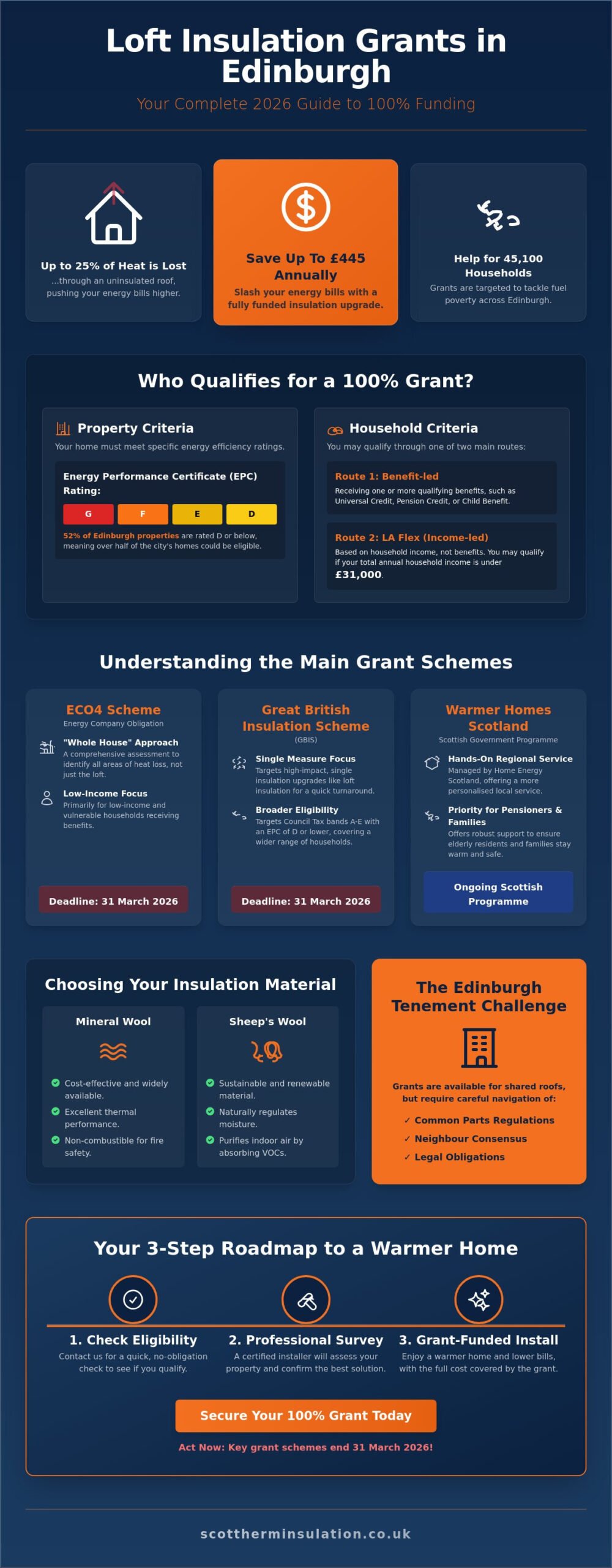
ECO4 remains the flagship programme for low-income and vulnerable households, adopting a “Whole House” approach. If you qualify, you won’t just get a loft top-up. You’ll receive a comprehensive energy assessment to identify every area where heat escapes. Conversely, the Great British Insulation Scheme (GBIS) serves a much broader demographic. It targets properties in Council Tax bands A to E with an EPC rating of D or lower. For many in the Lothians, GBIS offers the quickest route to securing loft insulation grants edinburgh homeowners need because it focuses on high-impact, single measures without the complexity of a full-house retrofit.
Why 2026 is a Critical Year for Scottish Grants
Time is the most significant factor this year. Both ECO4 and GBIS are currently scheduled to conclude their current phases on 31 March 2026. This deadline creates a genuine sense of urgency for homeowners who haven’t yet upgraded their thermal protection. Edinburgh’s own net-zero targets are also accelerating grant approvals, as the city council aims to lead the way in sustainable urban living. With 2026 energy price caps still keeping monthly bills high, the “payback period” for insulation has effectively vanished. When the government covers the installation cost, the financial benefit to your household budget is immediate. Don’t wait until the winter chill returns to start your application.
Who Qualifies for Free Loft Insulation in Edinburgh?
Determining your eligibility for loft insulation grants edinburgh residents can access is the first step toward a warmer, more efficient home. A common misconception is that these schemes are strictly reserved for those on means-tested benefits. In 2026, the criteria are broader, designed to capture a wider demographic of the Lothian population. The primary gateway remains the Energy Company Obligation (ECO4), which prioritises homeowners and private tenants receiving specific support such as Pension Credit, Universal Credit, or Income Support. However, even if you don’t receive these, you aren’t necessarily excluded from funding.
The City of Edinburgh Council operates the “Flex” route, also known as LA Flex. This allows local authorities to recommend households for insulation funding based on vulnerability or low income rather than benefit status alone. Currently, households with a total annual income under £31,000 may qualify for support. Your property’s physical characteristics are equally important. To meet the technical requirements for most 2026 grants, your home must have an Energy Performance Certificate (EPC) rating of D, E, F, or G. Research indicates that approximately 52% of properties in the Edinburgh area currently hold an EPC rating of D or below, meaning over half of the city’s housing stock could potentially benefit from these measures.
Grants for Pensioners and Families in the Lothians
Pensioners and families receive specific prioritisation under the Warmer Homes Scotland programme. This scheme offers robust protections for elderly residents, ensuring they can maintain a comfortable indoor temperature without financial strain. Families receiving Child Benefit also have a unique advantage, as this now acts as a qualifying gateway for many insulation measures. Whether you live in a private rental or own your home, these grants are designed to be accessible. If you’re unsure about your status, you can check your grant eligibility with our local team today.
The EPC Rating Hurdle
Your EPC rating is the definitive metric used by surveyors to approve grant funding. You can check your property’s current status on the official Scottish EPC Register. If your certificate has expired (they typically last 10 years) or your home has never been assessed, a new survey is usually the first requirement of the application process. The shift toward a “D” rating cut-off reflects a national effort to target the least efficient homes first. For more technical details on how these ratings are calculated and the benefits of different materials, the Energy Saving Trust loft insulation guide provides an excellent benchmark for homeowners.
Comparing Grant-Funded Materials: Mineral Wool vs. Sheep’s Wool
Most loft insulation grants edinburgh applications result in the installation of mineral wool. It’s a reliable, industry-standard material that offers excellent thermal resistance by trapping air within its dense, glass or stone-based fibres. For many households, this standard install is completely free and provides the necessary 270mm depth required by current Building Regulations to achieve a U-value of 0.16 W/m²K or lower. However, the Lothians present a specific environmental challenge. The coastal “sea haar” and high humidity levels mean your loft isn’t just dealing with cold; it’s dealing with moisture. While mineral wool performs well in dry conditions, it doesn’t possess the natural hygroscopic properties found in premium alternatives.
For those living in traditional stone properties, there’s a compelling case for sustainable sheep’s wool insulation. Sheep’s wool is a high-performance material that can absorb and release moisture without losing its insulating properties. This is a critical distinction for Edinburgh’s heritage housing stock. If your loft insulation grants edinburgh application covers only standard materials, some homeowners choose to “top up” the funding with their own capital to upgrade to these high-performance, natural fibres. This hybrid approach allows you to benefit from Scottish Government energy saving grants whilst ensuring your home has the best possible protection against the unique dampness of the Scottish climate. It’s a practical way to combine state support with a long-term investment in your building’s health.
Handling Damp and Condensation in Older Roofs
Traditional mineral wool can sometimes struggle in older, non-ventilated lofts because it can trap moisture if the roof isn’t perfectly sealed. When synthetic wool becomes damp, it can compress over time, which significantly reduces its thermal effectiveness. In contrast, sheep’s wool wicks moisture away from the timber structure, acting as a natural regulator for the building’s “breathability.” This prevents the growth of mould and rot in the roof timbers. Regardless of the material you choose, we ensure every grant-funded installation includes adequate eaves ventilation and pipe lagging to prevent the build-up of condensation in the colder months.
The Long-Term ROI of Premium Materials
Choosing wool insulation isn’t just about immediate warmth; it’s a strategic investment in your property’s future. Natural fibres have a significantly longer lifespan than many synthetic alternatives, often lasting the lifetime of the building without any loss of performance. In the competitive Edinburgh property market, eco-conscious buyers increasingly look for “low-carbon” credentials and sustainable building materials. A home insulated with high-value, natural materials often commands better interest and a higher resale value. It’s the preferred choice for those who prioritise environmental responsibility alongside technical proficiency and long-term financial efficiency.
The Edinburgh Tenement Challenge: Grants for Shared Roofs
Tenements are the heartbeat of our city, but their shared roof structures often complicate energy upgrades. In Edinburgh, roofs are legally classified as “Common Parts.” This designation means that whilst the top-floor resident feels the cold most acutely, the responsibility for maintenance and improvement typically rests with all owners in the block. Securing loft insulation grants edinburgh for these buildings requires a clear understanding of your title deeds and the consensus of your neighbours or property factor. Most tenement residents find that open communication is the best starting point for a successful application.
Technical constraints often deter tenement owners. Accessing high-ceilinged lofts via narrow hatches in a communal stairwell requires specialist equipment and careful planning. These lofts often house shared water tanks and complex pipework that must be professionally lagged to prevent freezing once the insulation is installed. If a top-floor flat qualifies for ECO4 funding, the work can often proceed for that specific section of the roof, provided there is agreement on access. However, the most effective results come from block-wide upgrades that treat the building as a single thermal unit.
Organising a Collective Grant Application
Applying as a group significantly increases your chances of success. Organisations like Changeworks specialise in tenement coordination, helping owners navigate the legalities of shared repairs and funding. Area-based schemes in Sighthill and Drylaw have successfully demonstrated this model. In these areas, entire blocks were upgraded simultaneously through local council initiatives. This collective approach reduces the administrative burden on individual owners and makes the project more attractive to certified installers who can work more efficiently across multiple properties.
Listed Buildings and Conservation Areas
If your home is in the New Town or Old Town, you may worry about planning restrictions. Generally, internal loft insulation is considered a non-invasive measure and does not require formal planning permission. It’s still vital to work with expert loft insulation fitters who understand the nuances of heritage rules. Using breathable, natural materials is often a requirement from conservation officers to ensure the historic stone structure remains healthy and free from trapped moisture. To navigate the complexities of shared roofs and heritage requirements, book a specialist tenement insulation survey with our Edinburgh team today.
How to Apply: Your Roadmap to a Warmer Edinburgh Home
Securing loft insulation grants edinburgh homeowners deserve involves a straightforward, five-step process designed to ensure your property meets the highest safety and efficiency standards. In 2026, the application pathway is more streamlined than ever, focusing on technical precision and verified results. Your journey begins with a simple documentation check. You’ll need to provide proof of residency, your property’s Council Tax band, and, if applying via the ECO4 route, evidence of qualifying benefits or household income statements. Having these ready prevents unnecessary delays during the initial verification phase.
Once your eligibility is confirmed, the following stages move quickly:
- Book a Specialist Inspection: A qualified professional visits your home to assess the loft space. This isn’t just a quick look; it’s a formal requirement for grant approval.
- The Technical Survey: The surveyor measures your current insulation depth against the 270mm regulatory target. They also conduct a vital dampness and ventilation check to ensure the structure can “breathe” once the new material is installed.
- Installation Day: Professional Scottish contractors typically complete the work within a few hours. They handle the heavy lifting, ensuring all pipework is lagged and eaves are kept clear for airflow.
- Certification and EPC Update: After the fitters finish, you receive a PAS2030:2019 certificate. This document is essential for updating your Home Energy Scotland records and your property’s EPC rating.
Choosing Local Edinburgh Installers
Selecting a local specialist is a strategic decision for your home’s long-term health. National companies often operate through distant call centres and lack an understanding of the specific humidity and architectural challenges of the Lothians. When evaluating your options, it’s worth understanding how to identify certified loft insulation installers in Scotland who meet the 2026 standards for breathable, climate-appropriate solutions. ScotTherm Insulation remains the preferred choice for residents because our team lives and works in this climate. We ensure every project adheres to TrustMark and PAS2030:2019 certifications, which are non-negotiable requirements for government-backed funding. This local expertise guarantees that your insulation is fit for purpose, protecting your building’s fabric whilst maximising your financial savings.
Beyond the Grant: Combining with Other Services
Many homeowners choose to enhance their project by adding loft boarding whilst the installers are on-site. It’s a practical way to regain storage space, but it must be done correctly. One common mistake is squashing new insulation under standard boards, which destroys the material’s thermal effectiveness. We recommend raised loft flooring systems that sit above the 270mm insulation layer. You might also consider integrating a new, draught-proof loft ladder. These additions aren’t usually covered by the grant itself, but coordinating them during the insulation phase is the most cost-effective way to upgrade your home’s functionality and value simultaneously.
Secure Your Path to a Warmer Edinburgh Home
Securing a more cost-effective and comfortable living environment in the Lothians is a practical reality within the 2026 funding landscape. By understanding the specific requirements of the ECO4 and HES schemes, you can navigate the route to 100% funding before the critical March deadlines. Whether you reside in a modern villa or a complex shared tenement, the loft insulation grants edinburgh residents can access provide a vital shield against volatile energy prices and the damp Scottish climate.
As TrustMark Registered Installers and specialists in traditional Scottish properties, we provide the expert guidance on ECO4 and HES funding you need to ensure a successful installation. We prioritise your domestic well-being whilst delivering the technical proficiency and long-term value your household deserves. Don’t let your hard-earned money escape through an uninsulated roof when government-backed support is readily available.
Check Your Eligibility for an Edinburgh Loft Insulation Grant Today and take the first step toward a more sustainable, energy-efficient future. You don’t have to face another cold winter with an inefficient home; the support is waiting for you.
Frequently Asked Questions
How do I know if I qualify for a loft insulation grant in Edinburgh?
Qualification depends on your property’s EPC rating and your household income or benefit status. You generally qualify if your home is rated D or below and you receive qualifying benefits or have a total household income under £31,000. It’s vital to check the official Scottish EPC Register to verify your current rating before starting your application for loft insulation grants edinburgh support.
Is loft insulation completely free under the ECO4 scheme?
Yes, the ECO4 scheme provides 100% funding for eligible households, covering both premium materials and professional labour. Because this scheme follows a “Whole House” approach, you might also receive additional measures like underfloor insulation to ensure maximum thermal efficiency. There are no hidden costs or repayments required for those who meet the specific 2026 criteria.
Can I get a grant if I live in a top-floor Edinburgh tenement?
You can certainly apply for funding if you live in a top-floor tenement flat. Whilst the legalities of “Common Parts” require agreement from other owners or your property factor, the funding is available for these traditional builds. Collective applications often streamline the process for shared roof spaces, ensuring the entire building benefits from improved heat retention.
What is the Great British Insulation Scheme and how does it apply to Scotland?
The Great British Insulation Scheme (GBIS) provides single-measure insulation grants to a broader range of households than ECO4. In Scotland, it’s available until 31 March 2026 for homes in Council Tax bands A to E with an EPC rating of D or lower. It’s an ideal route for residents who don’t qualify for benefit-led support but still need to improve their home’s energy efficiency.
Do I need to be on benefits to get help with insulation costs in 2026?
You don’t need to be on benefits to access help with insulation costs this year. The LA Flex route allows the City of Edinburgh Council to approve funding for households with a total income under £31,000 or those deemed vulnerable. Additionally, the GBIS scheme focuses on property characteristics rather than personal financial status, making it accessible to many more residents across the Lothians.
How much can I save on my energy bills with new loft insulation?
Properly insulating your loft can save a typical semi-detached house up to £270 per year on energy bills. For larger detached homes in Edinburgh, these annual savings can reach up to £445. Because heat rises, stopping the 25% of warmth that escapes through an uninsulated roof provides an immediate and tangible return on the installation whilst improving your domestic well-being.
Will the grant cover the removal of my old, damp insulation?
Grant funding typically covers the installation of new materials rather than the removal of existing, degraded insulation. If your current loft contents are damp or contaminated, a specialist must remove them before the new mineral or sheep’s wool can be laid. This preparation ensures the building’s fabric remains healthy and the new insulation performs at its peak thermal capacity for decades.
How long does the application and installation process take in Edinburgh?
The timeline from your initial enquiry to the final installation usually spans four to six weeks. The verification of your documents and the technical survey take the most time, whilst the actual installation is usually completed in less than half a day. Booking your assessment early is essential as demand increases significantly as the 2026 deadlines approach.