
Thicker insulation isn’t always better for a Scottish home; in fact, installing the wrong internal wall insulation is the quickest way to ruin traditional stonework through trapped moisture. If you’re living in one of the 600,000 traditional Scottish properties built before 1919, you likely feel the bite of the winter wind right through your walls. It’s exhausting to pay rising energy bills only to remain huddled in the one “warm” room whilst the rest of the house stays damp and draughty. You deserve a home that feels like a sanctuary, free from the persistent threat of mould and cold spots.
In this 2026 guide, you’ll discover how the right approach to thermal upgrades can slash your heating requirements whilst protecting your property’s structural health. We’ve compiled this FAQ to address your concerns about interstitial condensation and cost-effectiveness with the authority of a fully approved specialist. We’ll walk you through the essential materials, the latest Scottish building standards, and the proven steps to achieving maximum savings and comfort in your home today.
Key Takeaways
- Learn why internal wall insulation is the definitive solution for traditional Scottish properties with solid stone or brick walls.
- Discover the science of breathability and why moisture management is the top priority for protecting your home’s structural integrity.
- Compare the benefits of PIR boards and Mineral Wool to identify which high-performance material suits your specific room requirements.
- Find out how to organise a room-by-room installation to minimise household disruption whilst upgrading your living space.
- Understand the impact of thermal upgrades on your EPC rating and how they contribute to maximum savings on your annual heating bills.
What is Internal Wall Insulation and Why is it Essential for Scotland?
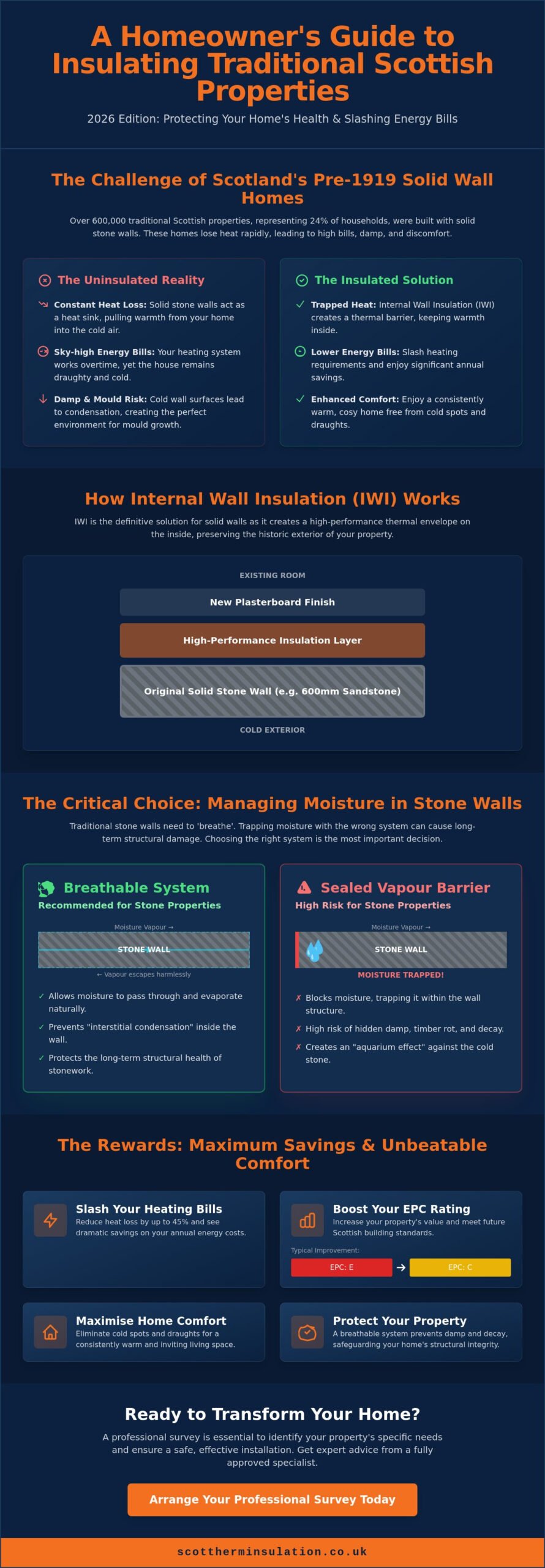
Internal wall insulation involves fixing a high-performance thermal layer to the inner face of your property’s perimeter walls. This process creates a robust thermal envelope that traps heat inside the living space rather than letting it bleed through the masonry. For the 24% of Scottish households living in solid-wall properties, this is often the only viable way to achieve modern efficiency levels. Internal wall insulation is the primary method for insulating pre-1919 Scottish properties to modern thermal standards.
Traditional Scottish construction relies on thick sandstone or granite blocks. Unlike modern homes built after 1945, these buildings don’t have a cavity to fill. Injecting insulation is impossible because there is no gap between the inner and outer layers of the wall. Without a thermal barrier, these solid walls act as a heat sink, absorbing warmth from your radiators and radiating it directly into the cold Scottish air. This leads to the draughty, uninviting atmosphere that many homeowners in the Central Belt know all too well.
The Scottish Government’s Heat in Buildings Strategy identifies 2026 as a pivotal year for homeowners to begin upgrading their properties. To meet future EPC requirements, uninsulated masonry must be addressed to reduce carbon output and fuel poverty. By installing internal wall insulation, you ensure your home stays ahead of evolving regulations whilst securing maximum savings and comfort. It’s a proactive step that transforms an old building into a high-performance, eco-friendly home.
The Challenge of Solid Wall Properties in Edinburgh and Fife
Edinburgh’s iconic tenements often feature 600mm thick stone walls. Whilst these are structurally sound, they offer poor thermal resistance compared to a modern 300mm insulated cavity wall. In coastal regions like Fife, homeowners face the added challenge of wind-wash. This is where high wind speeds strip heat from the external masonry at an accelerated rate, making the interior surface feel freezing to the touch. IWI stops this thermal transfer, ensuring that the heat you pay for stays exactly where you need it.
Internal vs External Wall Insulation: The Scottish Perspective
Choosing between internal and external options often comes down to local planning rules. In conservation areas across Stirling, Perthshire, and Edinburgh, external cladding is frequently prohibited to preserve the historic stone aesthetic. Internal wall insulation provides a discrete alternative that maintains the building’s character from the street. For mid-terrace homes, IWI is often more cost-effective as it avoids the need for expensive scaffolding and weather-dependent external works, allowing for a more controlled and reliable installation timeline.
Managing Moisture: Why Breathability Matters in the Central Belt
In the Central Belt, moisture isn’t just an outdoor problem; it’s a structural challenge. When you install internal wall insulation, you change how your house “breathes.” Traditional stone walls are porous. They absorb moisture from driving rain and release it naturally through evaporation. If you seal these walls with non-breathable materials, you risk trapping water within the masonry. This leads to the “dew point” shifting. The dew point is the temperature where air can no longer hold water vapour, causing it to turn into liquid. In an uninsulated home, this usually happens on the wall surface. With insulation, it can happen behind the thermal layer, leading to hidden damp.
Choosing between a breathable system and a sealed vapour-barrier system is the most important decision you’ll make. Sealed systems use plastic membranes to block moisture. Whilst effective in modern builds, they can be risky for old Scottish stone. Breathable systems, however, allow moisture to move through the wall and evaporate. This prevents the “aquarium effect” where water gets trapped against the stone. At ScotTherm, we advocate for vapour-open installations to ensure the long-term health of your property. This approach prioritises the structural integrity of the building whilst delivering the thermal performance you expect.
The Risk of Interstitial Condensation
Interstitial condensation is the technical term for moisture that forms inside the wall structure itself. If this goes unchecked, it can lead to timber rot and structural decay that remains invisible for years. Breathable materials allow stone walls to “dry out” towards the inside during warmer months, maintaining a healthy equilibrium. Before starting any project, a professional survey is essential to identify existing damp. Our fully approved contractors can assess your wall’s condition to ensure the insulation system matches your building’s specific needs.
Natural Wool vs Synthetic Boards
Sheep’s wool is a superior choice for moisture regulation in older masonry. Unlike synthetic PIR boards, wool is naturally hygroscopic. This means it can manage humidity levels by absorbing and releasing moisture as the room environment changes. It also filters harmful VOCs from the air, improving your indoor air quality. Synthetic boards like PIR offer high thermal resistance but require a perfect, airtight seal. If there’s even a small gap, moisture bridging occurs, concentrating damp in one spot. Natural wool can absorb 33% of its weight in moisture without losing thermal value, making it the safest option for the unpredictable Scottish climate.
Comparing Materials: Choosing the Best System for Your Home
Selecting the right internal wall insulation system requires balancing thermal efficiency against your available floor space. In smaller Scottish cottages, every centimetre counts. We typically categorise materials into three main groups based on their performance and physical properties:
- PIR Boards: These offer maximum heat retention in narrow rooms where space is at a premium.
- Mineral Wool: This material provides excellent fire safety and acoustic dampening, making it ideal for Stirling apartments.
- Natural Fibres: Sheep’s wool or recycled polyester provide breathable, eco-friendly alternatives for traditional masonry.
PIR (Polyisocyanurate) boards are often the preferred choice for tight spaces because they offer the highest thermal resistance per millimetre of thickness. This allows you to achieve a respectable U-value without significantly shrinking your living area. For homeowners in city centre flats, Mineral Wool is a compelling alternative. It is rated as non-combustible and helps block out street noise, offering an extra layer of comfort and security in multi-occupancy buildings.
Eco-conscious homeowners often look towards sustainable materials like sheep’s wool. These natural fibres don’t just insulate; they manage humidity and improve indoor air quality. Whilst these materials may require a slightly thicker application to match the thermal performance of synthetic boards, they provide a chemical-free environment that many find preferable. Balancing the U-value, which is the rate of heat transfer through a structure, with the physical depth of the material is the key to a successful project. A lower U-value signifies better insulation, but achieving the gold standard of 0.18 W/m²K often necessitates a thicker build-up.
Insulated Plasterboard: The All-in-One Solution
Bonded boards, where the insulation is pre-attached to the plasterboard, significantly speed up the installation process for Perth homeowners. These systems are available in various thicknesses, typically ranging from 22.5mm to 100mm. A 22.5mm board is excellent for a quick thermal top-up in areas where space is extremely limited. However, these thinner options often fall short of meeting the full 2026 Scottish building regulation standards on their own. They’re best used as part of a wider strategy or in rooms where a full-depth system isn’t feasible.
Stud Wall Systems for Maximum Depth
For significantly uneven stone walls common in older properties, a stud wall system is the most reliable approach. This involves building a timber or metal frame set slightly away from the masonry. This method allows for much thicker insulation layers, often exceeding 100mm, to be tucked behind the new wall surface. A major benefit of this structure is the creation of a service void. This gap makes it simple to run new electrical wiring or plumbing without chasing into the original stone, which is a significant advantage during a full room renovation.
The Installation Journey: What to Expect in Your Scottish Home
Undertaking a thermal upgrade is a significant home improvement project that requires careful planning to ensure success. The process begins with the “strip back” phase. You’ll need to move furniture away from external walls and arrange for a plumber to temporarily remove radiators. Our teams then remove existing skirting boards and decorative timber trim to expose the bare masonry. This preparation ensures the internal wall insulation creates a continuous thermal barrier without gaps or cold bridges. Whilst this sounds intensive, a room-by-room approach allows you to maintain a functional household throughout the project.
Managing your home’s services is a critical part of the installation journey. Because the new wall surface sits further into the room, light switches and plug sockets must be professionally relocated. Window sills also require extending, typically using matching timber or modern PVC to maintain a clean finish. In traditional Scottish homes, we take great care to reinstate period features. If your property has original cornices or deep mouldings, these can often be replicated or carefully worked around to ensure your home retains its historic character whilst benefiting from 21st-century warmth.
Addressing the Floor Space Objection
Homeowners often worry about losing valuable floor area. A standard high-performance system typically reduces the room’s footprint by 50-100mm per external wall. In a standard 4-metre wide living room, this is a minor 2% reduction in total area. You can mitigate this feeling of lost space with clever design choices, such as installing recessed shelving or “warm” LED lighting within the new wall depth. The trade-off is a room that is finally usable during the coldest January nights, free from the draughts that once made the perimeter of the room uninviting.
Professional Surveying and Fully Approved Fitters
Every successful project starts with a technical assessment to ensure your building’s specific needs are met. A specialist survey identifies existing damp issues and calculates the exact U-value improvements required to meet Scottish Building Standards. ScotTherm coordinates with a network of local specialists to ensure your project is handled by experienced professionals. All work is completed to current British Standards, providing you with the peace of mind that comes from using a verified team. Book your specialist free insulation inspection to begin your journey toward a warmer, more efficient home.
Maximum Savings: The Financial Impact of Internal Wall Insulation
Investing in internal wall insulation is a strategic move for long-term financial security in the face of volatile energy markets. For a typical 3-bedroom semi-detached home in Scotland, data from the Energy Saving Trust (2024) suggests that insulating solid walls can reduce annual heating bills by approximately £460. These aren’t temporary gains; they represent a permanent reduction in the energy required to keep your home comfortable. Unlike mechanical systems that require regular maintenance, high-quality insulation is a “fit and forget” solution that continues to deliver value for the lifetime of the property.
Your property’s Energy Performance Certificate (EPC) rating is also a major factor in its market appeal. By 2026, the Scottish Government expects most domestic properties to reach an EPC C rating. Improving your home’s thermal efficiency is the most direct route to achieving this goal. A 2023 study by Rightmove indicated that upgrading a home from an EPC rating of F to C could increase its market value by an average of 15%. This capital growth, combined with reduced running costs, makes thermal upgrades one of the most effective home improvements available today.
ECO4 Funding and Grants in Scotland
The ECO4 scheme is an essential resource for many Scottish households, and it’s scheduled to run until March 2026. This programme focuses on supporting low-income families and those living in the most energy-inefficient homes. Eligibility often depends on receiving specific benefits or meeting local authority flexibility criteria. Through ScotTherm’s network of fully approved contractors, you can determine if you qualify for fully funded installations or partial grants. We handle the technical details, ensuring your application meets all required standards for a successful outcome.
Combining IWI with Other Thermal Improvements
Internal wall insulation works most effectively when it’s part of a complete thermal strategy. To achieve maximum savings and comfort, you should ensure your home is sealed from top to bottom. This means pairing your wall upgrades with professional loft insulation to prevent heat from escaping through the roof. Similarly, you can stop cold draughts from rising through the floorboards by installing underfloor insulation in Edinburgh, Fife, or Stirling. This holistic approach creates a seamless thermal barrier that protects every room in your house.
Take the first step toward a more efficient future today. Our experienced team is ready to help you navigate the technical and financial aspects of your project. Book your professional survey now to secure the maximum comfort and savings your home deserves.
Secure Your Home’s Thermal Future and Comfort Today
Transforming your property from a draughty stone building into a high-performance sanctuary is a vital step toward meeting the 2026 Scottish Government energy standards. You now understand how managing moisture through breathable systems protects your home’s structural integrity whilst delivering significant thermal gains. By selecting the right materials and following a professional installation journey, you ensure your property remains warm, dry, and energy-efficient for decades to come.
ScotTherm offers a Proven Track Record of Maximum Savings for homeowners across the country. As specialists in breathable natural materials, we understand the specific challenges of the local climate and traditional masonry. Our team of Fully Approved Scottish Contractors is ready to guide you through every stage of the process, from the initial survey to the final finish. Don’t let another winter pass with escalating bills and uninviting cold spots. Book your free, specialist insulation inspection today to secure the long-term health of your home. It’s time to enjoy the peace of mind that comes with professional internal wall insulation and a truly comfortable living environment.
Frequently Asked Questions
Is internal wall insulation worth the cost in Scotland?
Yes, it is a highly effective investment for long-term savings. According to the Energy Saving Trust, insulating solid walls can reduce heat loss by over 30% in traditional properties. This directly translates to lower monthly outgoings and protects your home against future energy price spikes. Beyond the immediate financial return, internal wall insulation significantly improves the comfort of your living space by eliminating cold spots and draughts.
Can internal wall insulation cause damp or mould in older stone walls?
Incorrect installation can lead to issues, but using breathable materials prevents damp. Traditional stone buildings must “breathe” to allow moisture to evaporate. By using vapour-open systems like sheep’s wool, you ensure moisture doesn’t get trapped behind the thermal layer. A professional survey is vital to identify any existing damp before work begins; this ensures the system protects the building’s structural health and your indoor air quality.
How much floor space will I lose with internal wall insulation?
You will typically lose between 50mm and 100mm of floor space per external wall. Whilst this sounds significant, it’s often less than the width of a standard skirting board. Most homeowners find the trade-off worthwhile because it turns a cold, unusable room into a warm sanctuary. Clever furniture placement and light colours can help maintain the room’s spacious feel after the installation is complete.
Does internal wall insulation require planning permission in Edinburgh?
Generally, internal wall insulation does not require planning permission. However, if your property is a listed building or located in a conservation area in Edinburgh, you must consult the local planning department first. They may have specific requirements regarding the materials used to preserve the historic character of the interior. Our fully approved contractors can often provide guidance on local regulations during your initial inspection.
Can I stay in my house during the installation process?
Yes, you can remain in your home during the project. We recommend a room-by-room approach to minimise disruption to your daily life. This allows you to close off one area whilst the work is being carried out, keeping dust and noise contained. Our installers work efficiently to complete each room, typically taking between three and five days per space from preparation to the final plaster finish.
Is there a grant for internal wall insulation in Scotland in 2026?
Yes, funding is available through the ECO4 scheme until March 2026. This programme targets households in fuel poverty or those receiving specific benefits to help cover the cost of energy efficiency upgrades. Additionally, Home Energy Scotland offers interest-free loans and grants for various thermal improvements. Eligibility depends on your household income and the current EPC rating of your property, which we can help you assess during a survey.
What is the best material for insulating solid walls internally?
The “best” material depends on your specific property and goals. PIR boards offer the highest thermal resistance in tight spaces where every millimetre counts. For older stone buildings, breathable options like sheep’s wool or mineral wool are often superior as they regulate humidity. These natural materials prevent moisture build-up and improve indoor air quality, making them a favourite choice for traditional Scottish tenements and cottages.
How long does it take to insulate a standard room internally?
A standard room typically takes between three and five working days to complete. This timeline includes the removal of skirting boards and radiators, fixing the insulation boards or stud frames, and applying the final coat of plaster. You’ll also need to allow 48 to 72 hours for the plaster to dry completely before decorating. Our teams organise the project to ensure the most efficient use of time throughout the installation.