
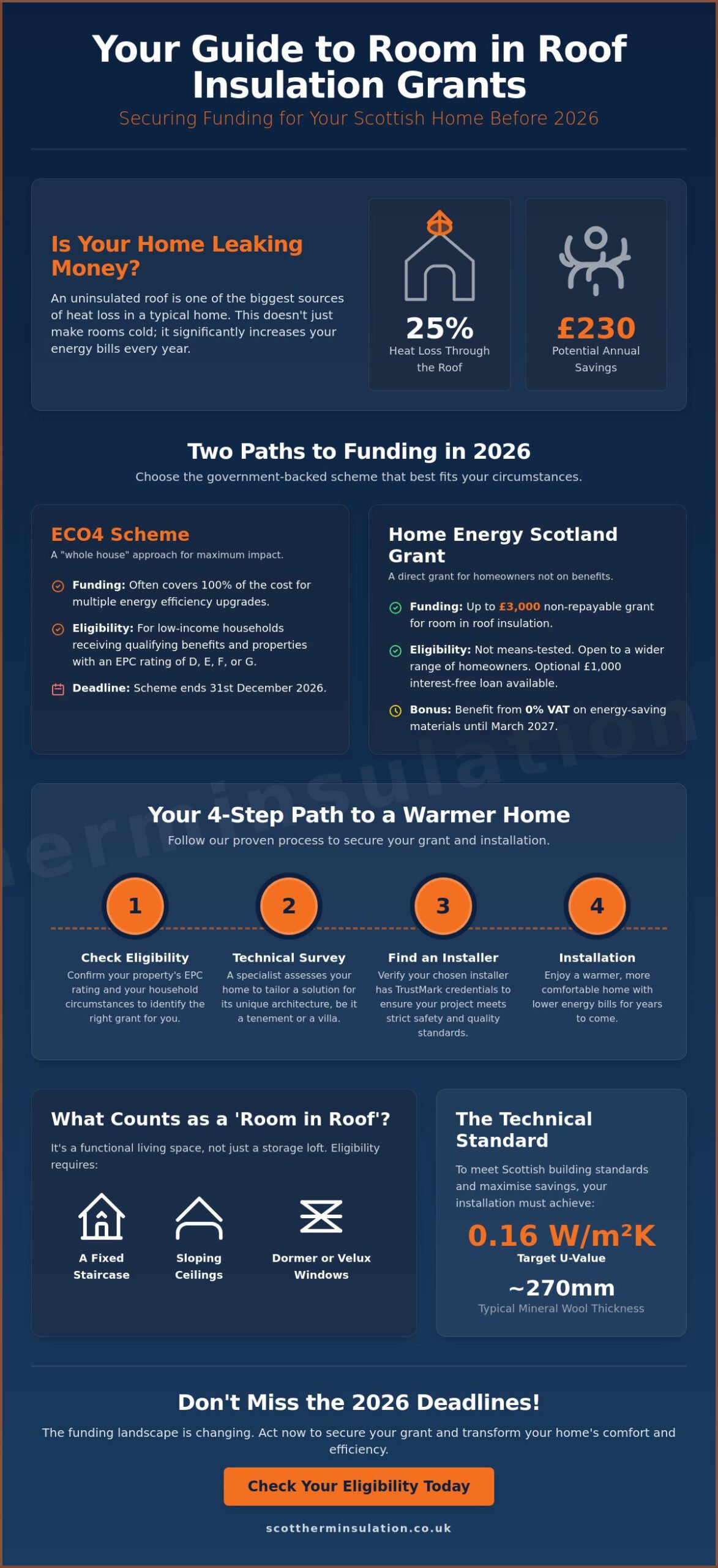
Did you know that an uninsulated attic room can bleed up to 25% of your home’s heat directly through the roof? For homeowners in Edinburgh tenements or Stirling villas, this isn’t just a comfort issue; it’s a financial drain that adds up to £230 to your annual energy bills. You’ve likely heard about the room in roof insulation grant but felt overwhelmed by conflicting information, especially with the Great British Insulation Scheme officially closed as of March 2026.
We understand the frustration of living with “ice-box” rooms in Fife or Edinburgh while heating costs climb. This guide provides a clear, step by step path for Scottish homeowners to secure funding through the Home Energy Scotland Grant or the ECO4 scheme before the December 2026 deadlines. You’ll learn exactly how to claim up to £3,000 in non-repayable funding, understand the 0% VAT benefits, and find a TrustMark registered specialist to ensure your home stays warm for years to come.
Key Takeaways
- Determine your eligibility for the ECO4 scheme or the Home Energy Scotland Grant to see if you qualify for full or partial funding.
- Secure your room in roof insulation grant by following a proven step-by-step application process before the 2026 scheme deadlines.
- Learn which high-performance materials are best suited for insulating sloping ceilings and dormer windows to achieve maximum energy savings.
- Find out how to verify your installer’s TrustMark credentials to ensure your project meets the strict safety standards required for government funding.
- Gain clarity on the technical survey process and how local specialists in the Central Belt tailor solutions for traditional Scottish architecture.
What is a Room in Roof Insulation Grant and Why Act Now?
A room in roof insulation grant is a vital financial tool for Scottish homeowners looking to transform cold, drafty attics into energy-efficient living areas. These grants are part of a national effort to improve Energy efficiency in British housing, specifically targeting the 25% of heat typically lost through an uninsulated roof. By accessing these government-backed funds, residents in Perth and Stirling can secure Maximum Savings & Comfort, often reducing annual heating bills by up to £230. These measures don’t just save money; they create a more stable, usable environment in homes that historically struggled to retain warmth during the Scottish winter.
Funding currently flows through two primary channels. The ECO4 scheme provides comprehensive support for low-income or vulnerable households, often covering the full cost of the installation. For those who don’t meet the ECO4 criteria, the Home Energy Scotland Grant offers up to £3,000 specifically for room-in-roof measures. Because ScotTherm works alongside Fully Approved contractors, we ensure every installation meets the high technical standards required to unlock this funding. With 0% VAT on energy-saving materials available until March 2027, there has never been a more cost-effective time to upgrade your home’s thermal performance.
The 2026 Funding Cliff-Edge in Scotland
The landscape of Scottish energy grants shifted on 31 March 2026. This date marked the official closure of the Great British Insulation Scheme (GBIS) to new applicants. Whilst that specific pathway has ended, the ECO4 scheme remains active until 31 December 2026. Local demand in Edinburgh and Fife is peaking as homeowners move to secure the remaining allocations before the schemes undergo further changes. It is essential to start your application now to ensure your technical survey is completed whilst funds are still available. Delays could mean missing out on the non-repayable grants that make these professional installations affordable for the average household.
Defining Your ‘Room in Roof’ Space
Distinguishing between a standard loft and a “room-in-roof” is a critical step for grant eligibility. A standard loft is usually an empty storage void accessed by a hatch. In contrast, a room-in-roof is a functional living space reached via a fixed staircase. These rooms are defined by sloping ceilings that follow the roofline and often feature dormer or Velux windows. Many older Scottish villas and tenements were built with minimal or no insulation in these areas. To meet current Scottish building standards, these spaces require enough insulation to achieve a U-value of 0.16 W/m²K. This typically involves installing approximately 270mm of high-quality mineral wool or equivalent high-performance boards to stop heat from escaping through the gable ends and sloping ceilings.
Eligibility Criteria: Do You Qualify for Funding in 2026?
Qualifying for a room in roof insulation grant in 2026 depends primarily on your property’s current energy performance and your household’s financial circumstances. To access ECO4 funding, your home must have an Energy Performance Certificate (EPC) rating of D, E, F, or G. This requirement ensures that government resources are directed toward the least efficient homes in Scotland. If your property is rated A, B, or C, it’s already considered energy-efficient enough by current standards. For those in older tenements or villas with poor EPC scores, this funding is a lifeline for achieving Maximum Savings & Comfort.
The ECO4 scheme is specifically designed to support low-income and vulnerable households. You may qualify automatically if a member of your household receives qualifying benefits. These include Universal Credit, Pension Credit, and Housing Benefit. Child Benefit also qualifies, though it’s subject to specific income thresholds. If you don’t receive benefits, you can still secure support through the Home Energy Scotland Grant and Loan Scheme. This pathway is not means-tested and provides a grant of up to £3,000 for room-in-roof insulation, alongside an optional interest-free loan of £1,000.
ECO4 vs Home Energy Scotland (The GBIS Shift)
With the Great British Insulation Scheme (GBIS) officially closed to new applicants as of 31 January 2026, homeowners must now choose between ECO4 and the Home Energy Scotland (HES) grant. ECO4 takes a “whole house” approach. This means if you qualify, you might receive multiple upgrades, such as heating controls alongside your insulation. HES is often a faster route for homeowners in North Berwick or Edinburgh who aren’t on benefits but still want to reduce their carbon footprint. Both schemes require the use of TrustMark registered, Fully Approved contractors to ensure the work meets national safety and quality standards.
LA Flex: The Scottish Council Advantage
Scottish councils in Fife, Stirling, and Edinburgh operate a ‘Local Authority Flexibility’ (LA Flex) scheme. This allows them to extend ECO4 eligibility to residents who don’t receive benefits but still face high energy costs. Typically, this applies to households with a combined annual income of less than £31,000. It also covers individuals with health conditions that are made worse by living in a cold, damp environment. ScotTherm works amongst local authorities to verify your status and ensure you don’t miss out on these regional advantages. You can verify your eligibility today with our local team to see which pathway fits your property and budget.
How to Choose the Best Insulation Materials for Your Attic
Selecting the right materials is the most critical decision in securing a high-performance room in roof insulation grant installation. In the Central Belt, our homes face unique challenges from high humidity and traditional stone construction. To achieve the target U-value of 0.16 W/m²K required by current Scottish building standards, we focus on a comprehensive approach that treats the sloping ceilings, stud walls, and gable ends as a single thermal envelope. Using the correct depth of insulation, typically around 270mm of mineral wool or a high-performance equivalent, ensures your attic transforms from a drafty void into a sanctuary of warmth.
Mineral Wool vs Sheep’s Wool for Scottish Homes
Mineral wool remains the industry standard because it’s cost-effective, fire-resistant, and offers a proven track record of durability. It is the go-to choice for most grant-funded projects in Stirling and Fife. However, for eco-conscious homeowners or those living in Edinburgh’s historic stone tenements, sustainable sheep’s wool is an increasingly popular alternative. Sheep’s wool is naturally breathable, meaning it can absorb and release moisture without losing its thermal properties. This is vital for older properties where moisture management is essential to prevent rot. Both materials are Fully Approved for use in government schemes, provided they meet strict safety and longevity criteria.
The Installation Method: Stud Walls and Slopes
The process involves more than just laying blankets of material. Our teams focus on the “residual” space behind ashlar walls, which are the short vertical walls in your attic room. By insulating these voids and the gable ends, we eliminate the cold spots that cause condensation. For the sloping ceilings, we often use a technique called “under-slabbing” or over-boarding. This involves fixing high-performance insulation boards to the underside of the rafters, which are then finished with plasterboard. This method provides Maximum Savings & Comfort whilst maintaining the necessary air gap above the insulation to prevent moisture build-up.
Your Step-by-Step Guide to Claiming and Installation
Securing a room in roof insulation grant is a structured process designed to ensure your property reaches its maximum thermal potential. We guide you through each stage, from the initial paperwork to the final certificate of work. Most homeowners find the process surprisingly straightforward when working with a local specialist who understands the regional funding nuances in the Central Belt. Our five-step approach ensures your application moves quickly through the system whilst maintaining the highest technical standards.
- Initial eligibility check: We verify your status against ECO4 or Home Energy Scotland criteria. This includes checking local authority flexibility (LA Flex) rules if you live in Fife or Stirling.
- Technical survey: A specialist visits your home to assess the roof structure and calculate current heat loss levels in your attic rooms.
- Funding approval: We submit the technical data to the energy provider for final sign-off. This ensures the full cost of your installation is covered by the grant before work begins.
- Installation day: Our Fully Approved teams carry out the work. Most projects are completed within 1 to 2 days, depending on the number of dormers and the size of the sloping ceilings.
- Post-install certification: You receive a 25-year guarantee and official TrustMark certification. This documentation is essential for updating your property’s EPC rating and proving the quality of the work.
Preparing Your Home for Installation
Before our Fully Approved contractors arrive, we ask that you clear any storage from the “eaves” spaces. These are the small triangular voids behind the ashlar walls that require direct access for insulation. We take regional pride in our tidy work habits and use protective coverings for your floorboards and favourite furniture. You don’t usually need to move out whilst we work. Our teams operate efficiently to ensure your home remains functional, focusing on one section of the roof at a time to minimise dust and disruption.
What Happens During the Technical Survey?
The survey is a vital safety check that goes beyond simple measurements. We use calibrated equipment to measure the exact thermal resistance of your sloping ceilings and gable ends. Our surveyors also check for signs of damp, condensation, or woodworm amongst the rafters. Identifying these issues early is part of our commitment to domestic well-being; we won’t install insulation over an existing structural problem. Finally, we verify that your roof has adequate ventilation paths to ensure the new room in roof insulation grant measures don’t cause moisture build-up in the future.
To start your journey toward a warmer home, apply for your free technical survey today and secure your 2026 funding allocation.
Why Choose a Local Scottish Specialist for Your Grant?
Choosing a local specialist for your room in roof insulation grant ensures that your project is handled with regional pride and accountability. Unlike national firms that often rely on a rotating network of sub-contractors, we live and work in the Central Belt. This proximity allows us to maintain a Proven Track Record across Edinburgh, Fife, and North Berwick. Being Fully Approved isn’t just a badge; it’s your guarantee that every material and method used meets the stringent safety standards required by government funding bodies. We often find that homeowners want to maximise their new space, which is why we offer the option to install professional loft ladders alongside insulation to provide safe, easy access to residual storage areas.
Our identity as “Insulation Installers Scotland” means we take personal responsibility for the comfort of our neighbours. We don’t just supply and fit materials; we provide a consultative service that prioritises safety and long-term value over quick sales. By choosing a specialist with a local footprint, you benefit from a team that understands the specific administrative requirements of councils in Stirling and Fife, ensuring your grant application moves through the system without unnecessary delays. This local expertise is the key to securing the dual benefits of financial savings and domestic well-being.
Expertise in Scottish Architecture
Stirling stone and Edinburgh brickwork behave differently under thermal stress compared to modern builds. A “one size fits all” approach from national companies often fails to account for the high moisture levels found in our climate. We understand these nuances and organise local teams who specialise in traditional Scottish architecture. This expertise ensures that your insulation doesn’t just block heat but also manages moisture correctly. Our local presence means we respond rapidly to enquiries and technical surveys, ensuring your application stays on track for the December 2026 ECO4 deadline.
Maximum Savings and Long-Term Comfort
To achieve Maximum Savings & Comfort, we recommend a whole-house approach. This often involves tying your grant-funded work to broader loft insulation in Scotland to seal the entire roof envelope. This strategy eliminates cold bridges and ensures every room in your home stays warm. Every professional installation we oversee comes with a 25-year guarantee, providing long-term peace of mind and protecting your investment. Your next step is simple. Book your specialist free insulation inspection today to secure your funding and transform your home’s efficiency before the current schemes expire.
Transform Your Attic Comfort Today
Securing a room in roof insulation grant is the most effective way to protect your household from rising energy costs whilst reclaiming a cold, unusable attic. With the ECO4 scheme running until 31 December 2026, homeowners in the Central Belt have a clear window to upgrade their properties. We’ve seen how the right choice between high-performance mineral wool and breathable sheep’s wool transforms the thermal performance of traditional Stirling villas and Edinburgh tenements.
Our team of Fully Approved Scottish Installers brings regional pride and technical expertise to every project. We specialise in the specific architectural needs of Edinburgh, Fife, and Stirling; ensuring every installation meets the target U-value of 0.16 W/m²K. Don’t let your funding allocation expire as the deadline approaches. You can take the first step toward Maximum Savings & Comfort today.
Book Your Specialist Free Insulation Inspection in Scotland and ensure your home stays warm for years to come.
Frequently Asked Questions
Is the room in roof insulation grant really free in Scotland?
Yes, for many households, the room in roof insulation grant can cover the entire cost of the project. Under the ECO4 scheme, low income and vulnerable households often receive 100% funding for all necessary measures. If you don’t qualify for ECO4, the Home Energy Scotland Grant provides up to 75% of the combined costs, capped at a maximum of £3,000. We’ll help you identify the best pathway during your initial assessment to ensure you access the maximum available support.
Can I get a grant if my attic was converted many years ago?
You can certainly apply if your attic conversion lacks modern insulation standards. Many older conversions in Edinburgh and Stirling use outdated materials that don’t meet the current 0.16 W/m²K U-value target. Our technical survey assesses the existing thermal resistance of your sloping ceilings and gable ends. If your current setup allows for 25% heat loss, you’re likely eligible for an upgrade to bring the space up to 2026 building regulations.
How long does it take to install room-in-roof insulation?
Most professional installations are completed within 1 to 2 working days. The exact timescale depends on the complexity of your roof, such as the number of dormer windows or the size of the stud walls. Our Fully Approved teams work efficiently to minimise disruption and maintain a tidy workspace. You won’t usually need to vacate your home, as we focus on securing the thermal envelope one section at a time to ensure your comfort.
What if I don’t receive any government benefits?
You don’t need to be on benefits to access funding in Scotland. The Home Energy Scotland Grant is not means-tested and provides up to £3,000 for these specific measures. Additionally, the LA Flex scheme allows local councils in Fife and Stirling to approve grants for households with an annual income below £31,000. This ensures that a wider range of Scottish homeowners can achieve Maximum Savings & Comfort without needing to receive Universal Credit or Pension Credit.
Will the insulation make my room smaller?
The impact on your room’s dimensions is minimal and often unnoticeable. We use high-performance insulation boards that provide maximum thermal retention with a very slim profile. Whilst we do add material to the sloping ceilings and ashlar walls, the loss of space is typically less than 50mm. This small trade-off results in a significantly warmer, more usable living area that stays comfortable throughout the winter months without increasing your heating bills.
What happens if the 2026 deadline passes before my install?
If the 31 December 2026 ECO4 deadline passes, you may lose access to 100% funding. Government schemes are subject to periodic reviews and budget caps. To avoid missing out, it’s vital to have your technical survey and funding approval finalised well before the end of the year. Acting now ensures your project is prioritised whilst the current 2026 allocations for the Central Belt remain available and the 0% VAT relief is still in effect.
Can I choose sheep’s wool insulation for my grant-funded project?
You can choose sustainable sheep’s wool if it meets the specific technical requirements of the grant scheme. Sheep’s wool is a favourite for Edinburgh’s stone properties because it’s naturally breathable and manages moisture effectively. As long as the material is TrustMark registered and fits within the funding limits, our Fully Approved contractors can install it. This provides an eco-friendly alternative to standard mineral wool for homeowners who prioritise natural, sustainable materials in their property.
Do I need to be an owner-occupier to apply for the grant?
No, both owner-occupiers and private tenants can apply for a room in roof insulation grant. If you are a tenant in a property with an EPC rating of D, E, F, or G, you may qualify under ECO4 with your landlord’s permission. This is a brilliant way for tenants to lower their monthly outgoings and improve their domestic well-being. We work with both parties to ensure the installation meets all legal and safety standards required by current Scottish building Handbooks.