
Why are thousands of homeowners in Edinburgh and Stirling still paying record-high prices for heat that escapes through their walls when the UK government has allocated £4 billion to stop it? It’s exhausting to watch your bank balance drop whilst your home remains stubbornly cold; especially as energy prices have stayed significantly higher than 2021 levels. You deserve a home that provides maximum savings and comfort without the stress of navigating dense bureaucratic jargon.
We understand the confusion surrounding current grants, which is why we’ve simplified the process for you. This guide will clarify your eco4 eligibility and provide a direct path to securing free home insulation before the 2026 deadline. You’ll discover exactly which benefits qualify your household and how to bypass the complex paperwork that often stops people from applying. Our comprehensive checklist covers everything from income thresholds to property types in Fife and across Scotland, ensuring you have the facts you need to lower your bills for good.
Key Takeaways
- Learn how the ECO4 scheme targets fuel poverty in Scotland to provide homeowners with maximum savings and long-term domestic comfort.
- Verify your eco4 eligibility using our definitive 2026 checklist, including the often-misunderstood income thresholds for Child Benefit.
- Identify the specific Energy Performance Certificate (EPC) ratings and property criteria required to secure full funding for your home.
- Discover how the LA Flex programme allows low-income households in Fife and Stirling to access grants without being on standard benefits.
- Master the step-by-step process of claiming your grant and ensuring a professional installation through a Fully Approved Scottish contractor.
What is the ECO4 Scheme and How Does it Benefit Scottish Homeowners?
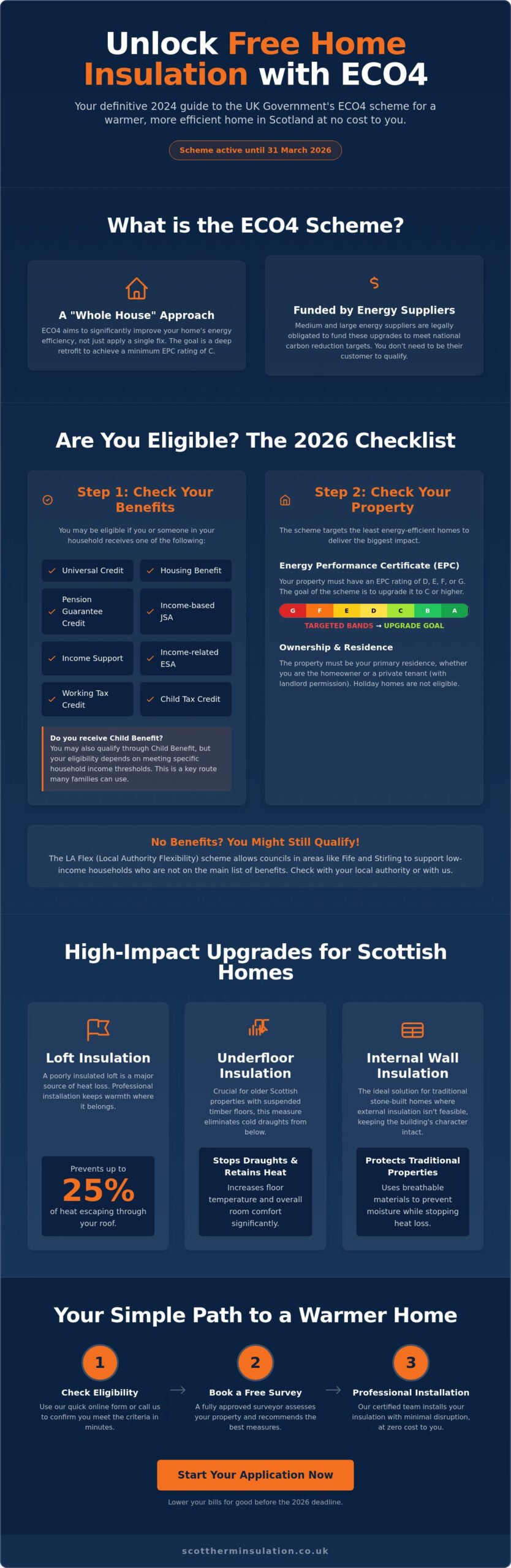
The ECO4 scheme is the fourth stage of the Energy Company Obligation (ECO), a government-backed initiative designed to improve the energy efficiency of the UK’s least efficient homes. Running until 31 March 2026, this phase focuses heavily on households struggling with high energy costs and those living in fuel poverty. Unlike previous iterations that allowed for “patchwork” fixes, ECO4 adopts a “whole house” retrofit philosophy. This means the goal isn’t just to install one measure, but to transform the entire property’s thermal performance to reach a minimum EPC rating of C. At ScotTherm Insulation, we are fully approved specialists who handle the insulation portion of these grants, ensuring your home’s envelope is sealed and secure.
For homeowners in Edinburgh, Fife, and Stirling, understanding your eco4 eligibility is the first step toward a warmer, more affordable home. Because the scheme prioritises those on specific benefits or low incomes, it provides a vital safety net. By focusing on deep retrofits, the programme ensures that heat stays inside your rooms, which directly reduces the amount of energy required to maintain a comfortable temperature. This approach delivers maximum savings and comfort, moving away from the inefficient practices of the past.
The Role of Energy Suppliers in Scotland
Under the ECO4 mandate, medium and large energy suppliers are legally required to fund these improvements. This isn’t a gesture of goodwill; it’s a statutory obligation regulated by Ofgem to ensure compliance and high installation standards. These firms must meet specific carbon reduction targets by 2026, which is why the funding is available. It’s a common misconception that you must be a customer of the firm providing the grant. In reality, you can receive funding from any participating supplier, regardless of who provides your gas or electricity. This system allows us to work alongside some of the best installers in the country to deliver these upgrades at no cost to the qualifying homeowner.
Why ECO4 is Vital for Older Scottish Properties
The Scottish housing stock presents unique challenges, particularly the traditional stone builds found throughout Edinburgh and the coastal regions of Fife. These properties often suffer from significant thermal bridging and heat loss through solid walls and uninsulated floors. Because these materials need to “breathe” to prevent moisture buildup, we use specialist breathable insulation that protects the structure of the building while stopping drafts. Eco4 eligibility often covers the following high-impact measures:
- Loft Insulation: Prevents up to 25% of heat from escaping through the roof.
- Underfloor Insulation: Seals the gaps in suspended timber floors common in older Stirling tenements.
- Internal Wall Insulation: Essential for stone properties where external changes aren’t possible. Homeowners in Edinburgh and Fife can explore internal wall insulation grants available in Scotland for 2026 to fund this measure at no upfront cost.
By targeting the most vulnerable areas of a property, ECO4 provides a long-term solution to the damp-prone Scottish climate. These measures offer the highest return on investment for heat retention, turning a cold, drafty house into a modern, energy-efficient home. If you’re unsure whether your roof qualifies, our guide on free loft insulation grants in Edinburgh and Fife addresses the most common misconceptions homeowners face before applying.
The Qualifying Benefits Checklist: Are You Eligible for ECO4 Funding?
To secure maximum savings and comfort for your home in Edinburgh, Fife, or Stirling, you must first confirm your eco4 eligibility through the Department for Work and Pensions (DWP) criteria. The primary rule is that the applicant must live in the property as their primary residence. Second homes or holiday lets don’t qualify for these fully approved upgrades. According to Ofgem’s ECO4 guidance, the scheme prioritises households in the lowest energy efficiency bands that receive specific financial support to ensure the fuel poor are protected first.
Core Qualifying Benefits
- Universal Credit
- Pension Guarantee Credit
- Income Support
- Housing Benefit
- Income-based Jobseekers Allowance (JSA)
- Income-related Employment and Support Allowance (ESA)
Working Tax Credits and Child Tax Credits both remain valid triggers for the 2026 eligibility criteria as long as the household meets the standard DWP verification checks. Many homeowners are surprised to learn that Child Benefit can unlock funding, but it’s subject to strict income thresholds. For a single claimant with one child, the annual income limit is £19,900; for a couple with four children, this threshold rises to £34,500. If your household income exceeds these figures, you might still qualify through the LA Flex route, where local councils identify vulnerable households based on high energy costs or specific health conditions. You can check your eligibility status with our specialist team to see which path fits your home.
Pensioners and Disability Allowance
Pensioners often find clarity through their Pension Savings Credit status. While Pension Guarantee Credit is an automatic qualifier, Pension Savings Credit also allows you to access ECO4 measures for your property. There is often confusion regarding disability benefits. In the transition to ECO4, some standalone disability benefits like Personal Independence Payment (PIP) and Disability Living Allowance (DLA) were removed as primary triggers. However, most recipients still meet the eco4 eligibility requirements because they usually receive a secondary means-tested benefit or fall under the LA Flex health criteria.
Always check your latest DWP award letter for the exact benefit name before applying. Using the correct terminology from your 2025 or 2026 documentation ensures our fully approved contractors can process your application without administrative delays. This precise approach is why we maintain a proven track record across Scotland, helping households transition to eco-friendly heating and insulation with zero friction.
Property Criteria: EPC Ratings and Insulation Standards for Scottish Homes
To secure funding, your house must be classified as energy inefficient by modern standards. This isn’t just about how cold your rooms feel during a Stirling winter; it’s about the Energy Performance Certificate (EPC) rating. An EPC measures a building’s efficiency on a scale from A to G. Under the current 2026 guidelines, official ECO4 scheme information confirms that a property must meet specific failure criteria to be considered for funding. If your home already has a high rating, it won’t meet the eco4 eligibility requirements because the potential for carbon savings is too low for the government’s targets.
EPC Requirements for Homeowners vs Tenants
The rules differ slightly depending on whether you own your home or rent it from a private landlord. These thresholds ensure that the funding reaches those living in the least efficient housing stock across Scotland. To find your current rating, you can search the official Scottish EPC register using your postcode. If no certificate exists, a pre-installation survey is mandatory to establish a baseline. The current requirements include:
- Homeowners: Properties must typically have an EPC rating of D, E, F, or G.
- Private Tenants: Usually restricted to ratings of E, F, or G. This ensures landlords aren’t using public funds to meet basic legal minimum standards they should have already achieved.
- Survey Requirement: A technical assessment will measure heat loss through walls, floors, and roofs to verify the EPC data is accurate.
The “Minimum Requirement” Improvement Rule
A core part of eco4 eligibility is the “Minimum Requirement” rule, which focuses on a whole-house transition rather than small, isolated fixes. The scheme mandates that any upgrades must move a property up by at least two full EPC bands. For example, a house starting at band F must reach at least band D after the work is finished. This high bar is why installers focus on high-impact measures that offer the best return on energy retention.
Loft and room-in-roof insulation are the primary choices for reaching these targets. These areas are responsible for roughly 25% of a home’s heat loss, so addressing them provides the most significant boost to an EPC score. ScotTherm provides specialist free insulation inspections to determine if your home can achieve this mandatory jump. Our fully approved team assesses the existing substrate and identifies the most effective materials to ensure your property hits the required efficiency marks for maximum savings and comfort.
Local Authority Flexibility (LA Flex): Eligibility Beyond the Benefit System
Many households across Scotland miss out on energy upgrades because they don’t receive specific government benefits. LA Flex solves this problem. It’s a targeted part of the energy scheme that allows local councils to nominate residents for funding based on local needs rather than just Department for Work and Pensions status. Councils in Fife, Perth, and Stirling have designed their own frameworks to help low-income families and vulnerable individuals. This route significantly widens eco4 eligibility, making it possible for more homeowners and private tenants to access high-quality insulation at no cost.
The system operates through four distinct routes designed to catch those who fall through the gaps of the standard benefit system:
- Route 1: Household income below a specific threshold (typically £31,000).
- Route 2: Multi-proxy targeting, combining factors like high energy costs and age.
- Route 3: Health-related vulnerabilities made worse by cold homes.
- Route 4: Bespoke referrals for specific local authority projects.
This local approach ensures that the unique challenges of the Scottish climate are addressed directly at the community level. It allows us to reach people who are working but still struggling with rising energy bills.
Income-Based Eligibility in the Central Belt
In the Central Belt, including Edinburgh and coastal towns like North Berwick, the £31,000 income threshold is the primary qualifier. This figure represents the total gross income for everyone living in the property. Local authorities are strict about verification to maintain the integrity of the scheme. You’ll need to provide recent bank statements, P60s, or pay slips to prove your status. Our team at ScotTherm Insulation works closely with these councils to streamline the application. We ensure your paperwork is accurate so you can focus on the long-term value of a warmer, more efficient home.
Health-Related Eligibility for Insulation
Cold Scottish winters pose a serious risk to residents with underlying health issues. If you or someone in your household suffers from a respiratory condition, cardiovascular disease, or limited mobility, you might qualify for funding regardless of your income. This health-based route requires a signed declaration from a GP or a registered health professional in most council areas. It’s a proactive way for the NHS and local authorities to reduce hospital admissions by improving domestic living conditions. For older residents in Stirling or Fife, this is often the most direct way to secure eco4 eligibility and install professional-grade insulation boards. Stone-built properties in these areas may also benefit from internal wall insulation grants in Scotland, which can be accessed through this same health-related LA Flex route.
Don’t let a lack of benefits stop you from upgrading your home. You can check if your household qualifies under the latest council rules by contacting our Fully Approved insulation experts today.
Claiming Your ECO4 Grant: Professional Installation with ScotTherm Insulation
Once you’ve confirmed your eco4 eligibility, the focus shifts from paperwork to physical home improvements. Securing a grant is only half the battle. The real value lies in the quality of the fit. As Fully Approved contractors, we ensure every Scottish home we touch meets the highest energy standards. We don’t just install; we optimise for the local climate. Our team understands the specific challenges of heating homes in the wind-swept areas of the East Coast and the damp conditions of the Central Belt.
The ScotTherm Installation Process
We’ve refined our workflow to be as non-intrusive as possible. Our goal is to move your project from enquiry to completion without the typical stress of home renovations. The process follows three distinct stages:
- Step 1: Local Assessment. Contact us to arrange a visit. We provide local assessments across Fife, Perth, and Stirling, ensuring we understand the specific layout of your property before any work begins.
- Step 2: Technical Survey. This is where we determine the best insulation material for your build. We don’t believe in a “one size fits all” approach. We evaluate your loft’s ventilation and structural integrity to choose between mineral wool or natural fibres.
- Step 3: Professional Installation. Our local Scottish team carries out the work. We handle everything from protecting your floorboards to the final sign-off, leaving your home tidy and significantly warmer.
Why Choose Sheep’s Wool for Your ECO4 Project?
Traditional Scottish builds, particularly those in historic centres like Stirling or Edinburgh, often require materials that breathe. Whilst mineral wool is a reliable, cost-effective industry standard, sustainable sheep’s wool offers unique advantages for older properties. It manages moisture naturally, absorbing and releasing water vapour without losing its insulating properties. This prevents the damp issues that can plague stone-built homes after they’ve been sealed for energy efficiency.
As trusted loft insulation installers in Scotland, we’ve seen how natural fibres provide superior thermal performance. Sheep’s wool is eco-friendly and requires a fraction of the energy to produce compared to synthetic alternatives. It’s an investment in the longevity of your property’s structure as much as it’s an investment in heat retention.
Choosing ScotTherm means you’re partnering with a team that has a Proven Track Record. We prioritise your peace of mind by using only the best materials and Fully Approved installers. Our commitment to Maximum Savings & Comfort ensures that your eco4 eligibility translates into a tangible reduction in your monthly outgoings. We’re here to make sure your home stays warm, dry, and cost-effective well beyond 2026.
Take Control of Your Home Energy Future Today
The ECO4 scheme represents a significant opportunity for households across Edinburgh, Fife, and Stirling to secure a warmer, more efficient living space before the 2026 deadline. By focusing on properties with an EPC rating of D, E, F, or G, the initiative ensures that those who need help most receive comprehensive upgrades. Whether you qualify through standard benefits or the local authority flexibility route, these improvements provide a permanent shield against rising energy costs. It’s the most effective way to protect your budget whilst increasing your property’s long-term value.
ScotTherm Insulation operates as a team of fully approved Scottish installers with a proven track record across the Central Belt. We specialise in using sustainable materials like breathable sheep’s wool to ensure your property remains healthy and well-ventilated whilst retaining maximum heat. Our experts have already guided hundreds of residents through the complexities of eco4 eligibility, turning technical requirements into tangible domestic comfort. Many homeowners are also surprised to discover they still qualify for free loft insulation in Scotland under the 2026 grant schemes, even if they previously believed the window had closed. Don’t leave your home’s efficiency to chance when professional support is available locally.
Check your ECO4 eligibility with ScotTherm today to find out how much you could save. We’re ready to help you transform your home into a sanctuary of warmth and efficiency for years to come.
Frequently Asked Questions
Is the ECO4 scheme really free for Scottish residents?
Yes, for eligible households, the ECO4 scheme provides 100% funding for energy-saving measures. Since 2022, the UK government has mandated that large energy suppliers allocate funds to improve the least energy-efficient homes. This means you won’t pay a penny for the supply or fit of approved upgrades. Our team ensures all work meets PAS 2035 standards, delivering maximum savings and comfort without any upfront costs to the homeowner.
Can I get ECO4 funding if I am a private tenant in Edinburgh?
You can access ECO4 funding as a private tenant in Edinburgh if you meet the specific income or benefit criteria for eco4 eligibility. While the tenant must qualify, the landlord’s permission is mandatory before any work begins. Under the 2022-2026 regulations, private rentals must have an EPC rating of E, F, or G to be eligible. This ensures that the most inefficient homes in the Lothians receive the necessary upgrades.
What happens if my home does not have an EPC rating?
If your home lacks an Energy Performance Certificate (EPC), a qualified assessor will perform a new assessment as part of your application. An EPC is essential for determining eco4 eligibility, as the scheme targets properties with a rating of D, E, F, or G. In 2023, approximately 40% of Scottish homes required an updated certificate to access government grants. We arrange these assessments through fully approved contractors to ensure your home meets technical requirements.
Does ECO4 cover loft boarding or just insulation?
ECO4 funding specifically covers the installation of insulation materials rather than decorative or storage features like loft boarding. The scheme prioritises thermal efficiency, meaning the grant pays for high-quality mineral wool or PIR boards to stop heat loss. If your loft requires boarding to maintain access to tanks or equipment, this often falls outside the grant’s scope. Our installers focus on achieving the best U-values to guarantee long-term energy savings.
How long does the ECO4 application process take in Scotland?
The typical ECO4 application process in Scotland takes between 4 and 12 weeks from the initial survey to the final installation. This timeline includes the mandatory technical survey, EPC verification, and the submission of paperwork to the energy supplier for approval. In 2024, high demand in areas like Fife and Stirling has occasionally extended wait times. We manage the entire process to ensure your upgrades are fitted efficiently by our proven team.
Can I choose the type of insulation material used in my home?
The choice of insulation material is determined by a PAS 2035 retrofit coordinator who assesses what’s most effective for your property’s structure. While you can’t pick a brand, the materials must be fully approved and meet strict UK building regulations for safety and fire resistance. Whether it’s foil-backed boards or glass mineral wool, our installers use the best materials to provide maximum savings and comfort. This professional selection ensures your home remains breathable.
What is the difference between ECO4 and the Great British Insulation Scheme?
ECO4 is a “whole-house” approach targeting low-income households, whereas the Great British Insulation Scheme (GBIS) focuses on single measures for a broader range of homes. ECO4 requires multiple upgrades to improve your property’s EPC by at least two bands. In contrast, GBIS, launched in 2023, helps those in lower council tax bands (A-D in Scotland) get a single insulation measure. Both schemes aim to reduce fuel poverty across Scotland through different pathways.
Are there grants available for pensioners who do not claim Pension Credit?
Pensioners who don’t receive Pension Credit can often qualify through the LA Flex route of the ECO4 scheme. Local councils in Edinburgh, Fife, and Stirling can refer residents who are on a low income or have health conditions made worse by a cold home. In 2024, the income threshold for many Scottish local authorities is set at £31,000 per year. This ensures that vulnerable households can still access vital energy efficiency improvements through our approved installers.