
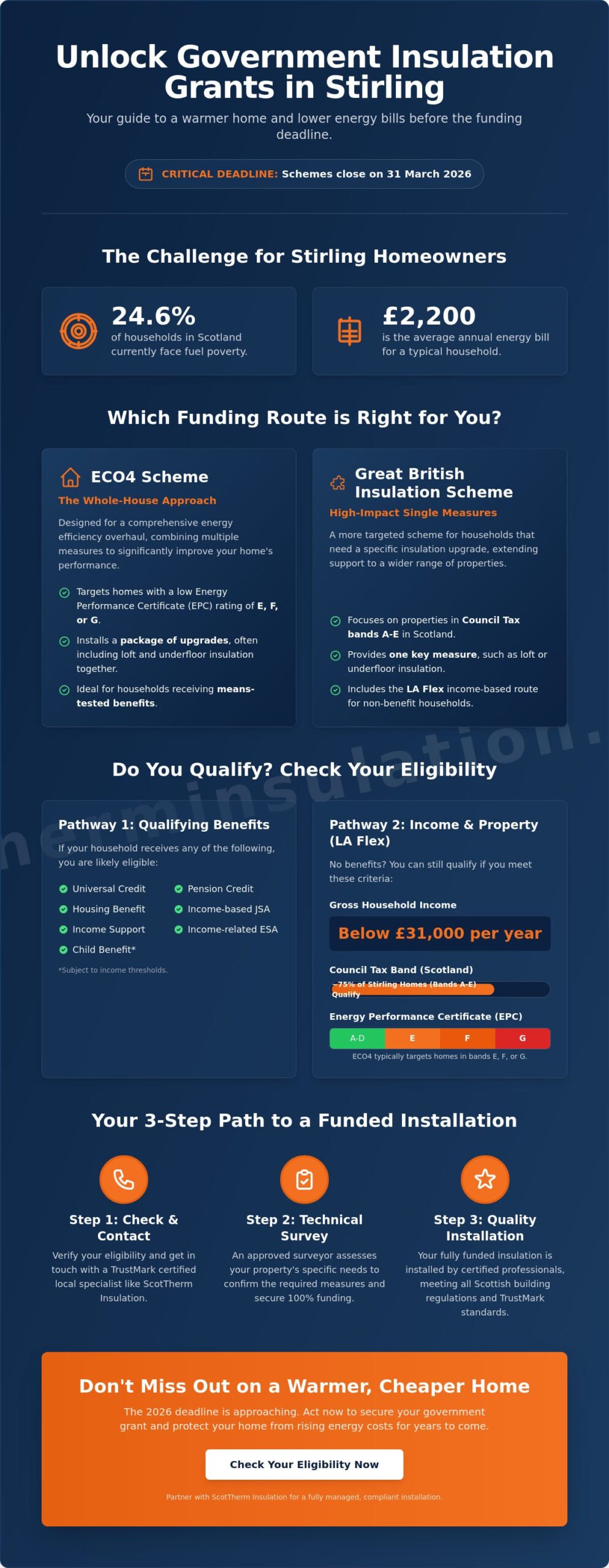
With 24.6% of households in Scotland currently facing fuel poverty whilst average annual energy bills sit at £2,200, the urgency to secure government insulation grants stirling homeowners can rely on has reached a peak. If you live in one of our city’s traditional stone properties, you’re likely all too familiar with the struggle of keeping rooms warm during a harsh Scottish winter. The upcoming closure of major funding schemes on 31 March 2026 means there’s a limited window to protect your home and your wallet.
We understand that navigating complex eligibility rules can be overwhelming, particularly when you just want a reliable way to lower your costs. This guide promises to simplify the process, showing you exactly how to access 100% funded measures such as loft or underfloor insulation. We’ll preview the latest ECO4 and LA Flex criteria, explain how Stirling’s Council Tax bands impact your application, and help you find a certified local specialist who understands the specific needs of our regional architecture.
Key Takeaways
- Identify the differences between the whole-house ECO4 approach and the single-measure Great British Insulation Scheme to find your best funding route.
- Determine your eligibility for government insulation grants stirling through either means-tested benefits or the £31,000 household income threshold.
- Understand how specialist loft and underfloor insulation can significantly reduce energy bills by targeting the primary areas of heat loss.
- Navigate the mandatory technical survey and documentation process required to secure 100% funding for your property.
- Discover why partnering with ScotTherm Insulation ensures your project meets strict TrustMark standards and Scottish building regulations.
Government Insulation Grants in Stirling: What is Available in 2026?
Stirling residents face a unique set of challenges when it comes to home heating. With our historic architecture and the biting Scottish winter, maintaining a warm home often feels like a losing battle against rising costs. Currently, 24.6% of Scottish households live in fuel poverty; a statistic that underscores the importance of accessing government insulation grants stirling providers can facilitate before the 31 March 2026 deadline. This year represents a critical juncture for Energy efficiency in British housing, as the government pushes to meet ambitious net-zero targets by phasing out these comprehensive funding streams.
The ECO4 Scheme in Scotland
The fourth phase of the Energy Company Obligation (ECO4) isn’t just a simple grant; it’s a complete “whole-house” strategy. Rather than installing a single measure, ECO4 focuses on lifting the overall energy performance of the property. If your home has an EPC rating of E, F, or G, you may qualify for a package that combines multiple upgrades. This often includes a combination of loft insulation and underfloor insulation to create a thermal envelope that keeps heat where it belongs. By prioritising the least efficient homes, the scheme ensures that those most at risk of high bills receive the most significant interventions.
The Great British Insulation Scheme (GBIS)
Not every household requires a full property overhaul. The Great British Insulation Scheme (GBIS) fills the gap for homeowners who might not qualify for the low-income ECO4 group but still need help with rising costs. GBIS focuses on high-impact single measures. In Stirling, approximately 75% of properties fall into Council Tax bands A to E, making a vast number of local residents eligible for this support. Whether it’s refreshing old mineral wool in the attic or installing specialist underfloor insulation, GBIS provides a streamlined route to efficiency without the complexity of a multi-measure install.
Stirling Council plays a pivotal role in this landscape through Local Authority Flexible Eligibility, commonly known as LA Flex. This allows the council to refer residents who don’t receive standard benefits but are still struggling. If your household income is under £31,000, you could still access the same level of support as those on Universal Credit. It’s a vital safety net for our community, ensuring that hardworking families in Dunblane, Bridge of Allan, and the city centre aren’t left in the cold. Because these schemes are scheduled to end in March 2026, acting now is the only way to guarantee your property is prepared for the years ahead.
Eligibility Criteria: Do You Qualify for Funding in Stirling?
Determining if your property qualifies for government insulation grants stirling programs is the first step toward a warmer home. While the rules may seem complex, they are designed to prioritise those who will benefit most from reduced energy consumption. Eligibility hinges on your financial circumstances, your property’s current energy performance, and occasionally, your health status. Securing these funds starts with understanding the specific criteria set by the Department for Energy Security and Net Zero, administered through the official ECO scheme guidelines.
Qualifying Benefits and Household Income
The Energy Company Obligation (ECO4) provides a clear path for residents receiving specific DWP benefits. If your household receives Universal Credit, Pension Guarantee Credit, or Housing Benefit, you’re likely eligible for full support. Other qualifying benefits include Income-related Employment and Support Allowance (ESA), Income-based Jobseeker’s Allowance (JSA), and Income Support. Child Benefit also acts as a trigger, provided your total household income falls below certain thresholds based on the number of children and adults in the home.
For those who don’t receive these benefits, the Great British Insulation Scheme and LA Flex offer alternative routes. If your gross household income is less than £31,000 per year, you can still qualify for significant funding. Your property’s Energy Performance Certificate (EPC) plays a vital role here; ECO4 typically targets homes rated E, F, or G, whilst GBIS extends support to those in Council Tax bands A to E in Scotland. This ensures that even if you aren’t on benefits, you aren’t left to face high heating costs alone.
Stirling Council LA Flex (Local Authority Flexible Eligibility)
Stirling Council uses Local Authority Flexible Eligibility (LA Flex) to support residents who might otherwise miss out on national schemes. This is particularly relevant for households in rural areas such as Callander, Aberfoyle, or the Trossachs, where older, hard-to-heat properties are common. The council can refer you for funding if someone in the home has a long-term health condition worsened by the cold, such as respiratory issues or cardiovascular disease. It also covers residents who are simply vulnerable to the effects of a cold home due to age or pregnancy.
The council identifies “fuel poor” households by looking at the ratio of heating costs to total income. This local approach ensures that support reaches those in our specific climate who need it most. If you’re unsure where you stand, you can always check your eligibility with ScotTherm Insulation to see which route fits your situation. A technical survey will eventually confirm if your home meets the physical requirements for measures like loft or underfloor insulation, ensuring the grant is used effectively to deliver long-term comfort.
Key Insulation Measures Covered for Stirling Households
To achieve maximum efficiency, we advocate for a “fabric-first” approach. This means prioritising the building’s thermal envelope before considering expensive heating upgrades. It is a logical sequence; there’s little point in installing a high-tech heat pump if 25% of that warmth escapes immediately through an uninsulated roof. For many in Stirling, accessing government insulation grants stirling homeowners qualify for is the most cost-effective way to establish this foundation. By sealing the gaps in your home’s structure, you create a stable environment that retains heat longer and requires less energy to maintain. This strategy is particularly effective for our local stone buildings, which often possess high thermal mass but poor actual insulation values.
Loft and Room-in-Roof Solutions
Loft insulation remains one of the most impactful upgrades for any property. In Stirling’s older housing stock, including our iconic tenements and villas, heat loss through the roof is a primary cause of high bills. Whilst standard mineral wool rolls are ideal for open lofts, room-in-roof insulation utilises high-performance boards to insulate the slopes and gable ends of converted attics. We pay particular attention to ventilation during these installs. Ensuring air flows correctly prevents the damp issues that can plague traditional Scottish buildings when they are sealed too tightly. For those seeking sustainable options, sheep’s wool insulation offers excellent breathability and moisture control, making it a favourite amongst owners of historic properties who want to protect their building’s fabric whilst staying warm.
Underfloor Insulation for Traditional Stirling Homes
Many traditional homes in the Stirling area, from the city centre to the surrounding villages, feature suspended timber floors. These designs often have a crawl space underneath that, whilst necessary for ventilation, allows cold air to seep through floorboards and create uncomfortable draughts. Professional underfloor insulation involves securing mineral wool or specialist sheep’s wool between the joists, effectively blocking the cold from below. This process doesn’t just lower your bills; it noticeably improves “foot comfort” during the winter months by eliminating that familiar chill on the ground floor.
The installation process is designed to be as non-intrusive as possible, typically involving access through the crawl space or by temporarily lifting a few floorboards. You can find more details on specific Scottish insulation grants to see which of these measures are currently covered for your specific postcode and property type. By choosing the right material for your home’s age and construction, you ensure a long-term solution that provides both financial efficiency and physical ease for years to come.
The Application Process: Navigating Stirling Council’s Grants
The road to a warmer home starts with a structured plan. Whilst the eligibility rules defined in previous sections provide the framework, the application process dictates the actual delivery. Securing government insulation grants stirling residents deserve requires more than just a simple enquiry; it involves a verified sequence of technical assessments and official documentation to ensure compliance with national standards. This rigour protects you, ensuring that every measure installed actually delivers the thermal efficiency promised. It is a collaborative process where the installer handles the bulk of the paperwork, but your involvement in the initial stages is vital for a smooth journey.
Step-by-Step Guide to Claiming
Your first action should be visiting the Scottish EPC Register to find your property’s current Energy Performance Certificate. If your rating is E, F, or G, you are in a prime position for ECO4 support. Once you have this, book a free technical survey with a local specialist. Unlike a generic sales call, this survey is a mandatory requirement where a professional assesses your loft, floors, and walls to determine property suitability. You will need to provide documentation at this stage, such as proof of qualifying benefits or household income statements for LA Flex applications. From this initial visit to the final installation, the timeline usually spans four to eight weeks. This period includes the time required for Stirling Council or the energy supplier to verify your eligibility and approve the funding.
Avoiding “Solar Cowboys” and Uncertified Installers
The surge in grant funding has unfortunately attracted non-local contractors who often lack the necessary certifications. To protect your home’s long-term value, you must only work with companies that are TrustMark registered and PAS 2030 certified. These credentials aren’t just badges; they are your guarantee that the work meets strict industry safety and quality benchmarks. TrustMark is the only government-endorsed quality scheme for home improvements, providing you with a clear route for dispute resolution and insurance-backed guarantees.
Be wary of cold-callers who promise “free grants” without a proper survey or those who don’t have a physical presence in the Stirling area. A local expert understands our specific climate and building types, from Dunblane villas to city tenements, and will be available for long-term support after the job is done. After the installation is complete, a final inspection ensures everything meets the required standard. Your installer will then update the Scottish EPC Register to reflect your home’s improved energy rating. This documentation is essential if you ever decide to sell or rent your property. If you’re ready to begin, you can start your grant application with ScotTherm Insulation to ensure your home is protected before the 2026 deadline.
Choosing a Local Specialist for Your Stirling Insulation Project
Selecting the right partner for your home improvement is as critical as the insulation material itself. Whilst many national companies offer a broad range of services, choosing a specialist with deep roots in the Central Belt ensures your project respects the unique architectural heritage of our region. At ScotTherm, our focus remains exclusively on thermal efficiency. We don’t dilute our expertise by pushing solar PV systems or boiler installations. Instead, we advocate for a dedicated fabric-first approach. By concentrating on high-performance loft and underfloor insulation, we ensure your home’s structure is optimised to retain heat before any other measures are considered. This specialisation is why we are a trusted name for those seeking government insulation grants stirling homeowners can rely on for long-term value.
Regional Pride and Local Accountability
Our team provides a reassuring, authoritative service across Stirling, Dunblane, and Bridge of Allan. We understand the specific challenges posed by the Scottish climate and the braw winds that sweep through the Forth Valley. This local knowledge is vital when interpreting Scottish building regulations, which often differ from those in other parts of the UK. Working with a local team means you aren’t dealing with a faceless corporation; you’re partnering with specialists who take pride in the tangible impact their work has on the community. We maintain strict adherence to TrustMark standards, providing the peace of mind that comes from using verified, certified professionals who are accountable for every roll of mineral wool or sheep’s wool installed.
Sustainable Insulation Choices for Stirling
Stirling’s historic housing stock requires a sympathetic touch. Many of our local properties were built using traditional methods that allow the building to “breathe.” Using the wrong materials can lead to trapped moisture and structural decay. We prioritise high-quality, breathable materials like sheep’s wool insulation for these older homes. Sheep’s wool is a sustainable, high-performance option that manages moisture naturally whilst providing exceptional thermal resistance. For more modern properties, we utilise premium mineral wool to achieve maximum energy savings without compromising safety.
Every home in Stirling has its own set of requirements, from suspended timber floors needing draught-proofing to cold lofts requiring a full thermal refresh. Our expertise ensures that the material chosen is the best fit for your property’s specific construction type. This disciplined, quality-conscious approach is what distinguishes a specialized local expert from a general contractor. If you are ready to secure your home’s future and lower your energy bills, contact ScotTherm today to see if you qualify for a grant. We’ll help you find the clearest path to a funded installation before the 2026 deadline, ensuring your home remains a warm, cost-effective sanctuary for years to come.
Secure Your Stirling Home’s Future Today
The fast-approaching 31 March 2026 deadline marks a final opportunity to transform your property’s thermal performance without the burden of upfront costs. Throughout this guide, we’ve highlighted how the whole-house ECO4 strategy and the targeted Great British Insulation Scheme provide essential support for our city’s diverse housing stock. By acting now to secure the government insulation grants stirling homeowners can access, you establish a warmer, more cost-effective environment that stands up to the harshest Scottish winters.
Choosing a TrustMark Registered Installer with specific expertise in Scottish housing stock ensures your project is handled with technical precision and regional care. Whether you require specialist underfloor measures or our expertise in sustainable wool insulation, we focus on delivering long-term comfort and safety. Don’t leave your property’s efficiency to chance whilst funding is still available. Check your eligibility for a Stirling insulation grant with ScotTherm and take the first step toward a more sustainable, cosy home today. Your path to lower bills and a warmer winter is just a survey away.
Frequently Asked Questions
Can I get an insulation grant in Stirling if I am a private tenant?
Private tenants in Stirling can certainly apply for funding, provided they have the landlord’s written consent. The eligibility is usually based on the tenant’s income or benefits status rather than the property owner’s financial position. This ensures that those living in colder, rented properties can still benefit from improved thermal efficiency and lower monthly outgoings whilst protecting the building’s fabric.
What is the difference between ECO4 and LA Flex in Stirling?
ECO4 is a national scheme primarily for those receiving specific DWP benefits, whereas LA Flex allows Stirling Council to set its own local criteria. This “flexible” route captures households that don’t receive benefits but are still considered fuel poor or vulnerable due to health issues. Both routes facilitate access to government insulation grants stirling providers use to improve the energy performance of the local housing stock.
How much can I save on my energy bills with a loft insulation grant?
Installing professional loft insulation can prevent approximately 25% of your home’s heat from escaping through the roof. With average annual energy bills currently sitting at £2,200 in Scotland, this translates to a significant yearly saving for the average household. The exact amount depends on your property’s size and previous insulation levels, but the impact on your domestic comfort and bank balance is immediate.
Do I need to pay anything towards the insulation cost under the ECO4 scheme?
Most qualifying households under the ECO4 scheme receive 100% funding, meaning there’s no personal contribution required for the installation. The grant covers the cost of high-quality materials and professional labour from start to finish. In some rare cases involving complex property types or very large homes, a small contribution might be discussed, but this is always clarified during the mandatory technical survey.
What happens if my home in Stirling already has some insulation?
If your existing insulation is old or below the current recommended thickness of 270mm, you may still qualify for a “top-up” grant. Many older Stirling properties have settled or insufficient mineral wool that no longer provides adequate thermal resistance. A technical survey will measure your current levels and determine if a funded upgrade is necessary to meet modern Scottish energy efficiency standards.
Is sheep’s wool insulation covered by government grants?
Sheep’s wool insulation is an eligible material under these grants and is often preferred for Stirling’s historic or stone-built properties. It offers superior breathability and moisture management compared to synthetic alternatives, which is vital for maintaining the structural integrity of older buildings. We often recommend this natural material for homeowners who want to combine high-performance efficiency with environmental responsibility and domestic well-being.
How long does the insulation installation process take?
A standard loft or underfloor insulation project is typically completed within a single day. The process is designed to be efficient and non-intrusive, causing minimal disruption to your daily routine or home environment. Once the technical survey and funding approval are finalised, our team can usually schedule the physical installation to suit your availability, ensuring your home is significantly warmer in a matter of hours.
What is an EPC rating and why does it matter for my grant application?
An Energy Performance Certificate (EPC) measures your home’s energy efficiency on a scale from A to G. For most government insulation grants stirling applications, your property must currently be rated E, F, or G to trigger the highest levels of support. The rating acts as an official baseline, allowing the government to prioritise the least efficient homes and track the improvement once the new insulation is installed.