
Did you know that up to 25% of your home’s heat escapes directly through an uninsulated roof? For many Scottish households, this isn’t just a dry statistic; it’s a significant monthly drain on your finances and your physical comfort. Finding reliable loft insulation installers is the most effective way to halt this energy loss, yet many homeowners hesitate because they fear poor workmanship or the risk of trapped moisture. You need a specialist who understands that our unique, damp-prone climate requires more than just laying rolls of material; it demands a precise, breathable solution tailored to Scottish building standards.
It’s natural to feel concerned about rising heating costs or the pressure to meet the 2026 EPC Band C requirements for rental properties. You deserve a home that stays warm whilst remaining cost-effective to run. This guide will show you how to identify certified professionals who prioritise your property’s structural health and thermal efficiency. We’ll explore the advantages of high-quality materials, such as mineral wool and sustainable sheep’s wool, and explain why local expertise is the key to securing long-term value and peace of mind for your home.
Key Takeaways
- Verify essential credentials like TrustMark accreditation and NIA membership to ensure your project meets government-endorsed quality standards.
- Evaluate the performance of mineral wool versus sustainable sheep’s wool, focusing on how breathable materials manage moisture in traditional Scottish homes.
- Learn why local loft insulation installers are better equipped to manage complex ventilation requirements that prevent damp and structural damage.
- Prepare for the installation journey by understanding the importance of pre-installation surveys, including joist checks and electrical cable safety.
- Discover the benefits of choosing a Central Belt specialist who understands regional building regulations and the specific thermal demands of our climate.
Why Choosing Specialist Loft Insulation Installers Matters in Scotland
The Scottish climate presents a unique set of challenges for maintaining a warm, dry home. Whilst many homeowners focus on windows or doors, the reality is that up to 25% of a property’s heat is lost through an uninsulated roof. Choosing specialist loft insulation installers is not merely about adding a layer of material; it’s about understanding the complex relationship between thermal retention and moisture management in a high-humidity environment. General contractors often treat insulation as a simple “lay and leave” task, yet this approach frequently overlooks critical ventilation requirements. In our region, blocking eaves or neglecting airflow can lead to stagnant air and structural dampness.
Professional specialists prioritise Building insulation principles that account for the “breathability” of the structure. For the stone-built homes common in cities like Edinburgh or coastal towns in Fife, using the wrong material or blocking natural ventilation paths can cause interstitial condensation. This occurs when moisture becomes trapped within the building fabric, potentially damaging historic masonry and timber. A dedicated expert ensures that the insulation works with your home’s natural behaviour, not against it.
The Financial Impact of Professional Fitting
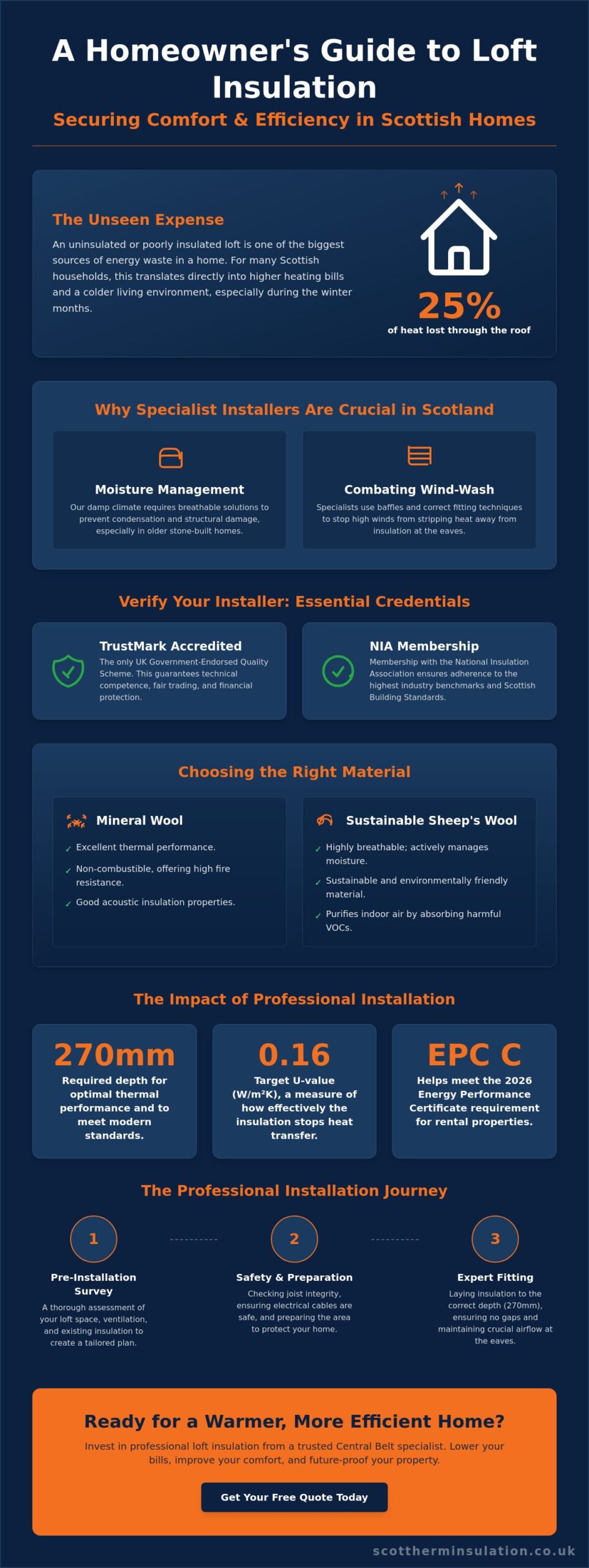
Investing in expert installation offers measurable financial returns beyond immediate comfort. By 2026, private rented sector homes in Scotland must achieve an EPC rating of Band C for new leases. Achieving this standard often requires a minimum insulation depth of 270mm to meet the recommended U-value of 0.16 W/m²K. Professional loft insulation installers ensure this thickness is uniform, eliminating thermal bridges that DIY attempts often miss. For households across the Central Belt, this precision translates into significant annual savings on heating expenditure. It also increases the long-term marketability of the property to energy-conscious buyers who prioritise low running costs.
Tackling the Scottish Weather: Wind and Damp
Our geography demands specific technical solutions to combat wind-wash and humidity. In exposed areas, high-velocity air can enter the loft space at the eaves, “washing” away the heat from the top of the insulation layer. Specialists use specific baffles or fitting techniques to prevent this whilst keeping the ventilation gaps clear. This balance is vital. Without consistent airflow, the humid Scottish air can settle on cold timber rafters, leading to dry rot or mould growth. Expert fitters understand these regional nuances, ensuring your home remains both thermally efficient and structurally sound regardless of the weather outside.
Essential Credentials for Loft Insulation Fitters in 2026
Identifying qualified loft insulation installers requires looking beyond a basic quote. In 2026, the industry is more regulated than ever, ensuring that homeowners receive lasting value and protection. Verifying credentials is the first step in protecting your property from “cowboy” installers who might compromise your home’s structural integrity or safety. A specialist’s certifications act as a badge of reliability, proving they’ve undergone the rigorous training necessary to handle modern thermal challenges.
TrustMark and Trade Associations
TrustMark is the only government-endorsed quality scheme for home improvements in the UK. When an installer carries this logo, it signifies they’ve been vetted for technical competence and fair trading practices. You can verify any firm’s status on the official TrustMark register to ensure their accreditation is current. Alongside this, membership in the National Insulation Association (NIA) acts as an additional layer of security. The NIA sets rigorous industry benchmarks that members must uphold, providing a formal route for dispute resolution and ensuring adherence to the latest Scottish Building Standards.
Choosing a specialist with these endorsements means your project is backed by financial protection and a commitment to high-level workmanship. For those seeking verified expertise in the Central Belt, consulting with established loft insulation installers ensures your project meets these exacting national requirements. Beyond trade bodies, always confirm that your chosen specialist holds comprehensive public liability insurance. This covers any accidental damage to your property during the installation process. Additionally, look for a 25-year guarantee on both materials and labour. A long-term guarantee is a hallmark of a contractor who is confident in their work’s durability and the quality of the products they use.
Health and Safety Standards
Professional installation involves more than just laying material; it requires strict adherence to health and safety protocols. Compliance with the Control of Substances Hazardous to Health (COSHH) is essential, especially when removing old, degraded materials or handling new mineral wool. Specialists use professional-grade PPE, including respirators and protective clothing, to prevent the inhalation of fibres or skin irritation. This disciplined approach protects both the workers and the residents of the home.
Finally, assess how the fitters manage the loft environment itself. Safe loft access and the use of proper working platforms are non-negotiable requirements. These measures protect the installers from falls and prevent damage to your ceiling joists or plasterwork. A professional team will always prioritise these safety standards, ensuring the job is completed without unnecessary risk to your property or their personnel.
Comparing Material Options: Mineral Wool vs. Sustainable Sheep’s Wool
The choice of material defines how your home breathes and retains heat. Whilst mineral wool remains the industry standard for many modern builds, sustainable sheep’s wool has become a favourite for those living in older Scottish properties. Expert loft insulation installers will assess your roof’s construction before recommending a product, as the wrong choice can lead to moisture imbalances. Both materials offer excellent thermal resistance, yet they interact with the humid Scottish air in very different ways. Selecting the right solution ensures that your investment provides long-term protection against the elements.
The Case for Sustainable Sheep’s Wool
Sheep’s wool is a premium, natural alternative that excels in moisture regulation. It can naturally absorb and release moisture without losing its insulating properties, which is vital for the stone-built tenements and cottages found in towns like St Andrews or Stirling. This “breathability” prevents damp from settling on timbers, reducing the risk of rot. From a technical standpoint, sheep’s wool has a higher specific heat capacity than mineral wool, 1800 J/Kg.K compared to 1030 J/Kg.K. This means it can absorb more heat before it transfers, keeping your home cooler in summer and warmer in winter. Beyond performance, it is safe to touch and lacks the irritating fibres associated with glass-based products. It maintains its loft over decades, resisting the settling that can occur with cheaper alternatives.
Mineral Wool: Performance and Value
Modern mineral wool is a highly engineered product that offers exceptional fire-retardant properties and thermal resistance. It is completely non-combustible, providing an extra layer of safety for your household. For standard modern homes in Perth or the Central Belt, it offers a cost-effective solution that professional loft insulation installers can fit quickly. For a broader look at technical specifications, the Energy Saving Trust guide provides a solid baseline for standard installations. It also provides significant acoustic benefits, deadening the sound of wind and rain against the roof. This is a common nuisance during Scottish winters that mineral wool handles with ease.
From an environmental perspective, sheep’s wool has a very low embodied carbon footprint as it is a renewable resource. Mineral wool, whilst more energy-intensive to manufacture, is often made from recycled glass or stone. Both materials significantly reduce your home’s carbon emissions by cutting energy demand. This helps you move towards a more sustainable lifestyle whilst lowering your monthly bills. Your specialist will help you weigh these factors to find the perfect balance for your specific property and budget.
The Installation Journey: What to Expect from Professional Fitters
A professional installation follows a precise, structured sequence. It distinguishes expert loft insulation installers from general contractors who might simply “lay and leave.” This process ensures your home meets the latest energy standards whilst protecting the property from structural issues. By following a disciplined technical path, specialists guarantee that the thermal improvements are both safe and durable for years to come.
The Pre-Installation Survey
Reputable firms begin every project with a specialist loft inspection. This initial assessment is vital. It identifies underlying issues that could compromise the work, such as active woodworm, pipe leaks, or existing damp patches on the rafters. Your installer will also measure the current insulation depth to calculate exactly how much additional material is required to reach the 270mm target recommended for 2026. This stage ensures the project is tailored to your specific roof structure and that no hidden defects are covered up, which could lead to costly repairs later.
Technical Execution and Safety
Preparation is the most critical phase of the actual install. Technicians use walkway boards to navigate the loft safely, preventing any accidental damage to your ceilings. They also manage electrical cables with care. High-current cables, such as those for showers or cookers, are often lifted and secured above the insulation to prevent overheating. Any recessed downlights must be fitted with fire-rated caps before the material is laid. This prevents the heat from the bulbs from becoming a fire hazard whilst maintaining a continuous thermal barrier. If you want to ensure your home is prepared for the winter, you can book a professional survey with our team to assess your current setup.
The insulation is usually applied in two distinct layers. The first layer sits between the joists, whilst the second layer is laid at a 90-degree angle across them. This “cross-layering” technique is essential because it eliminates thermal bridging, where heat escapes through the timber joists themselves. This method is a hallmark of professional loft insulation installers and is often missed in DIY attempts.
The journey concludes with a thorough post-installation check. Specialists verify that the eaves ventilation remains completely clear to allow for essential airflow. They also insulate the loft hatch and cold water tanks to prevent freezing in extreme temperatures. Finally, all debris is removed, leaving your home clean and significantly more energy-efficient. This attention to detail ensures your property remains warm, safe, and fully compliant with modern Scottish regulations.
ScotTherm Insulation: Your Local Specialists in the Central Belt
ScotTherm Insulation operates as a dedicated regional specialist, focusing on high-performance thermal solutions for homes across the Central Belt. We serve communities in Edinburgh, Fife, Perth, and Stirling, providing a level of local accountability that national providers often struggle to match. Our team specialises in residential thermal improvements, with a particular emphasis on breathable material expertise. We understand that Scottish homes require a specific technical approach to manage our unique climate. By adhering strictly to the latest Scottish Building Standards, we ensure that every installation provides maximum thermal efficiency whilst protecting the structural health of your property.
Why a Local Scottish Specialist Wins
Choosing local loft insulation installers offers distinct advantages when navigating the diverse architecture of our region. Our technicians possess a deep understanding of local building styles, ranging from the thick-walled sandstone tenements of Edinburgh to the modern timber-frame developments in Perthshire. This architectural insight is crucial for identifying the correct ventilation strategies and material choices. Whilst national utility firms might offer a generic service, we provide a tailored approach that considers the specific moisture behaviour of your home. Whether your property is best suited for traditional mineral wool or premium, sustainable sheep’s wool, we have the expertise to deliver a precise fit. This regional focus ensures faster response times and a commitment to long-term value for our neighbours in the community.
Getting Started with Your Loft Upgrade
Upgrading your home’s thermal envelope is a straightforward process when working with a disciplined local firm. We begin by listening to your specific concerns, whether you’re facing high energy bills or preparing a rental property for the 2026 EPC requirements. Our team can also help you understand the landscape of available support, such as the ECO4 scheme in Scotland, which provides grants for eligible low-income households. We guide you through the technical specifications and material benefits, ensuring you feel confident in your choice. This consultative approach removes the confusion often associated with energy efficiency upgrades. If you are ready to improve your home’s comfort and efficiency, you can organise your specialist free insulation inspection today. Our loft insulation installers are ready to provide the expert guidance and professional fitting your Scottish home deserves.
Secure Your Home’s Thermal Future Today
Choosing the right loft insulation installers is a decision that impacts your property’s structural health and your monthly finances for decades. We’ve explored how professional fitting ensures compliance with the 2026 Scottish Building Standards whilst preventing the moisture issues common in our humid climate. Whether you opt for the cost-effective performance of mineral wool or the natural breathability of sustainable sheep’s wool, the quality of the installation remains the most critical factor. By prioritising accredited specialists, you protect your home against heat loss and ensure a healthier living environment.
As TrustMark accredited installers serving Edinburgh, Fife, Perth, and Stirling, we take pride in delivering results that last. We’re committed to helping you navigate the technical requirements of modern insulation with transparency and local expertise. Don’t let another winter pass with high energy bills and a cold home. You can contact ScotTherm for a professional loft insulation quote to begin your journey toward a warmer, more efficient property. It’s time to invest in the long-term comfort and value your home deserves.
Frequently Asked Questions
How do I know if my loft insulation installers are properly accredited?
You can verify a specialist’s credentials by searching the official TrustMark or National Insulation Association (NIA) online registers. These platforms provide a verified history of technical competence and financial protection for homeowners. It’s essential to confirm that your chosen loft insulation installers hold current certifications before any work begins on your property to ensure the project meets national standards.
Do I need to clear my loft before the insulation fitters arrive?
Yes, you should clear all stored items from the loft area to allow fitters unobstructed access to the joists and eaves. Professional teams require a clear workspace to ensure even material coverage and to manage ventilation paths correctly. If you have heavy items or significant debris, it is best to discuss this during your initial site survey to avoid delays on the day of installation.
How long does it typically take to install loft insulation in a three-bedroom house?
A standard three-bedroom house typically takes between two and four hours to insulate fully. The exact duration depends on the complexity of the loft space and the amount of preparation required, such as securing electrical cables or capping downlights. Most professional loft insulation installers will complete the project within a single morning or afternoon session, causing minimal disruption to your daily routine.
Can loft insulation installers also help with loft boarding or ladders?
Many specialist firms focus strictly on thermal efficiency and moisture management through professional insulation fitting. Whilst some contractors offer ancillary services, you should verify if boarding or ladder installation is part of their verified scope of work. It is vital that any boarding used does not compress the insulation, as this significantly reduces its thermal effectiveness and can lead to moisture issues.
Is there a specific thickness required by Scottish Building Standards in 2026?
The current best-practice standard for existing buildings in Scotland requires a U-value of 0.16 W/m²K, which usually necessitates a total depth of 270mm for mineral wool. This thickness ensures your home meets the thermal requirements often needed for modern EPC improvements. Your installer will measure your current levels during the survey and calculate the exact top-up required to reach this target depth.
Will professional loft insulation make my home feel warmer immediately?
You’ll notice a difference in your home’s temperature almost immediately after the installation is finished. By creating a continuous thermal barrier, the material prevents heat from rising through the ceiling and escaping into the roof space. This leads to more stable indoor temperatures and reduces the frequency with which your heating system needs to run to maintain a comfortable environment.
Can I get a grant for loft insulation in Scotland?
Eligible households in Scotland can access funding through the Warmer Homes Scotland grant or the ECO4 scheme. Warmer Homes Scotland is the flagship national programme for those on lower incomes, whilst ECO4 focuses on properties with low energy ratings. You can also explore interest-free loans through Home Energy Scotland if you do not qualify for a full grant under current 2026 criteria.
What happens if there is existing old insulation in my loft?
Installers assess the condition of your existing material during the pre-installation survey. If the old insulation is dry and in good condition, it is usually left in place and topped up with new layers to reach the required 270mm depth. However, if the material is damp, compressed, or contaminated by pests, it may need to be removed to ensure the new thermal barrier performs correctly.