
What if your roof is actually the most expensive “appliance” in your home, costing you hundreds of pounds in wasted energy every single winter? It’s a common frustration for local residents who find that even with the heating turned up, the warmth simply vanishes through the rafters. We understand that managing the loft insulation cost edinburgh 2026 is about more than just a price tag; it’s about protecting your home from the biting North Sea winds and ensuring your traditional stone property stays dry and breathable.
You deserve a home that’s both cosy and cost-effective, without the lingering fear of dampness caused by the wrong materials. This guide provides precise 2026 pricing data tailored to the Scottish climate, helping you choose between high-performance boards and eco-friendly rolls with total clarity. We’ll walk you through the specific costs for various property sizes, highlight the best materials for Edinburgh’s unique architecture, and show you how to secure maximum savings through professional, fully approved installations.
Key Takeaways
- Gain precise insights into the projected loft insulation cost edinburgh 2026 to accurately budget for your home’s energy efficiency upgrades.
- Evaluate the performance of various materials, from standard mineral wool to sustainable sheep’s wool, to balance upfront costs with long-term thermal benefits.
- Understand how Edinburgh’s unique architectural landscape and tenement logistics impact installation complexity and final professional quotes.
- Identify the latest Scottish grants and projected energy savings to determine the exact payback period for your insulation investment.
- Learn why partnering with a fully approved local specialist is essential for achieving maximum savings and comfort in the specific Scottish climate.
The Real Cost of Loft Insulation in Edinburgh (2026 Estimates)
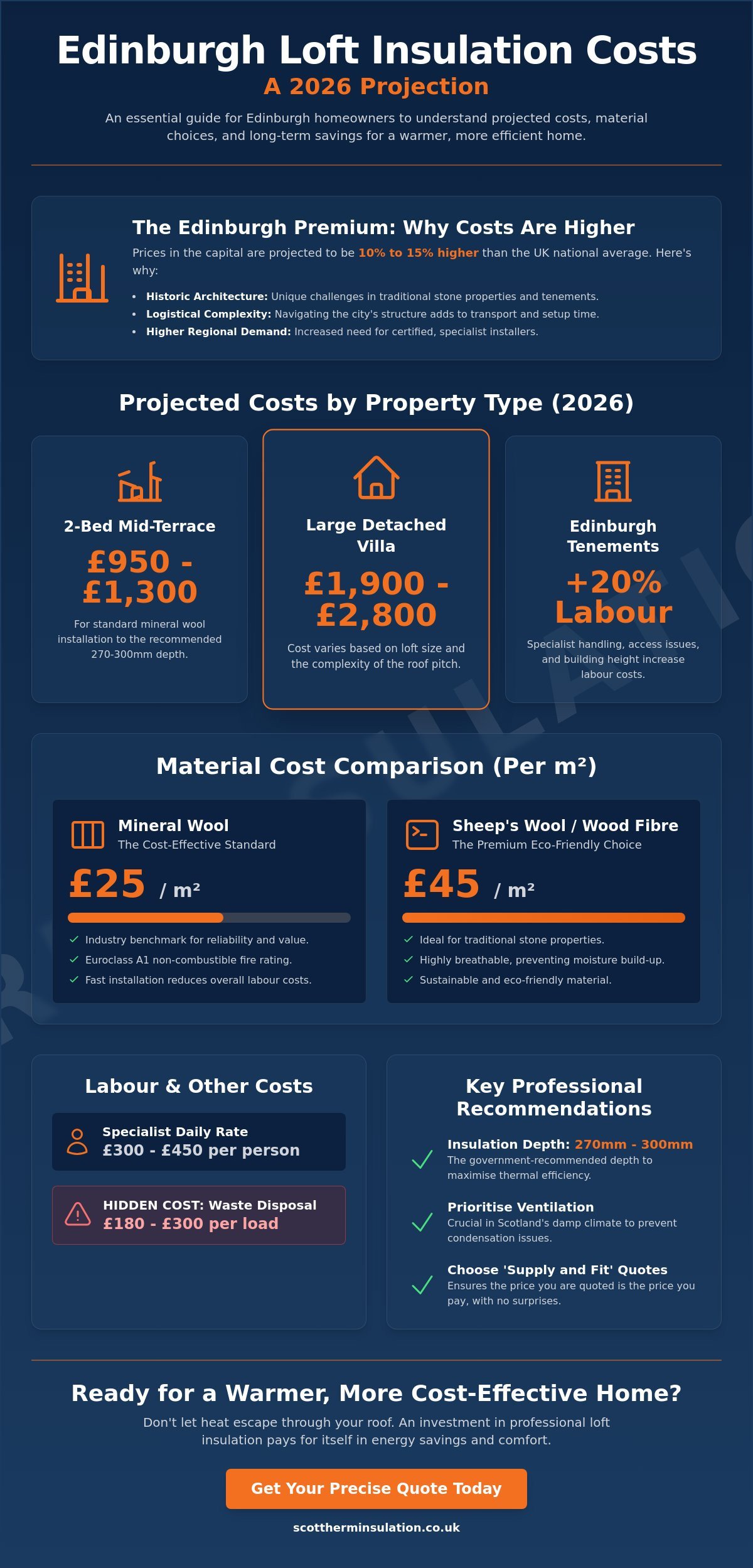
Understanding the loft insulation cost edinburgh 2026 requires a look at local market shifts and updated Scottish building standards. By 2026, energy efficiency has moved from a home improvement luxury to a financial necessity for Edinburgh homeowners. ScotTherm Insulation provides a proven track record in delivering these upgrades, ensuring your property meets the latest thermal requirements while securing maximum savings on your heating bills. Prices in the capital often sit 10% to 15% higher than the UK national average due to the specific logistical challenges of the city’s historic architecture and higher regional demand for certified installers.
The difference between a top-up and a full installation is significant. If your current insulation is 100mm but degraded, a top-up to the recommended 270mm or 300mm is often the most cost-effective route. However, if your existing material is damp or damaged, a full removal and replacement is essential to protect your roof structure. In 2026, material supply chains in Scotland have stabilised, yet local transport costs within the Lothians remain a factor in final quotes. For those seeking a comprehensive overview of insulation materials and their thermal properties, understanding how different products perform in our damp Scottish climate is the first step toward long-term comfort.
Average Costs by Property Type in the Lothians
- 2-Bedroom Mid-Terrace: Expect to pay between £950 and £1,300 for a standard mineral wool installation.
- Large Detached Villa: Costs typically range from £1,900 to £2,800, depending on the complexity of the roof pitch.
- Edinburgh Tenements: These require specialist handling. Access through narrow hatches and the height of the building can add 20% to the total labour cost.
- Material Variants: Standard mineral wool averages £25 per square metre, whilst eco-friendly options like sheep’s wool or wood fibre can reach £45 per square metre.
Labour Rates for Edinburgh Insulation Specialists
Daily rates for fully approved contractors in the Central Belt currently range from £300 to £450 per person. While you might find cheaper quotes from general builders, specialist installers offer better long-term value. They understand the specific ventilation needs of Scottish homes, preventing the condensation issues that often follow DIY attempts. It’s also vital to account for hidden costs. Waste disposal for old, contaminated glass wool can cost between £180 and £300 per load in 2026. Choosing a specialist who includes “supply and fit” ensures the loft insulation cost edinburgh 2026 you’re quoted is the price you actually pay, with no surprises at the end of the job.
Material Choices: Mineral Wool vs Sustainable Sheep’s Wool
Selecting the right material is the primary factor in securing long-term thermal performance. Edinburgh’s unique architectural heritage, ranging from traditional sandstone tenements to Victorian villas, requires a specific approach to insulation. By 2026, the focus has shifted toward materials that offer high R-values whilst protecting the structural integrity of these historic buildings. When calculating your total loft insulation cost edinburgh 2026, the choice between mineral and natural fibres remains the most significant variable for homeowners.
Mineral Wool: The Cost-Effective Standard
Mineral wool remains the industry benchmark for reliability and fire safety. To meet the 2026 standards for maximum energy efficiency, we typically install a total depth of 270mm to 300mm. This depth ensures that heat loss through the roof is minimised, which is a key recommendation from the Energy Saving Trust to achieve the best return on investment. Modern mineral wool rolls are manufactured with up to 80% recycled glass content, making them a more sustainable choice than versions produced a decade ago.
Installation speed is a major benefit of this material. The flexible, quilt-style rolls allow our Fully Approved installers to cover large areas quickly, reducing labour hours and overall project expenses. It carries a non-combustible Euroclass A1 fire rating, providing peace of mind for families. Because it’s lightweight and easy to fit around joists, it’s the go-to option for standard modern lofts where budget and efficiency are the top priorities.
Natural Sheep’s Wool: The Premium Scottish Choice
For owners of traditional stone properties, sheep’s wool is often the preferred premium alternative. Edinburgh’s damp climate can lead to moisture build-up in older roof spaces. Sheep’s wool is naturally hygroscopic, meaning it can absorb and release moisture without losing its insulating properties. This breathability is non-negotiable for protecting timber rafters from rot. It acts as a natural air purifier by absorbing harmful chemicals like formaldehyde, creating a healthier living environment for the household.
The material doesn’t require specialist protective gear during installation because it’s non-toxic and kind to the skin. While the initial loft insulation cost edinburgh 2026 for wool is higher than mineral alternatives, the long-term benefits for building health are substantial. This material doesn’t slump over time, maintaining its loft and thermal resistance for decades. For those seeking a tailored assessment of their roof space, our team can help you choose the right material for your specific property type. Choosing sheep’s wool is a commitment to both Scottish agriculture and the highest tier of domestic comfort.
Edinburgh Property Factors That Influence Your Quote
Edinburgh’s historic skyline is world-famous, but for a local homeowner, those steep pitches and stone gables present specific installation challenges. Your final loft insulation cost edinburgh 2026 depends heavily on how your property was built. Traditional stone villas and tenements don’t behave like modern timber-frame homes. They require a specialist touch to ensure energy efficiency doesn’t come at the expense of structural health. Our experience as insulation installers in Scotland shows that every street in the New Town or Morningside offers a different architectural puzzle.
The “Tenement Tax” is a reality for many in the city centre. This isn’t a literal government levy, but rather a reflection of the higher labour costs associated with four-storey climbs and narrow communal stairs. If your flat is at the top of a Marchmont tenement, the restricted access and lack of lift facilities can increase labour times by 15% to 20% compared to a standard semi-detached home. Similarly, older stone villas built before 1914 require breathable materials. Using the wrong synthetic products can trap moisture against the stone, leading to masonry issues. We prioritise long-term value by selecting materials that respect the city’s historic housing stock.
Loft Access and Storage Requirements
Many Edinburgh homes feature original loft hatches that are too small for modern rolls of mineral wool. If a contractor has to enlarge your hatch or install a new one, this adds to the initial quote. We also see many homeowners asking for loft boarding. To achieve Maximum Savings & Comfort, you must maintain a 270mm insulation depth. This requires “loft legs” or raised sub-frames to prevent compressing the material. Squashing insulation can reduce its thermal effectiveness by 50%. Integrating a telescopic loft ladder at the same time is often the most cost-effective way to upgrade your storage space safely whilst the team is on-site.
Ventilation and Roof Condition
Before any insulation is laid, a Fully Approved contractor must check for existing dampness. Edinburgh’s humid, coastal climate makes roof ventilation critical. Adding thick layers of insulation makes your loft space much colder, which can cause “interstitial condensation” if air isn’t circulating. You might need to budget for the installation of lap vents or tile vents. These small additions prevent timber rot and protect your investment. When planning these upgrades, it’s worth checking Scottish grants and schemes to see if your property qualifies for financial support toward these essential energy-saving measures. A specialist inspection is the only way to ensure your period home stays dry and warm for the long term. We bring a Proven Track Record to every inspection, ensuring your roof remains healthy after we leave.
Calculating ROI: Energy Savings and Scottish Grants in 2026
Investing in your home involves more than just the initial loft insulation cost edinburgh 2026. It’s a calculated decision to secure your financial future. By 2026, energy prices are projected to remain a significant portion of household spend, making thermal efficiency a top priority. A typical detached home in Edinburgh can expect to save approximately £380 per year on heating bills by upgrading to the recommended 270mm thickness. This creates a “Payback Period” of roughly three to four years, after which every penny saved is pure profit.
Your home’s Energy Performance Certificate (EPC) rating is another critical factor. Improving a property from a band D to a band C can increase its market value by an average of 10% based on Scottish property trends recorded in late 2024. This rating isn’t just a piece of paper; it’s a badge of quality that modern buyers actively seek out to avoid high running costs. You’ll find that a well-insulated loft is one of the most cost-effective ways to achieve this jump in rating.
Maximising Savings with the ECO4 Scheme
The ECO4 scheme remains a cornerstone of energy policy through 2026, offering Scottish homeowners a path to zero-cost upgrades. Eligibility often depends on your current heating system and whether you receive specific government benefits. At ScotTherm, we act as your local specialist to help you navigate these grant applications. We’ll help you check if you qualify for a free specialist insulation inspection, ensuring your project adheres to the strict PAS 2035 standards required for government-backed funding. Our team ensures that every “Fully Approved” installation meets the highest benchmarks for safety and performance.
Long-term Financial Benefits
High-quality materials like sheep’s wool provide a 40-year value proposition that cheaper alternatives can’t match. Sheep’s wool is breathable and naturally manages moisture, which protects your roof timbers from damp and rot. This prevents structural repair bills that can easily reach £5,000 or more in older Edinburgh properties. You’ll also notice a lighter load on your heating system. Reducing the strain on your boiler can extend its operational life by up to 5 years, delaying a replacement cost that typically exceeds £2,500.
- Annual Savings: Up to £380 for detached homes.
- Property Value: Potential 10% increase for EPC band improvements.
- Boiler Longevity: 3 to 5 years of additional service life.
- Material Durability: 40-year lifespan for premium natural fibres.
Choosing the right partner means you don’t have to guess about the technicalities. We focus on “Maximum Savings & Comfort” by matching the best materials to the specific climate of the Lothians. Whether you’re looking for a quick payback or a generation-long solution, the ROI remains one of the strongest in the home improvement sector.
Professional Installation with ScotTherm: Your Edinburgh Experts
The “Scot” prefix in our name is more than a geographic label; it is a badge of local expertise. We understand the specific demands the Scottish climate places on a building’s envelope. Edinburgh homes face unique challenges, from the persistent dampness of the coastal haar to the biting winds that sweep through the Lothians. Our team designs every installation to ensure Maximum Savings & Comfort. We don’t just lay materials; we engineer solutions that stand up to local weather patterns. Choosing a Fully Approved contractor provides the security of a proven track record. It means your project adheres to the highest safety standards and technical specifications required for the 2026 energy landscape.
We take pride in our identity as a trusted local specialist. Our reputation is built on reliability and a disciplined approach to energy efficiency. We often work alongside some of the best installers in the country to maintain our high standards. By focusing on the dual benefit of financial savings and physical warmth, we help homeowners realise the full potential of their properties. Our status as an industry leader ensures that every piece of advice we give is backed by professional certification and years of hands-on experience in the field.
The ScotTherm Installation Process
Our “Supply and Fit” guarantee ensures a seamless experience for homeowners across Edinburgh and the Lothians. We handle everything from the initial material logistics to the final site clearance. On the day of your installation, our team follows a structured protocol to keep disruption to a minimum. We treat your home with respect, using protective coverings and ensuring all work areas remain tidy. The typical process includes:
- A pre-install safety briefing and site preparation.
- The precision application of high-grade insulation materials to eliminate thermal bridging.
- Assessment of loft ventilation to prevent moisture build-up.
- A final thermal performance verification to confirm the installation meets our benchmarks.
This rigorous approach ensures that your loft insulation cost edinburgh 2026 is a one-time investment that delivers decade-long returns. After the work is complete, we provide comprehensive post-installation support. We want you to feel confident that your home is performing at its peak efficiency.
Request Your Personalised 2026 Quote
We avoid generic estimates because they rarely reflect the reality of Edinburgh’s diverse architecture. A Victorian villa in Trinity has different requirements than a modern townhouse in South Gyle. Providing a “one size fits all” price often leads to inaccuracies or hidden costs later. Instead, we advocate for bespoke site surveys. Our specialists visit your property to conduct a thorough inspection, looking at the structural nuances that others might miss. This ensures your quote is accurate, transparent, and tailored to your specific budget and comfort needs.
Our Edinburgh team is ready to help you navigate the changes in energy regulations and material costs. By booking a no-obligation consultation, you get clear facts and expert guidance without the high-pressure sales tactics. We focus on providing long-term value and helping you secure the best possible rates for the coming year. Don’t leave your home’s efficiency to chance. You can book your specialist free insulation inspection today and take the first step toward a warmer, more cost-effective future.
Secure Your Home’s Efficiency for 2026 and Beyond
Investing in your property now prepares you for the shifting energy landscape of the next decade. Understanding the loft insulation cost edinburgh 2026 allows you to plan for significant long-term returns. Most homeowners see a full return on investment within five years based on current Energy Saving Trust projections. Choosing the correct materials is essential for the city’s unique architecture. Our specialists recommend breathable sheep’s wool to protect the structural integrity of traditional stone properties whilst maintaining maximum warmth.
As Fully Approved Scottish Contractors, we’ve established a proven track record across Edinburgh and the Lothians for delivering technical excellence. We help you navigate available Scottish grants to ensure your upgrade is as affordable as possible. Don’t settle for subpar thermal performance when professional help is a click away. Get your free Edinburgh loft insulation quote from ScotTherm today and start enjoying a cosier, more efficient home. You’ll benefit from the reliability and regional expertise that only a local specialist can provide.
Frequently Asked Questions
How much does loft insulation cost for a 3-bedroom semi-detached house in Edinburgh in 2026?
A professional installation for a three-bedroom semi-detached home typically ranges between £1,000 and £1,300 according to 2026 industry benchmarks. This price covers the supply and fit of high-quality mineral wool to meet the latest thermal standards. Your final loft insulation cost Edinburgh 2026 depends on whether you require the removal of old, degraded materials or specific structural repairs before the new rolls are laid.
Can I still get free loft insulation in Scotland through the ECO4 scheme?
You can still access fully funded insulation through the ECO4 scheme until its scheduled conclusion in March 2026. This government initiative targets households with an EPC rating of D, E, F, or G that receive specific benefits like Universal Credit or Pension Credit. At ScotTherm, we help eligible Edinburgh residents navigate these grants to ensure zero-cost upgrades for those who meet the strict qualifying criteria.
Is sheep’s wool insulation worth the extra cost compared to mineral wool?
Sheep’s wool is a superior choice for homeowners prioritising breathability and moisture control in traditional stone properties. While it costs roughly 50% more than standard glass mineral wool, its ability to absorb and release moisture without losing thermal efficiency is vital for Edinburgh’s older tenements. It’s a sustainable, non-toxic material that provides excellent acoustic performance alongside a 50 year lifespan.
How long does it take for a professional team to insulate a loft in Edinburgh?
A standard professional installation usually takes between 2 and 4 hours to complete for a typical residential property. Our fully approved teams arrive with all necessary equipment to ensure a swift, clean process that causes minimal disruption to your daily routine. Larger projects or those requiring the removal of old, damp-affected materials may extend the timeline to a full 8 hour working day.
Will loft insulation cause damp or condensation in my older Edinburgh home?
Insulation itself doesn’t cause damp, but poor ventilation after an upgrade can lead to condensation issues. We prevent this by installing lap vents or tile vents to maintain a steady airflow within the roof void. This balance is critical for Edinburgh’s historic architecture, ensuring your home stays warm whilst allowing the building’s fabric to breathe and remain dry throughout the year.
What is the recommended depth for loft insulation in the UK for 2026?
The current recommended depth for glass mineral wool insulation is 270mm to achieve the best thermal performance for your home. If your loft currently has 100mm or less, topping it up to this 270mm standard can reduce heat loss through the roof by 25%. Our installers ensure this depth is consistent across the entire floor, including often-missed areas like the eaves and the loft hatch itself.
Does ScotTherm provide loft boarding alongside insulation services?
We provide professional loft boarding services using raised loft legs to ensure your new insulation isn’t compressed. Compressing 270mm of wool down to joist level reduces its effectiveness by over 50%, so we install a structural platform above the insulation layer. This approach allows you to maintain a functional storage space whilst still benefiting from the maximum savings and comfort promised by our approved contractors.
How much can I realistically save on my Edinburgh energy bills with new insulation?
Homeowners in a typical semi-detached house can expect to save approximately £350 per year on energy bills by upgrading to the recommended 270mm depth. These savings are based on 2026 energy price projections and represent a reliable return on your investment. Your loft insulation cost Edinburgh 2026 is often recovered through these reduced heating costs within 3 to 5 years of the initial installation date.